

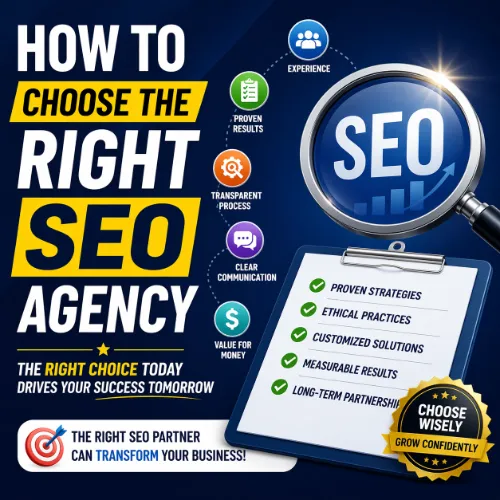
How to Choose the Right SEO Agency: The 2026 Marketer’s Checklist
Introduction
Did you know that 68% of online experiences begin with a search engine? Yet, nearly 60% of businesses feel they wasted money on an SEO agency at least once. Why? Because they didn’t know how to choose the right SEO agency from the start.
Choosing poorly leads to wasted budgets, Google penalties from black-hat tactics, and months of lost traffic. Choosing wisely, however, delivers sustainable growth, higher conversion rates, and a partner who evolves with algorithm updates.
This guide uses NLP-friendly language (clear, topic-clustered, intent-driven) and is structured for AI Overviews (featured snippets, “People also ask,” and listicles). For a comprehensive starting point, refer to this detailed guide on how to choose the right SEO agency which covers additional strategic insights. By the end, you will have a proven agency selection checklist to rank your options confidently.
Before You Start Searching: Internal Preparation
Before you research any firm, you must prepare internally. Most guides skip this. We won’t.
1. Define Your SEO Goals
A legitimate agency will ask: What does success look like to you?
Common goals include:
- Increase organic traffic by X% in 6 months
- Generate Y qualified leads per month from non-branded keywords
- Improve e-commerce sales from product category pages
- Dominate local SEO within a 20-mile radius
2. Understand Your Budget Range
SEO pricing typically falls into:
- Monthly retainer: $2,500–$15,000+ (SME to enterprise)
- Project-based: $5,000–$30,000 (audit + fix + content)
- Hourly consulting: $150–$500/hour
Pro tip: If an agency charges less than $1,500/month for “full SEO,” question their link-building quality.
3. Identify Your Ideal Agency Type
| Type | Best For |
|---|---|
| Boutique / specialized agencies | Niche industries (legal, SaaS, medical) |
| Full-service digital marketing agencies | Integrated SEO + PPC + social |
| Freelance SEO consultants | Startups, specific technical fixes |
| Enterprise-level firms | Multi-location, 100k+ keywords |
| Onshore vs. offshore | Onshore = accountability; Offshore = cost efficiency |
Key Services to Expect from a Legitimate Agency
Not all SEO packages are equal. A minimum viable SEO agency must provide:
Technical SEO Audit & Fixes
- Crawlability, indexing, Core Web Vitals, schema markup
- NLP keyword: “SEO audit process”
On-Page Optimization
- Title tags, headers, internal linking, image alt text
- NLP keyword: “on-page SEO best practices”
Content Strategy & Creation
- Topic clusters, entity-based writing, FAQ schema
- NLP keyword: “SEO content strategy”
White-Hat Link Building
- No PBNs, no bought links. Only earned, relevant backlinks.
Local SEO (if applicable)
- Google Business Profile optimization, local citations, review management
Transparent Reporting & Analytics
- Monthly dashboard with Google Search Console + GA4 data
No “Guaranteed Rankings”
Anyone promising a “#1 ranking guarantee” is lying. Google’s algorithm changes daily. Learn more about why guaranteed SEO services are always a red flag before signing any contract.
Red Flags to Avoid
Google’s quality rater guidelines penalize manipulative practices. Here are 7 non-negotiable red flags to watch for when evaluating SEO companies:
- Guaranteeing #1 Google rankings – Impossible. Even Google can’t guarantee that.
- No contract transparency – They hide cancellation terms or auto-renewal clauses.
- Using Private Blog Networks (PBNs) – Ask: “Do you use expired domains for links?” If yes → run.
- Vague or no reporting – They refuse to share a sample report before signing.
- No keyword or competitor research upfront – A real agency audits before pitching.
- You don’t own your assets – They create content but won’t give you login access.
- They ask for Google Ads-style “ad spend” – SEO has no media budget. Huge red flag.
For a deeper dive into deceptive practices, review this comprehensive list of red flags to watch for in SEO companies before making your final decision.
Evaluation Checklist: Vetting Potential Agencies
Use this listicle-style evaluation checklist to score each candidate (1–5 per item).
1. Case Studies & Proven Results (Relevant to Your Industry)
- ✅ Ask for a case study in your vertical (e.g., e-commerce, B2B, local service)
- ✅ Look for specific metrics: traffic growth, keyword rank improvements, conversion lift
2. Client Reviews & References
- Check Clutch, Trustpilot, and Google Reviews
- Ask for 2 reference calls (one current, one past client)
3. Transparency in Processes & Reporting
- Request a sample monthly report (before signing)
- Ensure it includes: rankings, clicks, impressions, backlinks gained, technical fixes completed
4. Communication Style & Frequency
- Weekly 15-min update? Biweekly? Slack access?
- AEO tip: Answer “How often should an SEO agency communicate?” → Minimum weekly, with a dedicated account manager.
5. Tools They Use
| Tool | Purpose |
|---|---|
| Ahrefs / Semrush | Competitor & keyword research |
| Google Search Console | Performance data straight from Google |
| Screaming Frog / Sitebulb | Technical audits |
| Google Analytics 4 (GA4) | Traffic and conversion tracking |
6. Contract Terms & Exit Clauses
- 3-month minimum trial is standard
- 30-day cancellation without penalty → non-negotiable
7. Ownership of Work
- ✅ You must own: all created content, link assets, and access to your Search Console + GA4
Questions to Ask During the Sales Call
Prepare these 10 questions (they are NLP-optimized for featured snippets). For a complete list, see these questions to ask before hiring SEO services to ensure no stone is left unturned.
- “How do you measure success for a client like me?”
→ Look for KPIs: qualified traffic, conversion rate, or revenue, not just keyword rankings. - “Can you share a detailed monthly report sample?”
→ It should show progress against baseline, not vanity metrics. - “What’s your link-building process?”
→ Acceptable: digital PR, resource page links, unlinked brand mentions. Unacceptable: PBNs, forum spam. - “Who will be my daily point of contact?”
→ Avoid agencies where you only speak to a salesperson after signing. - “How do you stay updated with Google algorithm changes?”
→ They should mention Search Engine Journal, Moz, or Google’s official updates. - “What happens if results don’t appear in 4–6 months?”
→ Honest answer: “We re-evaluate strategy; SEO is a 6–12 month game.” - “Do you provide content creation or require us to?”
→ Ideally, they write or you collaborate with their strategy team. - “What is your experience with [your CMS: WordPress/Shopify/Webflow]?”
- “How do you handle local SEO vs. national campaigns?”
- “Will I receive a technical SEO audit within the first 30 days?”
→ Yes → good. No → suspicious.
Comparing Proposals & Making the Decision
You have 2–3 proposals. Now what?
How to Read Between the Lines
| Vague Wording | What It Really Means |
|---|---|
| “Aggressive link building” | Likely spammy directories |
| “Proprietary ranking system” | Fake metrics to confuse you |
| “We focus on high-value keywords” | They haven’t done keyword research yet |
Comparing Pricing Models
- Monthly retainer: Best for ongoing growth
- Project-based: Best for a one-time audit + fix
- Hourly: Best for consultation only
Look Beyond Price
A $3,000/month agency that generates 50 leads/month = $60/lead.
A $1,500/month agency that generates 10 leads = $150/lead.
Cheaper is not cheaper.
Trial Period or Phased Start Recommendation
Ask for a 90-day pilot focused only on:
- Month 1: Technical audit + fix quick wins
- Month 2: On-page optimization + 4 content pieces
- Month 3: Link building + first full report
If results trend positively, extend.
Post-Selection: Onboarding & Working Together
Once you sign, set the relationship up for success.
What a Good Onboarding Looks Like
- Kickoff call with strategist, account manager, content lead
- Access granted: Google Search Console, GA4, social media accounts, CMS
- Baseline report within 7 days (current rankings, backlinks, site health)
Setting Up Regular Reporting & Review Cadence
- Weekly: 15-min tactical check-in
- Monthly: Full performance report + next 30-day plan
- Quarterly: Strategy review (what’s working, what to drop)
Defining Your Role vs. The Agency’s Role
| Agency Responsibilities | Your Responsibilities |
|---|---|
| Keyword research + content briefs | Internal approvals (legal, brand) |
| Link building outreach | Provide industry expertise |
| Technical fixes (if dev access given) | Prioritize dev resources |
When to Consider Parting Ways
- After 6 months, no organic traffic improvement (and you followed their advice)
- They stop answering Slack/email for >5 business days
- You discover a Google manual action penalty from their links
Conclusion & Final Tips
How to choose the right SEO agency in 3 steps:
- Prepare internally – Goals, budget, agency type.
- Vet with the checklist – Case studies, transparency, tools, red flags.
- Start with a 90-day pilot – Audit → On-page → Links → Review.
For long-term success, focus on agencies that demonstrate the best SEO agency traits for long-term growth such as adaptability, transparent reporting, and a commitment to ethical, white-hat strategies.
Question: What is the best way to choose an SEO agency?
Answer: The best way to choose an SEO agency is to first define your goals (traffic, leads, sales), then vet agencies using a checklist: check industry-specific case studies, ask for a sample monthly report, confirm they use white-hat link building, and avoid any agency that guarantees #1 rankings. Always start with a 90-day pilot before signing a long-term contract. For a complete framework, review this step-by-step guide on how to choose the right SEO agency.
Final Checklist
✅ You have defined your SEO goals (e.g., 20% traffic increase)
✅ You have a budget range ($2,000–$8,000/month typical)
✅ You avoided any agency with “ranking guarantee” – read more on why guaranteed SEO services are risky
✅ You asked for and reviewed a sample report
✅ You spoke to 2 client references
✅ You confirmed you will own all assets
✅ You started with a 90-day pilot contract
Next step: Visit SEO Mafia Club to access verified SEO experts, or download our free SEO Agency Scorecard (Excel template) to compare three agencies side-by-side.
20 Unique FAQs About Choosing an SEO Agency
1. Can an SEO agency guarantee a specific number of backlinks per month?
Answer: No. A reputable SEO agency will never guarantee an exact number of backlinks because link building depends on third-party websites agreeing to link to you. Instead, they should promise a monthly outreach volume (e.g., 50–100 relevant outreach emails) and report on earned links without using PBNs or paid directories.
2. How long should I wait before seeing first positive signals from a new SEO agency?
Answer: You should see technical improvements (faster load times, fixed crawl errors) within 30 days. Early ranking improvements for low-competition keywords may appear in 60–90 days. However, significant organic traffic or revenue growth typically takes 6–12 months.
3. What happens to my SEO progress if I cancel the agency contract?
Answer: You keep all assets you paid for: content, on-page optimizations, and backlinks already earned. However, ongoing work (monthly content, link outreach, technical monitoring) stops. If the agency used unethical tactics, you may inherit a Google penalty. Always ensure full asset ownership is in your contract.
4. Should I hire the same agency for SEO and PPC?
Answer: It depends. A full-service digital marketing agency can provide better cross-channel data (e.g., using PPC keywords to inform SEO strategy). However, specialized SEO agencies often outperform generalists. If hiring separate agencies, ensure they share data via a unified dashboard.
5. Do SEO agencies write the content themselves or outsource it?
Answer: Most agencies outsource content to freelance writers or specialized content agencies. A transparent agency will tell you who writes the content and allow you to approve writers. Some premium agencies have in-house content teams. Ask for writing samples before signing.
6. How do I verify if an agency’s case study is real?
Answer: Ask for verifiable proof:
- A link to the client’s live website
- A screenshot dated before the campaign (e.g., Google Search Console or GA4)
- A reference call with that specific client
- The client’s name and industry (redact sensitive data if needed)
Fake case studies avoid these requests.
7. What is a “sandbox” or “trial” period for SEO services?
Answer: A 90-day sandbox period is a short-term contract (3 months) focused only on foundational work: technical audit, keyword research, on-page fixes, and basic content. No long-term commitment. It allows you to evaluate the agency’s communication, reporting, and early deliverables before signing a 6–12 month retainer.
8. Can an SEO agency fix a Google manual penalty from a previous agency?
Answer: Yes, but it takes time. The agency must:
- Identify the cause (e.g., toxic backlinks, thin content)
- Remove or disavow bad links
- Submit a reconsideration request to Google
Timeline: 3–6 months for small penalties; 6–12 months for severe ones.
9. How often should an agency send progress reports, and what must they include?
Answer: Monthly is standard. A good report includes:
- Organic traffic (users, sessions)
- Keyword ranking changes (top 3, top 10, top 20)
- Backlinks earned (new vs. lost)
- Technical fixes completed
- Conversion data (if integrated)
- Next month’s action plan
Avoid agencies that send only a PDF of keyword rankings.
10. Do I need to give the agency full access to my website backend?
Answer: For technical SEO, they typically need:
- CMS admin access (WordPress, Shopify, etc.)
- Google Search Console & GA4 access
- Server log files (for advanced audits)
- FTP/SFTP access (less common)
You can grant limited access (e.g., editor role) and review all changes before they go live. Never give cPanel root access unless fully trusted.
11. How do SEO agencies handle seasonal businesses (e.g., tax services, holiday e-commerce)?
Answer: They should plan 3–6 months in advance. For example:
- Tax agencies: Start SEO in September for January–April peak
- E-commerce: Holiday content and links by August
- Tourism: Pre-season content 4–6 months ahead
Ask for a seasonal calendar in the proposal.
12. What is the difference between local SEO and national SEO agency pricing?
Answer:
| Type | Monthly Retainer | Key Activities |
|---|---|---|
| Local SEO (one location) | $1,500–$3,000 | GBP optimization, local citations, review management |
| Local SEO (multi-location) | $3,000–$8,000 | Location pages, schema, local link building |
| National SEO | $5,000–$20,000+ | Broad keyword targeting, national link outreach, content at scale |
13. Can an SEO agency also manage my Google Business Profile (GBP)?
Answer: Yes, most local SEO agencies include GBP management: optimizing categories, responding to reviews, adding posts, and tracking insights. However, Google prohibits agencies from owning or creating GBP listings on your behalf. You must retain ownership.
14. How do I handle an agency that uses black-hat SEO without my knowledge?
Answer: Immediately:
- Pause work and revoke all access
- Run a backlink audit (Ahrefs, Semrush) to identify toxic links
- Use Google’s Disavow Tool (last resort)
- Request a refund for any paid link schemes
- Leave a factual public review to warn others
Check your contract for a compliance clause – many allow you to terminate without penalty.
15. What is a “performance-based” SEO agency, and should I trust them?
Answer: Performance-based SEO means you pay only for results (e.g., per keyword ranked or per lead). Caution: Many performance-based agencies use short-term tricks like ranking for low-volume, low-value keywords or buying fake traffic. Legitimate performance models are rare. Always verify their metrics.
16. Do SEO agencies need access to my social media accounts?
Answer: Rarely. SEO and social media are separate channels. However, an agency might request:
- Read-only access to analyze social traffic in GA4
- Access to post content (if they also do social)
- Link to social profiles for brand signals
You should never give social media advertising billing access for SEO purposes.
17. How do I measure the ROI of an SEO agency beyond rankings?
Answer: Track:
- Cost per organic lead (total SEO spend / organic leads)
- Organic conversion value (e-commerce or form fills)
- Organic share of voice vs. competitors
- Branded vs. non-branded organic traffic growth
A good agency helps you set up goal tracking in GA4 before starting.
18. Can an SEO agency work with my in-house marketing team?
Answer: Yes, and this is ideal. Define clear roles:
- Agency: Strategic SEO, technical audits, advanced link building
- In-house: Content creation, social promotion, brand approvals
Regular weekly syncs prevent duplication. Many agencies offer a hybrid co- SEO model at a reduced retainer.
19. What is the difference between an SEO audit and an SEO strategy?
Answer:
- Audit: A one-time health check (technical, on-page, off-page). Output is a list of issues to fix.
- Strategy: A 6–12 month roadmap based on audit + competitor + keyword research. Output includes content calendar, link targets, and KPIs.
Never sign an agency that offers a “strategy” without performing a full audit first.
20. How do I know if my industry is too niche for a general SEO agency?
Answer: Ask specific questions only a niche expert would know:
- “What are the top 3 industry-specific forums or communities for backlinks?”
- “Which schema types matter most in our vertical?”
- “Who are our top 5 organic competitors and why?”
If the agency hesitates or gives generic answers, hire a specialized agency from a curated directory like SEO Mafia Club, which verifies niche expertise.







