By 2027, the search landscape will be almost entirely reshaped. Traditional search volume is projected to drop by 25%, as AI search captures an ever-growing share of queries. AI Agents will move from answering questions to completing tasks, evolving into an “agent manager” that orchestrates complex workflows.
With zero-click searches expected to hit 85%, Generative Engine Optimization (GEO) and Entity SEO will become the central pillars of digital discovery, requiring brands to build authority that can be understood and cited by Large Language Models (LLMs) rather than just fighting for click-through rates.
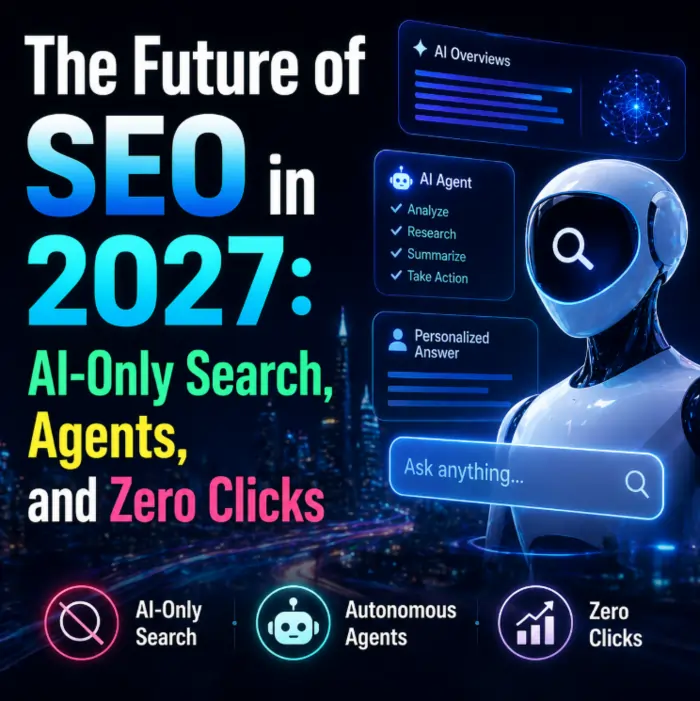
The ten blue links are fading. The search results page as we’ve known it for two decades is undergoing its most radical transformation yet. As we look toward 2027, three seismic forces—AI-only search, the proliferation of AI Agents, and the dominance of zero-click search—are converging to redefine how brands get discovered online.
For SEO professionals, this isn’t a distant future to prepare for. It is a reality that is already unfolding. The strategies that won traffic in 2024 are losing effectiveness in 2026, and by 2027, they may become entirely obsolete. This guide cuts through the speculation to provide a clear, data-driven forecast of what SEO will look like in 2027, and what you must do today to ensure your brand remains visible when screens are replaced by conversations and agents.
The Great Traffic Migration: From Search Engines to Answer Engines
The most fundamental shift underway is the migration of user attention from traditional search engines to AI-powered answer engines. This is not a subtle trend; it is a mass exodus driven by superior user experience. Research from Semrush reveals that AI search traffic is on track to completely overtake traditional Google search by 2027. The numbers paint a clear picture of this transition.
In early 2026, AI search held 12-15% of the global search market share. By 2027, this is projected to exceed 28% . This growth is propelled by the exploding user bases of major platforms. ChatGPT now reaches 900 million weekly users, Google AI Overviews are seen by 1.5 billion monthly users, and Perplexity processes 780 million queries per month across 45 million active users.
The Adobe/Incisiv report reinforces this, predicting that one in five search queries will be LLM-based by 2027. Kevin Indig, a well-known SEO expert, predicts ChatGPT alone will surpass Google’s search traffic by 2030, and when you combine all AI platforms, the crossover happens much sooner.
This migration is causing a corresponding collapse in traditional search volume. In 2024, Gartner made a bold prediction that traditional search engine volume would drop by 25% by the end of 2026. Looking at the latest data from early 2026, this forecast appears prescient, with the decline being driven by the very AI chatbots and virtual agents Gartner cited .
For businesses that have spent years building their Google rankings, this is an existential threat, as Gartner vice president Alan Antin notes that these generative AI tools are becoming “substitute answer engines, replacing user queries that previously may have been executed in traditional search engines”.
The Rise of the Zero-Click Apocalypse
If users are leaving traditional search, where are they going? The answer is the zero-click search phenomenon. SparkToro and Datos research shows that in Q4 2025, 56% of Google desktop searches resulted in zero-click outcomes. On mobile, where most searches occur, zero-click rates are significantly higher. The trend is accelerating, with projections indicating that by 2027, a staggering 85% of searches could end without a click to an external website.
AI Overviews are a primary accelerator. BrightEdge data reveals that AI Overviews now trigger on nearly half (48%) of all tracked queries. However, the real story is in user behavior. Research from the Pew Research Center indicates that the click-through rate for users when an AI Overview is present drops to just 8%, compared to 15% when the overview is absent. This means that for nearly half of all searches, the chance a user will click on your link is cut almost in half.
Deloitte estimates that 25% of Australians who engage with AI search summaries stop there, reading the overview and going no further, and projects that 50% of Australians will be engaging with AI search results daily by 2027.
Google’s Agent Manager: The End of Search as We Know It
The second pillar of this transformation is Google’s evolution from a search engine into an “agent manager” . In a landmark interview, Google CEO Sundar Pichai gave a clear roadmap for the future of search: “If I fast forward, a lot of what are just information-seeking queries will be agentic in Search. You’ll be completing tasks. You’ll have many threads running.” He then added that search will be an agent manager in which you’re doing a lot of things.
This vision fundamentally changes the nature of search queries. Instead of a user typing a query and receiving a list of links, the agent manager will break that query into “tens, maybe hundreds, maybe even thousands” of sub-queries. It will fan out across the web, and in many cases, directly to business APIs, to not just find information but to complete tasks. For example, an agent could find a restaurant, check its live availability, and book a table, all without the user ever leaving the search interface.
This process, known as query fan-out, is already being implemented in Google’s AI Mode. Controlled experiments have found that AI Mode draws from a proprietary content store called FastSearch rather than Google’s main live web index to reduce latency .
The key takeaway for SEO is that by 2027, the large-scale rollout of agent-based systems in search is expected to go mainstream. Brands will no longer be optimizing just for a user with a query; they will be optimizing for an AI agent that can take action. This marks the beginning of Agentic SEO, a discipline where the focus shifts from ranking on a page to ensuring your brand is the most compatible and trustworthy data source for these invisible agents.
Future of SEO 2027: The Fundamental Shift in Metrics
The metrics that have defined SEO success for a generation are becoming irrelevant. The most critical new metric is Share of Voice (SoV) in AI answers. BrightEdge research offers a crucial insight here: AI engines cite different sources but recommend the same brands.
Their analysis of five AI search surfaces (ChatGPT, Google AI Overviews, AI Mode, Gemini, and Perplexity) found that while the lowest level of overlapping source citations between any two engines was just 16%, the lowest level of overlapping brand citations was a much higher 36%. The highest level of brand overlap reached 55%.
This is the most important takeaway for your 2027 strategy. It means that while the specific web pages each AI engine uses may vary, the brands they trust to recommend are far more consistent. Building a strong, widely recognized brand name across the web is the single most effective way to ensure your brand is recommended by any AI. This phenomenon likely reflects how widely brands are cited by trusted websites and user intent, making brand authority the new PageRank.
The transition from clicks to citations is the defining characteristic of 2027 SEO. Traditional organic traffic is declining, but the conversion value of AI-driven traffic is substantially higher. SEMrush projects that the economic crossover point—where the total revenue from AI traffic surpasses that from traditional organic search—will happen by late 2027.
A traditional keyword-based SEO strategy optimized for click-through rates will no longer be sufficient. The 2027 playbook must be built around being the definitive source for an entity, a concept, or a question—one that AI agents will consistently cite as the authority on a topic.
Resetting Your Strategy: The 2027 SEO Imperatives
To thrive in this new environment, you must fundamentally reset your SEO strategy around three core imperatives.
First, prioritize share of voice in AI answers. Stop tracking only your rankings and clicks. Start measuring how often your brand name is mentioned in AI responses compared to your competitors. If your brand isn’t being recommended, you are losing the battle before the customer has even entered the market.
Second, dominate entity SEO. The units of discovery are shifting from keywords to entities. To become the “authority entity” for your core topics, you must publish original data, create definitive guides, and become a source that LLMs will use to train their models. This means moving away from keyword density and toward content that demonstrates deep, E-E-A-T-aligned expertise.
Third, prepare for an agent-first world. The future of search is not about being discovered in a list of links; it’s about being accessible to AI agents that can book, buy, and transact. This means overhauling your technical strategy. You need to move beyond basic schema markup. By 2027, structured data will be essential to feed machines with clear, actionable data that agents need to process instantly.
You will need to mark up products, services, and reviews thoroughly, provide real-time inventory and pricing feeds, and ensure your APIs are ready for query from AI agents. Your website must be built for machines first and humans second.
These technical preparations must be complemented by content strategies that directly optimize for AI agents. For a detailed roadmap on structuring your content for this new reality, explore our in-depth guide on how to Optimize for AI Overviews .
The Clock Is Ticking
The data is clear and the trendlines point in one direction: search as we know it is ending. The businesses that will dominate in 2027 and beyond are not the ones reacting to this change; they are the ones building their foundation now. If you start optimizing in 2027, you won’t see meaningful results until 2028.
Your customers are already getting answers from AI, making decisions, and moving on—often without ever seeing your website. You can choose to be the source that AI agents trust and recommend, or you can be the brand that gets left behind. The choice, and the time to act, is now.
For a holistic view of how these search agents will intersect with AI Overviews, featured snippets, and brand authority, explore our comprehensive resources on Zero Click SEO , Featured Snippet Optimization , and the Future of Search . To understand how to track your brand’s visibility across these emerging AI surfaces, a crucial resource is the Ahrefs SERP features glossary.
For the official developer perspective on how structured data powers modern search and agentic experiences, refer to Google’s structured data documentation. To better understand the broader economic forces, Gartner’s official reports on the decline of traditional search offer critical insights for strategic planning.
Frequently Asked Questions (FAQs)
1. What is the most significant trend for SEO in 2027?
The most significant trend is the convergence of three forces: the dominance of AI-powered answer engines (AI search), the rise of AI Agents that complete tasks, and the prevalence of zero-click search.
2. What is “Agentic SEO”?
Agentic SEO is the practice of optimizing your website and brand to be understood and used by AI agents. It focuses on providing clear, structured data and APIs so agents can complete tasks like booking appointments or checking inventory on behalf of a user.
3. Will traditional SEO be dead by 2027?
It won’t be completely dead, but it will be a shadow of its former self. Traditional keyword-based SEO, optimized for a link on a results page, will be far less effective. The focus will shift to GEO (Generative Engine Optimization) and Entity SEO.
4. How will zero-click search affect my website traffic?
It will likely cause a significant decline in direct organic traffic as more user queries are resolved entirely within the search interface or by an AI agent. However, the traffic you do receive may be of higher quality and convert at a better rate.
5. What is the most important new SEO metric for 2027?
Share of Voice (SoV) in AI answers is more critical than rankings or clicks. It measures how often your brand is mentioned and cited by AI engines compared to your competitors.
6. Who will be the most important search platform in 2027?
While Google will likely remain dominant, the search ecosystem will fragment. Success will require visibility across multiple platforms, including ChatGPT, Perplexity, Gemini, Claude, and Microsoft Copilot, as each serves a different user base and context.
7. What happens when an AI Agent completes a transaction?
This is “Agentic Commerce.” An agent could book a flight, order a product, or schedule a service on behalf of a user. The agent will rely on your site’s structured data and API integrations to do this. The sale happens without the user ever visiting your homepage.
8. How do I prepare for AI Agents in 2027?
You need to focus on technical SEO like never before. Invest in robust schema markup (Product, LocalBusiness, FAQ), ensure your site architecture is logical and crawlable, and for e-commerce, have an up-to-date, structured product feed that can be accessed via API.
9. Will being cited in an AI Overview still matter?
Yes, being cited in an AI Overview will be a primary driver of brand exposure. It signals authority to both users and the AI models themselves, building a feedback loop of trust.
10. What is the difference between SEO and GEO?
SEO (Search Engine Optimization) focuses on ranking in the ten blue links of a search engine results page. GEO (Generative Engine Optimization) focuses on making your content citable by LLMs so that your brand’s information is included in an AI’s synthesized, conversational answer.
11. How will voice search evolve with AI-only search?
Voice search will be a primary interface for interacting with AI Agents. Your zero-click content must be optimized for conversational queries so agents can retrieve the answer quickly for a voice response.
12. What specific job titles will be most impacted?
SEO specialists will need to evolve into AI Visibility Strategists or GEO Specialists. Content writers will need to master writing for citation, and technical SEOs will need to act more like data engineers, focusing on API integrations and structured data.
13. Will AI searches include ads?
Yes. Google and other platforms are already developing advertising models for AI-powered search. Expect to see sponsored placements within AI-generated answers and new types of agent-driven ad formats.
14. What is “entity SEO”?
Entity SEO is the practice of optimizing your brand as a distinct, well-defined “entity” within a knowledge graph. It focuses on building relationships between your brand and the topics, products, and services you represent, helping AI understand exactly what your brand is and does.
15. What is the biggest risk of ignoring these changes?
The biggest risk is becoming invisible to your target audience. If you are not cited by AI in 2027, a large and growing segment of your potential customers will simply never know your brand exists, as their primary “search” happens through conversations with AI, not Google.
16. How can I measure my Share of Voice in AI answers?
Use emerging AI citation tracking tools. You can also perform manual audits by asking a set of key prompts to ChatGPT, Perplexity, and Google Gemini, and then noting how often your brand appears compared to your competitors.
17. Will small businesses have a chance to compete in 2027?
Yes, but differently. AI engines reward genuine expertise and community-driven authority. A small niche expert can become the cited authority for a specific entity, beating a larger, less-focused competitor.
18. What role will user-generated content (UGC) play?
Surprisingly, UGC may become more important. BrightEdge data shows that citations of UGC sites range from 0.2% to 18% depending on the AI engine. Authentic, trusted community content (like Reddit, Quora, or niche forums) can be a powerful source of brand signals for AI.
19. Will backlinks still be important?
Backlinks will remain a factor, but their role will evolve. They will serve as one signal to establish entity authority, not as a primary ranking factor for a specific keyword query. The quality and relevance of the linking site will be far more critical.
20. What is the best course of action for an SEO professional right now?
Start your transition immediately. Audit your brand against key AI prompts. Begin building out structured schema markup for your most important pages. Shift your content strategy from targeting keywords to building definitive, cited resources on core entities. The future is not coming; it’s already here.