

If you want your brand to be visible in 2026, understanding ai overviews seo is no longer optional – it is survival. With AI Overviews now appearing on nearly half of all Google queries and 2 billion monthly users engaging with them, the brands that earn AI citations inside these summaries see 35% higher click‑through rates than those that are ignored.
This tactical guide gives you a proven, step‑by‑step framework to structure your content for Google’s AI Overviews, master Generative Engine Optimization (GEO) , and turn zero‑click visibility into a strategic advantage. You’ll learn the exact extraction signals that Google’s Gemini model looks for, and how to make your pages the most citable source for ChatGPT, Perplexity, Microsoft Copilot, Claude, and every major LLM.
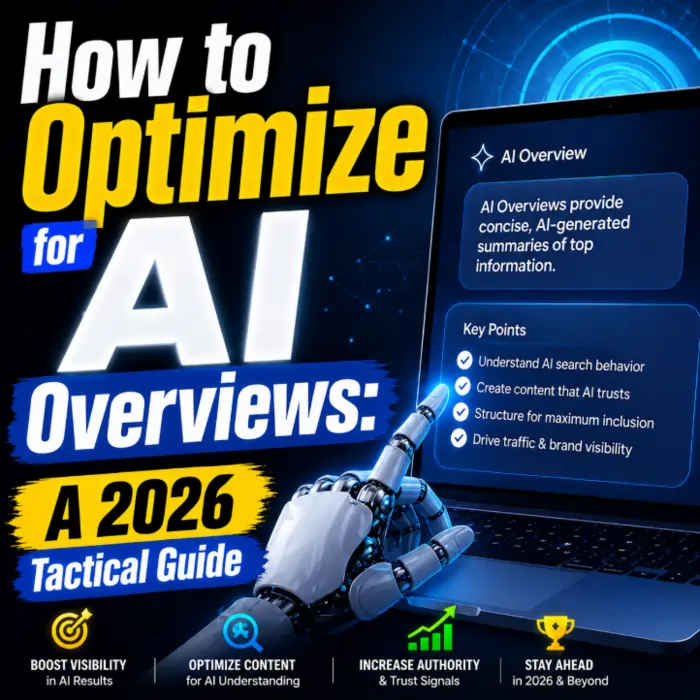
The search results page has changed forever. In 2026, Google’s AI Overviews now appear on 48% of all queries – up from just 31% a year ago. That is a 58% year‑over‑year surge. And when they do appear, organic click‑through rates can drop by as much as 61% .
But here is the part most SEOs miss: being cited inside an AI Overview changes everything. Pages that earn a citation inside that overview see 35% more clicks than the traditional organic result that sits below it. And AI Overview traffic converts at 14.2% compared to traditional organic’s 2.8% – a 5x quality premium. This is the new battleground for brand visibility.
This guide will walk you through exactly how to optimize for Google AI Overviews in 2026 – not with vague theories, but with actionable tactics, schema markup, and content architecture that works.
AI Overviews SEO: The Five Critical Extraction Signals
Before you can optimize, you need to understand how Google’s AI actually decides which pages to cite. Google’s Gemini model does not simply look for keyword matches. It evaluates five specific signals that determine whether your content is extractable.
Signal 1: Direct Answer Positioning
The most important factor is placing a clear, standalone answer within the first 80 words of your page. This answer must be complete on its own – it should not require the user (or the AI) to read surrounding context to understand it. It should also use the exact query phrase naturally.
For example, if your target query is “how to optimize for AI Overviews”, your opening answer block should begin with exactly those words: “To optimize for AI Overviews, you need to place a concise 40‑60 word answer directly under a question‑based heading.”.
Signal 2: Question‑Format Headings (H2/H3)
Google’s AI Overview system actively matches user queries against your H2 and H3 headings. Pages where headings are phrased as complete questions – such as “How does AI Overview extraction work?” or “What is the difference between SEO and GEO?” – are cited far more frequently than pages with declarative headings like “AI Extraction Methods”.
Signal 3: FAQPage and HowTo Schema
Properly implemented FAQPage schema gives the AI Overview system pre‑packaged Q&A units. Each question‑answer pair in the schema becomes a candidate extraction point. For step‑by‑step queries, HowTo schema works the same way. Sites that consistently use these schema types see significantly higher AI Overview citation rates for FAQ‑type and instructional queries.
Signal 4: E‑E‑A‑T Alignment
Google’s E‑E‑A‑T framework (Experience, Expertise, Authoritativeness, Trustworthiness) acts as an underlying filter for AI Overview sources. Pages lacking clear E‑E‑A‑T signals are disqualified before the AI even considers them. This means you need real case studies, specific client results, first‑person accounts, or proprietary data. Author bios must be on the page and link to verifiable credentials. A byline with a name, title, LinkedIn profile, publications, and relevant certifications is optimal.
Signal 5: Content Freshness
AI Overviews actively use dateModified signals. Content with recent publication or update dates – combined with proper dateModified schema – signals currency to the AI. For fast‑moving topics, stale content is actively deprioritized in favor of recent sources. In fact, content under 3 months old is 3x more likely to be cited.
The Content Architecture That Gets Cited
Once you understand the signals, you need to build pages specifically for AI extraction. The following content architecture has been proven to earn AI citations across thousands of queries:
- Open with a 50‑80 word direct answer block
- Follow with 6‑10 H2 sections – each addressing a related sub‑question
- Use short paragraphs (2‑4 sentences each)
- Include tables for data comparisons
- Add numbered lists for step‑by‑step processes
- Close with 4‑6 FAQ pairs using proper schema
This structure gives the AI Overview system multiple extraction points per page. When Gemini scans your content to synthesize an answer, it finds clean, quotable passages at every turn.
To see this architecture in action for broader zero‑click strategies, our Zero Click SEO guide walks through the exact same principles applied to featured snippets and AI Mode.
GEO vs AEO: Understanding the 2026 Optimization Landscape
In 2026, you cannot separate AI Overviews SEO from the broader fields of Generative Engine Optimization (GEO) and Answer Engine Optimization (AEO) . They work together, but they are distinct.
Generative Engine Optimization (GEO) focuses on getting your brand cited by large language models (LLMs) like ChatGPT, Claude, Perplexity, and Gemini inside their generated responses. GEO works by structuring content with evidence‑backed authority (original research, verifiable statistics), clear structure (schema markup, organized headings, tables), and transparency signals (clear authorship, proper citations).
Answer Engine Optimization (AEO) focuses on formatting content for AI search features like Google’s AI Overviews, Microsoft Copilot, and Perplexity’s instant answers. AEO prioritizes directness over cleverness – answer user questions clearly and immediately – and uses formats like FAQs, bullet points, tables, and lists to make content easily extractable.
In practice, you need both. GEO ensures AI engines trust your brand as a source. AEO ensures that trust translates into actual citations inside overviews and instant answers.
A Practical 5‑Step Plan to Earn AI Overview Citations
Now let’s move from theory to execution. Follow these five steps to systematically optimize your existing and new content for AI Overviews.
Step 1: Audit Your Current Content for AI Readiness
Run this audit on your top 30 organic keywords by traffic:
- Search each keyword in Google and note whether an AI Overview appears.
- For queries that do show an AI Overview, identify which pages are being cited.
- Compare your ranking page against the cited pages.
- Identify structural gaps – missing direct answer blocks, declarative instead of question‑format H2s, absent FAQPage schema.
- Prioritize pages where you rank in the top 5 but are not cited in the AI Overview.
Step 2: Place a “Definition Block” in the First 120 Words
AI loves clean, quotable definitions. In the first 120 words of your page – ideally under your first H2 – place a 50‑70 word block that clearly defines the topic. Use this structure:
[Topic] is [definition]. It works by [how it works] and is used for [primary use cases]. The most important factors in [topic] are [3 key factors]. In this guide, you’ll learn [specific outcome] and the exact steps to apply it.
This “definition block” acts as a citation magnet for informational queries.
Step 3: Add a “Key Takeaways” Bullet Point List
Immediately after your definition block, add a bulleted list of key takeaways – ideally 3‑5 points. AI engines frequently extract these for summary‑style answers. Each point should be a complete, standalone insight:
- The #1 factor that influences AI citation odds is direct answer positioning within the first 80 words.
- If you want to earn citations for comparison queries, start with a table that contrasts options.
- Avoid overly long paragraphs because AI struggles to extract concise answers from dense text.
This pattern not only helps AI but also gives human readers a quick roadmap.
Step 4: Add a Step‑by‑Step Section (3‑7 Steps)
For how‑to and process queries, a numbered step‑by‑step section is the easiest format for AI to summarize correctly. Each step should be a clear action followed by the expected outcome:
- Step 1: Run a GEO audit. Use a tool like Geoptie’s free audit to assess your site’s AI search readiness. This gives you a baseline.
- Step 2: Implement FAQPage schema. Add structured data to your top 10 informational pages.
- Step 3: Update stale content. Pages updated in the last 3 months are 3x more likely to be cited.
For a comprehensive GEO audit framework, our AI Citation Tracking guide walks you through exactly how to measure your brand’s citation share across ChatGPT, Gemini, and Perplexity.
Step 5: Add an FAQ Section That Mirrors Real Questions
Close every piece of content with 4‑6 FAQ pairs that mirror the real questions your audience asks. FAQs help you win long‑tail and conversational prompts, which are increasingly common in AI search. Implement FAQPage schema for maximum citation impact. Each answer should be 40‑100 words and include specific, verifiable claims – not vague generalities.
For a deeper look at how structured data works across all AI platforms, see our guide on featured snippet optimization – the tactics there directly overlap with AI Overview success.
The Citation vs. Click Balancing Act
Here is the uncomfortable truth about AI Overviews SEO: earning a citation does not guarantee a click. In fact, 93% of AI searches result in zero clicks – users get their answer directly inside the AI interface.
But that does not mean citations are worthless. Far from it. When a user sees your brand cited inside an AI Overview, you earn top‑of‑funnel authority at scale. And when they later search for a transactional query – “best SEO software,” “hire a consultant” – your brand name is already top of mind.
To protect the click, you should:
- Follow every direct answer with exploration content – a case study, downloadable template, or comparison table – that requires a click.
- For commercial keywords, ensure the AI Overview provides just enough information to trigger curiosity, not the complete answer.
As the search landscape evolves toward AI‑only search, understanding this balance becomes critical. Our future of search 2027 guide explores what happens when AI agents replace the ten blue links entirely.
Tools and Resources for AI Overviews SEO
Earning citations requires the right toolset. Here are five essential resources:
- Google Search Console: Filter by “Search appearance: AI Overview” to see which queries trigger an overview and whether your page is cited.
- Geoptie’s GEO Audit: A free tool that assesses your site’s AI search readiness and surfaces actionable insights in minutes.
- Ahrefs / SEMrush / Moz: Use their SERP feature filters to identify keywords where an AI Overview is present but your page is not cited.
- Schema Markup Generators: Tools like Merkle’s Schema Markup Generator help you implement FAQPage and HowTo schema without coding.
- BrightEdge / Seer Interactive Data: These firms publish regular AI Overview tracking reports that reveal industry‑specific citation patterns.
To understand why Google’s AI particularly favors certain sources, check the Ahrefs SERP features glossary – it breaks down every rich result type with real examples. And for the official developer perspective, Google’s structured data documentation explains how the search engine interprets different content formats.
Final Thoughts: Make AI Overviews SEO Your Competitive Advantage
Google’s AI Overviews are not a passing trend. At 48% query coverage and climbing, they are a structural feature of Google Search. The question is not whether to optimize for them – it is whether your content is built to be cited inside them or buried beneath them.
The brands that master ai overviews seo today will dominate visibility tomorrow. They will be the ones cited inside every relevant AI Overview, quoted by ChatGPT, referenced by Perplexity, and trusted by Gemini. They will enjoy the 5x conversion premium that AI‑referred traffic delivers, while their competitors watch organic clicks disappear.
Start with the five extraction signals. Use the content architecture outlined above. Audit your existing pages. And if you want a complete roadmap from strategy to execution, don’t miss our flagship Zero Click SEO pillar – it ties together everything from featured snippets to GEO to future‑proofing your entire search strategy.
Now go earn those citations.
Frequently Asked Questions (FAQs)
1. What is the difference between AI Overviews and featured snippets?
AI Overviews are synthesized answers pulled from multiple sources (often 2‑7 domains), while featured snippets are direct text, list, or table answers pulled from a single page. AI Overviews now appear on 48% of queries, while featured snippets appear on roughly 12‑15%.
2. How do I know if my content is already being cited in AI Overviews?
Use Google Search Console and filter by “Search appearance: AI Overview.” You can also manually search your target keywords and note whether your brand appears inside the generated answer.
3. Do I need to rank #1 to be cited in an AI Overview?
No. 46.5% of cited URLs rank outside the top 10 organic results. However, pages that rank in the top 5 are significantly more likely to be cited.
4. What is the ideal length for a direct answer block?
40‑60 words for paragraph answers, placed directly below a question‑format H2 heading. The answer must be complete and standalone.
5. Does backlinking still matter for AI Overview citations?
Yes, but differently. Backlinks help you rank high enough to enter the “candidate set” of pages the AI considers. Once in that set, structural formatting (direct answers, schema, headings) determines citation.
6. What types of content are cited most often?
Informational content – guides, comparisons, how‑tos, definitions – is cited 6x more often than purely transactional content like product pages.
7. How often should I update content for freshness?
Pages updated within the last 3 months are 3x more likely to be cited. For fast‑moving industries, aim for monthly updates on key performance pages.
8. What role does AI Mode play in AI Overviews SEO?
AI Mode is a separate conversational search interface that processes over 1 billion daily queries. Content that performs well in AI Overviews is also more likely to surface in AI Mode.
9. Can ChatGPT or Perplexity help me optimize for AI Overviews?
Yes. You can prompt ChatGPT to analyze a competitor’s AI Overview citation and suggest structural improvements to your own content. However, AI models should assist, not replace, human oversight for E‑E‑A‑T signals.
10. What is the single fastest way to earn an AI Overview citation today?
Identify a query where you already rank in the top 5 but are not cited. Add a direct answer block (40‑60 words) under a question‑format H2, implement FAQPage schema for related questions, and update the publication date. Wait 2‑4 weeks for Google to recrawl.
11. How does GEO differ from traditional SEO?
Traditional SEO focuses on rankings and clicks. GEO focuses on being cited by LLMs inside generated answers – visibility without a click. The two overlap, but GEO adds schema, entity optimization, and citation tracking.
12. Which industries see the highest AI Overview coverage?
Healthcare: ~88% of queries trigger an AI Overview. B2B Technology: ~82%. Education: ~83%. eCommerce, travel, and finance trail behind but are expanding rapidly.
13. Does Google reward original research in AI Overviews?
Yes. Proprietary data, first‑hand insights, and case studies are prioritized over generic information because they demonstrate Experience – a key E‑E‑A‑T component.
14. How do I measure the ROI of AI Overview citations?
Track branded search lift, direct traffic, and AI citation share using GEO audit tools. AI Overview traffic converts at 14.2% – roughly 5x higher than standard organic – so each citation has measurable value.
15. Can I appear in AI Overviews without FAQ schema?
Yes, but FAQPage schema significantly increases your chances for question‑based queries. Schema provides pre‑packaged, easily extractable Q&A units.
16. How does internal linking affect AI Overview citation odds?
Strong internal links help Google’s AI understand which page on your site is most authoritative for a given topic. Link from high‑authority pages to the page where you want to earn a citation to reinforce its topical relevance.
17. Will AI Overviews replace traditional organic search?
No. But they will continue to capture an increasing share of informational and navigational queries. The brands that thrive will be those that optimize for both – citations for visibility, and deep content for conversion.
18. What is the “retrieval‑augmented generation” (RAG) process?
RAG is how AI Overviews work: the model retrieves relevant passages from indexed pages in real time, augments its internal knowledge with that retrieved information, and generates a synthesized answer while citing the sources it used.
19. Do outbound links in AI Overviews increase my site’s authority?
Outbound links to authoritative, relevant sources help demonstrate trustworthiness and corroboration. They do not directly increase your citation odds, but they support E‑E‑A‑T signals.
20. What is the most common mistake in AI Overviews optimization?
Focusing only on ranking while ignoring “extractability.” You can rank #1 and still never be cited if your content lacks direct answers, question‑format headings, and clean paragraph structure. Structure for extraction first – rankings will follow.







