

If you want to dominate Google in 2026, mastering featured snippet optimization is no longer optional—it’s survival. With over 70% of searches now resulting in zero clicks, the brands that win are those that strategically steal competitor featured snippets by understanding question-based keywords for snippets, implementing content structure for AI models, and tracking SERP feature changes with precision.
This guide delivers a battle-tested framework for winning position zero and turning AI Overviews into your biggest visibility asset. Whether you’re optimizing for ChatGPT, Gemini, Claude, Perplexity, Microsoft Copilot, or any LLM, the tactics here will help you earn citations across every major answer engine.
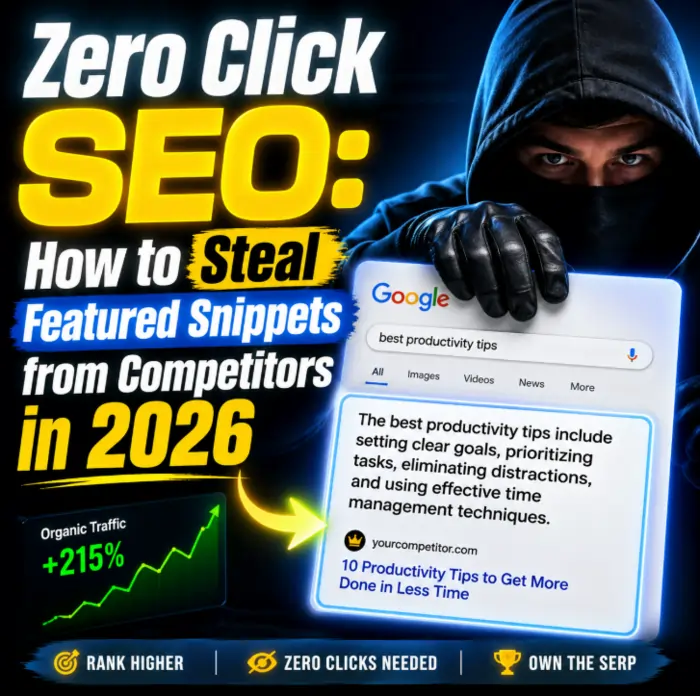
The search results page looks nothing like it did two years ago. If you’re still obsessing over ranking #1, you’re playing the wrong game. In 2026, the real battlefield is Position Zero—that coveted boxed answer sitting above every organic result. And if a competitor is sitting there while you’re not, they’re stealing your traffic, your authority, and your brand visibility without you even realizing it.
Welcome to the era of Zero Click SEO, where winning means getting cited—even when users don’t click through.
The New Math of Search: Why Zero Click SEO Defines 2026
Let’s start with the numbers that should keep every SEO professional awake at night. By early 2026, more than 70% of Google searches in markets like Australia resulted in zero clicks to any website, meaning fewer than three in ten queries lead to a site visit. Across the U.S. and Europe, zero‑click searches now account for roughly 68% to 72% of all Google queries. On mobile, that rate spikes even higher—up to 77%.
AI Overviews have accelerated this collapse of traditional click‑through rates. For informational B2B queries, organic CTR has dropped by 61% directly because of AI‑generated answers sitting at the very top of the page. A featured snippet that once guaranteed a flood of traffic now sees a desktop CTR of roughly 6% , compared to the 34% a standard #1 organic result might receive.
Yet—and this is crucial—when a snippet is optimized for high-intent transactional queries, it can still deliver a CTR above 42%. According to Gartner’s 2026 search predictions, nearly 75% of enterprise decisions will be shaped by zero‑click results within two years, making this shift impossible to ignore.
The conclusion is inescapable: Zero Click SEO isn’t about giving up on clicks—it’s about understanding which searches still produce clicks, and owning the answer space before your competitors do.
What Are Featured Snippets in 2026? A Quick Refresher
Before we steal anything, we need to understand what we’re taking. A featured snippet is a selected excerpt from a webpage that Google displays directly in the search results to answer a user’s query. It sits above all organic links and often appears inside a box, list, or table with a link to the source page.
In 2026, Google uses four main featured snippet types:
- Paragraph snippets: Short, direct answers to “what is,” “why does,” “who,” and “how” questions. Usually 40–60 words.
- List snippets: Ordered or unordered steps, ideal for “how to” guides, recipes, or checklists.
- Table snippets: Structured data presented in rows and columns, often triggered by comparison queries.
- Video snippets: Less common, but increasingly appearing for instructional or review content.
Each format has its own rules for winning. For example, paragraph snippets demand a concise 40- to 60‑word answer immediately below a heading that closely matches the search query. List snippets require properly formatted HTML lists. If you want to see a detailed breakdown of each snippet type, the Ahrefs SERP features glossary is an excellent resource that walks through every possible variation with real examples.
Why Stealing Your Competitor’s Snippet Is Smarter Than Creating from Scratch
Most SEO teams waste months producing content from nothing. Smart teams look at what’s already winning—and simply do it better.
Here’s why stealing competitor featured snippets is more efficient:
- The snippet format is already validated: If Google is showing a featured snippet for a given search, Google has already decided that question has a clear answer format. You don’t need to guess whether a paragraph, list, or table is appropriate.
- Competitors reveal their weaknesses: The current snippet holder might have a shallow answer, outdated data, or poor formatting. Analyze their content and you’ll see exactly what Google likes—and what could be improved.
- Google rewards “better” answers, not “first” answers: Snippets are re‑evaluated constantly. A page ranking #5 can steal the snippet from the #1 result if its answer is clearer, more recent, or better structured.
The goal is not to copy—it’s to reverse‑engineer, then outperform. And to help you measure when you’ve successfully stolen a snippet, you’ll want to track AI citation share across different engines.
We’ve written a complete guide on that exact topic: AI Citation Tracking: How to Measure Your Brand’s Share of Voice in ChatGPT & Gemini. It covers the KPIs that matter most when visibility doesn’t always mean a click.
Zero Click SEO: A Step‑by‑Step Framework for Stealing Featured Snippets
Let’s move from theory to execution. Below is a repeatable system any SEO team can use to systematically steal position zero from competitors.
Step 1: Identify Snippet Opportunities in Your Current Rankings
You can’t steal what you can’t see. Start by auditing your existing keyword portfolio for queries where:
- A featured snippet is present in the SERP.
- Your page ranks on the first page (positions 1–10) but does not currently own the snippet.
- The query has at least moderate search volume (100+ searches per month).
Tools like Ahrefs, SEMrush, and Moz can filter keywords by “SERP features,” showing you exactly which competitor holds each snippet. For a thorough breakdown of competitor SERP analysis, see our companion guide on AI citation tracking and visibility measurement.
Step 2: Inspect the Competitor’s Snippet Format
Once you’ve identified a target snippet, visit the live SERP and answer three questions:
- What type of snippet is it? Paragraph, list, table, or video?
- What exact question does it answer? Copy the query verbatim.
- Where does Google pull the answer from? Click the snippet to see the source page section. Note the heading directly above the answer and the surrounding content.
Most snippets are drawn from a single, tightly focused section of a page—not from a long, sprawling article. If the competitor’s snippet uses a numbered list, formatting your answer as a bullet‑point or plain paragraph will almost certainly fail. If you’re unclear about the technical boundaries, Google’s own structured data documentation explains exactly how the search engine interprets different content formats.
Step 3: Reverse‑Engineer and Outperform
Now you know the format. The next step is to create a definitively better answer. Outperforming a snippet generally means improving one of these dimensions:
- Clarity: Replace jargon with plain language. Use shorter sentences.
- Depth: If the competitor gives a three‑step answer, add a fourth step—but only if it truly adds value.
- Freshness: For time‑sensitive topics (statistics, news, product specs), update your content to reflect the most current data (ideally within the last 6–12 months). The latest WordStream 2026 SEO statistics provide excellent fact‑based ammunition for refreshing stale answers.
- Formatting precision: Use proper HTML for lists ( and ), tables (`
This process of strategic content engineering is at the core of modern search intent analysis. For a deeper dive into how to structure content that both Google and AI models love, check out our guide on zero‑click content strategy.
Step 4: Optimize Headings and On‑Page Structure
Google almost always pulls a snippet from content that sits directly below a heading closely matching the search query. For example, if you’re targeting “how to steal competitor featured snippets,” your H2 should be exactly that or a close variation.
Additional on‑page best practices:
- Place the target question as an H2, not buried in a paragraph.
- Immediately follow the heading with the answer—ideally in the next 40–60 words.
- Use subheadings to break long answers into scannable chunks.
Mastering these techniques is a core part of modern answer engine optimization (AEO). And if you want to see how this works specifically for Google’s AI Overviews, our detailed walkthrough on How to Optimize for AI Overviews: A 2026 Tactical Guide will give you a head start.
Step 5: Add Structured Data (Schema) When Possible
While schema markup is not a direct ranking factor for featured snippets, it significantly increases the chances that Google will interpret your content correctly. For snippet‑friendly content, consider:
- FAQ schema for question‑and‑answer pairs.
- HowTo schema for step‑by‑step instructions.
- QAPage schema for Q&A content.
If you’re unfamiliar with implementing these, our walkthrough of AI Overviews SEO tactics covers structured data in a practical, no‑developer way.
Step 6: Monitor and Iterate
Stealing a snippet is rarely a one‑and‑done event. Google refreshes snippets frequently, especially for trending topics. Use a rank‑tracking tool that monitors “SERP feature changes.” If you lose a snippet, re‑audit the page, check if a competitor has fresher data, and iterate.
For a complete guide on tracking these KPIs—including AI citation share of voice and brand lift from SERP features—refer to our deep‑dive on AI citation measurement.
The Zero‑Click Trapdoor: When Winning a Snippet Hurts Your Traffic
Here’s the paradox of Zero Click SEO: Winning a featured snippet can actually reduce your site traffic if the answer is so complete that users never feel the need to click.
For informational queries (“How tall is the Eiffel Tower?”), the snippet gives the entire answer. The user copies the number and moves on. Your brand gets the visibility, but zero visits.
For commercial or transactional queries (“Best SEO tools under $100”), the snippet can still generate significant clicks because users need to see pricing, reviews, or comparison details that don’t fit in 50 words.
The fix: If you pursue a snippet for a purely informational keyword, follow the direct answer immediately with “exploration content”—such as a case study, advanced tip, or downloadable resource—that requires a click to access. This strategy turns zero‑click visibility into a gateway, not a dead end.
Benefit‑Driven Lead: Right here, we want to make sure you don’t just read about the problem—you get a solution. That’s why we’ve created the “2026 Snippet Stealer Checklist” —a 25‑point tactical blueprint that walks you through every step from competitor audit to post‑steal monitoring.
It includes template spreadsheets, formatting cheat sheets for paragraph/list/table snippets, and a “Zero‑Click Trap Counter” worksheet to help you convert snippet views into email signups. Download the free checklist here and start stealing snippets the right way.
How Generative AI (ChatGPT, Gemini, Copilot) Changes the Game
Search isn’t just changing—it’s fragmenting. In 2026, a significant share of queries never reach Google at all. Users ask questions directly inside ChatGPT, Microsoft Copilot, Perplexity, Claude, or Gemini. These AI agents don’t show featured snippets the way Google does, but they do cite sources.
Generative Engine Optimization (GEO) focuses on making your content quotable by LLMs. Here’s how GEO overlaps with stealing featured snippets:
- Concise, factual answers: Both Google snippets and LLM citations prefer clear, direct responses.
- Structured data: FAQ and HowTo schemas are interpreted by AI engines during web crawling.
- Authority signals: If your content is repeatedly cited in Google snippets, LLMs are more likely to trust it.
If you want to see how the broader shift to AI‑powered search will reshape SEO over the next 18 months, our deep dive on the future of AI‑only search in 2027 provides a forward‑looking playbook.
Practical Tools for Featured Snippet Domination
Stealing snippets efficiently requires the right tools. Below are five resources that most snippet‑stealing guides mention only briefly—but we’ll tell you exactly how to use each.
1. Ahrefs – Keywords Explorer
Use the “SERP features” filter to find keywords where a featured snippet exists. Then click “SERP” to see the exact snippet content and source page.
2. SEMrush – Position Tracking
Set up a campaign and enable “SERP features.” SEMrush will alert you when you win or lose a snippet, or when a competitor captures one for a target keyword.
3. Moz – Rank Tracker
Moz’s Rank Tracker provides SERP feature insights, allowing you to see where your competitors appear in answer boxes, local packs, or knowledge panels.
4. Detailed.com – SERP Preview
This free tool gives a fast, visual breakdown of any SERP’s features, including snippet type, length, and source URL.
5. Google Search Console – Performance Report
Filter by “Search appearance: Featured snippet” to see which of your pages currently hold a snippet. Double down on those topics while looking for nearby keywords where you don’t yet have one.
Final Thoughts: Make Zero Click SEO a Competitive Advantage
The rise of zero‑click search, AI Overviews, and generative engines has created a massive opportunity for brands that adapt quickly. When most of your competitors are still fixated on ranking #1, you can leapfrog them by systematically stealing featured snippets from under their noses.
Remember: Zero Click SEO is not about giving up on traffic. It’s about acquiring strategic visibility—being the source that Google and AI models choose to cite. Over time, that brand lift compounds. Even when users don’t click today, they remember your name tomorrow. And when they’re ready to buy, they won’t search for a generic answer—they’ll search for you.
For a complete roadmap that ties together everything from content structure to future‑proofing your strategy, don’t miss our flagship pillar: The Zero-Click Apocalypse: How to Win AI Overviews & Featured Snippets (Before Your Competitors Do). It’s the definitive resource that all these cluster articles feed into.
Now go steal some snippets.
Frequently Asked Questions (FAQs)
1. What is a featured snippet in SEO?
A featured snippet is a highlighted answer box that appears at the top of Google search results, displaying a direct answer from a webpage alongside a link to the source.
2. How do I find which featured snippets my competitors currently own?
Use SEO tools like Ahrefs, SEMrush, or Moz to filter keywords by “SERP features.” These tools show you exactly which URLs hold snippets for your target terms and what format those snippets use.
3. Why would stealing a featured snippet hurt my traffic?
If the snippet fully answers an informational query, users may never click through to your site. This is the zero‑click trapdoor. For queries where users need additional details (pricing, comparisons, advanced steps), a snippet still drives significant traffic.
4. Can a page that ranks #5 win the featured snippet?
Yes. Google selects the snippet based on answer clarity and format relevance, not ranking alone. A well‑optimized page in position #5 can absolutely steal the snippet from a page in #1.
5. What is the best length for a paragraph snippet?
The ideal length is approximately 40–60 words, crafted as a single, self‑contained answer placed directly below a heading that matches the search query.
6. Do I need special coding to get a list snippet?
No, but you should use proper HTML list elements ( and ). Google extracts list snippets from both ordered and unordered lists; using heading tags before the list also helps.
7. How does Generative Engine Optimization (GEO) differ from featured snippet optimization?
GEO focuses on making content quotable by LLMs like ChatGPT and Gemini, while featured snippet optimization targets Google’s SERP features. However, the two overlap significantly because both reward concise, factual, well‑structured answers.
8. Can ChatGPT or Perplexity help me steal snippets?
Yes. You can prompt a model like ChatGPT to analyze a competitor’s snippet and suggest a “better” version that includes additional detail, simpler language, or more recent data.
9. Which industries benefit most from featured snippet optimization?
Industries with high volumes of “how‑to,” comparison, and definitional searches—such as software, finance, health, home improvement, and legal services—see the strongest ROI from snippet optimization.
10. How often do featured snippets change?
Frequently. For trending or rapidly changing topics, snippets can change daily. For evergreen queries, snippets may remain stable for months. Regular monitoring with rank‑tracking tools is essential.
11. What is the difference between a featured snippet and an AI Overview?
A featured snippet is a direct text, list, or table answer pulled from a single web page. An AI Overview synthesizes information from multiple sources to generate a paragraph‑length answer, often citing several pages.
12. Can I optimize old content to win featured snippets?
Yes. Identify existing content that ranks on page one, reformat the answer section to use proper headings, keep the answer concise (40–60 words), and add structured data where appropriate.
13. Do images or videos help with featured snippet rankings?
Sometimes. For “how‑to” queries, Google may display a video snippet if the source page includes a well‑structured video with transcript and timestamps. For most text‑dominant queries, images are not required.
14. What is “position zero” in SEO?
Position zero is an informal term for the featured snippet, which sits above the first organic search result. It is considered “zero” because it appears before position one.
15. How do I measure the value of a featured snippet if it doesn’t bring clicks?
Track brand lift metrics: direct traffic, branded searches, and mentions in AI Overviews. A snippet builds brand recognition even without an immediate click, which pays off in future search and referral traffic.
16. Is there a mobile‑specific strategy for featured snippets?
On mobile, featured snippets occupy most of the visible screen. Prioritize ultra‑concise answers (40 words or less) and use large, tappable headings to encourage scrolling to your organic listing.
17. What is “zero click content”?
Zero click content is any content explicitly written to be consumed directly on the search results page—either as a featured snippet, an AI Overview citation, or a voice assistant answer. Its primary goal is visibility and brand lift, not clicks.
18. How does internal linking affect my chances of winning a snippet?
Strong internal links help Google understand which page on your site is most authoritative for a given topic. Link from high‑authority pages to the page where you want to win a snippet to reinforce its topical relevance.
19. Will AI Overviews replace featured snippets entirely?
No. As of 2026, featured snippets remain Google’s primary format for direct answers to specific questions. AI Overviews generally appear for broader or comparative queries. Both formats coexist and are likely to continue doing so.
20. What is the fastest way to steal a snippet from a competitor today?
Run a competitor SERP analysis to find a query where your page ranks in positions 2–5 and a snippet exists. Copy the competitor’s format, improve the answer (add a step, add a statistic, make it more concise), reformat the relevant section of your page, and wait 2–4 weeks for Google to recrawl.







