Google AI Overviews Key Takeaways
Google AI Overviews are reshaping how search results display information, which directly affects organic click-through rates, brand visibility, and content strategy.
- Google AI Overviews occupy prime SERP real estate, reducing clicks to traditional organic results for many queries.
- Content that directly answers user questions with clear structure and cited sources is now more likely to be featured inside overviews.
- Brands must prioritise topical authority, structured data, and concise, citation-ready content to maintain visibility in the AI-driven search landscape.
Understanding How Google AI Overviews Reshape Search
In 2024, Google expanded its Search Generative Experience (SGE) into a fully integrated feature now known as Google AI Overviews. These overviews appear at the top of search results for billions of queries each month, providing a conversational answer assembled from multiple sources. For SEO professionals, the change is not subtle. It demands a fundamental rethinking of how content earns visibility, how traffic flows from search, and what metrics define success. For a related guide, see 15 Google Search Changes Hurting Organic Traffic: Expert Guide.
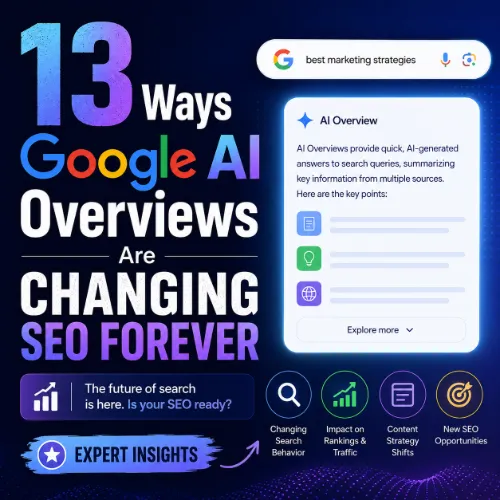
Below are the 13 most significant ways Google AI Overviews are changing SEO. Each point includes a practical implication you can apply to your strategy today.
1. Zero-Click Searches Become the Default
The most immediate impact of Google AI Overviews is the sharp increase in zero-click searches. When a user’s question is answered fully inside the overview, they rarely need to click through to a website. For publishers who relied on informational keywords, this means organic traffic can drop by 20-60% for affected queries.
SEO changes Google AI has accelerated include the need to measure brand exposure inside overviews, not just clicks. Track impressions within AI-generated answers using Google Search Console’s performance reports filtered by search appearance. For a related guide, see 8 Emerging AI SEO Trends Worth Watching.
2. Answer Formatting Becomes a Ranking Signal
Google’s AI prefers content that is structured in clear, extractable formats. Bullet points, numbered steps, short definitions, and concise paragraphs are more likely to be pulled into an overview. This shifts content creation from long-form storytelling toward modular, scannable answers.
To adapt, structure every piece of content around a primary question. Use Google AI Overviews as a guide: if your competitor’s content is already featured, study its formatting and improve upon it with more precise language and better citations.
3. Authority Now Requires Citation Readiness
Google’s AI cites sources inside overviews. Being cited builds trust and brand visibility even without a click. To earn citations, your content must include verifiable facts, statistics, and quotes from authoritative sources. Original research, expert interviews, and data-driven reports perform best.
Ensure every page has a clear publication date, author byline, and references. Google is more likely to pull content from pages that demonstrate editorial accountability.
4. Featured Snippets Are Merging Into Overviews
Traditional featured snippets (position zero) are increasingly being absorbed into Google AI Overviews for queries where the AI can produce a richer answer. This means pages that previously held featured snippets may see traffic redistribution to the overview itself.
Use tools like Ahrefs or Semrush to monitor featured snippet ownership. If you lose a snippet to an AI Overview, verify whether your content is still cited. If not, update the content to better match the AI’s preferred answer structure.
5. Search Intent Becomes More Granular
Google’s AI can now detect subtle differences in search intent. A query like “best running shoes” may trigger an overview comparing categories, while “best running shoes for flat feet” delivers a more targeted answer. This forces SEOs to refine keyword research beyond head terms.
Create content clusters around micro-intents. For each intent, produce a dedicated page that directly answers the question without forcing the user to navigate through multiple posts.
6. Brand Mentions as a Ranking Variable
AI Overviews impact SEO by increasing the value of brand mentions across the web. When Google’s AI synthesises an answer, it looks for consensus across multiple authoritative sources. A brand that is frequently mentioned by reputable sites is more likely to be included.
Invest in digital PR and link-building strategies that generate contextual brand mentions, not just backlinks. Unlinked mentions can still influence the AI’s confidence in your brand.
7. Structured Data Is More Important Than Ever
Schema markup helps Google’s AI understand content structure. FAQ schema, HowTo schema, and Article schema are directly used by the AI to identify extractable content. Without structured data, your content may be invisible to the overview generator.
Implement relevant schema on every page. Use Google’s Rich Results Test to validate your markup. For question-focused pages, include both FAQ and QAPage schemas.
8. Traffic Quality Shifts Over Quantity
With fewer total clicks, the visitors who do arrive via search are often more qualified. They come with specific, unanswered questions. This shift rewards sites that deliver precise answers and clear next steps, improving conversion rates even with lower traffic volumes.
Focus on conversion optimisation and user experience. Track engagement metrics like time on page, scroll depth, and click-through to secondary pages to measure real success.
9. AI Overviews Reward Multimedia Content
Google’s AI can pull information from images, videos, and tables inside an overview. Text-only content is no longer sufficient. Pages that combine written explanations with relevant visuals, embedded videos, and data tables have a higher chance of being featured.
Add at least one original chart, infographic, or short video to every pillar article. Use descriptive alt text and captions that the AI can parse.
10. Local SEO Gets an AI Boost
For local queries, Google AI Overviews often include local pack data, reviews, and business details in the answer. This creates new opportunities for local businesses to be featured without occupying a traditional map result.
Optimise your Google Business Profile with complete information, respond to reviews, and publish local-focused content. Mention landmarks, neighbourhoods, and local events to increase relevance.
11. Content Freshness Signals Intensify
The AI prefers current information, especially for topics that change frequently (e.g., pricing, policies, trends). Stale content is less likely to be cited in an overview. Regular updates signal to Google that your site is a reliable source.
Audit your existing content quarterly. Update statistics, replace outdated examples, and republish with a new date. Use the “last updated” field in your schema markup.
12. User Engagement Signals Influence AI Trust
Google’s AI analyses how users interact with the overview itself. If users click the “Show more” button or refine their query, the AI learns which content sources are more helpful. On-page engagement (bounce rate, dwell time) indirectly influences the AI’s selection.
Improve on-page readability with short paragraphs, clear subheadings, and internal links. Keep users engaged by answering their question immediately and then providing deeper supporting content.
13. SEO Strategy Must Be Answer-Centric, Not Link-Centric
The old model of building backlinks to rank high for keywords is being supplemented by a new requirement: your content must be the best possible answer for the query. Google AI Overviews reward depth, accuracy, and clarity over link authority alone.
Build topical authority by publishing comprehensive guides that cover every sub-question a user might have. Use internal linking to connect related answers, creating a web of cited content that the AI can trust.
SEO Entities and Their Functions
To succeed with Google AI Overviews, you need to master the signals that influence both traditional rankings and AI selection. Below are the key entities and how they function in this new environment.
- Organic keywords: Track which keywords trigger AI Overviews. Use tools like Ahrefs to identify overview-covered queries and measure traffic impact.
- Backlink entities: Referring domains and dofollow links still matter for authority, but unlinked brand mentions now also contribute to AI trust signals.
- Page entities: Top pages by traffic and top pages by links reveal which URLs the AI is most likely to cite. Prioritise updates on those pages.
- SERP entities: AI Overviews, People Also Ask, and featured snippets are all part of the same answer ecosystem. Optimise for all three simultaneously.
- Content entities: Publication date, author, and social shares signal freshness and credibility to the AI. Ensure every article has these elements.
- Technical SEO entities: Core Web Vitals and indexability directly affect whether the AI can access and trust your content. Fix crawl errors and improve page speed.
Useful Resources
For deeper analysis of Google AI Overviews and their impact on search, explore these authoritative sources:
- Google Search Central: AI Overviews and Search Features – Official documentation on how Google generates overviews and what content formats work best.
- Ahrefs Blog: How Google AI Overviews Affect SEO – Data-driven analysis of traffic changes, featuring case studies and actionable recommendations.
Frequently Asked Questions About Google AI Overviews
What are Google AI Overviews ?
Google AI Overviews are AI-generated answer boxes that appear at the top of search results. They synthesise information from multiple sources into a conversational summary, often reducing the need for users to click through to individual websites.
How do AI Overviews differ from featured snippets?
Featured snippets display a single block of text extracted from one page. AI Overviews combine content from several sources, include images and links, and can answer more complex, multi-part questions in a single response.
Will AI Overviews kill organic traffic?
For some informational queries, traffic drops significantly. However, traffic can stabilise or even grow for queries requiring deep research, purchase decisions, or local action. The key is to adapt content strategy to the new SERP landscape.
Do I need to change my keyword research?
Yes. Focus on long-tail, question-based keywords that reflect micro-intents. Traditional high-volume head terms may be dominated by AI Overviews, making them less valuable for click-through.
Can my content be featured inside an AI Overview?
Yes. Content that directly answers a question with clear formatting, cited sources, and structured data is eligible. Being featured builds brand visibility even without a click.
Are backlinks still important with AI Overviews?
Backlinks remain important for overall domain authority, but unlinked brand mentions and content citations now also influence whether the AI trusts your brand enough to include it.
Does structured data help with AI Overviews?
Absolutely. FAQ, HowTo, and Article schemas help Google’s AI understand content structure and extract answers more accurately. Implementation is strongly recommended.
What types of content perform best in AI Overviews?
Content that is concise, well-structured with headings and bullet points, supported by original data or expert quotes, and updated regularly performs best. Multimedia elements like images and tables also improve eligibility.
How can I track my visibility in AI Overviews?
Use Google Search Console under Performance > Search Results > Search Appearance. Filter by “AI Overviews” to see impressions and clicks generated through this feature.
Should I stop creating blog posts?
No. Blog posts that deliver unique value, original research, or in-depth analysis still attract links, social shares, and engaged readers. The format simply needs to include answer-friendly sections.
Do AI Overviews affect ecommerce sites?
Yes. Product comparison queries, buying guide queries, and local inventory queries can all trigger AI Overviews. Ecommerce sites should optimise product pages with clear specs, reviews, and structured data.
How often are AI Overviews updated?
Google refreshes its AI models continuously. Overviews can change daily based on new content, algorithm updates, or user feedback signals. Keeping content fresh is essential.
Can I opt out of AI Overviews?
No. If your content is publicly accessible and relevant, Google may include it. There is no opt-out mechanism. Focus on making your content so valuable that being cited is beneficial.
Do AI Overviews favour large publishers?
Not necessarily. While authority matters, Google’s AI cites smaller niche sites with original data or unique expertise. Building topical authority in a specific vertical can help smaller publishers compete.
Will AI Overviews replace the need for SEO entirely?
No. SEO evolves but does not disappear. The focus shifts from link building to answer creation, structured data, and brand trust. These are still SEO skills, just applied differently.
How do I optimise existing content for AI Overviews?
Identify pages that answer specific questions. Add a concise answer at the top using bullet points or a short paragraph. Implement FAQ schema and refresh outdated information. Then track through Search Console.
Is there a tool to check if my content appears in AI Overviews?
Beyond Google Search Console, tools like Semrush and Ahrefs offer SERP feature tracking that includes AI Overview visibility. Manual checking with Google’s SERP preview is also effective.
Do AI Overviews affect voice search?
Yes. Voice assistants often pull answers from Google’s SERP features, including AI Overviews. Optimising for overviews can therefore improve voice search visibility as well.
What role do user reviews play in AI Overviews?
For local and product queries, AI Overviews frequently incorporate aggregate review scores and snippets. Encouraging positive reviews on Google and other trusted platforms can increase your chance of inclusion.
Should I change my link building strategy for AI Overviews?
You should supplement traditional link building with brand mention building. Guest posting, digital PR, and expert roundups that mention your brand without linking still contribute to AI trust.