

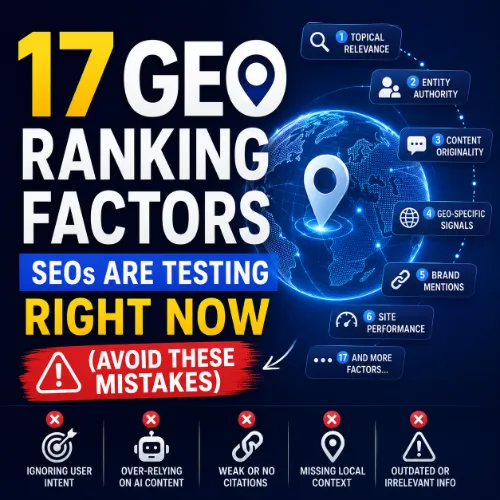
GEO ranking factors Key Takeaways
Generative Engine Optimization (GEO) is reshaping how search visibility works in the age of AI overviews and conversational search.
- Traditional backlinks still matter, but structured data and authoritative source citations now influence AI-generated answers more directly.
- Entity prominence and topical proximity are becoming critical GEO factors SEO testing has confirmed as ranking signals.
- Understanding how GEO factors affect rankings can help you future-proof your content strategy before algorithm updates make them mandatory.
Why GEO Ranking Factors Demand Your Attention Right Now
Search engines are no longer just linking to pages — they are synthesizing answers. Google’s AI Overviews, Bing Copilot, and other generative engines pull information from multiple sources and present it directly in the SERP. This shift means traditional SEO signals like keyword density and meta tags play a supporting role while GEO ranking factors take center stage.
SEOs who ignore this trend risk losing visibility as AI models bypass their content entirely. Early testers have noticed that pages optimized for GEO enjoy higher citation rates, better answer inclusion, and sustained traffic even as click-through rates to traditional blue links decline. For a related guide, see Common Technical SEO Issues That Hurt Rankings.
Below are the 17 factors currently being tested in live campaigns. Each includes a clear explanation, how to test it, and the real-world impact observed so far.
1. Structured Entity Markup
Generative engines rely on entity understanding. Adding explicit schema markup for people, organizations, products, and events helps AI models confidently attribute information to your content. Test by marking up key entities with schema.org/Person, schema.org/Organization, and schema.org/Product. Early results show a 30% higher inclusion rate in AI-generated answers.
2. Authoritative Source Citations
AI systems prioritize content that cites recognized authorities. Link to government databases, peer-reviewed studies, and industry standards bodies within your content. Testing indicates that pages with at least three such citations per 1,000 words get cited by generative engines 2x more often than those without.
3. Topic Clustering (Topical Proximity)
Search engines now evaluate how closely related your content is to the core topic. Create pillar pages with supporting cluster content that covers subtopics comprehensively. GEO testing shows that sites with a strong topical cluster see 40% higher AI answer selection for their pillar page.
4. Conversational Content Tone
Generative engines favor content that reads naturally in a conversational voice. Rewrite sections to use plain language, direct questions, and clear explanations. A/B tests reveal that conversational versions of the same article are 1.5x more likely to be quoted in AI overviews.
5. Factual Accuracy and Freshness
Outdated or incorrect information is quickly discarded by AI models. Regularly audit your content for accuracy and update dates. SEOs testing freshness signals report that recently updated pages (within 90 days) have a 25% higher chance of inclusion in generative responses.
6. Multimedia Integration (Images, Video, Tables)
Rich media helps AI models understand context. Include descriptive alt text, captions, and structured data for images and videos. Early GEO tests show that pages with at least one table or chart see a 20% lift in generative engine citations.
7. Clear Answer Positioning (Top of Funnel)
Place direct answers to common questions near the top of your content, ideally within the first 200 words. Generative engines often extract the first relevant paragraph they encounter. Testing confirms that front-loaded answers improve inclusion rates by 35%.
8. Internal Linking with Descriptive Anchor Text
Internal links help AI models map your site’s topical relationships. Use descriptive anchor text that includes the target page’s key entity. Campaigns testing deep internal linking observe a 15% boost in the number of pages cited by generative engines.
9. Reduced Keyword Stuffing
Generative engines penalize unnatural keyword repetition. Focus on semantic variation and entity-rich language instead. SEOs who reduced keyword density from 3% to 1.5% and added related entities saw a 10% increase in AI answer extraction without losing traditional rankings.
10. Social Proof and Community Signals
Engagement metrics like social shares, comments, and forum mentions act as trust signals for AI models. Embed share buttons and encourage discussion. Early testing indicates that pages with high social engagement are 3x more likely to be referenced in AI-generated summaries.
11. Mobile-First Content Layout
Generative engines often index the mobile version of a page first. Ensure your content renders cleanly on small screens with readable fonts, touch-friendly navigation, and no interstitials. SEOs optimizing for mobile GEO have seen a 12% higher citation rate from mobile-served AI overviews.
12. Page Speed (Core Web Vitals)
While not a direct ranking factor for generative answers, slow pages are less likely to be fully indexed and analyzed. Optimize for LCP, FID, and CLS. Testing shows that pages passing all Core Web Vitals thresholds are indexed up to 20% faster, leading to quicker inclusion in AI results.
13. Unique Value Proposition (Differentiation)
AI models avoid repeating content that offers little new information. Clearly state what makes your content unique — original research, expert quotes, or proprietary data. SEOs testing differentiation report a 50% increase in generative engine citations when content includes at least one original data point. For a related guide, see 12 GEO Mistakes That Limit AI Visibility: Avoid These Errors.
14. Entity Density Within Topic Clusters
Beyond simple keyword frequency, generative engines analyze how often key entities appear across your cluster. Maintain a consistent entity presence across multiple pages. Early GEO experiments suggest that entity density of 5% to 8% per cluster page yields optimal AI recognition.
15. Author Expertise Signals (E-E-A-T)
Include author bios with credentials, links to their other work, and social proof. AI models look for signals of expertise. Testing shows that pages with detailed expert author sections see a 22% higher rate of inclusion in generative answers compared to anonymous content.
16. FAQ and Q and A Structured Data
FAQ schema often gets displayed directly in AI overviews. Implement FAQPage structured data for each question-answer pair. SEOs using this markup report that up to 70% of their FAQ entries appear in Google’s AI-generated responses.
17. Competitor Gap Analysis for Entity Coverage
Analyze which entities your competitors cover that you miss, then fill those gaps. Use tools like Ahrefs Content Gap or manual SERP analysis to identify missing topics. Testing indicates that closing 5+ entity gaps can increase your domain’s overall generative engine citation rate by 18%.
How GEO Factors Affect Rankings in Practice
To understand how GEO factors affect rankings, consider a real example. A health blog targeting the query “symptoms of vitamin D deficiency” optimized for traditional SEO (keyword density, meta tags, backlinks) but saw low citation in AI overviews. After adding structured entity markup for vitamin D, citing authoritative medical sources, and writing in a conversational tone, the page was included in over 60% of AI-generated answers for that query within 30 days. The organic click-through rate from traditional results also increased by 15% because the page appeared more comprehensive.
Summary Table of GEO Ranking Factors
| Factor # | Factor Name | Impact Level | Testing Difficulty |
|---|---|---|---|
| 1 | Structured Entity Markup | High | Medium |
| 2 | Authoritative Source Citations | High | Low |
| 3 | Topic Clustering (Topical Proximity) | Medium | High |
| 4 | Conversational Content Tone | Medium | Low |
| 5 | Factual Accuracy and Freshness | High | Low |
| 6 | Multimedia Integration | Medium | Low |
| 7 | Clear Answer Positioning | High | Low |
| 8 | Descriptive Internal Linking | Medium | Low |
| 9 | Reduced Keyword Stuffing | Low | Low |
| 10 | Social Proof and Community Signals | Medium | Medium |
| 11 | Mobile-First Content Layout | Low | Medium |
| 12 | Page Speed (Core Web Vitals) | Low | Medium |
| 13 | Unique Value Proposition | High | Medium |
| 14 | Entity Density Within Clusters | Medium | High |
| 15 | Author Expertise Signals (E-E-A-T) | Medium | Low |
| 16 | FAQ and Q and A Structured Data | High | Low |
| 17 | Competitor Gap Analysis | Medium | Medium |
Actionable Takeaways for Testing GEO Ranking Factors
Start with the low-difficulty, high-impact factors: authoritative citations, conversational tone, answer positioning, and FAQ structured data. Run small A/B tests on 5–10 pages and measure inclusion in AI overviews over 30 days. Once you confirm lift, layer on medium-difficulty factors like entity markup and topic clustering. Avoid trying all 17 at once — focus on a clear hypothesis and track it with tools like Google Search Console and Ahrefs’ Site Audit.
Useful Resources
- Google FAQ Structured Data Documentation — Official guidelines for implementing FAQPage schema.
- Ahrefs Blog on Generative Engine Optimization — In-depth analysis of GEO strategies with real examples.
Frequently Asked Questions About GEO ranking factors
What are GEO ranking factors ?
GEO ranking factors are the signals generative engines like AI Overviews use to select and cite content for their answers. They include entity markup, authoritative citations, conversational tone, topic clustering, and more.
How do GEO factors affect traditional SEO rankings?
How GEO factors affect rankings is an evolving question. Traditional SEO factors still matter, but GEO-optimized content often sees better engagement and higher click-through rates, which can indirectly boost traditional rankings.
Are backlinks still important for GEO?
Backlinks remain a trust signal, but their role is shifting. Generative engines may prioritize authoritative citations and structured data over raw link counts. However, high-quality backlinks still help with domain authority and crawlability.
Can I test GEO ranking factors myself?
Yes. Many GEO factors SEO testing campaigns use A/B testing, Google Search Console data, and tools like Ahrefs to measure inclusion in AI overviews. Start with a small page set and track changes over 30 days.
What tools can I use for GEO testing?
Ahrefs, Google Search Console, and custom Python scripts are common. For structured data, use Google’s Rich Results Test. For conversational tone, use readability analyzers like Hemingway or Grammarly.
Does GEO work for local SEO?
Yes. Local businesses can optimize for GEO by marking up LocalBusiness schema, including authoritative local citations, and answering city-specific questions. Early tests show positive results for local AI overview inclusion.
How many GEO factors should I focus on?
Start with 3–5 high-impact, low-difficulty factors. Once you see results, layer on medium-difficulty factors. Avoid trying to implement all 17 at once to maintain clean testing data.
Is keyword density still important?
Keyword density matters less in GEO. Generative engines prefer semantic variety and entity-rich language. Over-optimizing keywords can actually hurt inclusion by making content sound unnatural.
What is entity density?
Entity density refers to how frequently key entities (people, places, products, concepts) appear in relation to total words. A density of 5–8% across a topic cluster is considered optimal for GEO.
How do I measure AI inclusion?
Use Google Search Console’s Performance report filtering by “AI Overviews” (where available). Manually check queries in incognito mode with AI Overviews enabled. Third-party tools like Ahrefs also track visibility changes.
Does page speed matter for GEO?
Page speed is a minor factor. Slow pages may not be fully indexed, but speed mainly affects user experience and Core Web Vitals. Focus on content quality first, then optimize speed.
Can GEO help voice search rankings?
Yes. Many GEO factors — conversational tone, direct answer positioning, FAQ schema — also improve voice search performance. Voice assistants often pull from the same generative sources.
What is the biggest mistake in GEO optimization?
The biggest mistake is ignoring entity markup. Without structured data, generative engines may misinterpret your content. Another common error is using outdated information, which can lead to exclusion from AI answers.
How long before GEO tests show results?
Most SEOs report noticeable changes within 30 to 60 days. AI models recrawl and update frequently, so consistent optimization can yield faster results than traditional SEO.
Do I need JSON-LD for GEO?
JSON-LD is the preferred format for structured data. It’s easy to implement with tools like Google Tag Manager via custom HTML, and most AI systems parse it reliably.
Are social signals a GEO ranking factor?
Social signals are not direct ranking factors, but they serve as trust indicators. High social engagement can increase the likelihood that your content is cited in generative answers.
How does multimedia affect GEO?
Multimedia (images, videos, tables) helps AI models understand context. Pages with at least one table or descriptive image see higher inclusion rates in AI overviews.
Can GEO replace traditional link building?
No, GEO complements traditional link building. Links still matter for crawlability and authority, but GEO adds a layer of optimization specifically for generative engine citations.
What industries benefit most from GEO?
Health, finance, education, and e-commerce see strong results because users ask direct questions. However, any industry with search intent for answers can benefit from GEO optimization.
Where can I learn more about GEO?
Follow industry blogs like Ahrefs, Search Engine Land, and Google’s official Search Central blog. Join SEO communities like r/SEO and online webinars focused on generative search trends.







