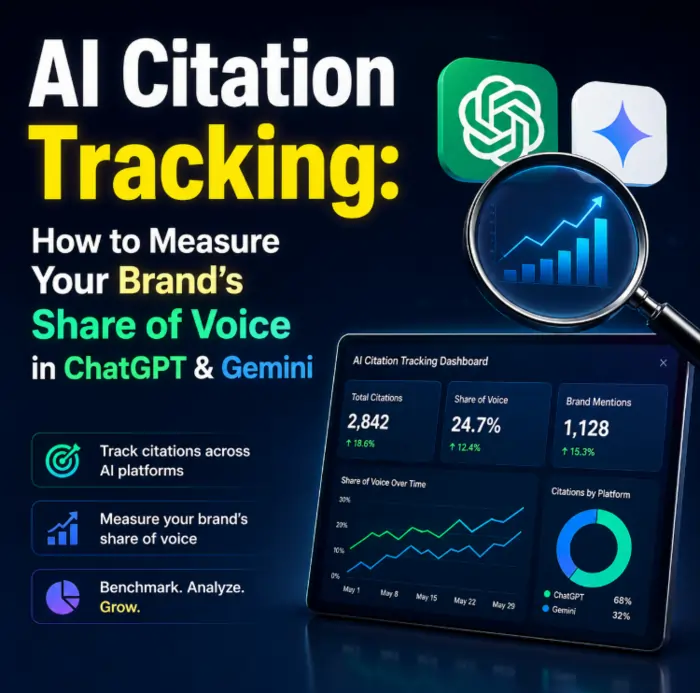
With 89% of brands already appearing in AI-generated results but only 14% of marketers tracking AI citations, most organizations are flying blind through the biggest shift in search history.
AI citation tracking helps you measure exactly which pages ChatGPT, Gemini, Perplexity, Claude, and Copilot cite, how often your brand appears compared to competitors, and which share of voice you actually own inside AI answers. This guide gives you a complete framework to track, measure, and improve your AI visibility across every major LLM.
The old SEO scoreboard is broken. For decades, marketing teams measured success with rankings, sessions, and blended Search Console clicks. That dashboard worked because there was a clear line from ranking to click to conversion. In 2026, that line has been erased.
Your brand is already showing up in AI-generated answers across ChatGPT, Perplexity, Gemini, Google AI Overviews, and Microsoft Copilot — whether you know it or not. A recent study found that 89% of brands already appear in AI-generated results. Yet the same study found that only 14% of marketers are tracking those AI citations. That gap is where opportunity lives.
This guide introduces AI citation tracking — the practice of monitoring which sources AI engines pull from, how often your site appears among those sources, and how that compares against competitors over time. You will learn exactly how to measure your brand’s presence across Generative AI platforms, turn that data into action, and stop flying blind through the AI search revolution.
What Is AI Citation Tracking? (And Why Your SEO Dashboard Already Misses It)
Let us start with a definition. AI citation tracking refers to the practice of monitoring which sources AI engines pull from when answering prompts in your category, how often your site appears among those sources, and how that compares against competitors over time.
If traditional SEO was about earning a spot among ten blue links, Generative Engine Optimization (GEO) is about earning a place among the two to seven domains large language models typically cite in a single response. When an AI engine names your brand in its answer, it delivers an implicit endorsement no organic listing ever could.
The difference matters because discovery has moved inside the answer. A user can see your brand name in a ChatGPT response, absorb your positioning, and never click. Another user can click a cited page after reading a synthesized answer, then convert at a much higher intent level than a typical organic visitor. A third user can encounter your brand in Google’s AI Mode and move into a paid placement before your analytics platform gives you any clear attribution.
Traditional dashboards cannot track this because visibility and clicks have stopped moving together. When that happens, old metrics start telling half‑truths. AI visibility, measured through citations and mentions rather than clicks, becomes the new north star.
The Data That Proves Why You Cannot Ignore AI Visibility
The numbers driving this shift are too large to dismiss. Gartner predicts traditional search volume will drop 25% by the end of 2026 as users shift to AI-powered answer engines. Google’s AI Overviews now reach more than 2 billion monthly users, ChatGPT serves 800 million users each week, and Perplexity processes hundreds of millions of queries every month.
A randomized field experiment found that AI Overviews reduced organic clicks on triggered queries by 38%, while zero‑click search rose from 54% to 72% when AI Overviews were shown. Ahrefs analyzed GSC data and reported a 58% drop in click‑through rate for top‑ranking pages when AI Overviews appeared. And according to the Pew Research Center, users click 8% of the time with AI Overviews compared to 15% without.
When AI Overviews appear, roughly 60% of Google searches end without a click. And 80%+ of LLM searches are zero‑click. The message is clear: a brand’s discoverability increasingly sits inside AI answers rather than on organic result pages.
AI Citation Tracking: The Five Core Metrics That Matter
Effective AI citation tracking starts with the right metrics. Traditional SEO measures are not sufficient for measuring brand visibility in the age of AI search. Instead, focus on these five core dimensions:
1. Brand Mention Rate
Your brand mention rate measures how often your brand name appears in AI-generated responses for a specific set of relevant prompts. This is the AI equivalent of brand awareness. When a potential customer asks an AI platform a question related to your industry, does your brand get mentioned at all? This metric is your north star for AI search monitoring.
2. AI Citation Rate
Citation rate tracks which specific URLs and pages AI engines reference when generating answers. A mention says your brand name appeared. A citation says your content was used as source material. Good citation tracking tools show exactly which URLs and domains AI platforms reference, categorized by type — reviews, media, competitors, owned.
3. Share of Voice (SOV)
Share of voice measures your percentage of mentions or citations compared to competitors across AI engines. This is the single best predictor of AI-driven revenue. Traditional share of voice measures ad impressions and organic rankings. AI SOV measures how often a brand is mentioned, cited, or recommended in AI-generated answers — a new and distinct metric.
4. Prompt Coverage
Prompt coverage tracks the share of target prompts or questions where your brand appears in the AI response. Not all prompts are equal. You need to know which specific questions trigger brand mentions and which do not, not just aggregate scores.
5. Average Position in AI Answers
When your brand is mentioned, where does it appear in the AI response? First? Third? Buried near the end? The average position in AI answers matters because the first citation in an AI Overview receives, on average, 28% of the residual clicks that do happen. Position drives both visibility and click‑through.
To track these metrics effectively, you need specialized AI visibility tools. For a complete breakdown of the best tools in 2026 — from enterprise platforms to accessible options for smaller teams — see the tools section below. And for a broader discussion of how zero click content feeds into this same visibility loop, refer to our guide on What Is Zero Click Content? .
How Different AI Engines Cite Content Differently
One of the most important discoveries in AI citation tracking is that different AI engines source content in dramatically different ways. Understanding these differences is the key to effective multi‑platform GEO strategy.
ChatGPT dominates with 40‑60% market share and relies primarily on training data, plus optional browsing. It prizes authoritative, comprehensive content and shows notable preference for Wikipedia — which accounts for approximately 5% of its citations, a pattern unique to ChatGPT. A staggering 64% of all analyzed citations across AI search come from ChatGPT, making it the dominant AI search surface by volume. Pages with author credentials (MD, PhD) see a 40% higher citation rate.
Perplexity (15‑20% market share) performs real‑time web search with inline numbered citations. It prioritizes freshness signals above all else and averages 21+ citations per answer, compared to approximately 8 for ChatGPT, meaning comprehensive content has more opportunities to be cited.
Gemini (10‑15% market share) integrates with Google Search and relies on Google ecosystem signals. If your domain performs well in traditional organic search, you already have a head start.
Claude (8‑12% market share) relies on training data with a specific emphasis on primary sources, original research, and detailed methodology.
Google AI Overviews now appear on roughly 50% of U.S. search queries and more than 70% of informational queries.
BrightEdge AI Catalyst research reveals that sourcing behavior varies dramatically across these engines. The share of citations coming from authoritative sources ranges from 10% to 26% depending on the engine. The share coming from user-generated content ranges from 0.2% to 18% — roughly a 90x spread. The top 10 most‑cited domains in ChatGPT account for only 18.5% of total citations, meaningfully lower than Perplexity (26.7%), Gemini (26.3%), or AI Mode (19.4%).
However — and this is crucial — the brands those engines ultimately recommend cluster in a much tighter range. Pairwise top‑100 overlap in named brands across engines falls between 36% and 55% (a 19‑point spread), while pairwise top‑100 overlap in cited sources ranges from 16% to 59% (a 43‑point spread). The playbook for brand visibility is not fragmented by engine — it is organized by content quality.
To understand how this engine‑specific behavior connects to stealing featured snippets and position zero, see our guide on Featured Snippet Optimization — the same principles of format and answer quality apply directly to earning citations.
A 5‑Step Framework to Set Up AI Citation Tracking
If you have never tracked AI citations before, start here. This framework turns a vague anxiety about AI search into a repeatable process.
Step 1: Run a Baseline Audit
Before you optimize anything, you need a baseline. An effective GEO audit should answer a few core questions: Are major AI engines citing your content at all? Can AI crawlers read and understand your structured data? How does your brand show up in AI‑generated answers — accurate, positive, neutral, or wrong? Where are competitors earning AI citations that you are missing?
You can start at no cost. Run 20 prompts that reflect real buyer intent across two engines (ChatGPT and Gemini is a good pair). Log whether your site gets cited and which competitor keeps showing up instead. That simple audit is your starting point.
Step 2: Choose Your Tracking Method
You have two options: manual or automated. For high‑stakes verification, manual sampling still beats every automated tool on the market. For ongoing scale, automated tracking is essential.
Manual tracking runs a set of prompts weekly, manually checks citations, and logs results in a spreadsheet. It is free, takes 2‑3 hours per week, and provides ground truth verification. However, it does not scale well.
Automated tracking uses specialized AI visibility tools. The best ones run automated queries against ChatGPT, Perplexity, Gemini, and Google AI Mode on a recurring schedule and report citation frequency, share of voice within a topic, and competitor comparisons.
Step 3: Track the Right Engines
Do not try to track everything at once. Start with the engines that matter most for your category. ChatGPT dominates citation volume (64% of all analyzed citations), so start there. Add Google AI Overviews — as of March 2026, AIOs appear on roughly 50% of U.S. search queries. Then add Perplexity if your category relies on fresh, real‑time information, and add Gemini if you already have strong organic Google visibility. Then layer in Claude and Copilot as time and resources allow.
Step 4: Establish a Baseline Share of Voice
For each engine, calculate your share of voice. Share of voice in AI search measures how often a brand is mentioned, cited, or recommended in AI‑generated answers. It is the percentage of AI‑generated responses in your category that mention your brand. SoV is the single best predictor of AI‑driven revenue.
Step 5: Close the Citation Gap
Once you know where you stand and which competitors are winning, you have a citation gap analysis: the practice of identifying which prompts and topics trigger competitor citations but not yours. Every gap is an optimization opportunity. Improve the content that targets that specific question, ensure your page has a direct answer block under a question‑format H2, and add FAQPage schema where appropriate.
For a detailed walkthrough of how to structure content to close these citation gaps — including the specific formatting and answer architecture that wins citations — refer to our guide on How to Optimize for AI Overviews .
The Best AI Citation Tracking Tools in 2026
Several tools now offer dedicated AI visibility tracking. Here are the leading options identified by recent research.
Scalenut tracks key metrics including brand mention rate, AI citation rate, share of voice, prompt coverage, and average position in AI answers. It is well‑suited for content teams needing integrated visibility with content creation workflows.
AirOps measures how often your brand shows up in AI-generated answers and automatically surfaces which specific prompts and topics are missing deep multi‑engine coverage. The Insights component tracks five AI search metrics including Mention Rate, Share of Voice, Citation Rate, Sentiment Score, and Average Position across ChatGPT, Gemini, Perplexity, Google AI Mode, and Google AI Overviews.
Omnia tracks ChatGPT, Perplexity, and Google AI Overviews, extracts exact citation sources, identifies citation gaps where competitors dominate, and turns insights into executable recommendations. Their guide describes AI citation tracking as giving you a repeatable way to answer where you stand in AI answers today, who is outranking you and on which prompts, and what you change first.
BrightEdge offers AI visibility tracking through its enterprise platform, though it is important to note that BrightEdge does not provide dedicated monitoring for AI engines like ChatGPT, Perplexity, Claude, Gemini, or Copilot — it is primarily an enterprise SEO platform with emerging AI modules.
Meridian tracks major AI platforms including Google AI surfaces and leading LLMs, with a unique focus on Improvement Actions and AI visibility workflows.
Profound offers comprehensive share‑of‑voice tracking across 10+ AI engines, making it ideal for enterprise teams needing competitive intelligence at scale.
Geoptie provides a free GEO audit that can assess your site’s AI search readiness and surface actionable insights in minutes, giving you a clear starting point before you invest in optimization.
For official technical references, Google’s structured data documentation explains how different markup types are interpreted, and the Ahrefs SERP features glossary provides detailed visual examples that remain relevant for understanding AI extraction patterns.
How to Improve Your AI Citation Share: A Tactical Checklist
Once you have tracking in place, use this checklist to systematically improve your citation share.
Content Structure
Use a clean heading hierarchy (H2 to H3 to H4) with question‑format headings for extraction points. Place direct answer blocks (40‑60 words) under question‑format H2 headings within the first 100 words. Keep paragraphs short — two to four sentences each — and use tables for data comparisons. Use numbered lists for step‑by‑step processes and bulleted lists for key takeaways.
Schema and Structured Data
Implement FAQPage schema for question‑and‑answer pairs. Each question‑answer pair becomes a candidate extraction point. Add HowTo schema for step‑by‑step instructions with step and instruction properties. Use Organization and Author schema to provide clear entity signals.
Authority and Freshness
Publish on recognized domains with strong backlink profiles. Include author credentials (name, title, LinkedIn, publications, relevant certifications). Publish original research and proprietary data. Update content every 3 months — pages updated in the last 3 months are 3x more likely to be cited.
Multi‑Platform Optimization
For ChatGPT, focus on comprehensiveness (1,500‑2,500 words optimal), Wikipedia strategy, and visible author credentials. For Perplexity, prioritize freshness signals and update dates. Structure content so each step can stand alone, as longer answers have more citation opportunities.
For Gemini, ensure strong Google Search visibility as a baseline. For Google AI Overviews, follow the same structure as featured snippet optimization — direct answers, question‑format headings, and structured data.
To see how mastering zero click content and answer‑first architecture directly drives citation share, read our comprehensive Zero Click SEO guide , which connects all these pieces into a single strategic framework.
The Future of AI Citation Tracking: What Comes Next
AI search does not stand still. Several trends will shape citation tracking in the coming year.
Google’s AI Mode is becoming its own search environment, not just a feature attached to standard search. It interprets a question, splits it into subtopics, and decides which sources deserve to support the answer. Google is layering paid and organic placements inside AI Mode, meaning visibility inside AI answers will increasingly have commercial implications.
Agentic commerce is arriving inside assistants, compressing the path from recommendation to purchase. When AI agents make decisions on behalf of users, being cited — or not — will directly affect revenue.
Cross‑engine consistency will matter more. Despite sourcing divergence, the brands that AI engines ultimately recommend remain far more consistent across engines than the sources those engines use. Brands that build strong entity authority, publish original research, and earn trusted third‑party citations will see compounding returns across every AI platform.
For a forward‑looking analysis of how these trends will reshape search in 2027 — including AI‑only search, AI agents, and the end of the ten blue links — see our deep dive on The Future of SEO in 2027 .
Build Your AI Visibility Dashboard Today
The gap between AI visibility and AI citation tracking is widening every week. Almost every brand is already appearing in AI answers. Almost no one can prove it. That gap is your opportunity.
Start with a baseline audit of 20 prompts across ChatGPT and Google AI Overviews. Log whether your site gets cited. Note which competitors keep showing up. That simple spreadsheet is the foundation of your AI visibility dashboard. Then layer in automated tracking, close your citation gaps one by one, and measure your share of voice every week.
The brands that master AI citation tracking today will own the answer space tomorrow. They will be the ones cited inside every relevant AI Overview, quoted by ChatGPT, referenced by Perplexity, and trusted by Gemini. They will enjoy the 5x conversion premium that AI‑referred traffic delivers, while their competitors watch organic clicks disappear.
Now go build your dashboard.
Frequently Asked Questions (FAQs)
1. What is AI citation tracking?
AI citation tracking is the practice of monitoring which sources ChatGPT, Perplexity, Google AI Overviews, and other AI engines pull from when answering prompts in your category — which URLs get cited, how often, and against which competitors.
2. Why is AI citation tracking important in 2026?
Because buyers are building shortlists in AI answers before they ever visit a website. Being absent from those answers is a distribution problem, not a content quality problem, and one you cannot fix if you cannot see it.
3. What is Share of Voice (SOV) in AI search?
Share of voice measures your percentage of mentions or citations compared to competitors across AI engines. It is the single best predictor of AI‑driven revenue.
4. How do ChatGPT and Perplexity cite content differently?
ChatGPT (dominant on training data) prefers authority, comprehensiveness, and Wikipedia patterns. Perplexity (real‑time web search) prioritizes freshness signals and averages 21+ citations per answer.
5. Can I track AI citations for free?
Yes. Run 20 prompts that reflect real buyer intent across two engines (ChatGPT and Gemini is a good pair). Log whether your site gets cited and which competitor keeps showing up instead. That simple audit is your free starting point.
6. What is the difference between a brand mention and a citation?
A brand mention means your brand name appeared in an AI answer. A citation means your specific URL or page was used as source material. Citations are generally more valuable because they include a linkable source.
7. How often should I run AI citation audits?
For ongoing tracking, weekly or bi‑weekly automated monitoring is ideal. For manual audits, run a baseline audit first, then re‑audit monthly or quarterly to track shifts in share of voice.
8. What tools can I use for AI citation tracking?
Leading options in 2026 include Scalenut, AirOps, Omnia, Meridian, Profound, Geoptie (free audit), and BrightEdge for enterprise. Choose based on your budget and engine coverage needs.
9. How do I improve my AI citation share?
Focus on direct answer blocks (40‑60 words under question‑format H2s), FAQPage schema, question‑format headings, fresh content (updated in the last 3 months), and clear author credentials.
10. Does Schema markup help with AI citations?
Yes. FAQPage, HowTo, and Organization schema provide AI engines with clear extraction signals and pre‑packaged Q&A units, increasing your likelihood of being cited.
11. What is prompt coverage?
Prompt coverage tracks the share of target prompts or questions where your brand appears in the AI response. It answers: for the questions that matter most in your category, does your brand show up?
12. Do I need to rank #1 to be cited in AI answers?
No. A page ranking #5 can be cited inside an AI Overview while a page ranking #1 is ignored. Structure for extraction — direct answers, question‑format headings — first, and rankings often follow.
13. How does GEO differ from traditional SEO?
Traditional SEO targets rankings and clicks on SERPs. GEO targets being cited inside AI‑generated answers across ChatGPT, Perplexity, Gemini, and other engines. The two overlap but require different metrics.
14. What is average position in AI answers?
When your brand is mentioned in an AI response, average position tracks where that mention appears — first, third, buried near the end. Earlier positions drive more visibility and residual clicks.
15. How do I track citations across multiple AI engines?
Use an AI visibility tool with multi‑engine coverage (ChatGPT, Perplexity, Gemini, Google AI Overviews, AI Mode at minimum) and daily refresh cycles. Most enterprise tools now offer this.
16. What is a citation gap analysis?
Citation gap analysis identifies which prompts, topics, or keywords trigger competitor citations but not yours. Every gap is an optimization opportunity — improve content for that specific query.
17. How does content freshness affect AI citations?
Pages updated in the last 3 months are 3x more likely to be cited. AI engines prioritize current information, especially for time‑sensitive or trending queries.
18. Does internal linking help with AI citations?
Yes. Strong internal links from high‑authority pages to your citation‑targeted page help AI engines understand topical relevance and which page on your site is most authoritative for a given topic.
19. How do I measure the ROI of AI citations?
Track branded search lift (increase in branded queries after earning citations), direct traffic changes, assisted conversions, and share of voice trends over time. AI‑referred traffic converts at approximately 5x standard organic rates.
20. What is the fastest way to start AI citation tracking today?
Run 20 prompts representing your category across ChatGPT and Google AI Overviews. Log citations and competitor presence. That simple spreadsheet is your baseline. Then choose a tracking tool and build your weekly dashboard.