

Google AI Overviews SEO Key Takeaways
Google AI Overviews are text-based, but they often reference images, videos, and infographics from source pages.
- Google AI Overviews SEO requires optimizing for answer-style snippets, not just keyword rankings.
- Content must be structured for authority and clarity to earn AI-generated citations.
- Traditional metrics like backlinks remain important, but topical relevance and entity coverage now carry more weight.
Understanding Google AI Overviews SEO and Its Impact
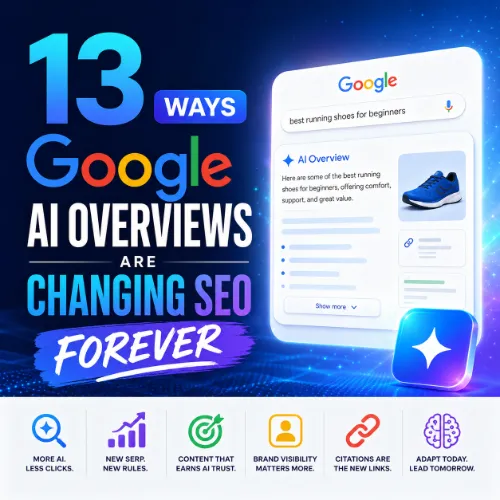
Google AI Overviews are AI-generated summaries that appear at the top of search results. They synthesize information from multiple sources to answer user queries instantly. For SEO professionals, this changes everything from keyword research to content strategy. Instead of chasing the first organic position, you now need to become a trusted source that Google’s AI cites in its overviews. This guide walks through 13 concrete ways this shift is rewriting the rules of search optimization. For a related guide, see How SEO Professionals Use Google Cloud for Data Driven Optimization.
1. Zero-Click Searches Are the New Norm
The most immediate impact of Google AI Overviews is the increase in zero-click searches. Users get answers directly in the overview, so they rarely click through to a website. For SEOs, this means optimizing for answer visibility, not just click-through rates. Focus on providing concise, accurate answers that the AI can pull directly into its summary. This maintains brand visibility even when users don’t visit your site.
2. Topic Authority Trumps Keyword Density
Google’s AI no longer relies solely on keyword matching. It evaluates topical authority by analyzing the depth and breadth of your content on a subject. Sites with comprehensive coverage across multiple related subtopics are more likely to be cited in overviews. Build pillar pages and cluster content around core themes to signal expertise. This approach strengthens your Google AI search impact and improves overall ranking potential. For a related guide, see AI Studio Updates and Their Impact on Content Ranking Strategies.
3. Structured Data Becomes Critical for AI Parsing
Schema markup helps Google’s AI understand your content structure. Use FAQ schema, HowTo schema, and Article schema to make your data more accessible. The AI Overview system prefers content that is clearly organized with headings, lists, and tables. Implementing structured data increases the chance that your content will be selected for inclusion in an overview. This is a direct technical SEO adjustment driven by SEO changes 2025.
4. Content Must Answer Implicit User Intent
Google AI Overviews now infer what users really want, even if they type vague queries. For example, a search for “best running shoes” might trigger an overview comparing stability, cushioning, and price. Your content should address these unspoken needs. Use tools like People Also Ask and topic clusters to identify related questions. Cover them within the same article to match the AI’s expanded understanding of intent.
5. Long-Tail Keyword Strategy Shifts to Question Optimization
Traditional long-tail keywords focused on low-competition phrases. Now, you need to optimize for question-based queries that trigger AI overviews. Target phrases like “how to fix a leaky faucet” or “why is my internet slow.” Create dedicated sections that provide step-by-step answers. Google’s AI Overviews frequently pull from content that directly addresses these conversational queries. This is a fundamental shift in Google AI Overviews SEO tactics.
6. The Role of Backlinks in AI-Generated Citations
Backlinks still matter, but their function changes. Google’s AI uses backlinks as a trust signal for source credibility, not just ranking juice. Links from authoritative .edu, .gov, and industry-leading sites increase the likelihood your content is cited in an overview. Focus on earning links from high-DR domains in your niche. Quality backlinks now serve as a gateway to AI-generated brand exposure.
7. Visual and Multimedia Content Gains Visibility
Google AI Overviews are text-based, but they often reference images, videos, and infographics from source pages. Including relevant visuals with alt text and schema can improve your chances of being featured. Videos embedded within your content may also appear in the overview’s supplementary carousel. This is a new opportunity within Google AI search impact that many SEOs overlook. Start adding custom graphics and short explainer videos to your guides.
8. AI Overviews Favor First-Party Data and Original Research
Google’s AI prioritizes content that includes original data, case studies, and first-party insights. Surveys, proprietary statistics, and expert interviews add unique value that AI algorithms detect. Republishing generic advice from other sources rarely earns a citation. Invest in conducting your own research and surveys. This differentiates your content and makes it a go-to source for AI summaries.
9. Local SEO Opportunities in AI Overviews
Local queries often trigger AI overviews that summarize business hours, service areas, and reviews. Optimize your Google Business Profile with complete, accurate information. Create local landing pages that answer common questions like “What is the best plumber in Austin?” Google’s AI pulls from both organic content and local listings. This intersection of local search and SEO changes 2025 creates new ways to capture local traffic.
10. SERP Features and Overviews Compete for Attention
AI Overviews sit above traditional SERP features like featured snippets and People Also Ask boxes. This means fewer users click on other SERP elements. To stay visible, ensure your content is optimized for multiple SERP features. A single page can be both an AI overview source and a featured snippet candidate. Use structured headings and direct answers to maximize real estate. This requires a holistic understanding of Google AI Overviews SEO.
11. Content Freshness Must Be Maintained Continuously
Google’s AI Overviews update frequently, especially for trending or time-sensitive topics. Stale content is less likely to be cited. Implement a content refresh schedule, updating statistics, examples, and links every 3–6 months. Add a “Last Updated” date to signal freshness. The AI prioritizes current, accurate information, making ongoing maintenance a core part of Google AI search impact strategy.
12. User Experience Signals Influence AI Selection
Core Web Vitals, mobile-friendliness, and page load speed impact whether Google’s AI considers your content trustworthy. Pages with low bounce rates and high dwell time signal relevance. Improve your site’s user experience with faster hosting, clean navigation, and readable typography. The AI Overview algorithm correlates positive user signals with content quality. This is an indirect but powerful aspect of SEO changes 2025.
13. The Rise of Semantic Search and Entity Optimization
Google AI Overviews rely on semantic understanding of entities like brands, people, places, and concepts. Optimize your content for entities by using clear definitions, linking to authoritative sources, and including related terms. For example, if you write about SEO tools, mention specific entities like Ahrefs, Domain Rating (DR), and keyword difficulty. This helps the AI map your content to the right knowledge graph. Entity optimization is the next frontier of Google AI Overviews SEO.
SEO Entities and Their Functions
Understanding how search engines and AI systems process content requires familiarity with key SEO entities. Here are the most relevant ones for adapting to AI Overviews:
- Domain entities: Root domain, subdomain, and URL-level analysis help identify whether authority belongs to the whole site or a specific page. AI Overviews often cite high-authority domains.
- Keyword entities: Organic keywords, keyword difficulty (KD), search volume, and SERP features reveal demand and competition. AI Overviews favor low-difficulty, high-intent queries with clear answers.
- Backlink entities: Referring domains, anchor text, and dofollow/nofollow links indicate trust. Quality backlinks increase the likelihood of being cited in an overview.
- SERP entities: Featured snippets, People Also Ask, and AI Overviews themselves show what content format the search result rewards. Structure content to match these formats.
- Metrics entities: Domain Rating (DR), URL Rating (UR), organic traffic, and referring domains count summarize authority and visibility. Monitor these to track AI Overview inclusion success.
Useful Resources
Explore these authoritative sources for deeper insights into Google AI Overviews SEO:
- Google’s Structured Data Guide – Official documentation on how schema markup helps search engines understand your content.
- Search Engine Land: AI Overviews Impact on Traffic – Real-world analysis of how AI summaries affect organic click behavior and what SEOs can do about it.
Frequently Asked Questions About Google AI Overviews SEO
Frequently Asked Questions About Google AI Overviews SEO
What are Google AI Overviews ?
Google AI Overviews are AI-generated summaries that appear at the top of search results, synthesizing information from multiple sources to directly answer user queries without requiring a click.
How do AI Overviews affect SEO?
AI Overviews shift focus from traditional rankings to being cited as a source in the summary, reducing click-through rates but increasing brand visibility for high-quality content.
What is a zero-click search?
A zero-click search occurs when a user gets the information they need directly from a SERP feature like an AI Overview, without clicking any organic or paid result.
Does Google AI Overviews kill organic traffic?
No, but it redistributes it. Traffic decreases for short, generic answers but increases for in-depth content that drives users to explore more after the overview.
How long do AI Overviews last in search results?
They are dynamic and can change based on query freshness, new content, and algorithm updates. Some overviews persist for months while others update daily for trending topics.
Which content types are most likely to be cited in AI Overviews?
Comprehensive guides with clear headings, step-by-step instructions, original research, and FAQ sections are most frequently cited. Lists and comparisons also perform well.
Do AI Overviews use schema markup?
Yes, structured data such as FAQ schema, HowTo schema, and Article schema help Google’s AI parse content more accurately, increasing the chance of inclusion.
How do I optimize for AI Overviews?
Focus on topical authority, clear structure, original data, and direct answers to common questions. Use schema markup and maintain content freshness.
Will AI Overviews replace featured snippets?
Not entirely, but they are replacing many featured snippets for informational queries. Featured snippets still appear for certain navigational and commercial intents.
What is the role of backlinks in AI Overviews?
Backlinks act as trust signals. High-quality links from authoritative sites increase the likelihood your content is considered a credible source for the AI summary.
Do AI Overviews penalize thin content?
Yes, thin or surface-level content is rarely cited. Google’s AI prefers in-depth, authoritative content that fully addresses the user’s intent with supporting details.
How does user intent affect AI Overviews?
The AI interprets the searcher’s implicit needs. For example, “best running shoes” triggers comparisons of stability, cushioning, and price, even if the user didn’t specify those.
What is entity optimization for AI Overviews?
Entity optimization involves clearly defining and linking to key concepts, brands, and terms (like Domain Rating or keyword difficulty) to help the AI map your content to its knowledge graph.
How often should I update content for AI Overviews?
Update core guides every 3–6 months, or more frequently for trending topics. Add fresh data, new examples, and remove outdated information to stay relevant.
Can small websites appear in AI Overviews?
Yes, if they produce unique, authoritative content on a specific niche. Small sites with original research or deep expertise are frequently cited alongside big publishers.
Do AI Overviews appear on all searches?
No, they are most common for informational, how-to, and comparison queries. Commercial and navigational searches less frequently trigger AI Overviews.
What is the difference between AI Overviews and Google’s Search Generative Experience (SGE)?
AI Overviews are the production version of SGE. SGE was an experimental phase; AI Overviews are now a permanent feature of Google Search.
How do Core Web Vitals influence AI Overviews?
Good Core Web Vitals improve user experience, which signals content quality to Google’s AI. Poor page experience reduces the chance of being cited.
Can I track whether my content appears in AI Overviews?
Tools like Ahrefs, Semrush, and Google Search Console can help monitor visibility. Look for impressions from branded searches and drops in click-through rates for featured snippets.
Will AI Overviews change the way Google ranks pages?
Yes, rankings now depend more on being a trusted source for the AI than on traditional keyword placement. Topical authority and entity coverage are becoming dominant ranking factors.







