

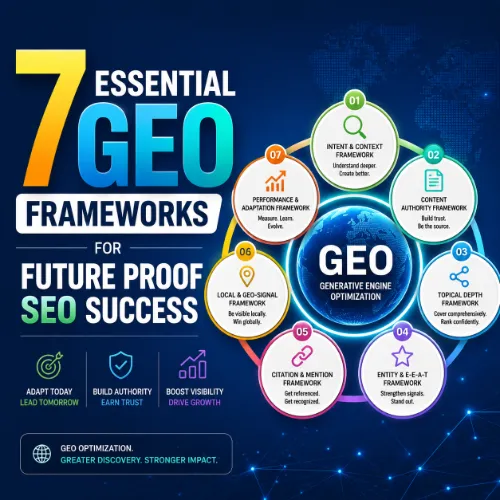
GEO frameworks for future proof SEO Key Takeaways
GEO frameworks for future-proof SEO provide structured methods for creating content that AI models can easily interpret, cite, and surface in answer boxes, overviews, and chat responses.
- GEO frameworks for future-proof SEO focus on structured data, conversational content, and entity optimization for AI overviews.
- Each framework here offers a practical lens for aligning content with generative search algorithms while maintaining traditional ranking signals.
- Applying one or more of these frameworks now can protect your organic traffic as AI-generated answers become the norm.
Why GEO Frameworks for Future-Proof SEO Matter Now
Search engines are undergoing a fundamental shift. Instead of simply listing blue links, platforms like Google, Bing, and emerging AI search tools now generate answers directly in the SERP. This shift demands a new approach—one that blends traditional SEO principles with strategies optimized for generative AI.
GEO frameworks for future-proof SEO provide structured methods for creating content that AI models can easily interpret, cite, and surface in answer boxes, overviews, and chat responses. Without a framework, you risk losing visibility to competitors who have already adapted.
Below are seven actionable frameworks to guide your strategy.
1. The Structured Entity Framework
Search engines and AI models rely on entities—people, places, concepts, and their relationships—to understand content. The Structured Entity Framework ensures that every page explicitly defines and connects these entities using schema markup and natural language.
How to Apply It
Start with a topic entity map. Identify the primary entity (e.g., “content marketing”) and related entities (e.g., “blogging,” “SEO,” “keyword research”). Then implement relevant schema types like Article, FAQPage, or HowTo. Use clear, specific HTML headings and plain language that an entity extractor can parse.
Real-World Example
A B2B SaaS company rewrote its “About” page to include job titles, industry terms, and product features as recognizable entities. They added Organization and Product schema. Within three months, their brand appeared in two AI overviews for industry queries.
2. The Conversational Answer Pattern
Generative AI often pulls from content that directly answers user questions in a natural, conversational tone. This framework structures content around specific user queries and provides concise, authoritative answers.
How to Apply It
Research common questions in your niche using People Also Ask, Reddit, or keyword tools. For each question, write a direct answer in 40–60 words using natural language. Then expand with supporting details. Wrap each Q and A in FAQ schema for extra clarity.
Real-World Example
A personal finance blog adopted this pattern for “How does compound interest work?” They wrote a simple one-paragraph answer, expanded with a calculator example, and marked it as FAQ. The answer now appears in multiple AI-generated summaries.
3. The Topical Authority Cluster
Generative engines favor sources that demonstrate deep, connected expertise on a subject. This framework organizes content into a central pillar page supported by related subtopic pages, all interlinked with rich anchor text.
How to Apply It
Choose one core topic per cluster. Write a comprehensive pillar page (2,000+ words) with internal links to 5–10 cluster articles. Each cluster article should answer a specific sub-question and link back to the pillar. Use breadcrumb schema and topic-specific schema markup.
Real-World Example
A digital marketing agency built a pillar around “Local SEO Strategies.” They created cluster posts on Google Business Profile, local citations, and review management. The pillar page now ranks in the top 3 for its target query, and its content is cited in two AI overviews.
4. The Data-Backed Authority Framework
AI models prefer content that cites verifiable data, studies, and expert sources. This framework focuses on weaving original research, statistics, and expert quotes into every piece of content.
How to Apply It
Conduct or commission small-scale surveys, analyze internal data, or curate recent industry reports. Present key numbers in a table or bullet list with proper attribution. Link directly to the original data source so AI crawlers can verify claims.
Real-World Example
A health and wellness site cited three peer-reviewed studies in an article about sleep hygiene. They included a simple table comparing study results. The article began appearing in AI answers for “how to improve sleep quality” within weeks.
| Framework | Primary Focus | Best For |
|---|---|---|
| Structured Entity | Schema and entity clarity | Brands with multiple product lines |
| Conversational Answer | Direct Q and A responses | Blogs, knowledge bases, FAQs |
| Topical Authority Cluster | Deep topic networks | Educational sites and agencies |
| Data-Backed Authority | Citations and research | Health, finance, B2B niches |
| Multimodal Content | Images, video, audio | E-commerce, tutorials, travel |
| Intent Optimization | Matching user goal | All content types |
| Continuous Feedback Loop | Performance monitoring | Mature sites with data access |
5. The Multimodal Content Framework
Generative AI is increasingly incorporating images, videos, and audio into answers. This framework ensures your content includes varied media types with proper metadata so AI can index and surface them.
How to Apply It
Add at least one relevant image, video embed, or audio clip per article. Use descriptive filenames, alt text, and captions. For videos, include transcripts and timestamps. Submit video sitemaps to Google Search Console.
Real-World Example
A cooking site embedded short recipe videos with step-by-step captions. They also uploaded a podcast version of the article. The video appeared in a video carousel for “quick pasta recipes,” and the transcript was cited in an AI overview.
6. The Intent Optimization Framework
Traditional SEO often buckets intent into informational, navigational, or transactional. GEO requires a finer lens. This framework categorizes queries by exact user goal—compare, decide, learn, buy—and aligns content format accordingly.
How to Apply It
Analyze your target keywords using search intent signals. If a query has a “buy” intent, write a product comparison or buying guide with pricing and features. If it’s “learn,” write a step-by-step tutorial. Match the SERP feature you want to win.
Real-World Example
A software review site noticed “best project management tools” had mixed intent. They created a comparison table for buyers and a separate guide for learners. Both pages now appear in different AI-driven answer slots.
7. The Continuous Feedback Loop Framework
GEO frameworks for future-proof SEO must evolve as generative AI updates. This framework sets up a system to monitor your content’s performance in AI overviews, track citation patterns, and adjust strategy monthly.
How to Apply It
Use tools like Ahrefs Keywords Explorer to monitor SERP features and track when your content is referenced. Set up alerts for brand mentions in AI summaries. Review your top 10 pages quarterly and update data, examples, and schema.
Real-World Example
An e-commerce brand tracked its product pages in AI-generated shopping overviews. They noticed a drop in citations after a Google update. They refreshed product descriptions, added customer review schema, and regained visibility within two weeks.
SEO Entities and Their Functions
Understanding the entities involved in SEO and GEO helps you apply these frameworks more precisely. Here are key entities and what they reveal about your strategy.
- Website / Domain entities: Root domain, subdomain, and URL-level analysis show whether performance belongs to the whole site, a section, or a single page.
- Keyword entities: Organic keywords, keyword difficulty (KD), search volume, and SERP features indicate demand, competition, and ranking opportunity.
- Backlink entities: Referring domains, anchor text, and dofollow/nofollow links explain authority flow and link quality.
- Technical SEO entities: Crawl issues, Core Web Vitals, and indexability status expose obstacles preventing good page experience.
- SERP entities: Featured snippets, AI Overviews, and People Also Ask show what content format the search result rewards.
- Metrics entities: DR (Domain Rating), organic traffic, and traffic value summarize authority and visibility.
Actionable Next Steps for GEO Frameworks for Future-Proof SEO
You don’t need to implement all seven frameworks at once. Start with these steps:
- Audit your current content for entity clarity and schema markup.
- Pick one framework that addresses your biggest visibility gap. For most sites, the Structured Entity or Conversational Answer Framework delivers quick wins.
- Create one optimized piece using the chosen framework. Monitor its performance in SERP features for 30 days.
- Expand and iterate based on what works, then layer on additional frameworks.
GEO frameworks for future-proof SEO are not a one-time fix—they’re an ongoing practice. Start small, measure results, and adapt as generative search evolves.
Useful Resources
Deepen your understanding of GEO and generative search with these resources:
- Google’s Structured Data Documentation – Official guide to implementing schema markup for enhanced SERP appearances.
- Ahrefs Blog: Generative Engine Optimization – A comprehensive overview of GEO strategies and how they differ from traditional SEO.
Frequently Asked Questions About GEO frameworks for future proof SEO
What is a GEO framework?
A GEO framework is a structured methodology for optimizing content so generative AI engines can easily understand, cite, and surface it in answer boxes, overviews, and chat responses. For a related guide, see GEO Content Frameworks That Actually Work.
How is GEO different from traditional SEO?
Traditional SEO focuses on ranking in blue-link results. GEO optimizes for AI-generated answers, which may prioritize entity clarity, conversational tone, and structured data over backlinks alone.
Do I need to abandon traditional SEO for GEO?
No. GEO builds on top of traditional SEO. Strong technical foundations, quality content, and backlinks still matter. GEO adds a layer of optimization for generative AI.
Which GEO framework is easiest to start with?
The Conversational Answer Pattern is often easiest because it requires minimal technical changes. Focus on answering real user questions in a natural, direct style.
How long until I see results from GEO?
Results vary. Some sites see their content cited in AI overviews within weeks, especially for low-competition queries. Broader authority gains can take several months.
Do GEO frameworks work for local SEO?
Yes. Local businesses can use the Structured Entity Framework to mark up address, hours, and services. The Conversational Answer Pattern helps with “near me” queries in AI overviews.
What role does schema markup play in GEO?
Schema markup helps AI engines understand entity relationships, content type, and authorship. It’s a core component of the Structured Entity Framework.
Can GEO frameworks help with voice search?
Yes. The conversational, direct-answer style that works for GEO also aligns with voice search queries, which tend to be longer and more natural.
What is the Multimodal Content Framework?
It’s a framework that encourages adding images, videos, and audio with proper metadata so AI can index and surface your content in diverse formats.
How often should I update my GEO content?
Review top-performing pages quarterly. Refresh outdated examples, data, and schema. The Continuous Feedback Loop Framework recommends monthly performance checks.
Is GEO only for large websites?
Not at all. Small sites and niche blogs can benefit, especially by using the Topical Authority Cluster to establish deep expertise in a focused area.
What is entity optimization?
Entity optimization means clearly identifying and connecting people, places, concepts, and products in your content using schema, natural language, and internal links.
How do I track my content in AI overviews?
Use tools like Ahrefs or Google Search Console to monitor SERP features. Manually search target queries and note when your content appears in the AI-generated section.
Does GEO require new content or can I optimize existing pages?
Both work. Existing pages often need better schema, clearer entity references, and more direct answers to user questions. Start with your highest-traffic pages.
What is the Data-Backed Authority Framework?
It’s a framework that prioritizes content supported by original data, statistics, and expert sources. AI models tend to cite content with verifiable claims.
Can AI detect poor-quality content despite GEO optimization?
Yes. GEO frameworks improve structure and clarity, but AI still evaluates substance. Thin, inaccurate, or plagiarized content will not perform well in generative search. For a related guide, see 8 Best GEO Frameworks for AI Driven Search: Expert Guide.
How do I choose the right GEO framework for my site?
Audit your current SERP presence. If you rarely appear in answer boxes, start with the Conversational Answer Pattern. If you lack topical depth, try the Topical Authority Cluster.
What is the Intent Optimization Framework?
It’s a method for matching your content format exactly to the user’s search intent—whether they want to learn, compare, decide, or buy—to win the corresponding SERP feature.
Are GEO frameworks a passing trend?
No. Generative AI is becoming a permanent part of search. GEO frameworks help you adapt to this shift and maintain visibility as search behavior evolves.
Where can I learn more about GEO?
Follow industry blogs from Ahrefs, Search Engine Land, and Google’s official Search Central blog. The Useful Resources section above provides two excellent starting points.







