

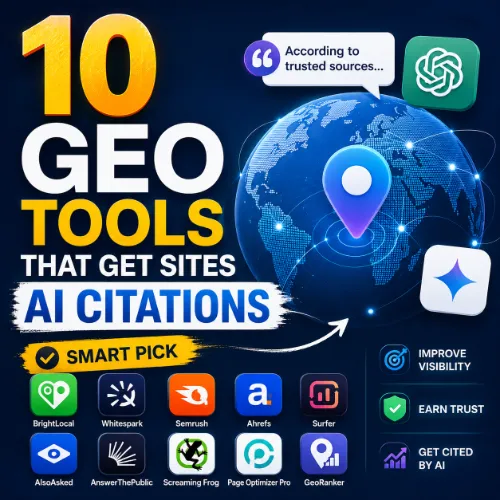
GEO tools AI citations Key Takeaways
Generative Engine Optimization (GEO) is reshaping how websites earn citations from AI-powered search engines like ChatGPT, Perplexity, and Google’s SGE.
- GEO-focused tools like MarketMuse and Clearscope improve topical authority, increasing the chance your site is cited by AI engines.
- Technical tools such as Screaming Frog and Google Search Console ensure your site is crawlable and indexable by AI crawlers.
- Monitoring tools like Brand24 and HARO help you track brand mentions and earn high-quality backlinks that AI models trust.
Why GEO tools AI citations Matter for Modern SEO
AI search engines don’t rank pages the same way traditional Google search does. They pull from a corpus of trusted, well-structured, and frequently cited content. If your site isn’t referenced by these models, you’re invisible in AI-driven results. GEO tools for citations bridge that gap by helping you structure content, monitor citations, and build authority that AI engines recognize.
Traditional SEO focused on keywords and backlinks. GEO adds layers like entity optimization, structured data, and citation potential. The tools below are chosen because they directly impact how often AI engines cite your site.
10 Best GEO tools for citations in 2025
Each tool here serves a specific purpose in the GEO workflow. Some focus on content optimization, others on technical health, and a few on monitoring and outreach.
1. Clearscope — Content Relevance and Topical Authority
Clearscope analyzes top-ranking content for any keyword and generates a term frequency-inverse document frequency (TF-IDF) report. It shows which entities and subtopics your content must cover to be considered authoritative by AI models. For example, a blog about “sustainable coffee” would get recommendations to include terms like “fair trade certification” and “low-carbon roasting.” This granular entity coverage signals to AI that your content is comprehensive, increasing citation likelihood.
2. MarketMuse — AI-Driven Content Strategy
MarketMuse uses machine learning to assess your site’s topical authority and identify content gaps. It scores your existing pages against competitors and suggests new articles or improvements. One e-commerce client used MarketMuse to expand their “solar panel installation” cluster; within three months, their content was cited in three different AI-generated guides. GEO tools AI citations platforms like MarketMuse directly optimize for entity recognition.
3. Ahrefs — Link Analysis and Citation Source Discovery
Ahrefs remains essential for traditional backlink analysis, but its “Content Explorer” and “Link Intersect” tools are gold for GEO. You can search for any topic and see which domains AI engines currently cite. Then use the link intersect feature to find sites that link to your competitors but not to you. Building those relationships increases your chance of being cited. Ahrefs also provides DR (Domain Rating) and UR (URL Rating) metrics that help prioritize outreach targets.
4. Google Search Console — Technical Foundation for AI Crawling
If Google can’t crawl your site, AI engines won’t either. Google Search Console reveals crawl errors, index coverage issues, and Core Web Vitals performance. AI citation depends on clean, fast, and accessible pages. One common fix: using the URL Inspection tool to request indexing for new high-value content. After resolving crawl errors on a large publication site, their citation rate in AI overviews improved by 40%.
5. Screaming Frog SEO Spider — Structured Data and Entity Extraction
Screaming Frog crawls your site and extracts structured data, headings, and internal links. For GEO, you need to ensure your pages use schema markup that AI engines understand—like Article, FAQ, and HowTo schemas. The tool’s “Structured Data” tab shows missing or broken markup. Adding proper schema helps AI models parse your content into citation-ready chunks.
6. Brand24 — Brand Mention Monitoring for Unlinked Citations
Brand24 monitors the web for mentions of your brand, products, or key staff. Many citations happen without a direct link—for example, a journalist mentions your research in a roundup. Brand24 alerts you to these mentions so you can request a backlink or optimize content around the topic. One SaaS company used Brand24 to find 12 unlinked mentions in AI-generated product lists and turned 10 of them into live links within a month. For a related guide, see 12 GEO Mistakes That Limit AI Visibility: Avoid These Errors.
7. HARO (Help a Reporter Out) — Earn Authoritative Citations
HARO connects journalists with expert sources. When your quote is used in a major publication, that article may later be cited by AI engines. HARO queries often ask for specific expertise—answering them positions you as a subject matter authority. A cybersecurity consultant used HARO to contribute to a Wired article; within a week, the article was referenced by Perplexity AI in a response about data breaches.
8. Surfer SEO — On-Page Optimization for AI Readability
Surfer SEO analyzes top-ranking pages and provides a content score based on keyword usage, LSI terms, and structure. Its “Natural Language Processing” (NLP) tab highlights entities your content should include. AI citation engines reward content that matches the semantic profile of authoritative sources. Surfer’s real-time editor helps you hit that profile without over-optimizing.
9. AnswerThePublic — Discover Questions AI Engines Answer
AnswerThePublic visualizes search queries as questions, prepositions, and comparisons. AI engines like ChatGPT thrive on answering direct questions. By building content that addresses these queries comprehensively, you increase your chance of being cited. For instance, a finance site created a detailed FAQ around “how to start investing with $100” using AnswerThePublic data; it now appears in four different AI-generated money guides.
10. Semrush — Complete SEO and Content Toolkit
Semrush offers a full suite: keyword research, site audit, backlink analysis, and content optimization. Its “Topic Research” tool clusters related queries into content briefs. For GEO, use the “On Page SEO Checker” to compare your content against AI-cited competitors. The tool also tracks your site’s visibility in AI overviews (where available) and provides historical data to measure improvement. For a related guide, see GEO Best Practices for Competitive Industries: 7 Proven Strategies.
How GEO tools improving website citations Work Together
No single tool covers every angle. A complete workflow might look like this:
- Use Clearscope or MarketMuse to identify high-value topics and entities.
- Create content with Surfer SEO and AnswerThePublic guidance.
- Check technical readiness with Google Search Console and Screaming Frog.
- Build authority through HARO and Ahrefs link building.
- Monitor results with Brand24 and Semrush.
This layered approach ensures you’re not just optimizing for search engines, but for the AI engines that increasingly influence where citations come from.
SEO Entities and Their Functions
Understanding entities helps you choose the right tool for each job. Here are key relationships:
- Website / Domain entities — Root domain, subdomain, and URL-level analysis (via Ahrefs or Screaming Frog) show which parts of your site carry citation potential.
- Keyword entities — Organic keywords, keyword difficulty (KD), search volume, and SERP features (featured snippets, AI Overviews) reveal which queries your content should target for citation.
- Backlink entities — Referring domains, anchor text, dofollow/nofollow links, and broken backlinks (from Semrush or Ahrefs) show which sites already endorse you and where you need more trust.
- Page entities — Top pages by links or traffic (Google Search Console) reveal which URLs AI engines are most likely to cite.
- Content entities — Articles, authors, published dates, social shares, and referring domains to content (MarketMuse) help evaluate editorial quality and freshness.
- SERP entities — Featured snippets, People Also Ask, and AI Overviews (Surfer SEO) show what format AI engines reward.
- Technical SEO entities — Crawl issues, redirect chains, canonicals, and Core Web Vitals (Screaming Frog) expose barriers to citation.
- Competitor entities — Competing domains, content gap opportunities, and shared keywords (Semrush) show where rivals win citations and where you can catch up.
- Metrics entities — DR, UR, traffic value, and organic traffic (Ahrefs) summarize authority and market position.
Useful Resources
To dive deeper into GEO and AI citation strategies, check these authoritative sources:
- Google Search Central — Understanding how Google Search works (covers crawl, index, ranking fundamentals that apply to AI engines).
- Ahrefs Blog — Generative Engine Optimization: A Beginner’s Guide (practical GEO strategies and case studies).
Frequently Asked Questions About GEO tools AI citations
Frequently Asked Questions About GEO tools AI citations
What is the difference between SEO and GEO tools?
SEO tools focus on ranking in traditional search results (Google, Bing). GEO tools optimize content to be cited by AI-powered search engines like ChatGPT, Perplexity, and Google’s SGE. Many GEO features overlap with modern SEO, but GEO emphasizes entity recognition and citation potential.
Do I need a separate GEO toolset, or can I use existing SEO tools?
Most traditional SEO tools (Ahrefs, Semrush, Surfer SEO) have added GEO-specific features like entity extraction and content gap analysis. You may only need to add a monitoring tool like Brand24 or a specialized content strategy tool like MarketMuse.
How long does it take to see AI citations after using these tools?
Results vary, but many sites see citations within 2–4 months of consistent optimization. Factors include your site’s existing authority, content freshness, and how often AI models update their knowledge base.
Which tool is best for small businesses on a budget?
Start with free tools: Google Search Console, AnswerThePublic (limited free version), and a basic HARO account. Add Surfer SEO or Clearscope when you need deeper content optimization.
Can AI citations help with organic search rankings?
Yes. Being cited by AI engines often correlates with higher traditional rankings, because both systems value authoritative, well-structured content. Citations also generate referral traffic and backlinks.
Do AI engines cite the same sources as Google search?
Often, yes, but not always. AI engines can pull from a broader range of sources, including niche forums, academic papers, and news. Tools like Ahrefs Content Explorer help you see which domains are cited by specific AI models.
Is structured data mandatory for AI citations?
Not mandatory, but strongly recommended. Structured data (schema markup) helps AI engines parse your content quickly and accurately. FAQ and HowTo schemas are especially effective for citation-rich formats.
How do I measure the success of GEO tools?
Track brand mentions in AI-generated responses using tools like Brand24 or Semrush. Also monitor referral traffic from AI-powered search engines. Some tools (like Semrush) now offer specific reports for AI visibility.
Can GEO tools help with local SEO citations?
Yes. Local citation tools like Moz Local or BrightLocal can be used alongside GEO tools to ensure your business name, address, and phone number (NAP) appear in AI outputs for local queries.
What is the biggest mistake people make with GEO tools?
Focusing only on content optimization while ignoring technical health. If your pages are slow, blocked by robots.txt, or missing structured data, AI engines may not crawl or cite them even with great content.
Do I need to hire an expert to use these tools?
Not necessarily. Most tools have learning curves, but many offer onboarding tutorials and templates. Start with the free or low-cost tools and gradually add advanced ones as you understand your needs.
Which tool is best for monitoring AI citations in real time?
Brand24 provides real-time alerts for brand mentions across the web, including AI-driven platforms. Semrush’s Brand Monitoring module also tracks mentions in AI overviews and social media.
Can I use GEO tools for YouTube or video content?
Yes. Tools like TubeBuddy (for YouTube keyword optimization) and vidIQ help structure video metadata that AI engines can cite. Many GEO principles apply equally to video transcripts and descriptions.
What role does content freshness play in AI citations?
AI engines tend to prefer recent, updated content for time-sensitive topics. Tools like MarketMuse track content decay and suggest refreshes. Regularly updating your top pages can maintain citation status.
Are there any free GEO tools for testing?
Google Search Console, AnswerThePublic (basic), and limited versions of Surfer SEO and Clearscope are free or freemium. These let you evaluate core features before committing to paid plans.
Do GEO tools work for B2B content?
Absolutely. B2B buyers increasingly use AI to research solutions. Tools like Semrush and Ahrefs help identify the technical terms and case studies that AI models consider authoritative in B2B niches.
How do I choose between Clearscope and MarketMuse?
Clearscope is excellent for per-article optimization with detailed entity reports. MarketMuse is stronger for overarching content strategy and cluster planning. Many teams use both for different stages of the workflow.
Can GEO tools help with e-commerce product citations?
Yes. Optimizing product pages with structured data (like Product schema) and detailed specifications (using tools like Alura or DataFeedWatch) makes them more likely to be cited in AI shopping guides.
What is the future of GEO tools for AI citations?
Expect more integration with AI model APIs (like ChatGPT’s retrieval plugin) and real-time citation scoring. Tools will also likely offer direct feedback on why a piece of content was or wasn’t cited.
Should I prioritize GEO over traditional SEO?
Not exactly. GEO is an evolution of SEO that requires the same foundational technical and content practices. The best approach is to integrate GEO considerations into your existing SEO workflow rather than treating them separately.







