

BOFU vs TOFU Content in SaaS SEO: What Drives Better Results?
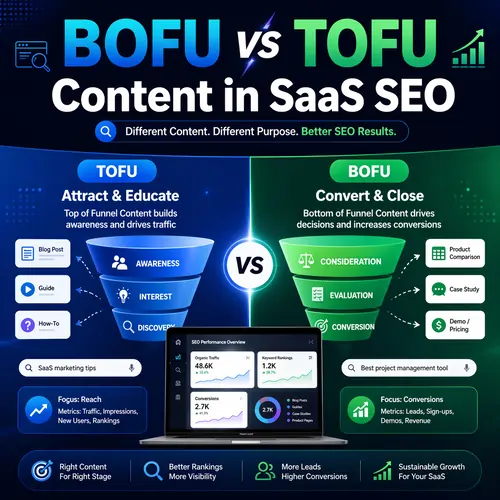
BOFU vs TOFU content in SaaS SEO comes down to purpose. TOFU content brings in awareness-stage users who are still learning. BOFU content targets high-intent users who are ready to compare tools, book a demo, or buy. The best SaaS SEO strategy does not choose one over the other. It uses TOFU content for traffic and topical authority and BOFU content for leads and conversions. If you want long-term growth, your SaaS brand needs both. To understand the broader funnel difference, this guide on BOFU vs TOFU content gives extra context.
Quick Answer
If your goal is organic traffic, brand awareness, and topical authority, focus on TOFU content in SaaS SEO. If your goal is demo requests, free trials, and qualified leads, focus on BOFU content in SaaS SEO. The strongest SaaS brands build a funnel where TOFU attracts the right audience and BOFU turns that audience into customers.
What Is TOFU Content in SaaS SEO?
TOFU content means Top of Funnel content. In SaaS SEO, it is the type of content created for people who are still researching a problem. They may not be ready to buy software yet. They are still asking questions, learning terms, and exploring possible solutions.
This is where awareness-stage content works best.
Common examples of TOFU content:
- Blog posts
- Beginner guides
- How-to articles
- Educational content
- Definitions and glossaries
- Trend articles
- Problem-solving content
A person searching for “how to improve team collaboration” or “what is workflow automation” is usually at the TOFU stage. They are not always looking for a tool yet. They want answers first.
That is why TOFU content in SaaS SEO is useful for:
- Attracting new visitors
- Building trust early
- Ranking for informational keywords
- Growing topical authority
- Bringing users into your content funnel
If you are building educational pages that pull in awareness-stage traffic, learning from product-led SEO strategies for SaaS brands can help shape a stronger TOFU approach.
TOFU content is not weak. It is the content that opens the door.
What Is BOFU Content in SaaS SEO?
BOFU content means Bottom of Funnel content. In SaaS SEO, it targets people who are already problem-aware and solution-aware. They know they may need software. Now they are deciding which one to choose.
This is where conversion-focused content matters most.
Common examples of BOFU content:
- Product comparison pages
- Alternative pages
- Pricing pages
- Demo pages
- Product-led landing pages
- Use case pages
- Case studies
- ROI pages
A user searching for “best CRM for small business”, “HubSpot alternatives”, or “project management software pricing” is much closer to taking action.
That is why BOFU content in SaaS SEO is useful for:
- Capturing high-intent traffic
- Supporting purchase decisions
- Driving sign-ups and demos
- Improving lead quality
- Shortening the sales cycle
For SaaS companies with longer buying journeys, a guide on SaaS SEO services for long sales cycles fits naturally with this BOFU strategy because long sales cycles need content that keeps decision-stage users moving.
BOFU content is where traffic becomes revenue.
BOFU vs TOFU Content in SaaS SEO: The Core Difference
The easiest way to understand BOFU vs TOFU content in SaaS SEO is this:
- TOFU content attracts
- BOFU content converts
Both matter, but they do different jobs.
Here is a simple comparison:
TOFU Content
- Targets informational search intent
- Reaches early-stage users
- Focuses on education
- Builds traffic and awareness
- Includes blog posts, guides, and how-to content
BOFU Content
- Targets transactional or commercial search intent
- Reaches decision-stage users
- Focuses on comparison and action
- Builds leads and conversions
- Includes comparison pages, demo pages, and case studies
In short, TOFU content builds reach, while BOFU content drives results closer to revenue.
Why SaaS Brands Need Both TOFU and BOFU Content
Many SaaS companies make the mistake of leaning too heavily in one direction.
Some brands publish endless blog posts and wonder why traffic does not convert. Others build only product pages and wonder why growth is slow. Both approaches miss the bigger picture.
A good SaaS content funnel needs both stages.
Why TOFU content matters:
- It expands your keyword footprint
- It helps your brand show up earlier in the journey
- It builds authority around your niche
- It feeds remarketing, email capture, and internal links
Why BOFU content matters:
- It matches high-buying intent
- It answers the final questions before conversion
- It gives buyers proof, clarity, and confidence
- It helps SEO support pipeline, not just pageviews
A full-funnel SaaS brand does not ask, “Should we create TOFU or BOFU?”
It asks, “How do we connect TOFU and BOFU better?”
When TOFU Content Should Be Your Priority
There are times when TOFU content in SaaS SEO should come first.
Prioritize TOFU if:
- Your brand is still new
- Your domain has low authority
- You need more organic traffic
- Your product category needs education
- Your audience is not yet fully aware of the problem
For example, if you sell a specialized SaaS product in a new or technical category, people may not search for your product name yet. They may search for the problem instead.
That is where how-to articles, beginner explainers, and educational blog posts can bring the right people in.
Strong TOFU keyword examples:
- what is employee scheduling software
- how to manage remote teams
- best ways to automate reporting
- project tracking tips for agencies
- how to improve customer onboarding
These are not always high-conversion keywords, but they are valuable because they start the relationship.
When BOFU Content Should Be Your Priority
There are also times when BOFU content in SaaS SEO should take center stage.
Prioritize BOFU if:
- You already have traffic but weak conversions
- You want more demos or free trials
- Your sales cycle is longer and research-heavy
- Buyers compare multiple vendors before choosing
- You want SEO to drive pipeline faster
BOFU content works well when your audience already knows the problem and wants the best software solution.
Strong BOFU keyword examples:
- best CRM for startups
- Asana alternatives
- payroll software pricing
- best help desk software for SaaS
- [your brand] vs [competitor]
- project management software demo
These keywords often bring less traffic than broad TOFU terms, but the quality is usually much higher.
Best TOFU Content Ideas for SaaS SEO
If you want more awareness and visibility, start with strong TOFU content ideas.
1. Beginner Guides
These help new users understand a topic from scratch.
Example:
- Beginner’s Guide to Workflow Automation
- SaaS Reporting Basics for Small Teams
2. How-To Articles
These target clear search intent and often perform well in search engines.
Example:
- How to Reduce Customer Churn
- How to Build a Better Onboarding Process
3. Problem-Aware Content
This content speaks to a pain point before users search for software.
Example:
- Why Teams Struggle With Manual Reporting
- Common Scheduling Problems in Small Businesses
4. Glossary and Definition Pages
These support AEO and GEO because they answer direct questions clearly.
Example:
- What Is Customer Lifecycle Management?
- What Is a Sales Pipeline?
5. Trend and Educational Content
This helps build authority and topical relevance.
Example:
- SaaS SEO Trends to Watch
- Why Product-Led Growth Changes Content Strategy
TOFU content works best when it is simple, useful, and tied to a real search need.
Best BOFU Content Ideas for SaaS SEO
If your goal is conversions, build more BOFU content ideas into your strategy.
1. Product Comparison Pages
These are powerful for users who are actively evaluating choices.
Example:
- Best CRM Software for Small Teams
- Top Email Marketing Platforms for SaaS Brands
2. Competitor Alternative Pages
These work well for branded competitor searches.
Example:
- Best HubSpot Alternatives
- Top Asana Alternatives for Agencies
3. Demo and Pricing Pages
These are key bottom of funnel content assets.
Example:
- Book a Live Demo
- Simple Pricing for Growing Teams
4. Use Case Pages
These help buyers see how your software fits their exact need.
Example:
- Project Management Software for Marketing Teams
- CRM for Real Estate Agencies
5. Case Studies
These build trust with proof.
Example:
- How a SaaS Startup Cut Onboarding Time by 45%
- How a Sales Team Increased Conversions With Automation
6. ROI Pages
These help justify the purchase.
Example:
- ROI of Workflow Automation Software
- Time Saved With Automated Reporting Tools
This kind of conversion-focused content can become your money pages.
How TOFU and BOFU Work Together in a SaaS Content Funnel
This is where smart SaaS SEO gets stronger.
A user may first find your brand through a TOFU blog post. They learn something useful. Then they click to a related use case page. Later, they land on a product comparison page or demo page. That is how the SaaS content funnel should work.
A simple path looks like this:
- User discovers a TOFU blog post
- User learns about the problem
- User clicks to a middle or bottom-funnel page
- User compares options
- User books a demo or starts a free trial
This is why internal linking matters.
Link TOFU pages to:
- product pages
- feature pages
- case studies
- demo pages
- pricing pages
- relevant comparison pages
When you connect top of funnel content to bottom of funnel content, you guide users naturally instead of hoping they find the next step on their own.
Common SaaS SEO Mistakes With TOFU and BOFU Content
Many SaaS companies create content, but the content does not perform because the funnel is broken.
Common mistakes:
- Too much TOFU, not enough BOFU
Traffic grows, but demos stay flat. - BOFU pages with weak SEO
The pages exist, but they are thin, vague, or poorly optimized. - No clear search intent match
A page tries to rank for one query but serves another need. - No internal links between stages
Users enter the site but do not know where to go next. - Weak calls to action
There is no natural next step. - No proof on BOFU pages
No testimonials, use cases, feature detail, or case studies. - Ignoring question-based queries
This hurts answer-engine visibility and AI Overview potential.
A strong SEO content strategy for SaaS should fix these gaps.
How to Build a Balanced BOFU and TOFU SaaS SEO Strategy
If you want a practical approach, follow this simple framework.
Step 1: Map Keywords by Funnel Stage
Separate keywords into:
- Informational keywords
- Commercial keywords
- Transactional keywords
This helps you see what belongs to TOFU and what belongs to BOFU.
Step 2: Build Topic Clusters
Create TOFU clusters around your core problems and industry themes.
Example:
- team collaboration
- workflow automation
- sales reporting
- customer onboarding
Step 3: Build Money Pages
Create BOFU pages around:
- best software for
- alternatives
- comparisons
- use cases
- pricing
- demo
Step 4: Add Internal Links
Every TOFU page should guide users toward the next stage.
Step 5: Improve BOFU Page Quality
Make sure BOFU pages include:
- clear benefits
- specific use cases
- proof points
- FAQs
- CTA buttons
- comparison details
Step 6: Measure the Right KPIs
TOFU and BOFU should not be judged the same way.
TOFU metrics:
- organic traffic
- impressions
- rankings
- engagement
- email signups
BOFU metrics:
- demo requests
- free trials
- lead quality
- assisted conversions
- revenue influence
This is how you keep your SaaS SEO strategy tied to real business goals.
Which Content Type Drives Better Results?
The answer depends on what you mean by “better.”
If better means more traffic, TOFU often wins.
If better means more conversions, BOFU usually wins.
But in real SaaS SEO, the better strategy is not either-or. It is sequencing.
TOFU is better for:
- brand discovery
- early trust
- topical authority
- organic reach
BOFU is better for:
- purchase intent
- demos
- trials
- conversion-driven SEO
The winning approach is simple:
Use TOFU content to grow visibility. Use BOFU content to monetize that visibility.
That is the real difference in BOFU vs TOFU content in SaaS SEO.
Final Thoughts
BOFU vs TOFU content in SaaS SEO is not a battle where one side should replace the other. They serve different stages of the buyer journey, and both are needed for long-term growth.
TOFU content helps SaaS brands attract the right people, build authority, and answer early questions. BOFU content helps SaaS brands turn that interest into action through comparison, proof, and product-focused decision support.
If your content only educates but never converts, your funnel is incomplete. If your content only sells but never attracts, growth will stay limited.
The best SaaS SEO strategy combines:
- educational TOFU content
- conversion-focused BOFU content
- strong internal linking
- clear search intent alignment
- simple, useful, human writing
That is how SaaS brands build traffic that actually leads to revenue.
FAQ: BOFU vs TOFU Content in SaaS SEO
What is TOFU content in SaaS SEO?
TOFU content in SaaS SEO is top-of-funnel content designed to attract early-stage users through educational, informational, and awareness-focused topics.
What is BOFU content in SaaS SEO?
BOFU content in SaaS SEO is bottom-of-funnel content designed to convert high-intent users through comparison pages, demo pages, pricing pages, and case studies.
Is BOFU content better than TOFU content?
BOFU content is usually better for conversions, while TOFU content is better for traffic and awareness. The best strategy uses both.
Why does TOFU content matter for SaaS brands?
TOFU content helps SaaS brands build visibility, topical authority, and trust before buyers are ready to make a decision.
Why does BOFU content matter for SaaS brands?
BOFU content helps SaaS brands capture decision-stage traffic and turn it into demos, trials, and qualified leads.
What are examples of TOFU content?
Examples of TOFU content include blog posts, beginner guides, how-to articles, industry education pages, and glossary pages.
What are examples of BOFU content?
Examples of BOFU content include product comparison pages, alternatives pages, use case pages, demo pages, pricing pages, and case studies.
How do I know whether a keyword is TOFU or BOFU?
If the keyword is informational, it is often TOFU. If it shows buying, comparison, or software-evaluation intent, it is usually BOFU.
Should a SaaS startup focus on TOFU or BOFU first?
A SaaS startup often begins with TOFU to build visibility, but it should still create a few BOFU pages early for high-intent opportunities.
How do TOFU and BOFU work together?
TOFU content attracts visitors at the awareness stage, and BOFU content helps move those visitors toward conversion through stronger buying intent pages.
Does TOFU content convert?
TOFU content can convert indirectly by bringing in the right audience and guiding them deeper into the funnel through internal links and calls to action.
Does BOFU content bring traffic?
Yes, BOFU content can bring highly targeted traffic, even if total traffic volume is lower than broad TOFU content.
What is the main difference between BOFU and TOFU content?
The main difference is funnel stage. TOFU content educates early-stage users, while BOFU content helps decision-stage users take action.
What pages should every SaaS website have for BOFU SEO?
Every SaaS website should have strong pricing pages, demo pages, feature pages, use case pages, and comparison or alternatives pages.
How can I improve TOFU content for SEO?
Improve TOFU content by matching search intent, using simple language, covering topics deeply, and linking to relevant BOFU pages.
How can I improve BOFU content for SEO?
Improve BOFU content by adding clear value points, proof, product detail, comparison information, FAQs, and strong calls to action.
What is a SaaS content funnel?
A SaaS content funnel is a structured journey where TOFU content attracts, middle-funnel content nurtures, and BOFU content converts.
Can one article target both TOFU and BOFU?
Yes, but most pages perform better when they focus on one primary intent while still guiding users to the next stage.
Why is internal linking important between TOFU and BOFU pages?
Internal linking helps move users through the funnel, improves site structure, and supports better engagement and conversions.
What is the best content mix for SaaS SEO?
The best content mix includes enough TOFU content to build organic visibility and enough BOFU content to turn that visibility into leads and sales.







