

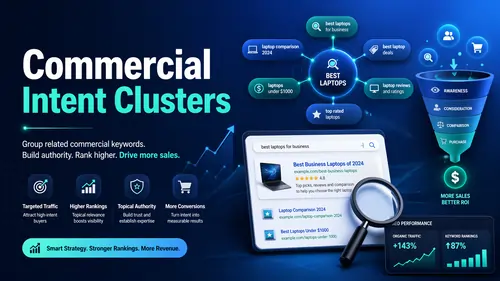
Commercial Intent Clusters: How to Build SEO Content That Ranks and Converts
Commercial intent clusters are groups of related keywords aimed at people who are comparing products, services, or providers before making a decision. Instead of publishing one standalone page, you create a main page plus supporting pages around terms like best, top, review, comparison, alternatives, vs, pricing, features, tools, and services. This approach helps search engines understand topical relevance, improves internal linking, attracts higher-intent visitors, and supports conversions. For agencies, SaaS brands, local businesses, and service providers, commercial intent clusters can help turn search visibility into qualified leads and sales.
Introduction
Getting traffic is not the same as getting results.
A lot of websites publish content that drives visits, but those visitors are often still in research mode. They may be learning the basics, looking for definitions, or browsing general information. That type of traffic has value, but it does not always lead to inquiries, bookings, or purchases.
That is why commercial intent clusters matter.
Commercial intent clusters are designed for users who are already comparing options. They are not just asking what something is. They are searching for the best fit, the right provider, the right tool, or the right price. They are much closer to action.
If you are offering SEO, digital marketing, or any service-based solution, this type of content can be especially powerful. For example, users comparing providers may look for topics related to affordable SEO services, research what small businesses should expect from an SEO provider, or weigh DIY SEO vs hiring an SEO agency before making a decision.
This guide explains how to build commercial intent clusters in a way that supports SEO, GEO, AEO, and user-focused content strategy.
What Are Commercial Intent Clusters?
A commercial intent cluster is a content structure built around keywords used by people who are evaluating options before buying.
These users are not searching for broad informational topics like:
- what is SEO
- how do backlinks work
- what is a CRM
They are searching with stronger buying signals, such as:
- best SEO agency for small business
- top CRM tools for startups
- SEO services pricing
- Ahrefs vs Semrush
- best local marketing services
- ecommerce SEO review
These queries show that the user is already in comparison mode.
Instead of targeting one isolated keyword, you create a cluster of related pages that support each other. A good example is a central resource about commercial intent clusters supported by content around pricing, comparisons, services, reviews, and alternatives.
That cluster model helps search engines understand the topic better and helps users move through the decision process more naturally.
What Is Commercial Intent?
Commercial intent is the search stage where a person is comparing choices before taking action.
Here is the simplest way to understand it:
1. Informational intent
The user wants to learn.
Examples:
- what is keyword clustering
- how SEO works
2. Commercial intent
The user wants to compare options.
Examples:
- best SEO services for small business
- local SEO agency review
- Ahrefs vs Semrush
- affordable SEO pricing
3. Transactional intent
The user is ready to act now.
Examples:
- buy SEO audit
- request SEO quote
- book a strategy call
Commercial intent is valuable because it attracts users who are close to a purchase decision. They may not buy immediately, but they are already looking for solutions, providers, features, pricing, and proof.
Why Commercial Intent Clusters Matter for SEO
Commercial intent clusters support rankings and conversions at the same time.
1. They improve topical relevance
A single page can target one keyword, but a cluster helps search engines see a broader subject area. When you have one main page supported by related content, your site looks more complete and more useful.
2. They help you rank for more valuable keywords
A high-volume keyword is not always the best keyword. Sometimes a lower-volume commercial query brings better leads because the user is further down the funnel.
3. They bring in qualified traffic
Someone searching best SEO services for small business usually has stronger intent than someone searching what is SEO. That makes commercial keywords more useful for revenue-focused content.
4. They support internal linking
Clusters create natural internal link opportunities between service pages, pricing pages, reviews, comparisons, and alternatives.
5. They match how people make decisions
Buyers often search in stages. They may begin with general service expectations, move into cost comparisons, and then compare whether to do it themselves or hire help. That is why pages like what small businesses should expect and DIY SEO vs hiring an SEO agency fit well inside a broader commercial cluster strategy.
Common Types of Commercial Intent Keywords
These keyword patterns often signal commercial intent:
1. Best
Example: best SEO tools for agencies
2. Top
Example: top SEO services for local businesses
3. Review
Example: SEO software review
4. Comparison
Example: SEO agency comparison
5. Alternatives
Example: Semrush alternatives
6. Vs
Example: Ahrefs vs Semrush
7. Pricing
Example: SEO services pricing
8. Features
Example: SEO reporting tool features
9. Tools
Example: best keyword research tools
10. Services
Example: local SEO services
These modifiers are useful because they reflect a real decision-making process. They also help shape content into more focused, conversion-friendly pages.
How to Identify Commercial Intent Keywords
Finding strong commercial keywords starts with understanding what the user is trying to do.
1. Look for buyer modifiers
Words like best, top, review, comparison, alternatives, vs, pricing, and services are often strong signals.
2. Study the search results
If the results page is full of listicles, service pages, reviews, pricing pages, and provider comparisons, the keyword likely has commercial intent.
3. Ask whether the searcher is trying to choose
If the query shows the user is deciding between tools, providers, or strategies, it belongs in a commercial intent cluster.
4. Review your own service journey
People searching for affordable SEO services are different from people casually learning SEO basics. The first group is more likely to compare cost, value, deliverables, and fit.
5. Use natural language variations
Do not only target one exact match phrase. Include related variations like:
- best affordable SEO services
- top SEO services for startups
- what should small businesses expect from SEO
- should I do SEO myself or hire an agency
- SEO agency pricing for small business
These phrases reflect how real people search.
How to Build Commercial Intent Clusters
Here is a simple process you can use.
Step 1: Choose one core commercial topic
Start with one service, category, or solution that matters to your business.
Examples:
- affordable SEO services
- best CRM software
- local SEO services
- email marketing tools
- ecommerce website services
Step 2: Find supporting keyword angles
For each core topic, identify supporting terms:
- best
- top
- review
- alternatives
- comparison
- vs
- pricing
- features
- services
Example for SEO:
- affordable SEO services
- SEO services pricing
- best SEO agency for small business
- DIY SEO vs hiring an SEO agency
- what small businesses should expect from SEO
- local SEO services review
Step 3: Map one keyword group to one page
Avoid forcing everything into a single article.
A better setup looks like this:
- Pillar page: Commercial Intent Clusters
- Support page 1: Affordable SEO Services
- Support page 2: What Small Businesses Should Expect From SEO
- Support page 3: DIY SEO vs Hiring an SEO Agency
- Support page 4: SEO Services Pricing
- Support page 5: Best SEO Agency for Small Business
This keeps each page focused and improves topical clarity.
Step 4: Build strong internal links
Link between the pages where it makes sense.
For example:
- The pillar page can link to affordable SEO services when discussing commercial service intent.
- A section about expectation-setting can link to what small businesses should expect.
- A section comparing service options can link to DIY SEO vs hiring an SEO agency.
Step 5: Match content to the buyer journey
Every page should help the user move one step forward.
That means:
- awareness pages explain the option
- comparison pages help evaluate choices
- pricing pages help estimate budget
- service pages help drive action
Example of a Commercial Intent Cluster
Let’s say your business offers SEO services to small businesses.
Core topic:
Commercial Intent Clusters
Supporting content:
- Affordable SEO services
- What small businesses should expect from SEO
- DIY SEO vs hiring an SEO agency
- SEO pricing guide
- Best SEO agency for local businesses
- SEO services comparison
- Local SEO services review
- SEO tools vs agency services
This structure works because it covers:
- pricing intent
- comparison intent
- service intent
- evaluation intent
- strategy intent
It also allows you to naturally support your audience whether they are cost-sensitive, expectation-focused, or deciding between doing the work themselves and hiring an expert.
Best Content Formats for Commercial Intent Clusters
Some page types work especially well for commercial search intent.
1. Listicles
Examples:
- best SEO agencies for small business
- top keyword research tools
- best local marketing services
These are useful because users can compare several options quickly.
2. Review pages
Examples:
- Surfer SEO review
- local SEO agency review
- email marketing software review
Review content builds trust and helps people weigh pros and cons.
3. Comparison pages
Examples:
- Ahrefs vs Semrush
- DIY SEO vs hiring an SEO agency
- in-house marketing vs agency marketing
Comparison pages target users who are trying to decide between two clear paths.
4. Pricing pages
Examples:
- SEO services pricing
- local SEO cost
- ecommerce SEO package rates
These pages answer budget questions early, which is important for conversion-focused traffic.
5. Expectation-setting guides
Examples:
- what small businesses should expect from SEO
- what to expect from a content marketing agency
- what is included in SEO services
These pages work well because they remove uncertainty and make decision-making easier.
6. Service pages
Examples:
- affordable SEO services
- local SEO services for dentists
- SEO services for ecommerce brands
These are often the conversion point of the cluster.
On-Page SEO Tips for Commercial Intent Content
To make your content stronger for SEO, GEO, and AEO, keep it clean and direct.
1. Answer the topic early
Start with a simple explanation near the top of the page. This helps readers and AI systems understand the main point immediately.
2. Use clear headings
H2 and H3 headings improve readability and make the content easier to scan.
3. Add list-based sections
Lists help with featured answers, snippets, and natural AI summaries.
4. Use internal and external links naturally
If you mention a relevant solution or related guide, link it in a way that feels helpful, not forced. For example, when discussing pricing, it makes sense to mention affordable SEO services. When discussing buying expectations, it is natural to reference what small businesses should expect.
5. Keep language simple
Do not overcomplicate the writing. Simple language often performs better because it is easier to understand, summarize, and trust.
6. Add conversion-focused context
Commercial pages should include:
- who the service is for
- what it includes
- key differences
- pricing context
- next steps
Common Mistakes to Avoid
1. Mixing too many intents on one page
A page about what SEO is should not compete with a page about best SEO services. Keep intent clean.
2. Writing content without a cluster structure
Random pages without internal logic are harder to rank and harder to navigate.
3. Ignoring real buyer questions
Users often want to know:
- how much does it cost
- what is included
- is it better to hire someone
- what should I expect
- which option is best for my business
If your content misses these questions, you miss commercial opportunities.
4. Overusing exact match keywords
Use the main terms naturally, but also include related phrases and natural wording.
5. Forgetting the conversion path
A commercial page should help the user move toward action, not just read and leave.
How Commercial Intent Clusters Support GEO and AEO
Commercial intent content works well for modern search because it is easy to summarize and easy to match with user questions.
GEO benefits
Generative search systems often prefer content that is:
- structured
- direct
- specific
- comparison-friendly
- rich in decision-stage details
AEO benefits
Answer engine optimization improves when content:
- defines the topic clearly
- answers the main question early
- uses lists and short sections
- includes FAQ-style answers
- reflects natural language
That is why content around commercial intent clusters can be effective in both traditional rankings and AI-supported search experiences.
Who Should Use Commercial Intent Clusters?
Commercial intent clustering works well for:
1. SEO agencies
They can build clusters around pricing, service types, local SEO, and business expectations.
2. SaaS brands
They can build clusters around tools, reviews, alternatives, features, and comparisons.
3. Local businesses
They can create local service pages plus supporting content around cost, comparisons, and service expectations.
4. Ecommerce brands
They can build clusters around product reviews, best-of lists, alternatives, and comparisons.
5. Small business-focused service brands
These businesses often benefit from content that answers value, budget, and fit questions. That is why topics like affordable SEO services and what small businesses should expect are strong supporting pieces.
FAQ: Commercial Intent Clusters
What are commercial intent clusters?
Commercial intent clusters are groups of related pages built around keywords used by people who are comparing options before buying.
Why are commercial intent keywords important?
They attract users who are closer to a decision, which can improve lead quality and conversion potential.
What are examples of commercial intent keywords?
Examples include best, top, review, comparison, alternatives, vs, pricing, features, tools, and services.
How do I build a commercial intent cluster?
Choose one core topic, find related commercial keywords, map them to separate pages, and connect the content with internal links.
Can commercial intent clusters help SEO agencies?
Yes. Agencies can use them to target service-based searches, comparison searches, and budget-related keywords like affordable SEO services.
Why is expectation-setting content important in commercial SEO?
Because users want clarity before they buy. Pages like what small businesses should expect help reduce uncertainty and improve trust.
Is comparison content useful for commercial intent?
Yes. Comparison content is one of the strongest formats because it directly supports buying decisions. A clear example is DIY SEO vs hiring an SEO agency.
Final Thoughts
Commercial intent clusters help you build content for people who are no longer just browsing. They are comparing, evaluating, and getting ready to choose.
That is why this strategy matters.
Instead of publishing disconnected pages, you build a smart structure around service intent, pricing intent, comparison intent, and buyer-stage questions. You create a path that helps both search engines and users understand how your content fits together.
For SEO agencies and service brands, that can include pages about affordable SEO services, content explaining what small businesses should expect, comparison pieces like DIY SEO vs hiring an SEO agency, and a central strategy page around commercial intent clusters.
This gives your site a clearer topic map, stronger internal linking opportunities, and better alignment with modern search behavior.
The real goal is not just more traffic.
It is better traffic with stronger intent.







