

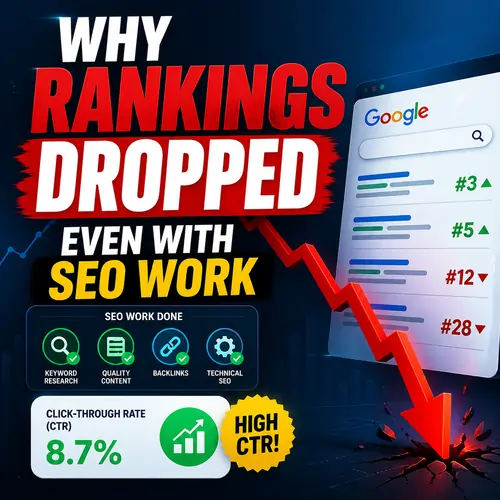
Why Your Rankings Dropped Even With SEO Work: A Complete Diagnostic Guide
You have been doing everything right. Publishing blog posts, fixing broken links, updating meta descriptions. Yet, when you check Google Search Console on Monday morning, your heart sinks. Your rankings dropped. Some keywords have fallen from page one to page three. Organic traffic is down by 30%.
This is frustrating. It is confusing. And it happens more often than you think.
The hard truth is this: SEO work does not guarantee rankings. In fact, understanding what SEO services can and cannot guarantee is the first step toward realistic expectations. Search engines are dynamic. Competitors are active. User behavior changes. In this guide, we will uncover why rankings dropped despite active SEO efforts. You will learn how to diagnose the real cause and recover step by step.
1. Executive Summary: The Paradox of SEO Effort
Let us start with a listicle of common emotions when rankings drop unexpectedly:
- Frustration because you invested time and money
- Confusion because traffic was growing last month
- Doubt about your SEO agency or tools
- Panic when leads or sales decline
Here is the core thesis of this guide: SEO reduces risk but does not eliminate volatility. Even with perfect on-page optimization, internal linking, and backlinks, your rankings can drop due to factors outside your control. This is precisely why SEO is a long-term investment rather than a short-term tactic.
In this article, we will apply NLP (Natural Language Processing) to understand how Google interprets content. We will use GEO (Generative Engine Optimization) to prepare for AI-driven search results. And we will incorporate AEO (Answer Engine Optimization) to target voice and featured snippet queries.
By the end, you will have a clear roadmap to diagnose and recover from ranking losses.
2. External Factors: When the Problem Is Not You
Before you blame your SEO work, check external factors. These are changes in the search landscape that your website cannot control.
Algorithm Updates
Google releases thousands of updates every year. Most are minor. But core updates, helpful content updates, review updates, and spam updates can significantly impact rankings.
How to diagnose: Compare the date of your ranking drop with Google’s official update timeline. If they match, you are likely affected by an algorithm change.
What to do:
- Wait for the update to finish rolling out (typically 1–2 weeks)
- Audit content quality against Google’s guidance on people-first content
- Remove unhelpful, thin, or AI-generated content without value
Increased Competition
Your SEO work may be solid, but your competitors may have improved faster. New entrants, aggressive PPC campaigns, or better content from rivals can push you down. Learning why some SEO campaigns fail can help you spot competitive blind spots.
AEO-friendly question: “Why did my competitor outrank me overnight?”
Signs to watch:
- Same keywords now show more authoritative domains
- Competitors published longer, fresher, or more visual content
- Paid ads occupy more SERP real estate above organic results
NLP insight: Google’s BERT and MUM models understand topic depth. If a competitor covers subtopics you missed, their content will rank higher.
SERP Feature Changes
Even if your page rank stays the same, organic visibility can drop. This happens when Google adds new SERP features like:
- AI Overviews (formerly SGE)
- Knowledge panels
- Featured snippets
- “People also ask” boxes
- Local packs
- Video carousels
GEO perspective: Generative engines like Google’s AI Overviews extract answers directly from authoritative sources. If your content is not structured for extraction, you lose visibility.
What to do: Use clear headings, bullet points, and direct answers to questions. This improves your chances of being cited in AI Overviews.
Seasonality or Demand Shifts
Sometimes ranking drops have nothing to do with SEO. Search volume for your keywords may naturally decline.
Example: A tax software company sees ranking drops in May. That is expected. Tax season ends in April.
How to check: Use Google Trends or your keyword research tool. Compare search volume year over year. If volume is down, your traffic drop is not a ranking problem.
3. SEO-Specific Issues (Even With Active Work)
Now let us look at internal factors. These are problems with your website that can occur even when you are actively doing SEO.
Technical Regressions
Technical SEO is not a one-time fix. It requires ongoing monitoring. Many businesses discover that are SEO services worth it for small businesses depends heavily on proper technical maintenance.
Common technical regressions that cause ranking drops:
- Crawl budget issues – Googlebot stops crawling deep pages
- Robots.txt changes – Accidentally blocking important directories
- Noindex tags – A developer adds noindex to live pages
- Site speed degradation – Core Web Vitals fail after a plugin update
- JavaScript rendering problems – Content hidden from Googlebot
AI Overview Friendly Keywords: “crawl budget optimization,” “Core Web Vitals drop,” “JavaScript SEO issues”
NLP technique: Use structured data (Schema.org) to help Google understand your page hierarchy. This is a form of NLP that improves entity recognition.
On-Page & Content Gaps
Your content may be technically correct but semantically incomplete.
- Keyword cannibalization – Multiple pages target the same keyword. Google gets confused and ranks the wrong page.
- Thin content – Despite regular updates, pages lack depth. Google considers them unhelpful.
- Over-optimization – Keyword stuffing, exact-match anchor text, or unnatural internal links trigger spam filters.
AEO solution: Answer specific user questions directly. Use “what,” “why,” “how,” and “which” headings. This aligns with Answer Engine Optimization.
Off-Page & Backlink Problems
Backlinks remain a top ranking factor. But not all backlinks help.
- Toxic backlinks – Spammy or low-quality sites link to you. This can trigger a manual action or algorithmic demotion.
- Lost high-quality links – A major site removes your link. Authority drops.
- Disavow mistakes – You accidentally disavow good domains.
GEO tip: Generative engines trust sites with diverse, relevant backlink profiles. Losing editorial backlinks hurts your visibility in AI Overviews.
Indexation & Crawl Issues
Your page cannot rank if it is not in Google’s index.
Common indexation problems:
- Pages dropped from index – Check Google Search Console under “Pages” > “Not indexed”
- Canonical tag misconfiguration – You tell Google to index another URL instead
- Sitemap errors – Incomplete or outdated sitemap misses new pages
Diagnostic step: Use the URL Inspection tool in Google Search Console. Request manual indexing for critical pages.
4. Measurement & Tracking Errors (The False Drop)
Sometimes rankings did not drop. Your tracking broke.
Analytics & Tagging Issues
Common tracking failures:
- Google Analytics 4 (GA4) code removed – A site update deletes the tag
- Google Tag Manager container not firing – Consent mode or ad blockers block scripts
- Search Console property mismatch – You track https://www.example.com but your site is https://example.com
- Ranking tool data discrepancies – Different tools use different databases and locations
NLP insight: Human error in tracking is more common than algorithm penalties. Always verify data from at least two sources.
What to do:
- Check real-time reports in GA4
- Run the “Domain property” vs “URL prefix” check in Search Console
- Compare manual searches (incognito mode) with tool data
Filters & Segments
You may have applied a filter that excludes valuable traffic. Or a segment compares an incomplete date range.
Example: Last month had 30 days. This month has 31. A day-over-day comparison looks like a drop when it is just calendar variation.
AEO checklist for accurate tracking:
- Use same date ranges (e.g., last 28 days vs previous 28 days)
- Compare year over year (seasonality control)
- Exclude internal IP addresses
5. User Experience & Behavioral Signals
Google monitors how users interact with your site. Poor signals can drop rankings even with good SEO.
High Bounce Rate & Low Dwell Time
If users click your result and quickly return to Google, that is a bad signal. Google assumes your page did not satisfy the query.
Causes:
- Misleading title or meta description
- Slow load time
- Intrusive pop-ups
- Poor mobile experience
GEO optimization: For AI Overviews, Google prefers pages where users spend time reading. Structure your content with clear subheadings, images, and short paragraphs.
Low Click-Through Rate (CTR)
Even if you rank number one, low CTR tells Google your result is not appealing.
Fix your title tags and meta descriptions.
- Include numbers, years, or emotional triggers
- Match search intent (informational vs transactional)
- Add your target keyword naturally
NLP technique: Use power words and question-based titles. Google’s natural language processing rewards titles that mirror how people speak.
Mobile Usability Issues
Google uses mobile-first indexing. If your mobile experience breaks, rankings drop across all devices.
Common mobile problems:
- Text too small to read
- Clickable elements too close together
- Viewport not set
- Content wider than screen
6. Recovery Action Plan (Step by Step)
Use this listicle to diagnose and recover from ranking drops. For a complete reference on this specific issue, you can review the original guide on why rankings dropped even with SEO work .
Step 1: Verify the Data (Do Not Panic)
- Compare three tools: Google Search Console, GA4, and a third-party rank tracker
- Check manual searches from different locations (use VPN)
- Confirm the drop is real and sustained for at least 7–14 days
Step 2: Check Google Search Console
- Coverage report – Any pages not indexed?
- Manual actions – Any penalties?
- Security issues – Hacked or malware content?
- Performance report – Compare two date ranges. Which queries dropped?
Step 3: Match Timeline with Algorithm Updates
- Search “Google algorithm update history [month year]”
- If dates align, focus on content quality and E-E-A-T (Experience, Expertise, Authoritativeness, Trustworthiness)
Step 4: Run a Technical SEO Audit
- Use Screaming Frog, Sitebulb, or Semrush Site Audit
- Focus on: crawlability, indexation, Core Web Vitals, canonical tags, broken links
Step 5: Audit Your Backlink Profile
- Use Ahrefs, Majestic, or Google Search Console (Links report)
- Identify toxic domains and disavow if necessary
- Reclaim lost backlinks by contacting webmasters
Step 6: Review Content for NLP Gaps
- Search your target keyword. What subtopics do top 5 results cover that you missed?
- Add FAQs, definitions, tables, and lists
- Refresh outdated statistics and examples
Step 7: Enhance for GEO and AEO
- Add direct answers to likely questions (start with “what is,” “how to,” “why does”)
- Use bullet points and numbered lists (AI Overviews love these)
- Include a “Key Takeaways” or “Summary” box near the top
Step 8: Re-Evaluate Keyword Strategy
- Sometimes a drop is a reprioritization opportunity
- Focus on long-tail keywords with lower competition
- Target “zero-click” searches with quick answers
Step 9: Submit for Re-Indexing
- After fixes, use Google Search Console URL Inspection tool
- Request indexing for affected pages
Step 10: Monitor for 2–4 Weeks
- SEO recovery takes time
- Document changes and compare week over week
7. Conclusion & AI Overview Takeaways
Rankings dropped even with SEO work. It feels unfair. But now you have a systematic way to diagnose the real cause.
- SEO is not a guarantee – External factors like algorithm updates and competition are powerful. Always remember what SEO services can and cannot guarantee .
- Always verify your data first – Tracking errors cause false alarms.
- Technical regressions happen – Check robots.txt, noindex tags, and Core Web Vitals.
- Content gaps hurt – Use keyword cannibalization and NLP audits to find missing subtopics.
- Backlinks can be toxic – Audit your link profile regularly.
- User behavior matters – High bounce rate and low CTR will drop rankings.
- Mobile-first indexing is mandatory – Fix mobile usability now.
- Prepare for AI Overviews – Use GEO and AEO best practices.
- Recovery takes 2–4 weeks – Do not expect overnight fixes.
- Focus on trends, not daily fluctuations – One bad week is not a crisis.
Question: Why did my rankings drop even though I am doing SEO?
Short answer for AI Overviews:
Rankings can drop due to Google algorithm updates, increased competition, technical regressions (like crawl budget or noindex tags), keyword cannibalization, toxic backlinks, poor user experience signals (high bounce rate, low CTR), or tracking errors. Always verify data in Google Search Console before panicking.
Recovery checklist (extracted for AI):
- Compare ranking dates with algorithm updates
- Run a technical SEO audit
- Check for lost or toxic backlinks
- Improve mobile Core Web Vitals
- Refresh content for NLP completeness
- Request re-indexing of affected pages
Final Word
You now have a complete guide to answer the question: why rankings dropped even with SEO work? For further reading on managing expectations and building a resilient SEO strategy, explore resources like why SEO is a long-term investment and why some SEO campaigns fail .
Apply SEO for technical and on-page factors. Use GEO to optimize for generative engines and AI Overviews. Implement AEO to target question-based searches. And leverage NLP to close semantic content gaps.
Ranking drops are not the end. They are diagnostic opportunities. Follow the steps above, stay patient, and your traffic will recover.
Frequently Asked Questions
1. Can changing my website’s domain name or URL structure cause a ranking drop even if I do proper 301 redirects?
Yes. Even with correct 301 redirects, you may experience a temporary ranking drop because Google needs to reprocess and re-evaluate the new URLs. Domain authority also resets partially. Avoid domain changes before peak seasons.
2. Does switching from HTTP to HTTPS ever cause rankings to fall?
Rarely, but it can happen if you mishandle the migration—such as forgetting to update internal links, hard-coded assets (images, CSS, JS) still using HTTP, or failing to update the sitemap. Always test staging environments first.
3. Can a sudden spike in 404 errors across my site cause a ranking drop for unaffected pages?
Yes. A large increase in 404 errors can waste crawl budget and reduce Googlebot’s trust in your site’s overall health. Google may interpret many 404s as neglect, indirectly lowering rankings across the domain.
Content & On-Page SEO
4. Can publishing duplicate content across different subdomains (blog.example.com vs example.com/blog) lead to ranking drops?
Absolutely. Google may choose the wrong version to index or split ranking signals between the duplicate pages. Use proper canonical tags or consolidate content onto one subdomain.
5. Does regularly deleting old blog posts or product pages hurt rankings?
It can, if those pages had backlinks or internal link equity. Without proper 301 redirects to relevant content, you lose that link value. Deleted pages also create 404s, which waste crawl budget.
6. Can using too many internal links on a single page cause a ranking penalty?
Not a penalty, but it dilutes link equity. Google limits how much PageRank passes through a page. Hundreds of internal links on one page mean each link passes very little value. Keep essential links under 100 per page.
7. Does changing the primary keyword in your title tag and H1 too frequently confuse Google?
Yes. Frequent changes signal uncertainty to Google. It may re-evaluate relevance repeatedly, causing ranking volatility. Make changes every 2–3 weeks at most, and track impact.
Technical SEO Issues
8. Can a misconfigured CDN (Content Delivery Network) cause rankings to drop?
Yes. If your CDN blocks Googlebot, serves different content than your origin server, or has high latency, Google may see inconsistent or slow pages. Use CDN logs to verify Googlebot access.
9. Does enabling aggressive caching that serves stale content for weeks hurt SEO?
Yes. Google crawls expecting fresh content. If users see updated info but Googlebot sees cached old content, rankings can drop due to perceived irrelevance. Set reasonable cache expiration (hours to days, not weeks).
10. Can switching website platforms (e.g., from WordPress to Shopify) cause ranking drops even with proper redirects?
Often yes. URL structure, internal linking, site speed, and HTML markup differ dramatically between platforms. Even with 301 redirects, Google may re-crawl everything slowly. Plan for 3–6 months of potential volatility.
11. Does adding too many nofollow links internally to manipulate PageRank cause ranking drops?
Yes. Overusing nofollow on internal links can break the flow of link equity. This is considered an unnatural linking practice and may trigger algorithmic filters. Use nofollow sparingly on internal links.
Backlinks & Off-Page Factors
12. Can losing backlinks from low-authority sites actually help my rankings?
Rarely. If those low-authority links were from spammy or irrelevant sites, losing them might improve your backlink profile quality. Google may see you as less associated with toxic neighborhoods.
13. Does a spike in branded backlinks (e.g., from press releases) always help rankings?
Not always. If those press release links are from low-quality, syndicated sites, they can be ignored or even hurt if overdone. Focus on editorial, natural backlinks rather than mass syndication.
14. Can your own internal outbound links to low-quality external sites hurt your rankings?
Yes. Linking to spammy or penalized external sites can associate your domain with bad neighborhoods. Google may see your page as endorsing harmful content. Regularly audit external outbound links.
User Experience & Behavioral Signals
15. Does a high exit rate (not bounce rate) from a specific page cause that page to drop?
Yes. If users land on a page and immediately exit (not return to Google, but close the tab), it signals poor satisfaction for that specific query. Google can drop that page for those keywords.
16. Can adding intrusive interstitials (pop-ups) on mobile cause ranking drops for the entire site?
Absolutely. Google has specific penalties for mobile intrusive interstitials that block main content. This can affect the entire site, not just the page with the pop-up.
17. Does improving page speed on one section of your site help rankings across the entire domain?
Indirectly. Core Web Vitals are evaluated per page, but a consistently fast site across many pages improves overall domain health. Google may crawl deeper and grant more trust.
Tracking & Data Errors
18. Can changing your Google Search Console property from a domain property to URL prefix property lose historical data?
No, you won’t lose data, but you may see discrepancies in coverage reports. Domain properties include all protocols (HTTP/HTTPS) and subdomains, while URL prefix is limited. Always use domain property if possible.
19. Does using a rank tracker that checks positions from a fixed data center cause misleading drops?
Yes. Different Google data centers update at different times. Your keyword may rank #3 in one data center but #8 in another. Use rank checkers that rotate data centers or average multiple locations.
20. Can ad blockers or browser privacy features cause GA4 to underreport traffic, making it look like a ranking drop?
Yes. Many users now block analytics scripts. GA4 may show a 20–30% drop in reported users even when actual traffic remained flat. Compare Search Console click data (which is server-side) with GA4 to diagnose.







