

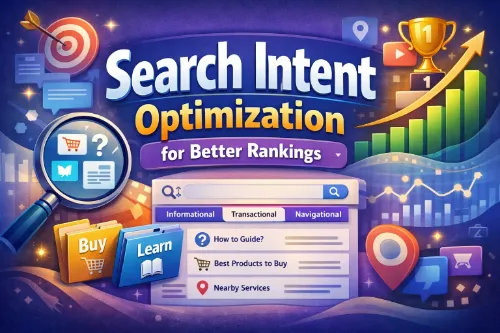
Search Intent Optimization for Better Rankings: The Complete Guide
In the early days of SEO, ranking high on Google was a simple numbers game. You found a keyword with high volume, stuffed it into your content 50 times, built a few low-quality backlinks, and watched your rankings climb. Today, that strategy will get you penalized or, worse, completely ignored.
The shift from keyword-focused to intent-focused SEO has transformed the search landscape. Google’s algorithms—RankBrain, MUM, and the Helpful Content Update—no longer just read your words. They try to understand the why behind the query. This is where search intent optimization for better rankings becomes the single most powerful lever you can pull.
If you want to truly master this, many businesses choose to work with professionals who offer SEO services that are specifically designed to align content with user intent. But even if you go the DIY route, understanding intent is non-negotiable.
But what exactly is search intent? In simple terms, search intent = the why behind a query. When someone types “best laptop for programming,” they don’t want a history of computer science. They want a comparison list. When they type “how to fix a leaky faucet,” they don’t want to buy a plumber’s service—they want a step-by-step tutorial.
The beautiful truth? One page can rank for hundreds of keywords if you nail the intent. Miss the intent, and even the most authoritative site will sink in the SERPs.
In this guide, we will walk through search intent optimization for better rankings using principles of SEO, GEO (Generative Engine Optimization), AEO (Answer Engine Optimization), and NLP (Natural Language Processing)—all explained simply, with actionable steps and listicles.
Part 1: The 4 Core Types of Search Intent You Must Know
Before you optimize anything, you need to classify every target keyword into one of four buckets. Google does this automatically. You should too.
1. Informational Intent
The user wants to learn something. They are not ready to buy.
- Keywords: “how to,” “what is,” “why does,” “guide,” “tutorial,” “meaning of”
- Example: “how to change a car tire”
- Content format: Blog posts, explainers, FAQs, step-by-step guides, videos
2. Navigational Intent
The user already knows a specific brand or website and wants to go there.
- Keywords: brand names + “login,” “official site,” “customer service”
- Example: “Semrush login,” “Nike returns”
- Content format: Homepage, dedicated login page, contact page, branded landing pages
3. Commercial Investigation Intent
The user is researching before a purchase. They want comparisons, pros/cons, and reviews.
- Keywords: “best,” “vs,” “review,” “top 10,” “affordable,” “for beginners”
- Example: “best noise-canceling headphones for flying”
- Content format: Listicles, comparison tables, “vs” posts, case studies, user ratings
4. Transactional Intent
The user is ready to take action—buy, sign up, or download.
- Keywords: “buy,” “discount,” “coupon,” “order,” “price,” “for sale,” “shipping”
- Example: “buy MacBook Pro M3 16GB”
- Content format: Product pages, pricing pages, checkout pages, “shop now” CTAs
NLP-friendly summary: Think of search intent as a spectrum from awareness → consideration → decision. Informational lives in awareness. Commercial lives in consideration. Transactional lives in decision. Navigational is a shortcut.
Part 2: How to Uncover True Search Intent (Not Just Guessing)
Most SEOs guess intent based on a keyword. That’s a rookie mistake. You must perform manual SERP analysis to see what Google already believes the intent is.
Step-by-Step Intent Discovery Process
- Search your keyword on Google (use incognito mode to avoid personalization).
- Observe what Google shows: Are there featured snippets? Video carousels? Shopping tabs? Local packs? Images? Each SERP feature signals intent.
- Featured snippet → Informational
- Shopping results → Transactional or commercial
- Video → “How to” (informational)
- Map pack → Local navigational or commercial
- Analyze the top 3–5 ranking pages for these signals:
- Content format: Is it a blog post, product page, video, or tool?
- Content angle: Step-by-step guide? Pros/cons list? Comparison? Single product review?
- Content depth: 200 words or 3,000 words? (Informational tends to be longer; commercial can be medium; transactional short and punchy.)
- Calls-to-action (CTAs): “Subscribe to newsletter” (informational) vs. “Add to cart” (transactional) vs. “Read comparison” (commercial).
Tools to Uncover Intent
- Google’s “People also ask” – reveals related sub-intents
- Related searches (bottom of Google) – shows variations of intent
- SEMrush / Ahrefs – use “SERP features” and “intent” filters
For a deeper technical approach, a full technical SEO audit can uncover hidden intent mismatches across your site. Many technical SEO issues like slow page speed or crawl errors can confuse Google about your true intent. You can explore common technical SEO issues and how to fix them. If you’re working with clients, it’s also critical to understand what SEO clients need to know about intent before they expect overnight rankings.
Also, remember that page speed impacts SEO performance significantly. A slow page can ruin even the best intent match. And Core Web Vitals for SEO are now direct ranking factors that affect how Google perceives user experience—and by extension, intent satisfaction.
Example: If you search “best running shoes,” and the top 3 results are all listicles with affiliate links, the intent is commercial investigation. Don’t write a single product page. Write a listicle.
Part 3: Mapping Content to Intent for Better Rankings
Once you know the intent, you must match your content format, angle, depth, and CTAs accordingly. Mixing intents on one page is the fastest way to confuse Google and users.
This is where on-page SEO services become invaluable. Professional on-page SEO services ensure that every element—from headings to internal links—reinforces the correct intent. Start with on-page SEO basics like title tags and meta descriptions, but go deeper. For example, internal linking improves rankings by passing intent signals across pages. Use a proper on-page SEO checklist for service-based websites to avoid missing critical intent signals.
Also, understand the difference between content optimization vs keyword stuffing. Intent-driven content is optimized naturally; keyword-stuffed content confuses both users and Google. Finally, learn how to optimize landing pages for search engines so that each landing page targets a single, clear intent.
Intent Mapping Table
| Intent Type | Best Content Format | Ideal Angle | Depth | Primary CTA |
|---|---|---|---|---|
| Informational | Step-by-step guide, FAQ, video tutorial | “How to solve X” | 1,500+ words | Subscribe, download cheat sheet |
| Navigational | Branded landing page, login page | “Official X login/support” | 300–500 words | Login, contact support |
| Commercial | Listicle, comparison table, “vs” post | “Best X for Y” or “X vs Z” | 1,000–2,000 words | Click to read reviews, compare prices |
| Transactional | Product page, pricing page | “Buy X now – price & specs” | 500–1,000 words | Add to cart, buy now, get quote |
Key Rule: Do Not Mix Incompatible Intents
- Wrong: A “how to fix a sink” page with a big “Buy our plumbing service” banner mid-tutorial. User gets annoyed and bounces.
- Right: The tutorial ends with a subtle link to “Need professional help? Here are vetted plumbers.”
AI Overview friendly summary: To rank well, publish one page per primary intent. Informational queries need guides. Commercial queries need comparisons. Transactional queries need purchase options. Never force a sales pitch onto a learning page.
Part 4: On-Page Signals That Reinforce Intent (SEO + GEO + AEO)
Google’s crawlers and AI models (like those used in Generative Engine Optimization and Answer Engine Optimization) look for specific on-page clues to confirm intent. Here’s how to send the right signals.
1. Headline & Subheadings Must Mirror Query Language
If the keyword is “best DSLR camera for beginners,” your H1 should be exactly that or very close (e.g., “The 7 Best DSLR Cameras for Beginners in 2026”). Subheadings should include secondary intent signals: “Comparison table,” “Pros and cons,” “What to look for.”
2. Introduction: State the Intent Within First 100 Words
- Informational: “In this guide, you will learn how to change a car tire safely in 10 minutes.”
- Commercial: “We tested 22 noise-canceling headphones to find the best 5 for frequent flyers.”
- Transactional: “Buy the Apple MacBook Pro M3 directly from our store with free 2-day shipping.”
This immediately satisfies Answer Engine Optimization (AEO) because you answer the unspoken question: “Will this page give me what I need?”
3. Content Structure by Intent
- Informational → Numbered steps, definitions, diagrams, bullet-point summaries
- Commercial → Comparison chart (e.g., “Feature vs. Price”), “Our pick” callout, user review snippets
- Transactional → Price clearly visible, stock status, return policy, checkout button above the fold
4. Internal Linking for Intent Funnels
Link from one intent stage to the next naturally:
- Informational post → “Now that you know how to choose, see our top 5 picks” (commercial)
- Commercial post → “Ready to buy? Check today’s best price” (transactional)
This creates an intent funnel that keeps users on your site and signals relevance to Google.
5. Multimedia That Matches Intent
- Video – essential for “how to” informational queries
- Tables – critical for commercial comparisons
- High-res product images – mandatory for transactional pages
- Screenshots – helpful for software tutorials
NLP tip: Use schema markup.
HowToschema for informational,Productschema for transactional,FAQschema for commercial comparison pages. This directly supports Generative Engine Optimization (GEO) because AI models (like Google’s SGE) pull structured data into AI Overviews.
Part 5: Common Intent Mistakes That Hurt Rankings (And How to Fix Them)
Even experienced SEOs fall into these traps. Avoid them for search intent optimization for better rankings.
❌ Keyword Cannibalization
Problem: Multiple pages on your site targeting the same keyword with the same intent. Google doesn’t know which to rank.
Fix: Consolidate into one authoritative page. Use 301 redirects or canonical tags.
❌ Thin Content Not Satisfying Full Intent
Problem: A 300-word “best coffee makers” listicle with no details, no comparison, no prices. Users click back immediately (high bounce rate = intent mismatch).
Fix: Expand to at least 1,500 words for commercial intent. Include real specs, pricing, and a comparison table.
❌ Ignoring Local Intent
Problem: “Pizza near me” leads to a generic blog post about pizza history.
Fix: Create a local landing page with NAP (Name, Address, Phone), local schema, and a map.
If your business serves a specific area, local SEO services for small businesses can help you capture local intent correctly. Optimizing your Google Business Profile optimization services is critical for “near me” queries. For multi-location brands, understand the local SEO ranking factors for multi-location brands. Also, local citation building reinforces your local presence. Whether you run a clinic, law firm, or restaurant, local SEO helps clinics, law firms and restaurants dominate map packs. Run a full local SEO audit guide to catch local intent gaps.
❌ Forcing Old Content Into New Intent
Problem: You have an informational post ranking for “how to learn Python.” You change the H1 to “best Python course” without rewriting the content. You won’t rank.
Fix: Either rewrite the entire page for commercial intent or create a new page.
❌ Assuming Single Intent for Ambiguous Keywords
Problem: “MacBook Pro” can be informational (specs), commercial (best model), or navigational (Apple’s site). One page cannot satisfy all.
Fix: Create separate pages and let Google choose based on user context, or use a hub-and-spoke model.
Part 6: Measuring & Iterating on Intent Optimization
You can’t improve what you don’t measure. Use these metrics to validate that your search intent optimization for better rankings is working.
Key Performance Indicators (KPIs) by Intent
| Intent Type | Primary KPI | Secondary KPI |
|---|---|---|
| Informational | Time on page, scroll depth | Bounce rate (lower is better) |
| Commercial | Click-through rate (CTR) to affiliate/product links | Comparison table interaction |
| Transactional | Conversion rate (purchase or signup) | Add-to-cart rate |
| Navigational | Low bounce rate, high session duration | Return visits |
How to Spot Intent Mismatch in Google Search Console
- High impressions, low clicks → Your title/description promises one intent, but page delivers another.
- High bounce rate (80%+) → User landed and left immediately. Likely wrong content format.
- Low average time on page → For informational content, this means you didn’t answer the question fully.
Winning SERP Features by Intent
- Informational: Target featured snippets, “People also ask,” video carousels
- Commercial: Target “comparison tables,” “top stories” (if timely), product review stars
- Transactional: Target shopping listings, price drop snippets
GEO & AEO friendly: Optimize for AI Overviews by writing clear, declarative sentences. “A leaky faucet is usually caused by a worn-out washer.” Avoid fluff. AI models love definitive, factual statements.
Part 7: Advanced Tactics for Intent Optimization
Once you master the basics, level up with these advanced techniques.
1. Intent Clusters (Topic Hubs)
Create a pillar page for a broad informational topic (e.g., “Complete Guide to Home Plumbing”). Then create cluster content for each sub-intent:
- Informational cluster: “How to unclog a drain without chemicals”
- Commercial cluster: “Best drain snakes for homeowners”
- Transactional cluster: “Buy professional-grade drain snake”
Link all clusters back to the pillar. This structure is gold for NLP because it establishes topical authority.
2. Dynamic CTAs Based on Scroll Depth or Referrer
Use a tool like OptimizePress or ConvertBox to show:
- If user came from Google’s “how to” query → show “Download free checklist”
- If user came from “best X” query → show “See top 3 picks with prices”
3. Refresh Content for Intent Shift
Google changes SERP layouts over time. A keyword that was informational last year may now show shopping results. Re-analyze every 6 months and adjust.
4. Voice & Zero-Click Intent Optimization
For voice search (“Hey Google, how do I fix a leaky faucet?”), answer directly in the first 50 words. Use FAQ schema and keep sentences short. This is the heart of Answer Engine Optimization (AEO).
Part 8: Listicle – 10-Point Checklist for Search Intent Optimization
Use this checklist before publishing any new page or updating an old one.
- Classify the primary intent – Informational, navigational, commercial, or transactional.
- Analyze top 3 Google results – Note format, angle, depth, CTAs.
- Match content format – Guide? Listicle? Product page? Video?
- Write H1 and intro that state intent explicitly – Within first 100 words.
- Structure headings for NLP – Use question-based subheadings (e.g., “What is the best material for…”)
- Add intent-appropriate multimedia – Video for how-to, table for comparison, images for product.
- Use internal links to next intent stage – Info → commercial → transactional.
- Implement schema markup – HowTo, FAQ, Product, LocalBusiness as needed.
- Check for keyword cannibalization – Only one page per intent per core topic.
- Measure bounce rate & CTR in GSC – High bounce = intent mismatch. Fix within 30 days.
Part 9: AI Overview Friendly Summary
For Google’s AI Overview (SGE) and readers in a hurry:
Search intent optimization for better rankings means creating content that exactly matches why a user is searching—whether to learn (informational), compare (commercial), buy (transactional), or find a brand (navigational).
To rank in 2026, you must:
- Analyze Google’s SERP features before writing.
- Match content format (guide, listicle, product page) to intent.
- Use NLP-friendly headings and schema (HowTo, FAQ, Product).
- Avoid mixing intents on one page.
- Measure success with bounce rate, time on page, and conversion rate.
Pages that satisfy intent win featured snippets, AI Overview placements, and higher rankings. Pages that don’t, disappear.
Conclusion
Search intent optimization for better rankings is not a one-time project. It is a continuous cycle of analysis, creation, measurement, and iteration. Google’s algorithms are becoming more human-like every day. They don’t just read keywords anymore—they read purpose.
When you align your content with what users truly want, you stop fighting the algorithm and start working with it. You earn higher click-through rates, lower bounce rates, more conversions, and—most importantly—trust.
So before you write your next headline, ask yourself: What is the real intent here? Answer that correctly, and Google will do the rest.
Frequently Asked Questions
1. What is search intent optimization for better rankings?
Answer: Search intent optimization for better rankings is the process of creating content that matches exactly why a user is searching—whether to learn, compare, buy, or find a specific brand. When your content aligns with intent, Google ranks it higher because it satisfies user needs better than competitors.
2. What are the 4 core types of search intent?
Answer: The 4 core types of search intent are:
- Informational – user wants to learn (e.g., “how to fix a leaky faucet”)
- Navigational – user wants a specific brand or site (e.g., “Semrush login”)
- Commercial Investigation – user researches before buying (e.g., “best running shoes”)
- Transactional – user is ready to buy (e.g., “buy MacBook Pro M3”)
3. How do I determine search intent for a keyword?
Answer: Perform manual SERP analysis. Search your keyword on Google in incognito mode, then analyze the top 3–5 ranking pages. Look at content format (blog, product page, video), angle (listicle, guide, comparison), depth (word count), and calls-to-action. Also check Google’s “People also ask” and related searches sections.
4. Why is search intent more important than keywords now?
Answer: Google’s algorithms—RankBrain, MUM, and the Helpful Content Update—now understand the why behind a query, not just the words. Matching intent leads to better user satisfaction, lower bounce rates, and higher rankings. Keyword stuffing without intent alignment no longer works and can lead to penalties.
5. Can one page rank for multiple intents?
Answer: Generally no. Mixing intents on one page confuses both users and Google. For example, adding a “buy now” button to a “how to” tutorial will increase bounce rates. Instead, create separate pages for each intent and link them together in an intent funnel.
6. What is the difference between commercial and transactional intent?
Answer: Commercial investigation intent means the user is researching before a purchase—comparing products, reading reviews, looking for “best X for Y.” Transactional intent means the user is ready to take immediate action—buy, sign up, or download. Commercial content uses comparison tables; transactional content uses “add to cart” buttons and pricing.
7. How does internal linking help with search intent?
Answer: Internal linking creates an intent funnel. You link from an informational post (“how to choose a laptop”) to a commercial post (“best laptops for students”) to a transactional page (“buy laptop now”). This guides users naturally and tells Google that your site satisfies multiple stages of intent.
8. What is GEO (Generative Engine Optimization)?
Answer: GEO stands for Generative Engine Optimization. It means optimizing your content so that AI models like Google’s SGE (Search Generative Experience) can easily extract and present your information in AI Overviews. Use clear, declarative sentences, structured data (schema), and intent-aligned headings.
9. What is AEO (Answer Engine Optimization)?
Answer: AEO stands for Answer Engine Optimization. It means optimizing content to directly answer user questions, especially for voice search and featured snippets. Answer the question within the first 50–100 words, use FAQ schema, and keep sentences short and factual.
10. How does NLP (Natural Language Processing) relate to search intent?
Answer: NLP helps Google understand the meaning and context behind words, not just the keywords themselves. For search intent optimization, you should use natural, conversational language, question-based subheadings, and synonyms. This helps Google’s NLP models correctly classify your page’s intent.
11. What are common intent mistakes that hurt rankings?
Answer: Common intent mistakes include:
- Keyword cannibalization (multiple pages targeting same intent)
- Thin content that doesn’t satisfy full intent
- Ignoring local intent for “near me” queries
- Forcing old content into a new intent without rewriting
- Assuming a keyword has only one intent when it has multiple
12. How does page speed affect search intent optimization?
Answer: Page speed impacts SEO performance directly. Even if your content perfectly matches intent, a slow-loading page will increase bounce rates. Users abandon slow pages, and Google interprets high bounce rates as intent mismatch. Core Web Vitals are now ranking factors that affect user experience and intent satisfaction.
13. What is keyword cannibalization in intent optimization?
Answer: Keyword cannibalization happens when multiple pages on your site target the same keyword with the same intent. Google doesn’t know which page to rank, so both may rank poorly. The fix is to consolidate into one authoritative page using 301 redirects or canonical tags.
14. How often should I refresh content for intent shift?
Answer: You should re-analyze your top-performing pages every 6 months. Google changes SERP layouts over time—a keyword that was informational last year may now show shopping results. If intent has shifted, update your content format, angle, and CTAs accordingly.
15. What is an intent cluster or topic hub?
Answer: An intent cluster (or topic hub) is a pillar page covering a broad topic, supported by cluster content for each sub-intent. For example, a “Complete Guide to Home Plumbing” pillar links to informational (“how to unclog a drain”), commercial (“best drain snakes”), and transactional (“buy drain snake”) pages. This structure builds topical authority.
16. How do I measure if my content matches intent correctly?
Answer: Use these KPIs:
- Informational: Time on page, scroll depth, low bounce rate
- Commercial: CTR to affiliate links, comparison table interaction
- Transactional: Conversion rate, add-to-cart rate
- Navigational: Low bounce rate, high return visits
In Google Search Console, high impressions with low clicks or high bounce rates (80%+) indicate intent mismatch.
17. What schema markup should I use for each intent type?
Answer:
- Informational: HowTo schema, FAQ schema
- Commercial: Product schema, Review schema, Comparison schema
- Transactional: Product schema with offers and price
- Navigational: LocalBusiness schema, Organization schema
Schema helps AI models (GEO) and search engines understand your intent.
18. Can local businesses benefit from search intent optimization?
Answer: Yes. Local businesses must optimize for local intent. For “near me” queries or “[service] + [city]” searches, create local landing pages with NAP (Name, Address, Phone), local schema, Google Business Profile optimization, and local citations. Ignoring local intent will cause you to lose map pack rankings.
19. What is the difference between informational and commercial keywords in SEO campaigns?
Answer: Informational keywords (e.g., “how to change oil”) target users who want to learn. Commercial keywords (e.g., “best oil filter for Honda Civic”) target users who are researching before a purchase. Informational content uses guides and tutorials. Commercial content uses comparison tables, pros/cons, and “best of” listicles.
20. How long does search intent optimization take to improve rankings?
Answer: If you fix a clear intent mismatch (e.g., wrong content format, high bounce rate), you may see improvements in 2–4 weeks. For building new intent-aligned content clusters and earning backlinks, expect 3–6 months. SEO is a long-term investment, but intent optimization delivers faster wins than traditional keyword targeting because it directly improves user satisfaction signals.







