

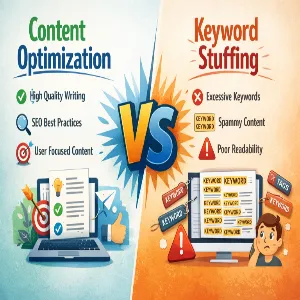
Content optimization means planning, structuring, and writing content so it answers user intent clearly, uses keywords naturally, and follows SEO best practices like proper headings, internal links, and clean meta tags. For deeper implementation, many teams back this up with structured SEO services, on-page SEO basics, and regular SEO audit services. It improves search rankings, builds topical authority, and keeps users engaged across devices and locations, especially when you address technical SEO issues and page-speed impacts on SEO performance.
Keyword stuffing is the outdated practice of forcing too many keywords into text, headings, and meta tags to manipulate rankings, a classic black-hat habit contrasted in guides like white-hat vs black-hat SEO link building. It hurts readability, damages trust, and can trigger search engine penalties. In 2026, the winning strategy is simple: optimize for real people, use relevant keywords naturally, and let search and AI systems reward useful, easy-to-understand content, supported by intent-led planning such as search intent optimization for better rankings.
What Is Content Optimization?
Content optimization is the process of improving a page so it can rank, engage, and convert. You are not just adding keywords; you are aligning every element of the page with user intent, often guided by a broader content SEO services: strategy, writing, and optimization plan and SEO content planning for topical authority.
A well-optimized page usually includes:
- A clear H1 that matches the main query and intent
- Organized H2 / H3 headings that break down subtopics
- Short paragraphs and bullet points for scannability
- Internal links to relevant pages and helpful external links (for example, explaining how internal linking improves rankings)
- Descriptive meta title and meta description
- Relevant images with natural alt text
- Fast loading, mobile-friendly layout, aligned with Core Web Vitals for SEO
For SEO, content optimization means search engines can easily understand what your page is about, which queries it should rank for, and how it fits into your broader site, whether it is a small local business using affordable SEO services for small business owners or an enterprise managing SEO for thousands of pages.
For GEO (geographic) optimization, you adapt content to specific regions or locations. For example, if you are targeting “content optimization vs keyword stuffing” for businesses in Australia, you might reference local SEO services for small businesses and local SEO ranking factors for multi-location brands, mention platforms common in that region, use local examples, currencies, or regulations, and include geo-specific modifiers like “for Australian small businesses” or “in Sydney” where relevant and natural.
For AEO (answer engine optimization), you structure content so AI Overviews, featured snippets, and voice assistants can easily extract clear answers. That means:
- Direct, concise definitions near the top
- FAQ-style questions and answers
- Lists and tables that summarize key differences
- Simple language that can be read aloud or summarized by AI
From an NLP perspective, optimized content uses semantic variety: related phrases, synonyms, and entities that show depth, not just repetition. Instead of repeating “content optimization vs keyword stuffing” in every line, you use related phrases like “smart keyword optimization,” “over-optimized content,” “natural keyword usage,” and “black-hat keyword stuffing,” while letting topic clusters like how blog clusters support SEO service pages reinforce topical authority.
What Is Keyword Stuffing?
Keyword stuffing is the opposite of smart content optimization. It is the practice of overloading a page with the same keywords or phrases to try to manipulate rankings, a tactic often mentioned alongside risky approaches in resources about cheap SEO services and red flags to watch for in SEO companies.
Common signs of keyword stuffing include:
- Repeating the exact same keyword in every sentence
- Piling keywords together (e.g., “content optimization, keyword stuffing, SEO, best SEO, keyword SEO content”)
- Forcing keywords into headings, alt text, and footers where they do not fit
- Writing long lists of locations or variations just to capture GEO traffic rather than using smarter local citation building and Google Business Profile optimization services
This style of writing feels robotic and unnatural. Users click away quickly because the content does not read like genuine advice or explanation, undermining otherwise solid strategies like ecommerce keyword research for buyer intent or commercial vs informational keywords in SEO campaigns. Modern search engines and AI systems can detect unnatural repetition and low-value patterns, which means keyword stuffing can:
- Hurt your rankings
- Reduce click-through rates and engagement
- Damage your brand’s credibility
- Prevent your content from appearing in AI Overviews or featured snippets, even if you are investing in broader initiatives like SEO consultant vs SEO agency
In 2026, keyword stuffing is a fast way to make good content underperform. Fewer people will read or share your article, and algorithms will treat it as low quality, which is why honest resources on what SEO services can and cannot guarantee consistently warn against it.
Content Optimization vs Keyword Stuffing: Key Differences
Here is a simple, AI overview–friendly table you can reuse or adapt. For a deeper dive dedicated to this topic, you can also reference the full explainer on content optimization vs keyword stuffing.
| Aspect | Content optimization | Keyword stuffing |
|---|---|---|
| Main goal | Help users, satisfy search intent, build authority (often reinforced by structured SEO services) | Manipulate rankings artificially |
| Keyword usage | Natural, strategic, varied (semantic SEO, supported by solid keyword research services) | Excessive, repetitive, forced |
| Readability | Clear, simple, user-friendly | Awkward, spammy, hard to read |
| Alignment with SEO | Follows best practices, supports long-term growth, plays well with technical SEO services and audits | Violates guidelines, risks penalties |
| Impact on UX | Higher engagement, more time on page, more shares | High bounce rate, low trust |
| GEO / local relevance | Integrates local terms and examples naturally, like in local SEO services for small businesses | Lists of locations just for the sake of ranking |
| AEO / AI visibility | Structured for snippets, AI Overviews, and voice answers | Often ignored or downgraded by AI systems |
| Long-term ROI | Sustainable traffic and brand trust, easier to measure via SEO KPIs every business owner should track | Short-lived wins, long-term ranking loss |
How to Optimize Content the Right Way (Without Keyword Stuffing)
Use these steps as a practical framework for SEO, GEO, AEO, and NLP-friendly writing. You can also pair them with checklists like the on-page SEO checklist for service-based websites or optimize landing pages for search engines.
1. Start With Search Intent
Before you write, ask: “What does someone really want when they search for ‘content optimization vs keyword stuffing’?”
They likely want:
- A clear definition of both terms
- A simple comparison of pros and cons
- Practical tips to optimize content without overdoing keywords
- Reassurance that their content strategy is safe and modern, similar to what you see in why SEO is a long-term investment
When you match that intent, SEO becomes much easier because your content is aligned with what users and search engines actually want, which is exactly what search intent optimization for better rankings emphasizes.
2. Use Keywords Strategically, Not Obsessively
Pick a main keyword (e.g., “content optimization vs keyword stuffing”) and a small set of related phrases. Then place them in key locations:
- Page title (H1 or meta title)
- First 100–150 words
- 1–2 relevant H2 or H3 headings
- Naturally in the body where they make sense
- Meta description
- URL slug, if you control it
You do not need to hit a magic “keyword density.” Focus instead on clarity. If you can read the paragraph aloud and it sounds natural, you are in a good place, and any remaining opportunities can be refined during an SEO audit or content refresh using content refresh services for old website pages.
3. Embrace Semantic SEO and NLP
Instead of repeating one exact keyword, use semantically related phrases and entities, such as:
- “keyword optimization”
- “natural keyword placement”
- “over-optimization”
- “search engine guidelines”
- “black-hat practices”
- “user-first content”
This helps search engines and AI understand context. It also makes your writing more interesting for humans and easier to slot into topic clusters like commercial intent clusters or industry-specific clusters.
4. Improve Structure and Readability
Well-structured content performs better across SEO, GEO, and AEO because it is easier to parse.
Best practices include:
- One clear H1, followed by logical H2s and H3s
- Short paragraphs (2–4 sentences)
- Bullet points and numbered lists for steps and tips
- Tables to summarize comparisons
- Descriptive anchor text for internal links, informed by best practices like how backlinks affect domain authority and rankings
This structure is also AI overview–friendly. When AI systems look for quick answers, they prefer content they can skim and segment easily—similar to how case studies like content-led SEO growth are often structured.
Signs You’re Doing Content Optimization Right
Use this list to confirm you are optimizing content and not sliding into keyword stuffing.
- Your article reads naturally when you read it aloud.
- You can summarize the main purpose of the article in one simple sentence.
- Your primary keyword appears in a few strategic places, not in every line.
- You use synonyms and related terms instead of repeating one phrase.
- Your headings describe what each section is about in plain language.
- You answer real questions your audience is asking (not just what tools suggest).
- You include internal links to other helpful pages, not just for SEO but for users, such as linking to SEO services clients need to know or how to choose the right SEO agency.
- The content is valuable to someone even if search engines did not exist.
- You consider local context when it matters (e.g., laws, currencies, regions), similar to local SEO helps clinics, law firms, and restaurants or local SEO audit guide for Philippine businesses.
- Your analytics show healthy engagement: time on page, scroll depth, and low bounce rate, which you track alongside SEO reporting metrics clients actually care about.
Listicle: Warning Signs of Keyword Stuffing
If you recognize several of these behaviors, it is time to rewrite and re-optimize.
- Your main keyword appears in almost every sentence.
- You have blocks of text that look like keyword lists instead of real sentences.
- Headings feel forced, as if they exist just to hold keywords.
- You added long lists of cities or locations just for GEO ranking instead of building proper local citations and local SEO strategies for property listings.
- Sentences sound unnatural or robotic when read aloud.
- You repeat the same anchor text for internal links over and over, instead of using varied, descriptive anchors as suggested in keyword mapping for service pages and blogs.
- Your content ignores real user questions and focuses on exact matches.
- You write for algorithms first and humans second.
- Engagement metrics are poor even though your keyword density looks “perfect,” a pattern you might notice while evaluating SEO ROI.
- You feel like you are “cramming” words into every possible place.
How to Fix Content That Is Keyword Stuffed
If you realize a page is over-optimized or stuffed, do not panic. You can repair it with a focused process, or fold it into a wider website SEO audit vs full SEO strategy.
Audit the page
Read your article as a user. Highlight every obviously repeated or forced keyword, similar to how you would note issues during a technical SEO audit.
Remove or rewrite repetitive phrases
Replace repeated exact matches with natural variants, synonyms, or pronouns.
Expand depth instead of repetition
Where you kept repeating a phrase, add real value: examples, mini case studies, FAQs, or simple analogies. Case studies like before and after SEO results and SEO wins from technical fixes alone are good models here.
Rebalance headings
If every heading includes your main keyword, keep it in the most important ones and simplify the rest.
Check meta tags and alt text
Make sure your title tag, meta description, and image alt text sound like real language, not keyword blocks. This is the same lens you would use when reviewing on-page SEO services work.
Re-test readability
Use simple language. Your goal is to be understood quickly by a busy person and by AI systems that prefer clear structure and concise answers.
Over time, this approach builds trust with users and search engines. Instead of chasing short-term tricks, you grow sustainable, organic traffic, just like the long-view highlighted in why SEO is a long-term investment and best SEO agency traits for long-term growth.
Modern answer engines and AI Overviews look for specific patterns in content. You can support them by:
- Placing a short, direct summary near the top (like the one in this article).
- Using clear questions as headings (“What is content optimization?”, “What is keyword stuffing?”).
- Answering each question in 1–3 simple sentences before adding detail.
- Using lists and tables to summarize key points, as commonly recommended in AI-focused guides and performance stories like traffic vs leads or how a service business increased leads organically.
This structure not only helps AI systems but makes your article more helpful for users who skim. It also aligns naturally with broader strategies like enterprise SEO services for large websites and automation opportunities in enterprise SEO.
Simple Takeaway
Content optimization is about clarity, usefulness, and natural keyword usage, supported by smart technical foundations like technical SEO for Shopify, WooCommerce, and Magento. Keyword stuffing is about forcing keywords at the cost of readability and trust, often showing up as a red flag in discussions of guaranteed SEO services and “too good to be true” packages.
When you focus on intent, structure, and user value, you automatically create SEO, GEO, AEO, and NLP-friendly content that works well in 2026 and beyond, whether you are running local campaigns, ecommerce SEO services for online stores, or complex SaaS SEO services for long sales cycles.
Frequently Asked Questions
How often should I update or re-optimize my existing content for SEO?
Most sites benefit from reviewing and updating key pages every 3–6 months, or sooner if rankings, traffic, or search intent clearly shift.
What metrics should I track to know if my content optimization efforts are working?
Focus on organic traffic, impressions, rankings for target keywords, click-through rate, time on page, scroll depth, and conversions or leads.
How long does it usually take to see results from content optimization changes?
Most meaningful changes start to show within 4–12 weeks, depending on crawl frequency, competition, and the scale of your updates.
Is it better to create new content or optimize old content first?
Start by optimizing your highest-traffic, highest-intent pages, then fill gaps with new content once existing assets are performing reliably.
How do I balance writing for AI Overviews with writing for traditional search results?
Lead with short, direct answers for AI Overviews, then expand into detailed sections, examples, and FAQs to satisfy traditional organic search.
Do I need different content optimization strategies for blog posts and landing pages?
Yes—blogs prioritize education and breadth, while landing pages prioritize conversion-focused structure, trust signals, and clear calls to action.
How does content optimization differ for B2B vs B2C websites?
B2B content usually targets longer sales cycles, multiple stakeholders, and deeper educational resources, while B2C content leans into clarity, emotion, and speed to purchase.
What role does search intent play in choosing which pages to optimize first?
Pages that clearly match high-intent queries (commercial, transactional, or high-value informational) should be prioritized because they impact revenue fastest.
How can I use schema markup or FAQPage schema to support content optimization?
Adding relevant schema helps search engines understand your content, can unlock rich results, and often improves visibility and click-through rates.
Does AI-generated content need to be optimized differently than human-written content?
Yes—you should always human-edit AI drafts to refine intent, structure, expertise, and internal linking before publishing.
How do I prioritize content optimization when I have hundreds or thousands of URLs?
Use a simple matrix: prioritize URLs with high business value, decent traffic, and low engagement or declining rankings first.
What is the relationship between content optimization and link building?
Well-optimized content is easier to earn links to; in turn, quality backlinks amplify the visibility and authority of your best-optimized pages.
How do I optimize content for branded queries versus non-branded keywords?
For branded queries, emphasize product clarity, trust, and proof; for non-branded, focus on intent-matched education and problem-solution framing.
Should I create separate content for each country or use one page with localized elements?
If intent, regulations, and language differ meaningfully, separate localized pages usually perform better than a single global page.
What are common content optimization mistakes besides keyword stuffing?
Common issues include thin content, weak internal linking, ignoring search intent, slow pages, poor mobile UX, and unhelpful or clickbait meta tags.
How does content optimization interact with Core Web Vitals and overall site speed?
Great content can underperform if pages are slow; improving speed and Core Web Vitals makes optimized content more accessible and rank-worthy.
What tools can help me audit and score the optimization level of my content?
You can use SEO suites (e.g., crawlers, on-page graders), analytics, and search console data to evaluate technical health, relevance, and engagement.
How do I optimize content for featured snippets and People Also Ask boxes specifically?
Give concise, direct answers in 1–3 sentences, use question-based headings, and support them with clear lists, tables, and step-by-step structures.
What is the best way to align content optimization with a broader SEO strategy or roadmap?
Tie every optimization task to specific goals—traffic, leads, or revenue—and map pages to keyword clusters and funnel stages before you start.
How can service-based businesses measure the ROI of content optimization on leads and sales?
Track form fills, calls, booked consultations, and closed deals back to optimized pages using analytics, CRM data, and clear conversion tracking.







