

topical authority Key Takeaways
topical authority is the measure of how comprehensively your website covers a specific subject, signaling expertise to both search engines and readers.
- topical authority shifts SEO from chasing keywords to dominating subject areas, earning higher rankings and trust.
- Building topical authority requires structured content clusters, pillar pages, and strategic internal linking, not just more blog posts.
- Practical steps include auditing existing coverage, filling content gaps, and earning contextual backlinks that reinforce subject mastery.
What Is topical authority and Why It Matters in 2025
topical authority refers to the depth and breadth of your website’s coverage on a well-defined subject. Instead of sprinkling loosely related posts across random keywords, you create a tightly interwoven library of content that answers every question a reader might have about that topic. Search engines such as Google evaluate this comprehensiveness and reward sites that demonstrate clear expertise.
Why does topical authority matter? Traditional SEO relied heavily on keyword density and backlinks. Today, Google’s Helpful Content System and E-E-A-T guidelines prioritize content that shows first-hand knowledge, clear authorship, and a complete treatment of the subject. Sites with strong topical authority see better organic visibility, higher click-through rates, and increased trust from their audience. For a related guide, see Topical Authority Outperforms Keyword Stuffing in Modern SEO.
How Topical Authority Differs From Keyword-Optimized Content
A keyword-optimized page targets one search term. topical authority content maps out the entire topic neighborhood. For example, a site about “coffee brewing” with topical authority covers bean origins, grind sizes, brewing methods, water temperature, and troubleshooting, all internally linked. The result: Google sees you as an expert across hundreds of related queries.
The Core Benefits of Building topical authority for Your Site
When you invest in a genuine SEO topical authority strategy, the benefits compound over time. You do not just rank for one or two terms; you dominate an entire space. Here are the most impactful advantages.
- Higher search rankings across multiple queries: Google rewards integrated coverage by boosting the entire cluster, not just individual pages.
- Reduced reliance on backlinks: While backlinks still matter, topical authority allows you to outrank sites with more links but thinner coverage.
- Improved user engagement: Readers stay longer, visit more pages, and return because your site answers their follow-up questions.
- Stronger brand credibility: You become the go-to resource, which drives natural mentions and links.
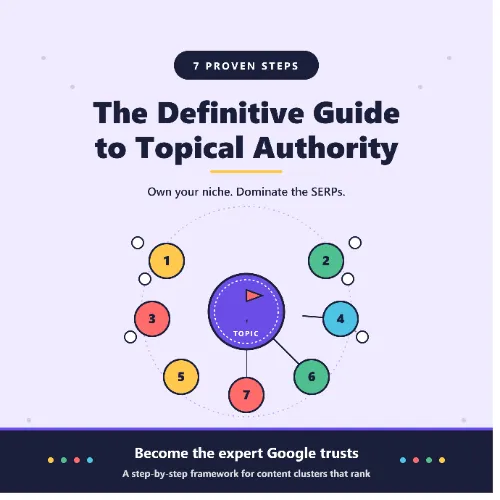
How to build topical authority: A 7-Step Framework
This step-by-step process gives you a clear path to establishing topical authority from scratch or strengthening your existing site. Follow each step in order for the best results.
Step 1: Define Your Core Topic and Subtopics
Start with one broad subject you want to be known for. For example, “sustainable gardening.” List all the questions a beginner or intermediate gardener would ask: soil preparation, composting, pest control, watering schedules, plant selection. This list becomes your content map. Use tools like Ahrefs or AnswerThePublic to discover related queries. Your goal is to cover the topic exhaustively, not thinly across many subjects.
Step 2: Build a Pillar Page and Content Cluster Structure
A pillar page is a comprehensive guide that covers the entire topic at a high level and links out to cluster pages. Each cluster page digs deep into one subtopic. For “sustainable gardening,” your pillar page summarizes the entire practice, while cluster pages cover Composting 101, Natural Pest Repellents, Drought-Tolerant Plants, and so on. Every cluster page links back to the pillar, creating a hub-and-spoke structure that Google recognizes as authority architecture.
Step 3: Audit Your Existing Content for Gaps
Before writing anything new, review what you already have. Which subtopics are covered thoroughly? Where are the gaps? A content gap analysis reveals missing pieces that could complete your topical picture. Use competitor analysis to see which questions rival sites answer that you do not. Prioritize filling those gaps first.
Step 4: Create High-Quality, Entity-Rich Content
Every piece of content should naturally include relevant entities—people, products, locations, methods, and measurements. For gardening, mention specific plant species, soil types, watering tools, and seasonal schedules. Search engines use these entities to understand your page’s context. Include expert insights, original data, or personal experience to differentiate from mass-produced articles.
Step 5: Implement Strategic Internal Linking
Internal links are the glue of topical authority. Link from your pillar page to every cluster page, and link between related cluster pages. When a reader reads about composting, link to your cluster page on soil preparation. Use descriptive anchor text that includes the target topic. This interconnectivity helps Google crawl your site efficiently and understand the relationship between pages.
Step 6: Earn Contextual Backlinks
While internal structure builds the foundation, external backlinks to your pillar and key cluster pages accelerate authority growth. Focus on earning links from sites that are already authorities on related topics. A backlink from a well-respected gardening blog to your pillar page signals to Google that your content is trustworthy. Outreach strategies include guest posting, resource link building, and digital PR. For a related guide, see 15 Easy Ways to Earn High Authority Backlinks for iGaming Sites.
Step 7: Continuously Update and Expand Your Coverage
Topics evolve. New research, tools, and practices emerge. Regularly review your content clusters and update outdated information. Add new cluster pages when new subtopics become relevant. Google considers freshness as part of authority, so keep your content current and accurate.
SEO Entities and Their Functions
Understanding how entities work in the context of topical authority helps you build more effective content. Here are the key entities and how they support your strategy.
- Website / Domain entities: Analyze performance at the root domain, subdomain, and URL level. For topical authority, root domain strength matters most, but subdomain analysis helps when you have separate blogs or resource sections.
- Keyword entities: Organic keywords, keyword difficulty, search volume, and SERP features reveal which topics to prioritize. Focus on keywords with moderate difficulty and clear search intent that align with your subtopics.
- Backlink entities: Referring domains, anchor text, and broken backlinks show where your authority comes from and where you have opportunities. Use this data to strengthen your link profile.
- Content entities: Authors, publish dates, and social shares contribute to E-E-A-T. Assign named authors to your pillar and cluster pages to boost credibility.
- SERP entities: Featured snippets, People Also Ask, and sitelinks indicate what content format Google rewards. Structure your cluster pages to answer specific questions in concise formats.
- Competitor entities: Competing domains and content gap opportunities help you find untapped subtopics. Use tools to see which queries bring traffic to your competitors but not to you.
Common Mistakes That Undermine topical authority
Even with the right framework, several pitfalls can slow your progress. Avoid these errors.
- Spreading too thin: Trying to cover several unrelated topics at once. Focus deeply on one core topic before expanding.
- Thin cluster pages: Writing 300-word posts just to have content. Each cluster page must be thorough enough to satisfy the searcher completely.
- Ignoring internal linking: Creating great content but forgetting to link it back to the pillar or related cluster pages. Without links, the cluster structure collapses.
- Neglecting user intent: Writing content that matches keyword volume but not what the user actually wants. Always match search intent: informational, commercial, or transactional.
Useful Resources
For further reading on building topical authority and improving your content strategy, explore these authoritative resources:
- Ahrefs: What Is Topical Authority and How to Build It — A detailed guide covering the concept with real examples and actionable advice.
- Google: Creating Helpful, Reliable, People-First Content — Google’s official guidance that aligns with the principles of topical authority.
Frequently Asked Questions About topical authority
What is topical authority in SEO?
topical authority is the measure of how comprehensively a website covers a specific subject, demonstrating expertise and trustworthiness to search engines and users.
How long does it take to build topical authority ?
Building measurable topical authority usually takes 6 to 18 months of consistent, high-quality content creation and strategic internal linking, depending on competition and content volume.
Can topical authority replace backlinks?
topical authority reduces your dependence on backlinks but does not entirely replace them. Backlinks remain a strong ranking signal, but deep topical coverage makes each link more powerful.
What is a content cluster?
A content cluster is a group of interlinked web pages centered around a pillar page that covers a broad topic. Cluster pages dive into specific subtopics and link back to the pillar.
How does internal linking help topical authority ?
Internal links connect related content, helping search engines discover all your pages and understand how they relate. This strengthens your site’s subject-level expertise and improves crawl efficiency.
What is a pillar page?
A pillar page is a comprehensive, long-form guide that covers a broad topic at a high level. It serves as the central hub for your content cluster and links out to all related cluster pages.
How do I choose a topic for topical authority ?
Choose a topic that aligns with your business expertise, has sufficient search demand, and offers room for deep coverage. Use keyword research and competitor analysis to validate.
Is topical authority a Google ranking factor?
Google has not officially named it as a direct ranking factor, but the principles of E-E-A-T and the Helpful Content System strongly reward the comprehensiveness that defines topical authority.
What is the difference between topic authority and domain authority?
Domain authority is a broad metric based on backlinks and overall site strength. topical authority is subject-specific and built through content depth, not just link profile.
How many cluster pages do I need per pillar?
Aim for at least 8 to 15 cluster pages per pillar topic to establish meaningful depth. Quality matters more than quantity; each page should fully satisfy a user’s search intent.
Can a small site build topical authority ?
Yes. Small sites can build topical authority by focusing on a narrow niche and creating exceptional content. Being smaller and more focused often leads to stronger authority per topic.
Should I use the same topic for all cluster pages?
Yes, all cluster pages should support a single core topic. This focus is what builds topical authority. Branching into unrelated subjects dilutes your expertise signal.
How does E-E-A-T relate to topical authority ?
E-E-A-T (Experience, Expertise, Authoritativeness, Trustworthiness) is Google’s quality framework. topical authority directly demonstrates expertise and authoritativeness through comprehensive, accurate content.
What tools help build topical authority ?
Tools like Ahrefs, Semrush, and MarketMuse assist with content gap analysis, keyword research, and cluster planning. Google Search Console helps monitor performance of your content clusters.
How do I measure topical authority ?
Track organic traffic growth to pages within your topic cluster, rankings for related keywords, and the number of referring domains pointing to that cluster. Improving these metrics indicates growing authority.
Is topical authority the same as niche expertise?
They are related. Niche expertise means you know the topic well. topical authority means your website proves that expertise through structured, comprehensive content that search engines can evaluate.
Can I build topical authority with video content?
Yes. Video content can be part of your content cluster. Embed videos within pillar and cluster pages, transcribe them for text, and optimize titles and descriptions with topic keywords.
Do I need to update old content for topical authority ?
Yes. Updating existing content with new information, better structure, and links to newer cluster pages strengthens your entire topical network and signals freshness to Google.
How does silo structure compare to content clusters?
Silo structures organize content by category, often preventing interlinking across silos. Content clusters are more flexible, allowing links across related subtopics, which modern SEO favors.
What is a content gap in topical authority ?
A content gap is a subtopic your site does not cover but that competitors or user search intent suggest is important. Filling gaps completes your topical coverage and strengthens authority.







