

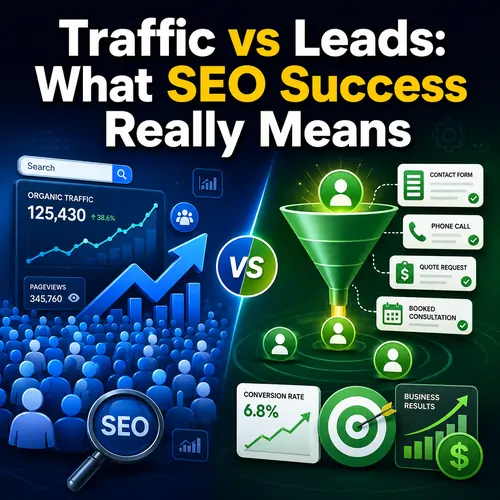
Many businesses believe that SEO success means getting more website traffic. When they see more people visiting their website, they feel excited because it looks like their SEO strategy is working. More visitors can be a good sign, but traffic alone does not always mean success.
Real SEO success is not just about getting more clicks. It is about attracting the right people, answering their needs, and turning those visitors into leads, inquiries, calls, quote requests, booked consultations, demo requests, or sales opportunities.
This is where the difference between traffic vs leads becomes important. For a deeper comparison, this guide on traffic vs leads explains why more visits do not always mean better business results.
Website traffic tells you how many people visit your site. Leads tell you how many of those visitors are interested enough to take action. A website can get thousands of visitors every month but still fail to generate business. On the other hand, a website with fewer visitors can still perform well if those visitors are highly targeted and ready to inquire.
In simple terms, traffic shows visibility, but leads show business impact.
If you want your SEO strategy to support real growth, you need to look beyond rankings and clicks. You need to understand search intent, user experience, conversion rate, service page optimization, local SEO, and how every part of your website guides visitors toward action.
What Is Website Traffic in SEO?
Website traffic refers to the number of people who visit your website. In SEO, organic traffic usually comes from search engines like Google. When someone searches for a keyword, clicks your website, and visits a page, that counts as organic traffic.
Organic traffic is important because it shows that your website is visible in search results. If your pages rank well, more people can discover your brand, read your content, and learn about your products or services.
Website traffic can come from different types of pages, such as:
- Blog posts
- Service pages
- Location pages
- Product pages
- Landing pages
- Homepage visits
- Resource pages
- Case studies
- Guides and tutorials
- FAQ pages
High website traffic can mean your SEO strategy is improving your search presence. It may also show that your content is answering common questions, ranking for broad keywords, or attracting people who are searching for information.
However, traffic is only one part of the picture.
A large number of visitors does not automatically mean those visitors are potential customers. Some may only be looking for general information. Others may not be in your target location. Some may not need your service at all.
This is why businesses should not measure SEO success by traffic alone. Instead, they should also look at the right SEO KPIs every business owner should track, such as conversions, leads, rankings, and revenue impact.
What Are Leads in SEO?
Leads are potential customers who show interest in your business by taking action. In SEO, a lead usually comes from someone who found your website through organic search and then completed an action that shows buying intent or inquiry intent.
Examples of leads include:
- Contact form submissions
- Phone calls
- Quote requests
- Booked consultations
- Demo requests
- Email sign-ups
- Appointment bookings
- Free trial sign-ups
- Product inquiries
- Service inquiries
A lead is more valuable than a simple website visit because it shows that the person is not just browsing. They are interested enough to connect with your business.
For example, a visitor who reads a blog post about “how to improve website SEO” may only be learning. But a visitor who lands on a service page for “SEO services near me” and fills out a contact form is much closer to becoming a customer.
That is why leads are a stronger sign of SEO performance.
Traffic can show attention. Leads show action.
Traffic vs Leads: What Is the Difference?
The main difference between traffic and leads is simple:
Traffic measures visitors. Leads measure potential customers.
Traffic tells you how many people are coming to your website. Leads tell you how many people are interested in your business, product, or service.
Here is a simple comparison:
| SEO Metric | What It Means | Why It Matters |
|---|---|---|
| Website traffic | Number of visitors to your site | Shows visibility and reach |
| Organic traffic | Visitors from search engines | Shows SEO performance |
| Leads | People who take action | Shows business opportunity |
| Conversion rate | Percentage of visitors who become leads | Shows how effective your website is |
| Quote requests | Visitors asking for pricing or service details | Shows high intent |
| Booked consultations | Visitors scheduling a call or meeting | Shows strong interest |
| Phone calls | Visitors contacting your business directly | Shows immediate need |
Both traffic and leads matter, but they do not carry the same value.
Traffic helps people discover your business. Leads help your business grow.
Why Website Traffic Alone Can Be Misleading
High website traffic can look impressive, but it can be misleading if it does not lead to meaningful action.
A website might get 10,000 visitors in a month, but if only two people contact the business, that traffic may not be helping much. Another website might get only 800 visitors but generate 50 qualified leads. In that case, the smaller traffic number is actually more valuable.
This usually happens because not all keywords bring the same type of visitor.
Some keywords attract people who are only looking for information. These are called informational keywords. They can bring traffic, but they may not always bring leads.
Other keywords attract people who are comparing options, looking for a provider, or ready to inquire. These are commercial, transactional, or local keywords. They may bring fewer visitors, but they often bring better leads.
For example:
- Informational keyword: “What is SEO?”
- Commercial keyword: “Best SEO agency for small business”
- Transactional keyword: “Hire SEO specialist”
- Local keyword: “SEO services near me”
The first keyword may bring more traffic. The last three may bring better leads.
This is why an SEO strategy should not only focus on getting more clicks. It should focus on attracting the right visitors with the right search intent.
What SEO Success Really Means
SEO success means your website is attracting the right audience, ranking for relevant keywords, and converting visitors into leads or customers.
It is not only about being seen. It is about being found by people who actually need what you offer.
A successful SEO campaign should improve:
- Organic traffic
- Keyword rankings
- Search visibility
- Click-through rate
- User experience
- Conversion rate
- Contact form submissions
- Phone calls from organic search
- Quote requests
- Booked consultations
- Revenue from organic leads
- Brand trust
- Local search presence
- Service page performance
- Business growth
This means true SEO success is connected to business results. If you want to understand how to connect SEO efforts with revenue, this guide on how to measure SEO ROI for your business can help explain what numbers matter most.
Ranking on Google is important. Traffic is important. Content is important. But if your SEO strategy does not support leads, sales opportunities, or revenue, then it may not be working as well as it should.
Why Leads Are a Stronger SEO Success Metric
Leads are a stronger SEO success metric because they are closer to revenue. A lead shows that someone has moved from simply visiting your website to showing real interest.
This is especially important for service-based businesses, local businesses, B2B companies, agencies, clinics, contractors, consultants, SaaS companies, and professional service providers.
For these businesses, website traffic is only useful if it supports lead generation.
A good SEO strategy should help people:
- Find your website
- Understand your service
- Trust your business
- See your value
- Take action
That action may be filling out a contact form, requesting a quote, calling your office, booking a consultation, or asking for more information.
When leads increase, it usually means your SEO is attracting better searchers, your website content is clearer, and your conversion paths are working.
The Role of Search Intent in SEO Success
Search intent is one of the most important parts of SEO. It means understanding why someone is searching.
When a person types a keyword into Google, they have a goal. They may want to learn something, compare options, find a nearby service, or make a purchase.
The four common types of search intent are:
1. Informational Intent
This is when someone wants to learn about a topic.
Examples:
- “What is SEO?”
- “How does organic traffic work?”
- “What is conversion rate?”
- “Why is website traffic important?”
These keywords are useful for blog posts, guides, and educational content. They can build brand awareness and trust.
2. Commercial Intent
This is when someone is comparing solutions before making a decision.
Examples:
- “Best SEO agency for small business”
- “SEO services for contractors”
- “Top local SEO companies”
- “SEO consultant vs SEO agency”
These keywords are stronger for lead generation because the searcher is already considering a service.
3. Transactional Intent
This is when someone is ready to take action.
Examples:
- “Hire SEO specialist”
- “Book SEO consultation”
- “Request SEO quote”
- “SEO audit service”
These keywords often bring high-quality leads because the person has a clear need.
4. Local Intent
This is when someone is searching for a nearby provider.
Examples:
- “SEO services near me”
- “Digital marketing agency in [city]”
- “Local SEO consultant near me”
- “SEO company for small business in [location]”
Local SEO is very important for businesses that serve a specific area. Local keywords may not always bring the highest traffic, but they can bring highly qualified leads.
Quality Over Quantity: Why the Right Audience Matters
In SEO, more traffic is not always better. Better traffic is better.
A website that attracts the wrong audience may have high bounce rates, low engagement, and few conversions. A website that attracts the right audience may have fewer visitors but more form submissions, phone calls, quote requests, and booked consultations.
The right audience includes people who:
- Need your product or service
- Are located in your service area
- Match your ideal customer profile
- Have a problem you can solve
- Are willing to take action
- Are searching with the right intent
- Have budget or decision-making power
- Trust your content and offer
For example, a local plumbing company does not need traffic from people across the world. It needs traffic from people in its service area who are searching for plumbing repair, emergency plumbing, or plumbing installation.
The same idea applies to SEO services. A business offering SEO for local contractors should not only target broad terms like “marketing tips.” It should also target keywords like “SEO for contractors,” “local SEO for service businesses,” and “SEO services for small business owners.”
Relevant traffic is more valuable than random traffic.
How Blog Posts and Service Pages Work Together
A strong SEO strategy uses both blog posts and service pages.
Blog posts are useful for building visibility, educating readers, and answering common questions. They often target informational keywords.
Service pages are designed to explain what your business offers and encourage visitors to take action. They often target commercial, transactional, and local keywords.
Both types of content are important, but they serve different purposes.
Blog Posts Help With:
- Brand awareness
- Educational content
- Informational search intent
- Internal linking
- Top-of-funnel traffic
- Answering common questions
- Building topical authority
- Supporting AI Overview visibility
Service Pages Help With:
- Lead generation
- Conversion rate
- Quote requests
- Phone calls
- Booked consultations
- Local SEO
- Commercial intent
- Service-specific rankings
A common mistake is focusing only on blog traffic while neglecting service pages. Blog posts can bring visitors, but service pages usually bring more direct leads.
The best approach is to connect both.
For example, a blog post about “how to choose an SEO agency” can link to a service page about “SEO services for small businesses.” This helps guide readers from learning to taking action.
How to Turn Website Traffic Into Leads
Getting traffic is only the first step. Your website also needs to convert visitors into leads.
Here are practical ways to improve lead generation from SEO traffic:
1. Use Clear Calls to Action
Every important page should tell visitors what to do next.
Examples of clear CTAs include:
- Request a quote
- Book a consultation
- Call us today
- Get a free SEO audit
- Schedule a strategy call
- Contact our team
- Start your project
- Ask for a proposal
A visitor should not have to guess how to contact you.
2. Optimize Service Pages
Your service pages should clearly explain what you offer, who you serve, and why your service is valuable.
A strong service page should include:
- Main service keyword
- Simple explanation of the service
- Benefits of the service
- Problems you solve
- Proof or trust signals
- Location targeting if needed
- FAQs
- Clear CTA
- Contact form or phone number
- Internal links to related pages
3. Match Content With Search Intent
Do not create content just to get traffic. Create content that matches what your audience is actually looking for.
If the keyword has informational intent, provide a useful guide.
If the keyword has commercial intent, compare options and explain value.
If the keyword has transactional intent, make it easy to inquire.
If the keyword has local intent, include location-specific details.
4. Improve User Experience
Good SEO is not only about keywords. User experience also matters.
Visitors are more likely to become leads when your website is:
- Easy to navigate
- Fast-loading
- Mobile-friendly
- Clear and simple
- Trustworthy
- Easy to read
- Easy to contact
- Free from confusing layouts
If visitors cannot find what they need, they will leave.
5. Add Trust Signals
People need to trust your business before they contact you.
Trust signals include:
- Client reviews
- Testimonials
- Case studies
- Certifications
- Portfolio samples
- Years of experience
- Industry expertise
- Real photos
- Clear contact information
- Professional website design
Trust can improve conversion rate because people feel more confident taking action. Businesses can also build topical authority by creating helpful content clusters. This guide on trust-building clusters explains how content can support credibility and buyer confidence.
Important SEO Metrics Businesses Should Track
To understand SEO success, businesses should track both traffic-focused metrics and lead-focused metrics.
Here are the most important SEO metrics to monitor:
1. Organic Traffic
Organic traffic shows how many people find your website through search engines. This helps measure search visibility.
2. Keyword Rankings
Keyword rankings show where your website appears in Google search results for target keywords.
3. Click-Through Rate
Click-through rate shows how often people click your website after seeing it in search results.
4. Conversion Rate
Conversion rate shows the percentage of visitors who become leads. This is one of the most important SEO success metrics.
5. Form Submissions
Contact form submissions show how many visitors are reaching out through your website.
6. Phone Calls
Phone calls from organic search are especially important for local SEO and service-based businesses.
7. Quote Requests
Quote requests show that visitors are interested in pricing, services, or project details.
8. Booked Consultations
Booked consultations show strong intent and are often closer to sales opportunities.
9. Cost Per Lead
Cost per lead shows how much you spend to generate each lead through SEO.
10. Revenue From Organic Leads
Revenue from organic leads is one of the clearest ways to connect SEO with business growth.
These numbers also make reporting more useful. Instead of only showing rankings and traffic, SEO reports should explain the business value behind the data. This guide on SEO reporting metrics clients actually care about explains which metrics are most useful for clients and business owners.
How Long Does It Take for SEO to Generate Leads?
SEO does not usually produce results overnight. It takes time for search engines to crawl pages, understand content, rank keywords, and send qualified traffic to your website.
In many cases, SEO results depend on:
- Website age
- Competition level
- Keyword difficulty
- Content quality
- Technical SEO condition
- Backlink profile
- Local SEO strength
- Website authority
- Conversion paths
- Consistency of SEO work
Some businesses may see early improvements in impressions, rankings, or organic traffic. However, consistent lead generation usually takes longer because it requires both visibility and conversion.
For a more detailed explanation, read this guide on how long SEO services take to work. It explains why SEO is a long-term strategy and why business owners should measure progress in stages.
What Does SEO Success Really Mean?
SEO success means more than getting website traffic. True SEO success happens when a website attracts the right visitors from organic search and turns them into qualified leads, phone calls, quote requests, booked consultations, or customers. Traffic shows visibility, while leads show business impact. A successful SEO strategy should focus on search intent, relevant keywords, useful content, strong service pages, local SEO, clear calls to action, and conversion rate optimization.
Signs Your SEO Is Bringing the Right Traffic
Your SEO may be attracting the right audience if:
- Visitors spend time reading your pages
- Your service pages get organic traffic
- Contact form submissions increase
- Phone calls from organic search improve
- Quote requests become more consistent
- Booked consultations increase
- Your conversion rate improves
- Your local SEO rankings grow
- Your pages rank for commercial keywords
- Your content answers real customer questions
- Visitors come from your target location
- Your organic leads become paying customers
These signs show that your SEO strategy is not just creating traffic. It is supporting lead generation and business growth.
Signs Your SEO Is Getting Traffic but Not Leads
Your website may be getting traffic without real business impact if:
- Visitors leave quickly
- Blog posts get traffic but service pages do not
- Contact forms are rarely submitted
- Phone calls are not increasing
- The website ranks for broad keywords only
- Traffic comes from outside your target location
- Visitors do not match your ideal customers
- Pages do not have clear CTAs
- Service pages are thin or unclear
- Conversion rate is very low
- Your website does not explain your offer clearly
- You cannot connect SEO traffic to revenue
If this is happening, your SEO strategy may need better keyword targeting, stronger search intent alignment, and improved conversion paths.
How Local SEO Supports Better Leads
Local SEO helps businesses appear in search results when people are looking for services in a specific area. This is especially useful for companies that serve nearby customers.
Local SEO can help generate leads through:
- Google Business Profile visibility
- Local service pages
- Location-based keywords
- Customer reviews
- Map pack rankings
- Local citations
- Phone calls
- Direction requests
- Website visits from nearby searchers
- Location-specific landing pages
For example, someone searching “SEO services near me” or “best marketing agency in [city]” likely has stronger intent than someone searching “what is marketing.”
Local SEO traffic may be smaller, but it is often more qualified.
Why Conversion Rate Matters in SEO
Conversion rate is the percentage of website visitors who take action. This action can be a form submission, phone call, email sign-up, quote request, booked consultation, or demo request.
For example, if 1,000 people visit your website and 50 people contact you, your conversion rate is 5%.
Conversion rate matters because it shows whether your website is turning traffic into leads.
A website with high traffic but low conversion rate may have problems with:
- Poor calls to action
- Weak service pages
- Confusing layout
- Slow loading speed
- Lack of trust signals
- Wrong keyword targeting
- Poor search intent match
- Unclear offer
- Difficult contact process
- Low-quality traffic
Improving conversion rate can help you get more leads without needing more traffic.
How to Balance Traffic and Lead Generation
A good SEO strategy should balance traffic and lead generation. You do not need to choose only one.
Traffic helps build awareness. Leads help grow the business.
Here is a simple SEO balance:
Use Blog Content for Visibility
Blog posts can answer questions, educate readers, and bring organic traffic. They are useful for building topical authority and reaching people early in the customer journey.
Use Service Pages for Leads
Service pages should target commercial and transactional keywords. These pages should explain your offer and encourage people to contact you.
Use Internal Links to Guide Visitors
Internal links help move visitors from informational content to conversion-focused pages.
For example:
A blog post about “how to improve website traffic” can link to a service page about “SEO strategy services.”
Use FAQs for AEO and AI Overview Visibility
FAQ sections help answer direct questions. This supports Answer Engine Optimization, voice search, and AI Overview-friendly content.
Use Local SEO for High-Intent Searches
Location-based pages and Google Business Profile optimization can help attract nearby searchers who are ready to act.
Common Questions About Traffic vs Leads
What is more important in SEO: traffic or leads?
Leads are usually more important than traffic because leads show real business interest. Traffic is still important because it brings visibility, but leads show whether SEO is helping generate inquiries, calls, quote requests, booked consultations, and sales opportunities.
Can high website traffic mean poor SEO results?
Yes. High traffic can still mean poor SEO results if the visitors are not relevant, do not match the target audience, or do not take action. SEO success should be measured by both organic traffic and lead generation.
Why am I getting traffic but no leads?
You may be getting traffic but no leads because your keywords are too broad, your visitors have low buying intent, your service pages are weak, your calls to action are unclear, or your website does not match search intent.
How do I know if my SEO is working?
Your SEO is working if your website is gaining relevant organic traffic, ranking for useful keywords, improving conversion rate, generating contact form submissions, increasing phone calls, producing quote requests, and supporting business growth.
What are qualified leads in SEO?
Qualified leads are visitors who match your target audience and show real interest in your product or service. They may request a quote, book a consultation, call your business, submit a form, or ask for more information.
Is organic traffic still important?
Yes. Organic traffic is still important because it shows that people are finding your website through search engines. However, organic traffic should be measured together with conversion rate, lead quality, and revenue from organic leads.
Final Takeaway: SEO Should Bring More Than Clicks
Traffic is important, but it is not the final goal of SEO. A website with growing traffic may look successful, but if that traffic does not turn into leads, the strategy may need improvement.
True SEO success means attracting the right audience, matching search intent, building trust, and guiding visitors toward action.
The best SEO strategy does not only ask, “How many people visited the website?”
It also asks:
- Did the right people visit?
- Did they find what they needed?
- Did they trust the business?
- Did they submit a form?
- Did they call?
- Did they request a quote?
- Did they book a consultation?
- Did they become customers?
When SEO brings qualified leads, it becomes more than a marketing activity. It becomes a business growth strategy.
In the end, SEO success is not just about more traffic. It is about meaningful traffic, qualified leads, stronger conversion rates, and measurable business impact.
Frequently Asked Questions
1. What is the difference between a visitor and a lead?
A visitor is someone who lands on your website. A lead is a visitor who takes action, such as submitting a form, calling your business, booking a consultation, or requesting a quote.
2. Why does my blog get traffic but my business still gets no inquiries?
Your blog may be attracting readers with informational intent instead of buyers with commercial or transactional intent. To fix this, connect blog posts to service pages using clear internal links and calls to action.
3. Can SEO generate leads without high traffic?
Yes. SEO can generate leads even with lower traffic if your website targets high-intent keywords and attracts people who are ready to inquire, book, call, or buy.
4. What type of SEO content is best for lead generation?
Service pages, location pages, comparison pages, case studies, landing pages, and bottom-of-funnel blog posts are usually best for lead generation because they target people closer to making a decision.
5. What are high-intent SEO keywords?
High-intent SEO keywords are search terms used by people who are likely to take action. Examples include “request a quote,” “book consultation,” “SEO services near me,” “best SEO agency,” and “hire SEO expert.”
6. How can I tell if a keyword will bring leads?
A keyword may bring leads if it includes buying signals, service terms, location terms, comparison words, or action-based phrases like “hire,” “best,” “near me,” “cost,” “pricing,” “agency,” or “consultation.”
7. Is ranking number one on Google always a sign of SEO success?
Not always. Ranking number one is helpful, but it only matters if the keyword attracts the right audience and leads to conversions, inquiries, or revenue.
8. Why do some low-traffic pages generate more leads?
Low-traffic pages can generate more leads when they target specific, high-intent searches. A service page with 200 monthly visits may bring more inquiries than a blog post with 5,000 visits if the service page attracts ready-to-act visitors.
9. What is a lead-focused SEO strategy?
A lead-focused SEO strategy targets keywords, content, and website improvements that attract qualified visitors and guide them toward taking action, such as calling, booking, or submitting a form.
10. Should every blog post try to generate leads?
Not every blog post needs to sell directly. Some blog posts build awareness and trust. However, each post should still guide readers to a relevant next step, such as reading a service page, downloading a resource, or contacting the business.
11. How do landing pages help convert SEO traffic into leads?
Landing pages help by focusing on one specific offer, service, location, or audience. They reduce distractions and make it easier for visitors to understand the value and take action.
12. What is a good conversion rate for SEO traffic?
A good conversion rate depends on your industry, offer, traffic quality, and website design. In general, service-based websites should track whether conversion rates are improving over time instead of relying only on a fixed benchmark.
13. Why should SEO and CRO work together?
SEO brings visitors to your website, while conversion rate optimization helps turn those visitors into leads. When SEO and CRO work together, your website can attract the right audience and convert more of them into customers.
14. What pages should I optimize first to get more leads?
Start with your homepage, main service pages, location pages, contact page, and high-traffic blog posts. These pages often have the biggest impact on lead generation.
15. How do calls to action affect SEO leads?
Calls to action tell visitors what to do next. Clear CTAs like “Request a Quote,” “Book a Consultation,” or “Call Today” can increase the number of visitors who become leads.
16. Can poor website design reduce SEO leads?
Yes. Poor design can make visitors leave even if your SEO brings traffic. A confusing layout, slow pages, weak messaging, or hard-to-find contact information can reduce conversions.
17. Why is lead quality more important than lead quantity?
Lead quality matters because not all leads are likely to become customers. A few qualified leads from your ideal audience can be more valuable than many low-quality leads who are not ready, able, or willing to buy.
18. How can I improve lead quality from SEO?
You can improve lead quality by targeting specific keywords, creating detailed service pages, qualifying visitors through your content, using clear pricing or service information, and focusing on your ideal customer’s pain points.
19. What is the buyer journey in SEO?
The buyer journey is the process a person follows before becoming a customer. In SEO, this usually includes awareness, research, comparison, decision, and action. Your content should support each stage.
20. What is the biggest mistake businesses make when measuring SEO success?
The biggest mistake is focusing only on rankings and traffic. These metrics matter, but they do not show the full value of SEO unless they are connected to leads, conversions, and revenue.







