How to Measure SEO ROI for Your Business (Complete Guide)
Introduction
Search Engine Optimization (SEO) is one of the most powerful long-term digital marketing strategies—but many business owners still ask:
“How do I measure SEO ROI accurately?”
Unlike paid ads, SEO doesn’t deliver instant results. It builds over time, making it harder to track performance without a clear system.
According to Google, businesses should focus on user value and measurable outcomes, not just rankings. This is why understanding SEO ROI is critical.
If you want a deeper understanding of how Google evaluates websites, you can explore their official guide here:
👉
In this guide, you’ll learn:
- How to calculate SEO ROI
- The most important SEO performance metrics
- Tools for tracking SEO revenue
- Proven ways to improve your ROI
What Is SEO ROI?
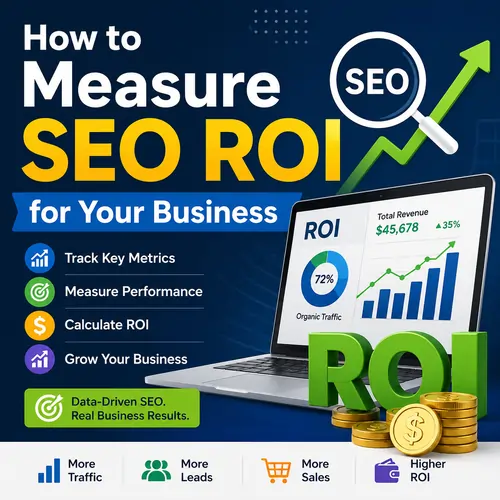
SEO ROI (Return on Investment) measures how much revenue your SEO efforts generate compared to your total investment.
Simple Formula:
SEO ROI = (Revenue from SEO – Cost of SEO) ÷ Cost of SEO × 100
This formula helps answer a key business question:
👉 “Is my SEO strategy actually making money?”
For a deeper breakdown of ROI fundamentals in marketing, you can refer to this resource:
👉
Why Measuring SEO ROI Matters
Measuring SEO ROI helps you move beyond vanity metrics and focus on real business growth.
Key Benefits:
- Understand what’s working in your SEO strategy
- Allocate budget more effectively
- Identify high-performing keywords and pages
- Improve decision-making with data
- Justify SEO investment to stakeholders
Without measuring ROI, SEO becomes guesswork.
Key Metrics to Track for SEO ROI
To accurately measure SEO ROI, you need to track four major categories of metrics.
1. Traffic Metrics (Top of Funnel)
These show how many users are discovering your website through search engines.
- Organic traffic
- Impressions
- Click-through rate (CTR)
- Keyword rankings
You can track these using tools like Google Analytics and Google Search Console.
If you’re new to tracking organic traffic, this guide is useful:
👉
2. Engagement Metrics
Traffic alone is not enough—you need to know how users behave.
- Bounce rate
- Average session duration
- Pages per session
High engagement indicates your content matches search intent.
3. Conversion Metrics
These metrics connect SEO to actual business outcomes.
- Leads generated
- Form submissions
- Purchases
- Conversion rate
Understanding conversion tracking is crucial. Learn more here:
👉
4. Revenue Metrics
This is where SEO becomes measurable in financial terms.
- Revenue from organic traffic
- Average Order Value (AOV)
- Customer Lifetime Value (CLV)
How to Calculate SEO ROI (Step-by-Step)
Let’s break this down into a simple, actionable process.
Step 1: Calculate Revenue from SEO
Using Google Analytics, track how many conversions come from organic traffic.
Example:
- Organic visitors: 10,000
- Conversion rate: 2%
- Customers: 200
- Average sale: $50
Revenue = $10,000
Step 2: Calculate SEO Costs
Include everything:
- SEO tools (like Ahrefs or SEMrush)
- Content creation
- Technical SEO
- Agency or in-house costs
Example:
- Tools: $300
- Content: $1,000
- SEO expert: $1,200
Total = $2,500
Step 3: Apply the Formula
SEO ROI = ($10,000 – $2,500) ÷ $2,500 × 100 = 300%
That means every $1 invested returns $3.
Best Tools to Measure SEO ROI
Choosing the right tools is essential for accurate tracking.
Recommended Tools:
- Google Analytics – Traffic and conversion tracking
- Google Search Console – Search visibility
- Ahrefs – Backlinks and keyword tracking
- SEMrush – Competitive analysis
For a comparison of SEO tools, you can check:
👉
Attribution Challenges in SEO
SEO ROI is not always straightforward.
Common Issues:
- Multi-touch journeys
- Delayed conversions
- Cross-device behavior
- Assisted conversions
To understand attribution models better, explore:
👉
Factors That Affect SEO ROI
Several variables influence your results.
Key Factors:
- Keyword intent
- Competition level
- Content quality
- Technical SEO
- User experience
Google emphasizes helpful content—learn more here:
👉
9 Proven Ways to Improve Your SEO ROI
1. Target High-Intent Keywords
Focus on keywords that lead to conversions.
2. Optimize Existing Content
Update pages that already rank.
3. Improve User Experience
Better UX = higher conversions.
4. Build High-Quality Backlinks
Authority improves rankings and trust.
5. Use Data-Driven Content Strategy
Base content on search intent and keyword data.
6. Align SEO with Business Goals
Traffic without revenue is meaningless.
7. Improve Conversion Rate (CRO)
Optimize landing pages.
8. Focus on Topic Clusters
Build authority in your niche.
9. Track Performance Consistently
SEO is ongoing, not one-time.
How to Report SEO ROI Effectively
Clear reporting helps stakeholders understand SEO value.
Best Practices:
- Use dashboards
- Highlight revenue impact
- Show growth trends
- Simplify technical data
Common Mistakes to Avoid
- Focusing only on rankings
- Ignoring conversions
- Underestimating costs
- Expecting quick results
Conclusion
SEO ROI is not just about rankings—it’s about real business impact.
By using tools like Google Analytics and Google Search Console, tracking the right metrics, and continuously optimizing your strategy, you can turn SEO into one of your most profitable marketing channels.
In today’s competitive digital landscape, businesses that measure and improve SEO ROI consistently are the ones that win on search engines—and in revenue.
Frequently Asked Questions
1. How long does it take to see SEO ROI?
SEO ROI typically takes 3 to 6 months to become noticeable, but in competitive industries, it may take 6 to 12 months or longer. Results depend on factors like domain authority, competition, and content quality.
2. Can small businesses achieve a positive SEO ROI?
Yes, small businesses can achieve strong SEO ROI by targeting local SEO keywords, optimizing Google Business profiles, and focusing on high-intent, low-competition keywords.
3. Is SEO ROI higher than paid advertising ROI?
SEO often delivers a higher long-term ROI than paid ads because traffic continues even after the initial investment, unlike ads that stop when spending ends. However, paid ads provide faster short-term results.
4. How do you measure SEO ROI for lead generation businesses?
For lead-based businesses, SEO ROI is measured by:
- Number of qualified leads
- Conversion rate
- Average deal value
- Lead-to-customer conversion rate
You assign a monetary value to each lead to calculate ROI.
5. What is a good SEO ROI percentage?
A good SEO ROI varies, but many businesses aim for at least 200% to 500% ROI. High-performing campaigns can exceed this depending on efficiency and industry demand.
6. How do you track offline conversions from SEO?
Offline conversions can be tracked by:
- Using unique phone numbers (call tracking)
- Asking customers how they found you
- Integrating CRM systems with tools like Google Analytics
7. Does blogging increase SEO ROI?
Yes, consistent blogging improves SEO ROI by:
- Increasing organic traffic
- Targeting more keywords
- Building authority and trust
- Supporting internal linking strategies
8. How important is mobile optimization for SEO ROI?
Mobile optimization is critical because most users browse on mobile devices. A poor mobile experience can reduce rankings, increase bounce rates, and lower conversions.
9. Can you measure SEO ROI without eCommerce tracking?
Yes, by assigning estimated values to:
- Leads
- Form submissions
- Phone calls
- Email sign-ups
This allows ROI calculation even without direct sales tracking.
10. What role does content marketing play in SEO ROI?
Content marketing drives SEO ROI by:
- Attracting organic traffic
- Engaging users
- Supporting conversions
- Building topical authority
11. How often should you measure SEO ROI?
SEO ROI should be reviewed:
- Monthly for performance tracking
- Quarterly for strategic decisions
- Annually for long-term ROI evaluation
12. What industries benefit the most from SEO ROI?
Industries with high ROI potential include:
- eCommerce
- SaaS
- Healthcare
- Real estate
- Local service businesses
13. Does page speed affect SEO ROI?
Yes, faster websites improve:
- User experience
- Conversion rates
- Search rankings
All of which directly impact SEO ROI.
14. How does local SEO impact ROI differently?
Local SEO often delivers faster ROI because it targets high-intent users searching for nearby services, leading to quicker conversions.
15. Can AI tools improve SEO ROI?
Yes, AI tools can improve SEO ROI by:
- Automating keyword research
- Optimizing content
- Enhancing data analysis
- Improving personalization