

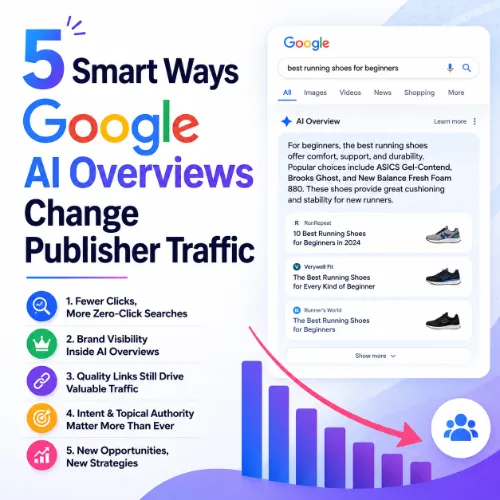
Google AI Overviews publishers Key Takeaways
Google AI Overviews are transforming how search results display information by generating AI-powered summaries at the top of the SERP.
- Google AI Overviews publishers need to rethink content structure and authority signals to stay competitive in the new search landscape.
- Publishers can protect traffic by focusing on E-E-A-T, unique insights, and formats that AI Overviews cannot easily replicate.
- Adaptation is not optional—testing and monitoring performance across affected queries will become a core publishing workflow.
What Google AI Overviews Mean for Publishers Right Now
Google AI Overviews are AI-generated summaries that appear at the top of search results for certain queries, providing users with a synthesized answer without requiring a click. For publishers, this is not just a new SERP feature—it represents a fundamental change in how traffic is distributed. Early data suggests that some queries see click-through rates drop by 30–50% when an AI Overview is present. That means publishers who rely on informational keywords must adapt quickly. For a related guide, see 18 Google SEO Updates You Must Know in 2026 (Essential Guide).
The Google AI Overviews impact extends beyond traffic volume. It also changes user behavior: searchers may find their answer in the summary and leave the SERP with no need to visit a publisher site. For content that ranks well but overlaps with what the AI can summarize, the risk is especially high. The key for publishers is to understand which of their topics are most vulnerable and to adjust content strategy accordingly.
Publishers should also note that AI Overviews are not universal across all queries. They appear more frequently for questions with clear, well-structured answers. This means publishers can still win clicks for complex, opinion-based, or highly original content that requires depth and nuance beyond what a summary can deliver.
5 Smart Ways to Adapt Your Content Strategy for Google AI Overviews publishers
Adapting to AI Overviews requires a shift from producing generic informational content to creating differentiated, authoritative material. Below are five actionable strategies that publishers can implement today.
1. Prioritize Original Research and Unique Data
Original studies, surveys, proprietary data, and exclusive interviews are hard for an AI Overview to replicate. When a publisher’s content contains fresh data or unique analysis, search engines recognize it as a source worth linking to—even if a summary appears above. Publishers should invest in creating one-of-a-kind resources that become the primary reference for a topic. This approach reduces dependency on generic keyword rankings and builds long-term authority.
For example, a publisher covering digital marketing might run an annual survey on industry benchmarks. When Google’s AI summarizes the topic, it may still pull stats from that survey and include a citation, driving referral traffic back to the original source.
2. Strengthen E-E-A-T Signals Through Expert Authorship
Google’s search quality guidelines emphasize Experience, Expertise, Authoritativeness, and Trustworthiness (E-E-A-T). Google AI Overviews for publishers makes E-E-A-T even more critical because the AI relies on high-authority sources to generate summaries. Publishers should clearly display author bios, credentials, and links to professional profiles. Adding reviewer information, expert quotes, and cited references within articles signals that the content is trustworthy and fact-checked. For a related guide, see 9 Emerging SEO Trends After AI Overviews to Watch in 2026.
One practical step is to create author pages with full biographies, publication history, and social proof. Content co-authored with industry experts or academics carries additional weight. Over time, these signals help ensure that when Google’s AI selects sources, your content is among the top candidates for inclusion.
3. Focus on Content Formats That Are Hard to Summarize
Certain formats naturally resist summarization: long-form guides with step-by-step instructions, interactive tools, case studies with specific outcomes, video tutorials, and opinionated analysis. Publishers should identify their most valuable topics and convert them into these deeper formats. For instance, an article on “how to start a podcast” could become a multi-part guide with downloadable checklists, audio clips, and community discussion—all elements that an AI Overview cannot fully encapsulate.
By offering a complete experience, you increase the likelihood that users will click through even if an AI Overview is present. The goal is to shift from being a source of answers to being a destination for learning and application.
4. Monitor Queries Where AI Overviews Appear and Adjust Content
Publishers must actively track which queries trigger AI Overviews and how their content performs on those SERPs. Tools like Google Search Console, third-party rank trackers, and manual checks can reveal patterns. Look for drops in click-through rate and impressions on key pages. When you detect a decline, consider adding unique sections that address sub-topics, include original quotes, or offer contrasting viewpoints that the AI overview may not cover.
You can also test schema markup such as FAQ and HowTo structured data to increase the chances of your content appearing in rich results even when an AI Overview is present. Structured data helps Google understand the depth of your content and can lead to more granular inclusion.
5. Build Brand Authority Through Community and Backlinks
AI Overviews often cite well-known, trusted domains. Smaller publishers can compete by building a recognizable brand in their niche. This involves consistent publishing, active engagement on social platforms and forums, guest posting on established sites, and earning backlinks from authoritative sources. When Google’s AI sees consistent references to your brand across the web, it increases the likelihood of your content being featured in summaries.
Link building focused on topical relevance—rather than generic domain authority—is especially effective. A publisher covering renewable energy will benefit more from a backlink from an academic institution or government site than from hundreds of low-quality links. Over time, this targeted authority helps insulate your traffic from the negative effects of AI Overviews.
SEO Entities and Their Functions
Understanding key SEO entities helps publishers measure and improve their presence in AI Overviews. Below are the most relevant for this topic:
- Website / Domain entities: Root domain and subdomain analysis reveals whether AI Overviews affect your entire site or only specific sections, such as a blog subfolder.
- Keyword entities: Organic keywords, search volume, and keyword difficulty (KD) show which terms are most at risk. Queries with high volume and low KD may become AI Overview targets.
- SERP entities: AI Overviews, featured snippets, and People Also Ask boxes are the new SERP components publishers must monitor. Understanding which features appear for your keywords helps prioritize content changes.
- Backlink entities: Referring domains, dofollow vs. nofollow links, and lost links affect domain authority, which influences whether Google trusts your site as a source for AI summaries.
- Content entities: Published dates, author authority, and social shares signal freshness and editorial quality—both important for AI Overview selection.
- Technical SEO entities: Core Web Vitals, indexability, and crawl issues ensure your content is accessible. If Googlebot cannot crawl your page, it will never be considered for an AI Overview.
Useful Resources
For further reading on AI Overviews and publisher strategies, visit these trusted sources:
- Google Search Central: AI Overviews documentation – Official guidance from Google on how AI Overviews work and what signals matter.
- Search Engine Land: How AI Overviews affect publisher traffic – In-depth analysis and data from industry experts.
Frequently Asked Questions About Google AI Overviews publishers
What exactly are Google AI Overviews?
Google AI Overviews are AI-generated summaries that appear at the top of search results for certain queries. They synthesize information from multiple sources to provide a direct answer without requiring a click.
How do Google AI Overviews affect publisher traffic?
For queries where an AI Overview appears, click-through rates can drop significantly—often by 30–50%—because users find their answer in the summary. Publishers with strong authority and unique content may still get referral traffic from source citations.
Which types of content are most at risk from AI Overviews?
Informational content that answers a straightforward question with a single, widely accepted answer is most at risk. Content that relies on unique data, opinion, or step-by-step instructions is generally safer.
Can publishers still rank well even with AI Overviews?
Yes. Publishers can rank well by focusing on E-E-A-T, original research, and content formats that are hard to summarize. Google’s AI still cites authoritative sources, and ranking in the top organic results remains possible.
Should I remove content that is summarized by AI Overviews?
Not necessarily. If the content drives brand awareness, backlinks, or serves as a foundation for deeper articles, keep it. Consider expanding it with unique analysis or merging related posts to create a more comprehensive resource.
How can I check if my content appears in an AI Overview?
You can use Google Search Console to monitor impressions and clicks. Additionally, perform manual searches for your target keywords and look for the AI Overview box. Some third-party SEO tools now track AI Overview visibility.
Does structured data help with AI Overviews?
Yes. FAQ and HowTo structured data can help Google understand your content’s structure, which may increase the chance of being referenced in an AI Overview or other rich results.
What is E-E-A-T and why does it matter for AI Overviews?
E-E-A-T stands for Experience, Expertise, Authoritativeness, and Trustworthiness. Google uses these signals to evaluate content quality. High E-E-A-T makes your site more likely to be cited as a source in AI Overviews.
Do AI Overviews appear for every search query?
No. AI Overviews appear only for certain queries where Google’s systems determine that an AI-generated summary would be helpful. They are more common for informational queries with clear answers.
Can I opt out of having my content used in AI Overviews?
As of now, publishers cannot opt out of being included in AI Overviews. However, you can use the nosnippet meta tag to prevent any snippet from appearing, though this is a drastic step that affects all search appearances.
How do AI Overviews impact mobile vs. desktop traffic?
AI Overviews appear on both mobile and desktop, but the layout differs. On mobile, the overview takes up more screen space, often pushing organic results further down, which can reduce clicks more dramatically.
What should I do if my traffic drops due to AI Overviews?
Analyze which pages and queries are affected. Strengthen those pages with unique content, improve E-E-A-T signals, and consider creating newer, more authoritative resources. Diversify traffic sources beyond organic search.
Are AI Overviews considered a form of featured snippet?
No. While both present information at the top of SERPs, AI Overviews are generative and synthesize multiple sources, whereas featured snippets pull a specific passage from a single site. They are separate SERP features.
How long do AI Overviews take to appear for a new query?
Google gradually rolls out AI Overviews. A new query may not trigger an overview immediately; it can take weeks or months after Google’s systems analyze enough content and relevance signals.
Can backlinks protect my site from AI Overview traffic loss?
Indirectly, yes. Strong backlinks improve domain authority and trust signals, making your content more likely to be cited as a source. This can lead to referral traffic even if the AI Overview captures the main answer.
Should I target long-tail keywords to avoid AI Overviews?
Long-tail keywords often trigger AI Overviews less frequently because they are more specific. However, if a long-tail query has a clear answer, it may still get an overview. Focus on depth and uniqueness rather than just keyword length.
What role do images and videos play in AI Overviews?
AI Overviews can include images and video links. Pages with high-quality, relevant media may be more attractive for inclusion. Videos are especially useful for “how-to” queries where visual demonstration adds value.
How do AI Overviews affect local search results?
For local informational queries (e.g., “best coffee shop in Austin”), AI Overviews may still appear, but local pack results also show. Publishers with strong local SEO and verified Google Business Profiles can maintain visibility.
Will AI Overviews replace traditional organic results?
No. AI Overviews complement organic results. They are designed to answer simple questions quickly, but complex or transactional queries still drive users to websites. The balance may shift, but organic listings remain essential.
What is the best long-term strategy for publishers facing AI Overviews?
Build a strong brand, invest in original content, diversify traffic sources (email, social, direct), and focus on user experience. Publishers that become trusted destinations for deep, actionable information will thrive regardless of SERP changes.







