Choosing between a gTLD vs ccTLD might be the most consequential domain decision you make. Get it right and you’ll accelerate growth in your target markets. Get it wrong and you’ll spend years fighting uphill battles for visibility and trust.
A gTLD (Generic Top-Level Domain) like .com works globally, while a ccTLD (Country Code Top-Level Domain) like .uk targets specific countries. Search Engine Journal reports that Google’s John Mueller has clarified the strategic differences between these domain types, particularly for international businesses.
After 18 years managing domains across 10+ countries, I’ve seen businesses thrive by choosing the right domain type and struggle by choosing wrong. The decision isn’t about which type is “better.” It’s about which aligns with your business model, target audience, and growth strategy.
Table of Contents
Understanding gTLDs: Generic Top-Level Domains
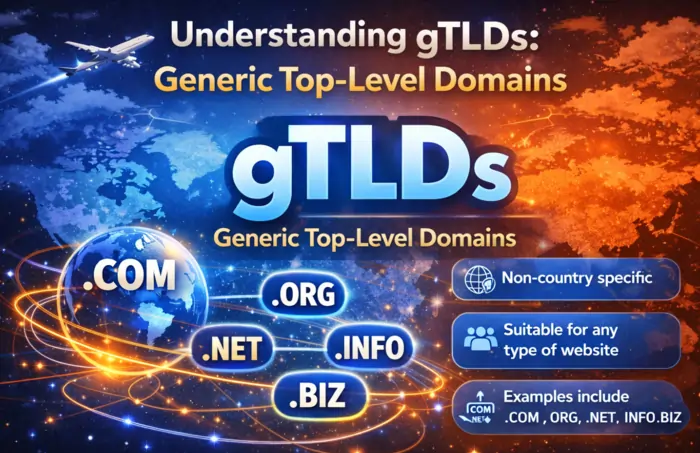
Generic top-level domains are extensions not tied to any specific country. Anyone, anywhere can register them.
Common gTLD Examples
The most recognized gTLDs include .com (commercial), .org (organization), .net (network), .edu (education), and .gov (government).
Newer gTLDs from ICANN’s expansion include industry-specific options like .tech, .shop, .app, and .blog. By Q2 2025, generic TLDs accounted for the majority of global domain registrations.
How gTLDs Signal to Search Engines
According to Webnic, gTLDs tell search engines that your website is neutral geographically. You’re not targeting one specific country. You’re open to traffic from anywhere on the planet.
This geographic neutrality works perfectly for businesses serving international audiences or planning global expansion.
Understanding ccTLDs: Country Code Top-Level Domains
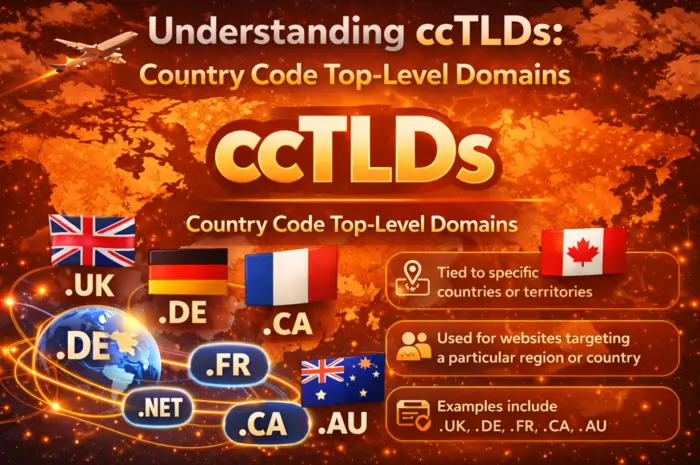
Country code top-level domains use two-letter codes based on international country standards. Each nation has its designated extension.
Common ccTLD Examples
Popular country codes include .uk (United Kingdom), .de (Germany), .ca (Canada), .au (Australia), .jp (Japan), and .fr (France).
By mid-2025, ccTLD registrations reached 143.4 million globally. Despite the rise of gTLDs, country-specific domains remain incredibly popular.
How ccTLDs Signal to Search Engines
Webnic explains that ccTLDs tell search engines your website targets a specific country. This geographic signal can boost your visibility in local search results for that nation.
When someone in Germany searches for your product category, a .de domain gets preferential treatment in German search results compared to a generic .com.
gTLD vs ccTLD: The Key Differences
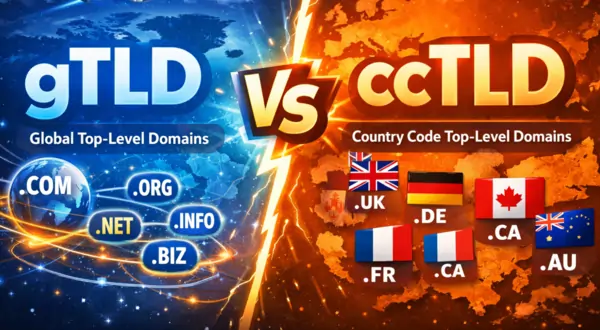
The strategic differences between these domain types affect everything from SEO to brand perception.
Geographic Targeting
gTLDs: No automatic geographic association. Search engines treat them as globally focusedunless you manually set targeting in Google Search Console.
ccTLDs: Automatic country-specific targeting. Search engines inherently understand that .uk domains serve UK audiences, .de serves German audiences, and so on.
SEO and Local Search Performance
gTLDs: Better for ranking globally across multiple countries simultaneously. One domain can rankin many countries without creating separate websites.
ccTLDs: Superior for ranking in specific local markets. Miromind’s research shows that ccTLDs give you heightened visibility in country-specific local searches because they signal direct relevance to local searchers.
Trust and Credibility Signals
gTLDs: Communicate international presence and global reach. The .com extension carries universal recognition and trust across all markets.
ccTLDs: Build stronger local trust and brand loyalty. PixelToKIG research confirms that consumers feel more confident buying from domains matching their country code.
Domain Authority and Link Equity
gTLDs: All backlinks and authority consolidate into one domain. SearchVIU explains that pages on the same domain benefit from each other’s links better than pages on different domains.
ccTLDs: Each country domain builds separate authority. Links to your .uk site don’t directly benefit your .de or .fr sites.
For a comprehensive understanding of how TLD types work, read What Is a TLD? Understanding Domain Extensions in SEO.
Advantages of gTLDs (Generic Domains)
Generic top-level domains offer compelling benefits for certain business models.
Centralized SEO Authority
The biggest advantage according to SearchVIU is consolidated link equity. Every backlink to any page on your domain strengthens your entire site. You build one powerful domain instead of fragmenting authority across multiple country-specific sites.
This centralization means your content marketing, PR efforts, and link building all compound into a single, increasingly powerful domain.
Lower Operational Costs
Running one gTLD requires less budget than managing multiple ccTLDs. You maintain one website, one content management system, one technical infrastructure.
Multiple ccTLDs essentially mean running separate websites for each country, multiplying your hosting, development, and content costs.
Simpler International Expansion
Adding new country targeting with a gTLD means creating new subdirectories (example.com/de, example.com/fr) or subdomains (de.example.com, fr.example.com). This approach is faster and cheaper than registering and building out new ccTLD sites for each market.
Better for Global Brands
GMR Web Team research shows that gTLDs make branding much easier for businesses building international recognition. A single .com domain works everywhere without explaining different extensions to different markets.
Increased Creativity and Uniqueness
With new gTLDs from ICANN’s expansion, businesses have unprecedented branding opportunities. Extensions like .tech, .shop, .studio, and .app let you craft memorable domain names that align perfectly with your industry.
This creativity helps you stand out from competitors while maintaining global accessibility.
Disadvantages of gTLDs
Generic domains aren’t perfect for every situation.
Weaker Local Market Signals
The neutrality that makes gTLDs global also means you don’t get automatic local preference in country-specific searches. You must work harder to convince search engines and users that you serve their market.
Requires Manual Geo-Targeting Setup
Unlike ccTLDs that automatically signal geographic focus, gTLDs need manual configuration. You must implement hreflang tags correctly, set geographic targeting in Search Console for subdomains/subdirectories, and ensure proper technical implementation.
Mistakes in hreflang or geo-targeting can confuse search engines about which version serves which country, especially for pages in the same language targeting different markets (UK vs US English, for example).
Less Trust in Some Local Markets
Certain countries show strong preference for local ccTLDs. Consumers in these markets may perceive .com domains as foreign or less trustworthy than their country’s extension.
Risk of Generic Branding
Online On Time warns that pure generic domains (like “shoes.com”) can endanger brand seriousness. They’re harder to differentiate from competitors and more vulnerable to copycats than unique branded names.
Advantages of ccTLDs (Country Code Domains)
Country-specific domains deliver powerful benefits when targeting defined geographic markets.
Superior Local Search Rankings
The primary advantage according to HostPapa is higher SEO value for country-based search results. Search engines return different results based on the searcher’s IP address and location, giving ccTLDs preferential treatment in their respective countries.
Miromind research confirms that ccTLDs rise up the rankings in country-specific organic searches because they display clear affiliation to that market.
Stronger Local Trust and Credibility
PixelToKIG’s research shows that ccTLDs are good for credibility and give visitors more confidence. When customers see a domain matching their country, they consider the website local and trustworthy.
The ccTLD appeals directly to consumers’ sense of brand loyalty and trust in local products. An Indian customer searching for products responds more positively to Amazon.in than Amazon.com because the local extension suggests locally relevant offerings.
Better Content Localization Match
Customers are happier according to Miromind because their intent is more likely satisfied by a ccTLD than a generic domain. Local consumers want local products, local pricing, local shipping options, and local customer service.
A ccTLD domain signals all of these before users even click.
Fewer Registration Restrictions
PixelToKIG notes that ccTLDs often have fewer restrictions compared to some gTLDs. Registration requirements are typically less stringent, making it easier to secure your desired domain name.
Additionally, ccTLDs may have fewer regulations regarding content and website management, providing more flexibility.
Supports Digital Infrastructure Development
OffshoreDedi explains that nations using ccTLDs create incentives for digital infrastructure development. Businesses choosing local domains promote enhanced internet services and technology development, creating a stronger digital atmosphere.
The revenue from ccTLD registration often feeds back into community support, cybersecurity improvements, and educational programming.
Disadvantages of ccTLDs
Country-specific domains come with significant drawbacks for certain business models.
Fragmented SEO Authority
The biggest disadvantage according to SearchVIU is that each ccTLD builds separate authority. Links pointing to your .uk domain don’t strengthen your .de or .fr domains. You’re essentially building multiple separate websites.
This fragmentation means your SEO efforts don’t compound. You must build authority from scratch in each market.
Significantly Higher Operational Costs
Running multiple ccTLDs requires more budget than managing a single gTLD. Each country domain is literally a separate website needing separate hosting, development, content creation, and ongoing maintenance.
Multiply your web development costs by the number of markets you serve.
Complex Management and Coordination
Managing five or ten separate country websites creates enormous operational complexity. Different hosting setups, separate Google Search Console properties, individual analytics configurations, and coordinated content updates across all properties.
The administrative overhead alone can overwhelm small teams.
Slower International Expansion
Entering new markets with ccTLDs means registering new domains, building new websites, creating localized content, and building authority from zero. This process takes significantly longer than adding a new subdirectory to an existing gTLD.
Risk of Confusing Customers
If you operate multiple ccTLDs without careful brand coordination, customers may not realize they’re related. Someone who discovered your .uk site may not find your .de site when traveling or relocating.
For more detail on how different TLD types impact SEO performance across markets, see TLDs Explained: How Domain Extensions Affect SEO Rankings.
When to Choose a gTLD
Generic top-level domains make strategic sense for specific business models and goals.
You’re Building a Global Brand
Choose a gTLD when your audience spans multiple countries and you want one unified brand identity worldwide. Companies like Amazon, Google, and Netflix use gTLDs because they serve customers everywhere.
A single .com domain communicates global presence and international accessibility.
You Have Limited Resources
If budget constraints matter, one gTLD with subdirectories for different markets (example.com/uk, example.com/de) costs far less than maintaining separate ccTLD websites for each country.
Small teams can manage one website far more effectively than multiple country-specific sites.
You Want Consolidated SEO Authority
When you prefer all backlinks flowing into one domain, gTLDs excel. Every piece of content, every earned link, every brand mention strengthens the same domain.
This consolidation creates compounding returns. Your domain gets stronger with each piece of content and link.
You’re in Tech or Digital Services
Newer gTLDs like .tech, .app, or .io signal innovation and technical sophistication. These extensions work particularly well for SaaS companies, tech startups, and digital service providers.
Your industry-aligned TLD becomes part of your brand story.
You Need Fast Market Expansion
Adding new country targeting with subdirectories or subdomains happens quickly. You can launch a new market in weeks rather than months.
This speed gives you competitive advantages in fast-moving industries.
When to Choose a ccTLD
Country code domains deliver superior results in specific strategic scenarios.
You Serve One Primary Country
If your business operates primarily within one country, a ccTLD is often the best choice. Local businesses, regional retailers, and country-specific services benefit enormously from the local trust signal.
A German company serving only German customers wins with a .de domain.
Local Trust Is Critical
In markets where consumers strongly prefer local businesses, ccTLDs build immediate credibility. Financial services, healthcare, legal services, and government-related businesses benefit from the trust signal.
The country code extension tells customers you’re one of them, not a foreign company.
You Have Market-Specific Offerings
When your products, pricing, inventory, and services differ significantly by country, separate ccTLDs make operational sense. Amazon uses country-specific domains (Amazon.uk, Amazon.de, Amazon.fr) because each market has completely different product catalogs, fulfillment systems, and customer experiences.
The separate domains reflect genuinely separate businesses.
You Want Maximum Local SEO Advantage
If ranking in local search results is your primary goal, ccTLDs provide an advantage. The automatic country targeting signal helps you compete against local businesses on their home turf.
This advantage matters most in competitive markets where every ranking factor counts.
You Can Afford Separate Operations
Large companies with resources to maintain multiple websites, create localized content, and build separate authority in each market can leverage ccTLDs effectively.
If you have country-specific teams managing each market, separate ccTLD websites align with your organizational structure.
The Hybrid Approach: Using Both gTLDs and ccTLDs
Many sophisticated international businesses don’t choose one or the other. They use both strategically.
How the Hybrid Strategy Works
Register your primary brand as a gTLD (.com) and use it as your global domain. Simultaneously register ccTLDs for your most important markets. This defensive registration protects your brand across geographies.
You can then decide market by market whether to redirect the ccTLD to your gTLD or build separate localized sites.
When Hybrid Makes Sense
Large e-commerce companies often use this approach. They might run separate ccTLD sites (Amazon.uk, Amazon.de) for major markets while redirecting smaller market ccTLDs to appropriate subdirectories on their .com domain.
This gives you flexibility to invest heavily in localization for your biggest markets while maintaining presence everywhere else.
Managing the Transition
Google’s phasing out of ccTLD preference according to Heroes of Digital means the SEO advantages of ccTLDs are shrinking. More businesses are consolidating from multiple ccTLDs into single gTLDs with well-implemented hreflang, proper geo-targeting, and strong localization.
If you’re running multiple ccTLDs, consider whether consolidation into a gTLD structure would simplify operations without sacrificing local relevance.
Technical Implementation Considerations
Regardless of which domain type you choose, proper technical implementation determines success.
For gTLD International Sites
Proper implementation according to Heroes of Digital requires:
URL structure: Subfolders (example.com/sg) tend to be more SEO-friendly than subdomains (sg.example.com) because they share authority.
Hreflang tags: Implement them properly for every version of your site. No copy-paste jobs with broken syntax.
Canonical tags: Ensure you’re not cannibalizing your own rankings across regions.
Language declarations and structured data: These help reinforce your target market to search engines.
Manual geo-targeting: Set geographic targeting in Google Search Console for each subdomain or subdirectory.
For ccTLD Sites
Managing ccTLDs according to SearchVIU requires:
Separate Search Console properties: Each ccTLD needs its own property for monitoring and optimization.
Independent hosting: Consider hosting each ccTLD in its target country for faster load times.
Localized content: Translate and culturally adapt content rather than just copying from your main site.
Country-specific link building: Build authority separately for each ccTLD through local backlinks.
Coordinated updates: Maintain consistency across sites while adapting to local needs.
Real-World Examples and Case Studies
Understanding how major companies approach gTLD vs ccTLD decisions provides valuable insight.
Amazon’s Multi-ccTLD Strategy
Amazon operates separate ccTLDs for major markets: Amazon.com (US), Amazon.co.uk (UK), Amazon.de (Germany), Amazon.fr (France), Amazon.jp (Japan), and more.
This approach works for Amazon because they have completely different product catalogs, fulfillment networks, and customer experiences in each country. The separate domains reflect genuinely separate businesses.
Google’s gTLD Approach
Google uses Google.com globally with country-specific subdirectories and interfaces (google.com/intl/de/, google.com/intl/fr/). They maintain ccTLD redirects (google.de redirects to google.com with German interface) for convenience.
This gTLD-centered approach consolidates all authority into Google.com while still serving localized experiences.
When Companies Switch from ccTLDs to gTLDs
SearchVIU documents cases where companies consolidated multiple ccTLDs into a single gTLD structure. Success factors included proper 301 redirects, excellent hreflang implementation, and strong localized content.
The companies switching to gTLDs typically prioritized operational simplicity and consolidated authority over maximum local market signals.
Making Your gTLD vs ccTLD Decision
After reviewing the strategic considerations, advantages, and disadvantages, here’s how to decide.
Assess Your Business Model
Are you truly international or primarily local? Do you serve multiple countries equally or focus on one primary market?
Local businesses almost always win with ccTLDs. Global brands typically benefit from gTLDs.
Evaluate Your Resources
Can you afford to build and maintain separate websites for each country? Do you have the team capacity to create localized content and build authority in multiple markets simultaneously?
Limited resources favor gTLDs. Abundant resources enable ccTLD strategies.
Consider Your Growth Trajectory
Where will your business be in five years? If you’re currently focused on one country but planning international expansion, starting with a gTLD might save you from complex migrations later.
Scalability often favors gTLDs.
Analyze Your Competition
What domain strategies do successful competitors use? Industry norms matter because they shape customer expectations.
If everyone in your industry uses ccTLDs, bucking that trend requires strong justification.
Test and Measure
For major markets, consider testing both approaches. Run a ccTLD in one country and a gTLD subdirectory in another similar market. Measure which performs better for your specific business.
Data beats theory every time.
For strategic guidance on combining your domain type decision with the perfect domain name, read TLDs Explained: How Domain Extensions Affect SEO Rankings.
Key Takeaways: gTLD vs ccTLD
The choice between generic and country-code domains shapes your international strategy for years.
gTLDs consolidate authority, reduce costs, and simplify operations. They work best for global brands, resource-constrained businesses, and companies prioritizing scalability.
ccTLDs maximize local trust, boost country-specific search rankings, and align with market-specific operations. They excel for region-focused businesses, industries where local credibility matters, and companies with resources for separate market management.
Neither option is universally superior. The right choice depends on your specific business model, target markets, resources, and strategic goals.
The domain decision you make today will influence your growth trajectory for years. Choose based on where you’re going, not just where you are now.
More SEO Insights from Jin Grey
On Domain Strategy:
- What Is a TLD? Understanding Domain Extensions in SEO – Complete breakdown of TLD types, how they work, and what they mean for your website
- TLDs Explained: How Domain Extensions Affect SEO Rankings – Complete analysis of gTLDs, ccTLDs, and new domain extensions with data-backed insights on how each type impacts search performance
More SEO Blogposts
- How to Choose the Perfect Domain Name for Your Brand in 2026
- The Calm SEO Framework: Building a Long-Term SEO Strategy Without Panic
- What Google Actually Rewards (And What It Ignores) in 2026
- Why Chasing SEO Trends Is Killing Your Rankings
- The Difference Between SEO Noise and Real Ranking Signals
- Why SEO Still Works in 2026 (If You Ignore the Noise)
- SEO Was Never the Problem. The Noise Was.
- My SEO Story: 18 Years of Survival, Strategy, and Success
- GEO vs. SEO: How to Rank in the Era of Answer Engines
- How to Rank When AI Answers Steal Your Clicks (2026 SEO Guide)
- SEO Without Traffic: How People Make Money in 2026