Google core update SEO Key Takeaways
Google’s latest core update reinforces the importance of helpful content and user-first design.
- Google core update SEO now prioritizes pages that demonstrate genuine expertise and satisfy user intent over those that simply optimize for keywords.
- Page experience signals like Core Web Vitals remain important but no longer guarantee top positions without strong content relevance.
- Actionable adjustments include reviving thin content, improving internal linking, and monitoring backlink quality for unnatural patterns.
What SEO Adjustments for the Latest Google Core Update
Google releases several core updates each year, each refining how the search engine evaluates and ranks content. The latest update is no exception. It places a heavier emphasis on content that truly serves the reader, penalizing pages that exist simply to rank for a keyword. For SEO professionals and site owners, this means a shift away from purely technical tactics and toward holistic quality. For a related guide, see 5 Risks of Googles Latest Algorithm Update: Protect Your SEO Now.
If your site saw a drop in traffic after the update, it may not be due to a technical penalty. Instead, Google likely determined that competing pages deliver a more complete or trustworthy answer. Understanding the SEO impact of Google core update is the first step to recovering and strengthening your organic presence.
The core update does not target specific types of sites, but it does reward those that demonstrate topical authority, reliable sourcing, and a clear focus on the user’s intent. For example, a health information page might now be outranked by a hospital’s official site if the hospital’s content is more medically vetted. This is why every adjustment you make must start with a content quality audit.
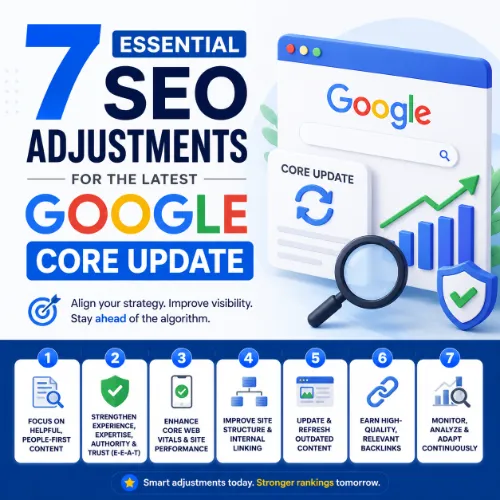
7 Actionable Adjustments for Google Core Update SEO
Below are seven proven strategies to help your site adapt to the Google core update SEO changes and maintain or improve your search rankings.
1. Audit Your Content for Helpfulness and Expertise
Begin by reviewing your highest-traffic pages and those that lost visibility. Ask: Does this page provide a complete answer? Does it include original insight, data, or a personal perspective? Google’s Helpful Content system now heavily rewards content that is clearly created by or with input from someone with real expertise. For a legal advice page, for example, including a lawyer’s byline and credentials is now a strong ranking signal.
Remove or substantially rewrite pages that are thin, overly generic, or that simply restate what multiple other sites say. Combine related posts into a single authoritative guide rather than leaving many shallow pages alive.
2. Improve Core Web Vitals Without Obsessing Over Perfect Scores
Page experience signals still matter, but Google has clarified that a perfect Lighthouse score is not a ranking requirement. Instead, focus on fixing genuine user-harming issues: large layout shifts that cause misclicks, slow loading times on mobile, and unresponsive buttons. Use the PageSpeed Insights lab data for guidance, but prioritize real-user metrics from the Chrome User Experience Report. A fast, stable experience combined with great content is a powerful combination for Google core update SEO.
3. Strengthen Your Internal Linking Structure
Core updates often reward sites that help users navigate to relevant content naturally. Review your pillar content and ensure that related supporting articles link to it with descriptive anchor text. Likewise, pillar pages should link out to those supporting articles. This creates topic clusters that signal authority to Google. Use a tool like a site auditor to find orphan pages (pages with no internal links) and decide whether to link to them or remove them.
4. Monitor Backlink Profiles for Unnatural Patterns
The update has also tightened Google’s handling of link spam. Check your backlink profile for sudden spikes of low-quality or irrelevant links, especially from sites in different languages or unrelated niches. Use the disavow tool only if you have a clear spam attack — otherwise, focus on earning a few high-quality, contextually relevant links each month. A clean, natural link profile is a core component of Google core update SEO resilience.
5. Refresh Outdated Content and Add Fresh Data
Google values recency and freshness more in some verticals than others. For topics like “best SEO tools 2025,” an article from 2022 is likely outdated. Update your pages with the current year, new statistics, and revised recommendations. Add a “last updated” date visible to readers. This not only helps rankings but also builds trust with your audience, which indirectly supports engagement metrics.
6. Optimize for User Intent, Not Just Keywords
The SEO impact of Google core update is most visible in queries where the top results now match the search intent more precisely. For a query like “SEO tools for beginners,” Google favors tutorials that compare 5–7 tools with use cases, not a list of 50 tools. Review your target keywords and ensure that your content format matches what searchers actually want: guides, product comparisons, how-to steps, or listicles. Use the People Also Ask section and related searches to identify missing intent signals.
7. Keep Your UX Simple and Ad-Free
Intrusive ads, autoplay videos with sound, and pop-ups that block the main content now hurt rankings more than ever. Google’s page experience update made this official, but core updates continue to reinforce it. Ensure your ads do not push content below the fold aggressively. Use responsive design that respects text size preferences from the device settings. A clean, readable layout encourages visitors to stay longer, reducing bounce rate and improving your site’s perceived quality.
How to Monitor the Google Core Update SEO Impact
To track how the update affects your site, compare your organic traffic week over week using Google Search Console. Look specifically at top pages by clicks and impressions to identify which queries lost or gained positions. Also check the “Queries” report for changes in average position for your most valuable keywords. For a deeper analysis, use a tool like Ahrefs or SEMrush to examine changes in keyword rankings and traffic value.
Remember that fluctuations during a core update rollout are normal. Wait at least two weeks after the update completes before making major changes. This gives the algorithm time to settle. Then implement the adjustments above and monitor again.
Useful Resources
For more detailed guidance on recovering from a core update, visit Google’s official core updates page. To analyze your site’s content quality and backlink profile, consider using Ahrefs’ suite of SEO tools.
Frequently Asked Questions About Google core update SEO
What is a Google core update ?
A Google core update is a broad change to Google’s search algorithms that can significantly affect how websites rank. These updates aim to improve search relevance and user satisfaction by promoting high-quality content over low-quality content.
How often does Google release core updates?
Google typically releases multiple core updates per year, often every few months. Major updates are announced on Google’s official search status dashboard, and they usually take one to two weeks to fully roll out.
What should I do if my rankings drop after a core update?
First, wait for the update to complete. Then audit your content for quality and relevance, improve page experience signals, and strengthen your backlink profile. The seven adjustments described in this article are a great starting point.
Does a Google core update affect all sites equally?
No, the impact varies by industry, content quality, and site authority. Sites with thin or unoriginal content are more likely to be affected, while those with strong expertise and user-focused design tend to remain stable or improve.
Can I recover from a core update penalty?
Yes. If your site’s content genuinely serves users well, recovery is possible by improving content depth, removing low-value pages, and earning high-quality backlinks. It may take until the next core update to see full recovery.
How does Google measure content quality?
Google uses a combination of human quality raters and algorithmic systems to evaluate E-E-A-T (Experience, Expertise, Authoritativeness, Trustworthiness). Factors include content accuracy, sourcing, author credentials, and user satisfaction metrics.
Do backlinks still matter after a core update?
Yes, backlinks remain a strong ranking factor. However, Google now places more weight on the contextual relevance and quality of the linking site rather than just the number of links. Unnatural link patterns can still hurt rankings.
Is page speed a ranking factor?
Yes, page speed is part of Google’s page experience signals, which include Core Web Vitals. While not the most important factor, a slow page can hurt rankings, especially for mobile searches. Aim for good real-user metrics rather than perfect lab scores.
How long does a core update take to roll out?
Most core updates take about one to two weeks to fully deploy. During that time, rankings may fluctuate as the algorithm recalculates. Google announces the start and completion of major updates on its search status page.
Should I pause my SEO efforts during a core update?
No, continue your regular SEO work. However, avoid making major site-wide changes during the rollout, as it can be hard to attribute any resulting traffic changes to your actions versus the update itself.
What is the difference between a core update and a spam update?
A core update aims to improve search result relevance across all types of content, while a spam update specifically targets pages that violate Google’s spam policies, such as keyword stuffing or cloaking. Both can affect rankings.
Do featured snippets change during a core update?
Yes, because featured snippets are pulled from top-ranking pages. As rankings shift, the snippets can change to reflect new winning content. Reviewing snippets for your key queries can give you early insight into ranking changes.
Can local SEO be affected by a core update?
Yes. Core updates affect organic search results, but local pack results can also shift if the underlying organic ranking signals change. Local SEOs should focus on maintaining accurate Google Business Profiles and local content. For a related guide, see AI Studio Updates and Their Impact on Content Ranking Strategies.
What tools should I use to track core update impact?
Google Search Console is the most essential tool for monitoring clicks, impressions, and average position by query. Third-party tools like Ahrefs and SEMrush help track ranking changes across a broader set of keywords.
Is it true that YMYL sites are more affected?
Yes, sites that cover Your Money or Your Life (YMYL) topics such as health, finance, and safety are subject to higher quality standards. Core updates often lead to stricter evaluation of these pages, requiring more expertise and trust signals.
Should I delete old blog posts?
Not automatically. Review each old post individually. If it contains outdated but correct information, update it. If it is irreparably thin or irrelevant, redirect it to a more comprehensive page or 404 it after ensuring traffic is low.
Does Google core update affect paid search ads?
No, core updates only influence organic search results. They do not affect Google Ads or paid search rankings. However, if organic traffic drops, you may choose to adjust your PPC strategy to maintain overall visibility. For a related guide, see Google Core Update Winners and Losers: What Changed After the Core Update?.
How can I future-proof my site for upcoming core updates?
Focus on building genuine expertise in your niche. Invest in original research, encourage author bylines with credentials, improve site navigation, and maintain a clean backlink profile. A user-first approach is the most resilient strategy.
What are Core Web Vitals exactly?
Core Web Vitals are a set of three user experience metrics: Largest Contentful Paint (loading time), First Input Delay (interactivity), and Cumulative Layout Shift (visual stability). They are part of Google’s page experience ranking signals.
Can a core update improve my rankings without any action?
Yes, if your site consistently provides high-quality content that matches user intent, you may see rankings improve even without making changes. However, proactive adjustments often help accelerate recovery or growth.