Zero click content is the only way to stay visible when AI Overviews, featured snippets, and answer engines now resolve over 60% of Google searches without a single website visit.
Brands that master answer engine optimization (AEO) by writing concise, question‑based answers, formatting comparison tables, and adding FAQ schema are winning AI citations inside ChatGPT, Perplexity, Microsoft Copilot, Claude, and Gemini – earning trust and downstream conversions even with zero clicks. This guide delivers a complete framework for creating zero click content that ranks, gets cited, and builds authority in 2026.
For years, success in SEO meant one thing: clicks. The more people clicked your link, the better. But something has quietly broken that equation. Roughly 60% of Google searches now end without a click on any website, and for informational queries that number can climb to over 70% . In 2026, zero click search no longer describes a niche behaviour – it describes the default way most people now find answers online.
This guide explains exactly what zero click content is, why it matters more than ever, and how to write answers that rank, get cited inside AI engines, and keep your brand visible even when no one clicks.
Defining Zero Click Content: The New Atomic Unit of Visibility
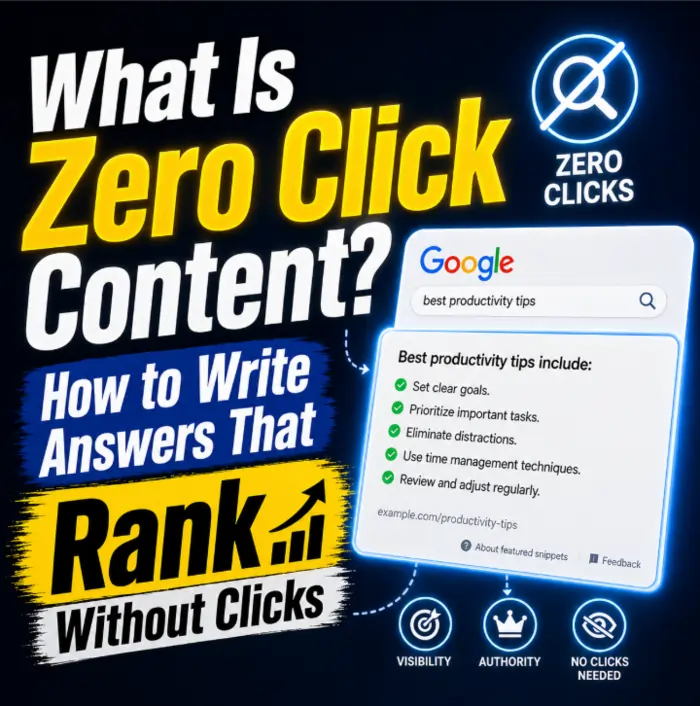
Zero click content is information specifically structured to be consumed directly on the search engine results page (SERP) or inside an AI platform, without requiring the user to visit a website. It is the opposite of traditional content marketing, which assumes a click is the first step. Zero click content assumes the click may never come – and prepares your brand to win anyway.
In practice, zero click content appears in several forms: a concise paragraph answer inside a featured snippet, a row inside a comparison table, a step inside a numbered list for a “how to” query, or a citation inside an AI Overview summarizing information from multiple sources. According to research from the Pew Research Center, only 1% of users click a link inside an AI Overview, versus 15% for the same query when no overview is shown. That difference represents a fundamental reordering of how traffic is distributed.
The Three Forces Crushing the Click Economy
1. AI Overviews (Google)
Google’s AI Overviews now appear in roughly 47% of search results and are most common on informational queries (approximately 58% coverage) and question‑format queries (around 86% coverage). When an AI Overview appears, the click‑through rate for the first organic result drops by an average of 34.5%. A randomized field experiment found AI Overviews reduced outbound organic clicks by 38% on triggered queries, with zero‑click search rising from 54% to 72%.
2. Answer Engines (ChatGPT, Perplexity, Copilot, Gemini, Claude)
Standalone answer engines go a step further: they give complete, confident responses in conversational interfaces, often without showing any links at all. According to McKinsey, unprepared brands may see traffic declines of 20–50% as AI search reshapes discovery. Answer engines compress what used to be a multi‑step journey into a single moment of decision, and often that moment includes no click.
3. Traditional SERP Features (Featured Snippets, People Also Ask, Knowledge Panels)
Even before AI Overviews, featured snippets were already taking clicks. Today, featured snippets contribute significantly to the zero‑click dynamic, where roughly 60% of Google searches are zero‑click. When a featured snippet fully answers a question, the user gets what they need and leaves. When it provides only partial information (e.g., comparisons, pricing, “best of” lists), clicks can still exceed 42% for transactional queries.
For a deeper breakdown of query‑specific CTR patterns, refer to our guide on Featured Snippet Optimization: Steal Position Zero in 7 Steps , which includes detailed decision frameworks for choosing when to optimise for views versus clicks.
Rethinking “Ranking”: Why Being Cited Matters More Than Position #1
The old maxim “the best place to hide a dead body is page two of Google” no longer captures how search works. A page ranking #5 can be cited inside an AI Overview. A page ranking #1 can be ignored. More importantly, a user who never clicks but sees your brand cited in three different AI Overviews over a week is far likelier to search for your brand directly the following week.
That pattern – assisted conversion – has become the hidden ROI of zero click content. A user searches “how to fix slow WordPress site”, sees your brand cited in an AI Overview without clicking. Five days later, when their site crashes, they search for your brand name directly. Your content assisted that conversion without ever receiving the initial click. According to SparkToro research, the first citation in an AI Overview receives, on average, 28% of the residual clicks that do happen – which makes earning that first position inside AI answers a highly valuable objective even in a zero‑click environment.
For a detailed methodology on tracking these assisted metrics, see our dedicated resource on AI Citation Tracking: How to Measure Your Brand’s Share of Voice in ChatGPT & Gemini.
## Zero Click Content: A 4‑Step Framework for Writing Answers That Rank and Get Cited
Zero click content follows different rules from traditional content. Below is a four‑step framework you can apply to any page to make it more quotable, more citable, and more visible across search engines and AI platforms.
Step 1: Target Queries with a High Zero‑Click Probability
Not every query is worth optimising for zero‑click visibility. You need to identify keywords where:
- AI Overviews or featured snippets are already present in the SERP (tools like Ahrefs, SEMrush, and Google Search Console allow you to filter by “SERP features”);
- Search intent is informational or question‑based (e.g., “what is,” “why does,” “how to,” “who”);
- Search volume is meaningful (at least 100−500 monthly searches);
- Transactionality is low – users are learning, not buying.
If a keyword triggers a transactional SERP (e.g., “buy,” “pricing,” “discount”), zero‑click optimisation is generally less effective because users are more likely to click through. For commercial or transactional queries, you should instead use a hybrid approach – a short answer block for visibility plus a compelling hook that drives clicks to your product or service pages.
Step 2: Write a Front‑Loaded Answer Block (40–60 Words)
The single most important element of zero click content is the front‑loaded answer block. This is a concise, standalone answer placed within the first 100 words of your page, ideally directly under a question‑format H2 heading.
Structure of an effective answer block:
- Length: 40‑60 words (any longer and AI engines may truncate it);
- Format: Complete sentence(s) that require no additional context;
- Placement: Immediately after the heading, before any fluff or scene‑setting sentences;
- Avoid: Hedging language (“it depends,” “in many cases,” “generally speaking”) – AI engines interpret hedging as low‑confidence content and are less likely to cite it.
Example:
Question‑format H2: “What is zero click content?”
Answer block: Zero click content is information structured to be consumed directly on the SERP or inside an AI platform, without requiring a user to click through to a website. It appears as featured snippets, AI Overview citations, knowledge panels, and voice assistant answers. Its goal is visibility and brand lift, not immediate clicks.
If the specific query requires a list, bullet point breakdown, or comparison table, use the appropriate formatting immediately after the answer block.
To see this technique applied across different types of SERP features – including paragraph snippets, list snippets, and table snippets – read our comprehensive guide on Feature Snippet Optimization .
Step 3: Build Supporting Content That Reinforces, Not Replaces, the Block
Once the answer block is in place, the rest of your page serves a different purpose than it would in traditional SEO. Instead of slowly building toward the answer, you should immediately build out from it.
Effective supporting elements include:
- Explanation expansion – After the answer block, provide the “why behind the what” in 2–3 concise paragraphs, each focused on a single sub‑point;
- Comparison tables – For “X vs Y” queries, a properly formatted HTML table (
<td>) allows AI engines to extract row‑by‑row comparisons. Google’s structured data documentation includes specific examples of how to mark up tables for extraction; - Numbered steps – For “how to” queries, an ordered list (
<ol>) with 3–5 clear steps, each starting with an action verb; - Relevant statistics – Fresh data (ideally less than 12 months old) increases the likelihood that AI Overviews will cite your page for time‑sensitive queries.
Step 4: Add Structured Data So AI Engines Can Parse Your Content Correctly
Structured data acts as a set of instructions for Google’s extractor and LLMs. For zero click content, the most valuable schema types are:
- FAQPage schema – For question‑and‑answer pairs. Each
QuestionandAnswerpair becomes a candidate extraction point for AI Overviews and voice answers; - HowTo schema – For step‑by‑step instructions. Includes
stepandinstructionproperties that tell AI engines exactly where your steps begin and end; - Product schema – For ecommerce queries; includes
review,aggregateRating, andoffersproperties that can appear in rich snippets; - Organization and Author schema – AI Overviews increasingly cite sources with strong entity signals. Pages with clear
OrganizationandAuthormarkup are more likely to be attributed correctly.
If you are unfamiliar with schema implementation, the Ahrefs SERP features glossary provides a detailed breakdown of each feature type and the schema that supports it.
Comparison Tables, Q&A Blocks, and Schema: The Technical Backbone
AI Overviews and answer engines particularly favour structured, scannable content. Comparison tables, bullet‑point Q&A blocks, and proper HTML lists give extraction systems clear reading paths.
Comparison Tables
For queries involving comparisons (“HubSpot vs Salesforce,” “best CRM software”), a table is the most effective format. Place the table directly under a question‑format H2, keep the number of rows to 3–5, and use clear, scannable cell content.
FAQ Blocks
An FAQ section at the end of your page serves two purposes: it captures long‑tail conversational queries, and when marked up with FAQPage schema, it provides pre‑packaged extraction units for Google’s AI. Each question‑answer pair should be 40–100 words and include specific, verifiable claims rather than vague generalities.
If you are already optimising for featured snippets or AI Overviews, you are essentially building zero click content – the overlap is significant. For a full walkthrough of how these disciplines work together, see our pillar guide on Zero Click SEO .
Common Zero Click Content Mistakes (And How to Avoid Them)
❌ Burying the Answer
Pages that open with “In today’s digital landscape…” or “For many businesses, the question of…” before delivering the answer will lose AI extraction opportunities entirely. Lead with your conclusion. Supporting context belongs after the answer block.
❌ Using Hedging Language
Phrases like “it depends,” “in many cases,” “typically,” and “generally speaking” signal to AI engines that your content lacks a definitive answer. For queries that genuinely depend on context, use conditional framing but still state the most common scenario first, then “however, if X, then Y.”
❌ Making Answers Too Long (or Too Short)
Paragraph answers longer than approximately 60 words are often truncated by Google’s extractor. Answers shorter than 40 words rarely provide enough context to be considered complete. The sweet spot is 40–60 words.
❌ Ignoring Schema
Many SEOs still view schema as “optional.” For zero click content, it is not optional. FAQPage, HowTo, and Product schema are directly used by AI engines during the extraction process. Implementing them can be the difference between being cited and being ignored.
❌ Not Tracking Assisted Conversions
Teams that measure only direct clicks will underestimate the value of zero click content. You should also track branded search lift (monitoring whether branded queries increase after earning AI citations), direct traffic changes, and “assist” outcomes in analytics platforms that attribute conversions to touchpoints that do not end in a click.
How Zero Click Content Feeds the LLM Citation Loop
ChatGPT, Perplexity, Microsoft Copilot, Claude, and Gemini are all powered by large language models (LLMs). When a user types a question into an answer engine, the LLM retrieves relevant passages from the web (a process called retrieval‑augmented generation, or RAG) and then generates a synthesized answer while citing its sources. Pages that are structured as zero click content – with clear answers, question‑format headings, and schema – are far easier for LLMs to parse and cite.
This creates a self‑reinforcing loop: the more you are cited by LLMs, the more training data those models have about your brand’s expertise, which can improve your relevance signals across all platforms that use those same training data. In 2026, this loop represents one of the most significant competitive advantages available to content publishers.
For a forward‑looking analysis of where this trend is headed – including AI‑only search and AI agents that never click – read our in‑depth piece on The Future of SEO in 2027: AI-Only Search, Agents, and Zero Clicks .
Tools to Build, Optimise, and Measure Zero Click Content
- Google Search Console – Filter by “Search appearance: AI Overview” and “Search appearance: Featured snippet” to see which queries are already surfacing your content in zero‑click formats;
- Ahrefs / SEMrush – SERP feature filters allow you to identify keywords where AI Overviews or featured snippets are present but your page is not yet cited;
- Schema Markup Generator (Merkle) – A free tool to generate FAQPage, HowTo, and Product schema without coding;
- Geoptie’s GEO Audit – A free audit tool that assesses your site’s AI search readiness and surfaces actionable insights;
- BrightEdge / Seer Interactive Research – Regular industry‑wide tracking reports on AI Overview coverage and citation patterns.
To understand the big‑picture economic forces driving the explosion of zero‑click search, read Gartner’s 2026 predictions on why traditional click‑through metrics are becoming obsolete for an increasing number of decision‑making journeys: Gartner’s 2026 search predictions.
For an authoritative technical reference on which SERP features trigger zero‑click behaviour and how each feature type extracts content, consult Search Engine Land’s featured snippet guide: Search Engine Land featured snippet guide. Additionally, the latest WordStream SEO statistics provide fresh 2026 data on CTR trends across different SERP feature configurations: WordStream 2026 SEO statistics.
If you want to dive deeper into AI‑specific strategies for earning citations inside ChatGPT and Perplexity, refer to our detailed companion article: How to Optimize for AI Overviews: A 2026 Tactical Guide , which covers the five critical extraction signals that Google’s Gemini model uses when selecting sources.
Conclusion: Winning the Era of Zero Click Search
Zero click content is not a concession to algorithmic change. It is an intentional strategy for staying visible when clicks can no longer be the only currency that matters. Brands that master zero click content will own the answer space inside AI Overviews, featured snippets, and LLM citations. They will build brand recognition that drives downstream conversions, even when users never click today. And they will be prepared for the next stage of search – AI‑only interfaces and AI agents – where clicking is not even an option.
Start with one page. Add a 40‑word answer block under a question‑format H2. Add an FAQ section with schema. Monitor your Search Console impressions. Then scale what works.
Now go build content that wins even when no one clicks.
Frequently Asked Questions (FAQs)
1. What is zero click content?
Zero click content is information structured to be consumed directly on the search engine results page (SERP) or inside an AI platform, without requiring a user to click through to a website.
2. How is zero click content different from traditional content?
Traditional content assumes a click is the first step and optimises for click‑through rate. Zero click content assumes the click may never come and optimises for visibility, brand lift, and assisted conversions.
3. What types of zero click content exist?
Common types include featured snippets (paragraph, list, table, video), AI Overview citations, knowledge panels, People Also Ask boxes, voice assistant answers, and comparison tables.
4. How do I find keywords where zero click content makes sense?
Use Google Search Console, Ahrefs, or SEMrush to filter by “SERP features.” Look for keywords where AI Overviews or featured snippets already appear and where search intent is informational or question‑based.
5. Do I need to rank #1 to be cited in an AI Overview?
No. 46.5% of cited URLs rank outside the top 10 organic results. However, pages that rank in the top 5 are significantly more likely to be cited.
6. What is the ideal length for a zero click answer block?
40–60 words, placed directly below a question‑format H2 heading, within the first 100 words of the page. The answer must be complete and standalone.
7. Does zero click content still drive brand value without clicks?
Yes. Being cited builds brand recognition, which leads to branded search lift, direct traffic, and assisted conversions. A user who sees your brand cited in three AI Overviews over a week is likelier to search your brand name later.
8. What is an assisted conversion in the context of zero click search?
An assisted conversion occurs when a user sees your brand cited in an AI Overview or featured snippet without clicking, but later searches your brand directly or converts through another channel because of that exposure.
9. Do I need schema markup for zero click content?
Strongly recommended. FAQPage, HowTo, Product, and Organization schema help AI engines parse your content correctly and increase the likelihood of citation.
10. Can I repurpose existing content as zero click content?
Yes. Audit existing pages that rank on page one. Add a front‑loaded answer block (40‑60 words), reformat supporting content with bullet points or tables, and add FAQ schema. Then monitor for extraction in Search Console.
11. What is the difference between zero click SEO and zero click content?
Zero click SEO is the broader discipline of optimising for zero‑click environments. Zero click content is the specific output – the actual answers, tables, and structured data you create.
12. Does zero click content work for ecommerce?
Yes, but with a different approach. For commercial queries like “best wireless earbuds under $100,” zero click optimisation should focus on capturing the first citation in AI Overviews and using comparison tables that leave enough unanswered to drive click‑through to product pages.
13. How do I measure the success of zero click content?
Track SERP impression share (are you appearing in more zero‑click features?), branded search lift (are more users searching your brand name?), direct traffic changes, and assisted conversion metrics in analytics platforms.
14. What is retrieval‑augmented generation (RAG) and why does it matter?
RAG is the process by which LLMs retrieve relevant passages from the web to augment their internal knowledge before generating an answer. Content that is well‑structured for extraction is more likely to be retrieved and cited.
15. Can ChatGPT or Perplexity help me optimise zero click content?
Yes. You can prompt an LLM to analyse a competitor’s zero click content and suggest improvements to your own content in terms of clarity, depth, formatting, and factuality.
16. How often should I refresh zero click content?
For time‑sensitive topics, update content every 3 months. Pages updated in the last 3 months are 3x more likely to be cited in AI Overviews. For evergreen queries, a full audit every 6 months is sufficient.
17. Does internal linking affect zero click citation odds?
Yes. Strong internal links from high‑authority pages to your zero click‑targeted page help Google’s AI understand which page on your site is most authoritative for a given topic.
18. Will AI Overviews kill zero click content?
No. AI Overviews are the primary driver of zero click search. Zero click content is the solution to staying visible inside them. The two are complementary.
19. What is the single fastest way to start with zero click content today?
Take one existing page that ranks in positions 2–5 for an informational keyword. Add a 40‑word answer block under a question‑format H2 at the top of the page. Add an FAQ section with schema. Wait 2‑4 weeks, then check Google Search Console for appearance changes.
20. Will zero click content become less relevant as AI search evolves?
No. As search moves toward AI‑only interfaces and AI agents, the ability to be retrieved and cited will become more important, not less. Zero click content skills are future‑proofing skills for the next decade of search.