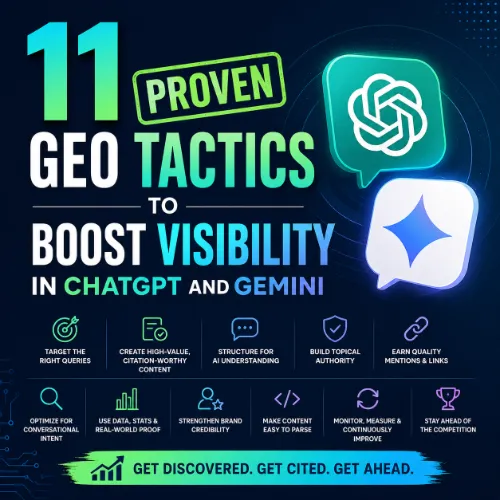
GEO tactics Key Takeaways
Generative engine optimization (GEO) is the new frontier for brands aiming to appear in AI-generated answers from ChatGPT, Gemini, and similar platforms.
- GEO focuses on creating authoritative, clearly structured content that AI models cite directly.
- Trust signals like author bios, citations, and fresh data are critical for AI model selection.
- Structured data and conversational question answering boost your chances of appearing in AI overviews and chat responses.
Why Traditional SEO Tactics Fall Short for AI Search
Classic search engine optimization targets Google’s ranking algorithms—link profiles, keyword density, and domain authority. While those still matter for organic traffic, AI models like ChatGPT and Gemini work differently. They rely on pattern recognition across trusted datasets, not just backlink counts. If your content lacks clarity, authority signals, or direct answers, the AI will skip it in favor of a more structured source. That’s why dedicated GEO tactics have become essential for brands that want to improve visibility in ChatGPT and Gemini. For a related guide, see 10 Proven Geo-SEO Tactics to Boost Your Local Search Rankings.
Tactic #1: Structure Content for Direct Answers
AI models extract short, precise snippets when a user asks a question. If your article buries the answer in a long paragraph, the model might miss it. Use clear subheadings, bullet points, and short paragraphs that answer one specific query at a time. For example, if you’re writing about “how to reduce bounce rate,” include a sentence like “Three effective ways to reduce bounce rate include improving page speed, simplifying navigation, and matching content to search intent.” This gives the AI a ready-made citation.
Tactic #2: Publish Authoritative Author Bios
AI models increasingly check the credibility of the author behind the content. Every article you publish should include a byline with a short bio that lists the author’s credentials, industry experience, and links to other authoritative work. This signals to models like ChatGPT that the information comes from a reliable human source, not a generic content mill.
Tactic #3: Leverage Structured Data Markup
Schema markup helps AI platforms understand the context of your content. Use FAQ schema, HowTo schema, and Article schema on relevant pages. For example, a well-structured FAQ section with JSON-LD markup makes it easier for Gemini to pull a direct answer into its AI overview. This is one of the most technical but high-impact GEO tactics for brands that want to improve visibility in ChatGPT and Gemini.
Tactic #4: Cite Trusted External Sources
AI models favor content that references authoritative third-party data. When you make a claim, link to a credible source such as a government report, peer-reviewed study, or established industry publication. This not only builds trust with human readers but also signals to the AI that your content is fact-based and not fabricated.
Tactic #5: Write with Conversational Question Intent
Many users phrase queries as full questions: “How do I optimize my site for AI search?” Your content should include these exact questions as subheadings, followed by a clear, succinct answer. This technique increases the likelihood that the AI model will match your content to the user’s natural language query. It also aligns with the way both ChatGPT and Gemini process conversational prompts.
Tactic #6: Update Content Regularly with Fresh Data
AI models prioritize recency, especially for topics where information changes quickly. Set a content refresh schedule—every three to six months—for your high-value pages. Update statistics, examples, and references. A timestamp showing “Last updated: March 2025” at the top of the article tells the AI that your content is current and trustworthy.
Tactic #7: Build a Strong Entity Association Network
AI models map entities (people, brands, concepts, locations) and the relationships between them. Strengthen your entity associations by consistently linking related articles on your site and using internal links with descriptive anchor text. For example, if you run a marketing blog, link from a post about “content strategy” to your post about “AI search trends.” This creates a topic cluster that AI models recognize as comprehensive authority.
Tactic #8: Optimize for AI Overviews with Summary Paragraphs
AI overviews often appear at the top of search results, pulling content from a single page. Write a concise summary paragraph at the beginning of each article that encapsulates the main takeaway. Keep it between 40 to 60 words. This paragraph becomes a prime candidate for AI citation because it provides a clean, self-contained answer.
Tactic #9: Remove Content Ambiguity and Jargon
AI models can misinterpret vague language or industry jargon. Replace ambiguous phrases with specific, measurable terms. Instead of saying “many companies benefit from this strategy,” say “a 2024 Ahrefs study found that 68% of SaaS companies saw a traffic increase after implementing structured data.” Precision improves the AI’s confidence in using your content as a source.
Tactic #10: Publish Authoritative Guest Content on High-DR Domains
Being mentioned or cited on a site with high Domain Rating (DR) builds your brand’s overall digital authority. AI models often weigh these citations heavily. Contribute guest articles to respected industry publications, and ensure your author bio includes a link back to your site. The more your brand appears alongside authoritative sources, the more likely AI models will treat you as a primary reference.
Tactic #11: Monitor and Adjust Using GEO-Specific Analytics
Track how often your brand appears in ChatGPT and Gemini responses. You can use tools like Brand24 or manual testing with specific prompts. If you notice your brand missing from certain query results, analyze the content that does appear. Adjust your GEO tactics accordingly—for example, by adding a missing question format or including a statistic that the competing source lacks. Continuous monitoring is the key to long-term success as you improve visibility in ChatGPT and Gemini.
Useful Resources
- Ahrefs: Generative Engine Optimization Guide — A solid primer on how GEO differs from traditional SEO.
- Google: Structured Data Documentation — Official guidelines for implementing schema markup, which directly supports GEO efforts.
Frequently Asked Questions About GEO tactics
What are GEO tactics ?
GEO tactics are strategies designed to optimize content for visibility in AI-generated search results, such as those provided by ChatGPT, Gemini, and other large language models.
How is GEO different from traditional SEO?
Traditional SEO focuses on Google’s ranking algorithm, while GEO focuses on making content easily discoverable and citable by AI models that generate conversational answers.
Does GEO work for all industries?
Yes, but it is especially effective for industries where users ask complex, informational questions, such as healthcare, finance, technology, and education.
Do I need schema markup for GEO?
While not strictly required, schema markup significantly increases the chances that an AI model will correctly interpret and cite your content, especially for FAQs and how-tos.
How long does it take to see results from GEO?
Results vary, but many brands report visible improvements in AI-generated citations within 2 to 4 months of consistent implementation.
Can I use GEO tactics on existing content?
Absolutely. Updating older posts with structured data, direct answer paragraphs, and fresh citations can revive their visibility in AI search results.
What role do backlinks play in GEO?
Backlinks from high-authority domains still help because AI models often use the same trust signals that Google does, though the weight is less direct than in traditional SEO.
Do AI models prefer short or long content?
AI models prefer content that directly answers a question in a clear, concise manner, regardless of total article length. Long-form content that is well-structured can still perform well.
Should I optimize for ChatGPT and Gemini separately?
No. The same core principles—clarity, authority, structured data, and conversational Q and A—benefit both platforms equally.
Is GEO a replacement for SEO?
No. GEO complements traditional SEO. You should maintain both strategies to capture traffic from Google search and from AI-generated answers.
How do I check if my brand appears in AI responses?
Manually test relevant prompts in ChatGPT and Gemini, or use third-party monitoring tools like Brand24 or SEMrush that track AI mentions.
What is the most important GEO tactic?
Structuring content for direct answers is the single most impactful tactic because AI models prioritize extractable, concise information.
Does user engagement affect GEO?
Indirectly, yes. High engagement signals (low bounce rate, long dwell time) indicate content quality, which can influence citation trust models.
Can video content help with GEO?
Yes, especially if you transcribe the video and publish the text alongside it. AI models cannot watch videos, but they can index the transcript for answers.
Do social signals matter for GEO?
Not directly, but strong social shares can lead to more backlinks and brand mentions, which indirectly boost your digital authority.
How often should I refresh my GEO content?
Every three to six months for fast-changing topics, and annually for evergreen content, to maintain freshness signals for AI models.
What is the biggest mistake in GEO?
Writing vague, unsourced claims. AI models penalize content that lacks verifiable data or author credibility, making it invisible in responses.
Do I need a technical background to implement GEO?
No. Most GEO tactics involve content structure and authority building, which any skilled writer can implement without coding knowledge.
Will GEO become more important in the future?
Almost certainly. As AI-powered search grows, brands that fail to optimize for it will lose visibility to competitors who adopt these tactics. For a related guide, see 22 Proven GEO Tactics to Earn AI Citations for Your Brand.
Can small businesses benefit from GEO?
Yes. Small businesses with authoritative, niche content often have higher trust density than larger competitors, making them strong candidates for AI citation.