

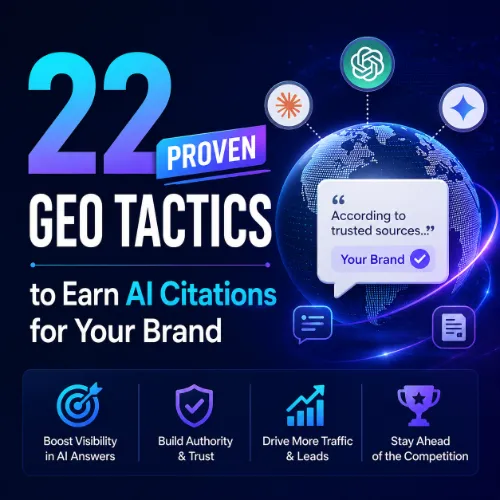
GEO tactics for AI citations Key Takeaways
As AI-powered search and generative engines reshape how users find information, brands that implement GEO tactics for AI citations gain a measurable edge in visibility and trust.
- Understand how generative engines rank and cite sources differently from traditional search.
- Discover structured data, topical clustering, and link strategies that directly boost AI citation frequency.
- Learn to measure and refine your approach using SEO entities and performance data.
Why GEO Tactics for AI Citations Matter Now
Generative engine optimization (GEO) is no longer a futuristic concept. AI models from Google, OpenAI, and Perplexity pull from indexed content to answer user queries. If your brand doesn’t appear in those citations, you lose prime real estate in AI-generated responses. GEO tactics for AI citations focus on making your content the default source for AI training data and live inference.
Traditional SEO targets search engine result pages (SERPs). GEO targets the AI models themselves. That means optimizing for extractability, factual density, and structured markup rather than just rankings. Brands that adapt early see higher referral traffic from AI tools and stronger brand authority signals.
The Shift from Keyword Density to Entity Clarity
AI citation algorithms prioritize content that clearly defines entities—people, places, products, concepts—and their relationships. A page that mixes terms like “GEO tactics” without linking them to specific methodologies or examples loses credibility. Focus on entity clarity first.
22 GEO Tactics for AI Citations That Deliver Results
Each tactic below addresses a specific aspect of how generative engines discover, extract, and cite content. Apply them in order of impact for your niche.
1. Build Topical Clusters Around Core Entities
AI models love completeness. Create content clusters that cover every subtopic related to your core entity. If your brand specializes in “geotechnical SEO,” produce articles on site audits, link profiles, and keyword research—each linking back to a central pillar page.
2. Implement Schema Markup for Every Content Type
Use FAQ, HowTo, Article, and Organization schema. AI crawlers parse schema to extract structured facts. Without it, your facts are just text. Add FAQ schema to your FAQ section and Article schema to blog posts.
3. Write Extractive-Friendly Definitions
Place clear, concise definitions of key terms in the first two paragraphs of any page. For example, if you define “GEO tactics for AI citations” as “strategies to earn mentions in AI-generated search summaries,” include that exact phrase early. AI models scan for these re-usable definitions.
4. Publish Data-Backed Claims with Sources
When you state a statistic or claim, link to a credible external source. AI citation algorithms verify facts against multiple authoritative pages. A claim about “22 proven tactics” gains weight when each tactic links to a case study or research paper. For a related guide, see 14 Site Speed Fixes That Reduced Bounce Rate: Proven Tactics.
5. Optimize for People Also Ask (PAA) Boxes
PAA questions appear in AI overviews. Use tools like Ahrefs or Semrush to find PAA queries in your niche. Answer them directly in your content with a heading that mirrors the question. AI models extract those Q and A pairs for citation.
6. Use Lists and Tables for Structured Data
AI models prefer well-structured lists and tables. Present your 22 tactics as an ordered list with clear headings. Each tactic becomes a candidate for extraction.
7. Create a Dedicated Data and Research Page
Gather original research, surveys, or industry stats on a single page. Cite these throughout your other content. AI models treat that page as a citation hub, increasing your brand’s credibility.
8. Optimize Internal Link Context
Each internal link should include descriptive anchor text that includes the target page’s primary entity. For example, link to your “geotechnical SEO guide” with “learn more about geotechnical SEO” rather than “click here.”
9. Build Topic Authority with External Backlinks
AI citation algorithms analyze the backlink profile of a domain. A page with links from sites like Ahrefs, Moz, or industry publications is more likely to be cited. Focus on earning links from authoritative .edu, .gov, and .org domains.
10. Include Author Bylines with Credentials
Show author expertise with bylines that include relevant credentials, publications, and social proof. AI models consider author authority as a citation signal. Use Author schema with a link to the author’s profile.
11. Structure Content with Clear H2/H3 Hierarchy
AI models parse headings to understand content structure. Use H2 for major sections that each contain a unique facet of your main entity. Subheadings under H2 should be H3. Never skip levels.
12. Embed High-Quality, Cited Images
Images with alt text that describes the image content and includes key terms help AI models understand visual context. Use original infographics or data visualizations and cite them properly.
13. Use Natural Language with Conversational Tone
AI training data includes billions of conversational queries. Writing in a natural, direct tone increases the chance that your content matches spoken or typed questions. Avoid jargon unless you define it.
14. Publish Frequently Updated Content
Freshness is a signal for AI models. Update your core pages every 6-12 months with new data, links, and examples. Show the last updated date on the page.
15. Answer Follow-Up Questions in the Same Page
Anticipate what a reader would ask next. If you explain “what is GEO tactics for AI citations,” answer “how do I measure GEO performance” later on the same page. This creates narrative completeness that AI models prefer.
16. Create a Glossary of Key Terms
A glossary page that defines all your niche terms in a consistent format becomes a citation magnet. Link to it from relevant articles using the term as anchor text.
17. Use Video Transcriptions for AI Learning
If you produce video content, publish full transcriptions. AI models often index the text version of videos better than the video itself. Include citations to your written content within the transcription.
18. Monitor AI Citation Generation Tools
Use tools like Perplexity’s API or Google’s AI Overview testing tools to see if your content appears in AI responses. Track which tactics generate citations and refine accordingly.
19. Build a Wikipedia-Style Knowledge Panel
Create a page that mimics a knowledge panel: concise summary, key facts, image, and links to authoritative sources. AI models pull from such pages for entity descriptions.
20. Claim Your Organization on Data Aggregators
Sites like Crunchbase, LinkedIn, and official business registries are used by AI models to train entity data. Ensure your brand information is accurate and consistent across all platforms.
21. Participate in Industry Roundups and Quotes
When you contribute quotes or insights to roundup articles, those mentions become external citations. AI models index these as evidence of authority. Pitch yourself as a source for relevant topics.
22. Test Your Content with Generative AI Tools
Use ChatGPT, Claude, or Gemini to ask questions about your niche. If your content doesn’t appear in the answers, you know it’s not being extracted. Adjust your structure or entity clarity.
How to Measure GEO Tactics for AI Citations Impact
Measuring GEO success requires different metrics than traditional SEO. Track brand mentions in AI-generated responses using manual queries or third-party tools like Brand24 or Mention. Monitor changes in referral traffic from AI search tools such as Perplexity and Bing Chat. Also watch for increases in direct traffic and branded search volume—signs that users are searching for your brand after seeing it in an AI answer.
SEO Entities and Their Functions
Understanding SEO entities helps you apply GEO tactics for AI citations more effectively. Here are the key entity types and how they support your strategy:
- Domain entities (root domain, subdomain, URL-level) – Identify which parts of your site earn AI citations. Use Ahrefs Site Explorer to compare authority across sections.
- Keyword entities (organic keywords, keyword difficulty, search volume, traffic potential) – Show which queries have citation potential. Focus on questions with high search volume and low keyword difficulty.
- Backlink entities (referring domains, dofollow/nofollow, anchor text) – Help assess which external links boost domain authority for AI extraction.
- Page entities (top pages, best by links, best by traffic) – Reveal which URLs are most likely to be cited. Double down on those.
- Content entities (articles, authors, published dates, social shares) – Signal freshness and editorial quality to AI models.
- SERP entities (featured snippets, PAA, AI Overviews, local packs) – Indicate what answer format the AI prefers. Align your content to match.
- Technical SEO entities (crawl issues, Core Web Vitals, indexability) – Remove obstacles that prevent AI crawlers from accessing your best content.
- Competitor entities (competing domains, content gaps, shared keywords) – Find where rivals earn citations and create better, more complete content.
- Link building entities (link opportunities, unlinked mentions, outreach targets) – Turn authority gaps into citation-building campaigns.
- Metrics entities (Domain Rating, URL Rating, organic traffic, referring domains count) – Summarize your current standing and track progress.
Useful Resources
Dive deeper into GEO and AI citation strategies with these expert resources:
- Ahrefs AI Search Optimization Guide – Comprehensive overview of how to optimize for generative engines.
- Search Engine Journal on GEO Tactics – Latest research and case studies on GEO implementation.
Conclusion: Earn GEO Tactics for AI Citations and Future-Proof Your Brand
Implementing GEO tactics for AI citations is not a one-time project but an ongoing discipline that aligns content strategy with how generative AI models discover, understand, and reference sources. From structuring content with clear heading hierarchies to building topical authority and monitoring citation generation, each tactic strengthens your brand’s presence in the AI-driven search landscape.
Brands that invest in GEO now gain a first-mover advantage as AI-powered search becomes the default. Start with the tactics that address your biggest content gaps, measure your progress, and iterate. The result is a brand that doesn’t just rank—it gets cited.
Frequently Asked Questions About GEO tactics for AI citations
What are GEO tactics for AI citations?
GEO tactics for AI citations are strategies that help brands appear as cited sources in AI-generated search results, overviews, and chatbot answers.
How is GEO different from traditional SEO?
GEO optimizes content for extractability and entity clarity so AI models can easily cite it, while traditional SEO focuses on ranking in SERPs.
Can a brand get AI citations without backlinks?
Yes, but backlinks boost authority and extraction likelihood. GEO tactics for AI citations emphasize both content structure and link authority. For a related guide, see Link Building Tactics: 10 Powerful Ways to Boost Rankings.
Do AI citations drive traffic?
Yes, when a user clicks on an AI-generated citation or summary, they are often redirected to the original source page.
Which schema types help the most with AI citations?
FAQ, HowTo, Article, and Organization schema are most effective for helping AI models extract structured facts.
How long does it take to see results from GEO tactics ?
Some changes, like updating schema, can show impact within weeks. Building topical authority usually takes 3-6 months.
What is entity clarity in GEO?
Entity clarity means defining key terms, proper nouns, and concepts clearly so that AI models can associate them correctly.
Can I use GEO for local SEO?
Absolutely. Local GEO tactics include city-specific pages, local schema, and citations in local business directories. For a related guide, see 10 Proven Geo-SEO Tactics to Boost Your Local Search Rankings.
Do AI models prefer certain content formats?
Yes, lists, tables, and Q and A formats are highly extractable and often preferred for AI-generated answers.
How do I check if my brand appears in AI answers?
Use generative search tools like Perplexity, Google AI Overviews, or Bing Chat to query your brand’s niche topics.
What is a topical cluster?
A group of interlinked pages covering related subtopics that together establish comprehensive authority on a core subject.
Is GEO compatible with Gutenberg and Elementor?
Yes, as long as you use clean semantic HTML without inline styles or unsupported wrappers, GEO content renders properly in both.
Do I need to write differently for GEO vs SEO?
GEO content should be more direct, definition-heavy, and structured for extraction, while both benefit from entity clarity and readability.
Can images help with AI citations?
Yes, images with descriptive alt text and proper attribution can be surfaced in AI visual answers and enhance authority.
What role do author credentials play in GEO?
Author bylines with credentials and links to profiles increase the trust signal for AI citation algorithms.
How often should I update content for GEO?
Update core pages every 6-12 months with fresh data, examples, and links to maintain citation freshness.
Do AI citations affect brand reputation?
Yes, being cited by AI tools positions your brand as an authoritative source, enhancing trust among users.
Is GEO a one-time effort?
No, GEO requires ongoing monitoring, testing, and content refinement as AI models evolve.
Can small brands compete with GEO?
Yes, focusing on niche topics and creating highly extractable, well-structured content level the playing field.
What is the biggest mistake brands make with GEO?
Treating GEO like traditional SEO—without optimizing for entity extraction, structured data, and conversational tone.







