geographic SEO Key Takeaways
Geographic SEO is the practice of optimizing your online presence to attract customers from specific locations.
- Optimizing your Google Business Profile is the single most effective geographic SEO tactic for immediate visibility.
- Local keyword research and localized content help you attract searchers at every stage of the buying journey.
- Building local backlinks and managing online reviews create trust signals that search engines reward.
What Is Geographic SEO and Why It Matters for Local Traffic
When a user searches for “coffee shop near me” or “plumber in Austin,” search engines rely on geographic signals to deliver relevant results. Geographic SEO is the set of tactics that help your website appear in those local search results. Unlike traditional SEO, which targets global or national audiences, geographic SEO focuses on a defined radius — a city, a neighborhood, or even a specific zip code. For a related guide, see 5 Powerful Benefits of Generative Engine Optimization (GEO) for Beginners.
For small businesses, this is critical. According to Google, nearly one-third of all mobile searches are related to location. People searching for local services often have high purchase intent. By implementing strong local SEO strategies, you can ensure your business is the first one they see — and the one they call.
How Geographic SEO Differs from National SEO
National SEO typically targets broad keywords like “best running shoes.” Geographic SEO narrows that to “best running shoes in Denver.” The difference is precision: you’re competing for fewer searches, but the conversion rates are much higher because the searcher is ready to buy nearby.
This means your entire SEO approach shifts. Instead of trying to rank for hundreds of generic terms, you focus on a handful of high-value, location-specific queries. You also need to optimize for Google’s local pack, maps, and reviews — elements that don’t matter for national campaigns.
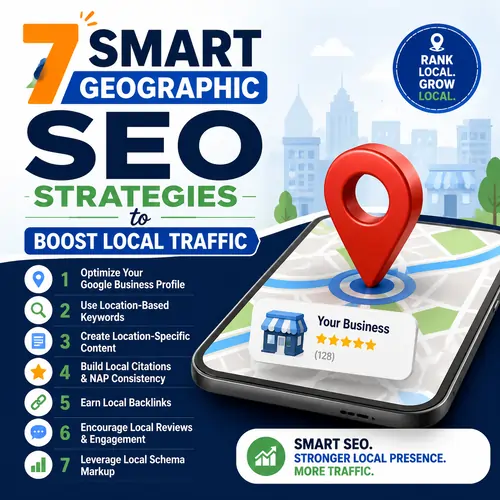
Strategy 1: Optimize Your Google Business Profile (GBP)
Your Google Business Profile is the centerpiece of any geographic SEO effort. It controls how your business appears in Google Maps and the local 3-pack. Without a fully optimized profile, you’ll struggle to rank for local searches regardless of what you do on your website.
Step-by-Step GBP Optimization
Start by claiming and verifying your profile. Then fill out every field completely: business name, address, phone number (NAP), website URL, hours of operation, and categories. Use your primary category carefully — choose the one that best describes your core service.
Next, add high-quality photos of your storefront, interior, and team. Businesses with photos receive 42% more requests for directions and 35% more click-throughs to their website. Finally, post regular updates and offers directly on your GBP — Google rewards active profiles with better visibility.
Common GBP Mistakes
One common error is using a P.O. box or virtual address when your business doesn’t serve customers at that location. Google may suspend such profiles. Another mistake is inconsistent NAP across the web. Every citation — Yelp, Facebook, Yellow Pages — must match your GBP exactly.
Strategy 2: Conduct Local Keyword Research
To increase website traffic with geographic SEO, you need to target the exact phrases local customers use. Generic keywords like “pizza delivery” are too competitive. “Pizza delivery in Buckhead Atlanta” is specific and winnable.
Tools and Methods for Local Keyword Research
Use Google’s Keyword Planner with a location filter set to your city or region. Also check Google Autocomplete — type your service plus “near” or your city name to see real user queries. For example, “dentist near” often suggests “dentist near me open Saturday.”
Don’t ignore long-tail question keywords like “where can I find an emergency vet in Portland?” These have lower search volume but very high conversion rates. Include your primary geographic SEO keyword naturally in titles, meta descriptions, and body content where it reads naturally.
Grouping Keywords by Intent
Separate your keywords into three buckets: informational (“how to fix a leaky faucet”), navigational (“Roto-Rooter Chicago”), and transactional (“book plumber Chicago same day”). Tailor your content for each stage. An informational blog post can lead into a service page that targets the transactional query.
Strategy 3: Create Localized Content at Scale
Search engines love content that demonstrates local expertise. If you run a real estate agency in Phoenix, write about “The Best Neighborhoods in Phoenix for First-Time Homebuyers.” If you own a bakery in Seattle, publish “Where to Find Gluten-Free Pancakes in Seattle.”
Types of Localized Content That Work
Consider these formats: neighborhood guides, “best of” lists, local event calendars, case studies featuring local clients, and interviews with other local businesses. Each piece should include location-specific details — street names, landmarks, local slang. That signals to Google that your content is truly relevant to that area.
Internal Linking with Geographic Context
When you create a page for “Austin Flooring Services,” link to it from your Austin home page, your blog post about “Best Flooring for Texas Humidity,” and your local reviews page. This builds topical authority and sends clear location signals to search engines.
Strategy 4: Earn Local Backlinks and Citations
Backlinks from local websites — like chambers of commerce, local news sites, and community blogs — tell Google your business is an established part of the local landscape. These are among the most powerful local SEO strategies for improving domain authority. For a related guide, see How Backlinks Affect Domain Authority and Rankings.
How to Build Local Backlinks
Start by getting listed in local business directories like Yelp, Angi, and the Better Business Bureau. Then look for sponsorship opportunities with local sports teams or charity events — they often include a link back to your site. You can also offer to write a guest post for a local blog about your industry from a local perspective.
Using Local PR for Links
Reach out to local journalists when you have news — a new location, a community fundraiser, or a unique product. Press releases with local angles can earn high-quality editorial links. Even a link from a small local newspaper’s website can boost your geographic SEO significantly.
Strategy 5: Manage Online Reviews and Reputation
Reviews directly influence local rankings. Google’s algorithm factors in review quantity, recency, and sentiment. A steady stream of positive reviews can help you outrank competitors with weaker reputations.
Best Practices for Review Generation
Ask every satisfied customer to leave a review on your Google Business Profile. Send a follow-up email with a direct link. Never offer incentives — that violates Google’s guidelines. Respond to every review, positive or negative, within 48 hours. A thoughtful response to a negative review can actually improve trust with potential customers.
Dealing with Negative Reviews
Never argue publicly. Apologize, acknowledge the issue, and offer to make it right offline. This shows future customers that you care about service quality. It also prevents the reviewer from posting follow-ups, which would keep the negative review visible longer.
Strategy 6: Optimize for Voice Search and “Near Me” Queries
Voice search is now a major source of local traffic. People ask their phones, “Where’s the best Thai restaurant near me?” or “Find a locksmith open now.” These queries are longer, more conversational, and almost always have local intent.
How to Optimize for Voice Search
Include FAQ sections on your pages that answer common voice queries. For example, “What time does your hardware store close?” Write the answer naturally: “Our hardware store at 123 Main Street closes at 8 PM on weekdays.” Use schema markup for business hours, location, and FAQs to help Google extract those answers for featured snippets.
Targeting “Near Me” Without Overusing It
Instead of stuffing “near me” into every sentence, focus on natural phrasing. “We serve customers in the downtown Chicago area” works better than a robotic “Chicago near me service.” Google understands context — if your GBP address is Chicago and your content mentions Chicago landmarks, you’ll rank for related “near me” queries automatically.
Strategy 7: Track and Measure Your Local SEO Performance
You can’t improve what you don’t measure. Use Google Search Console and Google Analytics to track which local pages are driving traffic. Pay attention to clicks from maps, impressions in the local pack, and phone calls generated by your GBP.
Key Metrics to Monitor
Focus on these KPIs: local search impressions, click-through rate from the local pack, number of direction requests, phone calls from GBP, and conversion rate on local landing pages. Set up call tracking if possible — many local leads happen over the phone rather than through form fills.
Adjusting Your Strategy Based on Data
If a specific page like “St. Louis HVAC Repair” isn’t ranking, check its internal links, content depth, and loading speed. Maybe it needs more local reviews or better schema markup. Use the data to make targeted improvements rather than guessing.
Useful Resources
For further reading on geographic SEO, check out Google’s SEO Starter Guide, which includes a section on local SEO basics. Additionally, Moz’s Local SEO Checklist offers a comprehensive list of on-page and off-page factors to optimize.
Frequently Asked Questions About geographic SEO
What is geographic SEO ?
Geographic SEO is the practice of optimizing your online presence to rank higher in location-based searches, such as “plumber in Seattle” or “coffee shop near me.” It involves tactics like Google Business Profile optimization, local keyword targeting, and earning local citations.
How long does it take to see results from geographic SEO ?
Results vary, but many businesses see noticeable improvements in local search visibility within 60 to 90 days. Quick wins like fixing NAP inconsistencies can help within weeks, while building local authority through backlinks takes several months.
Is geographic SEO only for brick-and-mortar businesses?
No. Service-area businesses like plumbers, cleaners, and consultants also benefit. Even online-only businesses can use geographic SEO if they target customers in specific regions or cities.
Can geographic SEO help increase website traffic from outside my city?
Yes, if you target broader regions like states or metro areas. For example, a hotel in Orlando might optimize for “Florida vacation rentals” to attract visitors from across the state.
What’s the difference between geographic SEO and local SEO?
They are often used interchangeably, but geographic SEO can also refer to targeting broader regions (like “southeast Pennsylvania”) rather than just a single city. Local SEO usually focuses on a specific town or neighborhood. For a related guide, see GEO vs. SEO: How to Rank in the Era of Answer Engines.
Do I need a separate page for each city I target?
Yes, if you serve multiple distinct cities. Create a unique landing page for each location with locally relevant content, customer reviews, and contact information. Avoid duplicating content across pages.
How do I find local keywords for my business?
Use Google Keyword Planner with a location filter, check Google Autocomplete suggestions, and analyze competitor keywords with tools like Ahrefs or Semrush. Also look at your Google Search Console data for queries that already bring traffic.
What is a local citation?
A local citation is any online mention of your business’s name, address, and phone number (NAP). Consistent citations across directories like Yelp, Yellow Pages, and Facebook help improve local search rankings.
How many online reviews do I need to rank locally?
There’s no magic number, but businesses with 25–50 recent, positive reviews tend to outperform those with fewer. Consistency and recency matter more than total count.
Does schema markup help with geographic SEO ?
Yes. LocalBusiness schema markup helps search engines understand your location, hours, and services. It can also enable rich results like star ratings and business hours in search listings.
Should I use a different domain for each city?
Generally, no. Subdirectories (example.com/chicago/) or subdomains (chicago.example.com) work better than separate domains. Multiple domains dilute your authority and require more maintenance.
What is the local pack?
The local pack is the set of three local business listings that appear at the top of Google’s search results for location-based queries. It often includes a map, reviews, and contact details.
How do I optimize for “near me” searches without using that phrase?
Focus on your Google Business Profile accuracy, include local landmarks in content, and use natural phrasing like “serving customers in the downtown area.” Google understands location context from your address and content.
Can social media help with geographic SEO ?
Indirectly. Social media engagement can build brand awareness and generate local links. Posts tagged with location data may also appear in local search results on some platforms.
What’s the most common mistake in geographic SEO ?
Inconsistent NAP across the web is the most frequent issue. Even a small discrepancy like “St.” versus “Street” can confuse search engines and hurt rankings.
Do I need to blog for geographic SEO ?
Blogging helps, especially with locally relevant topics. Each blog post is an opportunity to target a new long-tail keyword and earn links. It also keeps your site fresh in Google’s eyes.
How do I track phone calls from local SEO?
Use a call tracking service like CallRail or Google’s Call Reporting (available in some Google Ads accounts). Track calls that come through your GBP or website to measure conversions.
What is a geo-targeted landing page?
A geo-targeted landing page is a webpage optimized for a specific location, such as “Phoenix Roofing Services.” It includes local keywords, customer testimonials, and location-specific calls to action.
Can geographic SEO work for ecommerce?
Yes, especially for ecommerce stores with physical pickup locations or regional shipping. You can optimize pages for “same-day delivery in Miami” or “free pickup in Austin.”
Should I hire an agency for geographic SEO ?
If you have the budget, an agency with local expertise can accelerate results. However, many tactics like GBP optimization and local keyword research are doable in-house with the right tools and training.