

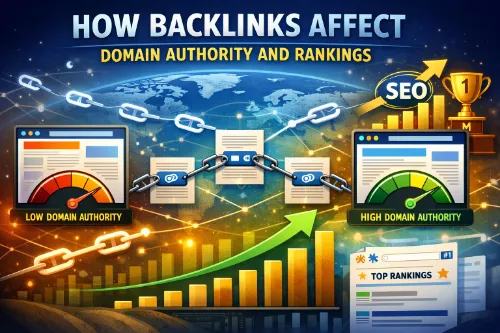
How backlinks affect domain authority and rankings comes down to one core idea: high‑quality, relevant links act like votes of trust that help your whole domain and individual pages rank higher in competitive SERPs. When you combine smart link building with strong SEO services, clean technical foundations, and a clear content strategy, you build an authority engine that compounds over time instead of relying on short‑term tricks.
What Are Backlinks and Domain Authority?
Backlinks are hyperlinks from one website to another, often called inbound links or SEO backlinks, and they remain one of the strongest off‑page ranking signals in modern SEO. When a trusted site links to your content, it tells search engines that your page offers reliable information, which passes “link equity” (link juice) and boosts your perceived authority.
Domain Authority (DA) and Domain Rating (DR) are third‑party metrics that estimate the overall strength of a domain’s backlink profile and its likelihood to rank in search results. While DA/DR are not direct Google ranking factors, they correlate strongly with real‑world visibility because they reflect the quality and quantity of links pointing to your site.
In practice, this means that as your domain earns more high‑quality backlinks from relevant, authoritative sites, your DA or DR tends to rise, and you usually find it easier to rank new content across a wider range of keywords. If you want to understand how all the moving parts fit together, start with foundational resources like technical SEO services and what SEO clients need to know before they commit to a campaign.
Why Backlinks Matter for Rankings
Search engines use backlinks to decide which pages deserve the top positions for any given query, especially when two pages have similar on‑page optimization and content quality. A website with more relevant, high‑quality backlinks usually ranks higher because it appears more trustworthy and useful to users.
Backlinks contribute to how algorithms evaluate importance and relevance within the web graph, working together with your content quality, site structure, and user signals. The more strong links a page earns from reputable sites, the more authority it can accumulate and pass to other URLs via smart internal linking. If you want to squeeze more value from each backlink, tighten your on‑page foundations using on‑page SEO services, follow on‑page SEO basics, and use an on‑page SEO checklist for service‑based websites before you push hard on outreach.
Backlinks also help search engines understand your domain’s topical relevance. If several authoritative industry sites link to your guide on technical optimization, algorithms infer that your content (and domain) can be trusted on that subject. A clean technical SEO audit and regular monitoring of common technical SEO issues ensure your site is technically healthy enough to convert that authority into rankings and traffic.
How Backlinks Affect Domain Authority (and Domain Rating)
Backlinks significantly influence Domain Authority and Domain Rating by shaping your site’s perceived trust, relevance, and link equity profile. As you earn links from high‑DR or high‑DA domains, your own scores tend to improve because these metrics are calculated largely from backlink data.
Two main principles drive this effect:
- Quality over quantity: A single backlink from a strong, niche‑relevant site can have more impact on your DA/DR than dozens of low‑quality links from unrelated blogs or directories. Learning how to evaluate the quality of backlinks helps you focus on the links that truly move the needle.
- Relevance and context: Links from sites that share your topic or local market send clearer topical and GEO signals, which can move both authority metrics and rankings more effectively. For small local brands, combining strategic backlinks with local SEO services for small businesses and local citation building is often the fastest way to see real‑world lifts in calls and leads.
Low‑quality backlinks from spammy, irrelevant, or obviously manipulative sources can dilute your authority and, in some cases, trigger penalties or devaluations. To stay on the safe side, understand the differences between white hat vs black hat SEO link building and make sure your off‑page work is aligned with long‑term compliance rather than quick wins.
Backlink Quality vs Quantity in SEO
From an SEO perspective, backlink quality vs quantity is not a close contest—quality is the clear winner in today’s search landscape. Search engines give greater weight to backlinks that come from reputable, topic‑aligned sites and are placed contextually inside valuable content, not from random guest post farms or low‑effort directories.
However, quantity is not irrelevant. A healthy backlink profile combines:
- A core of high‑authority, trusted referring domains
- A diverse mix of mid‑tier links from relevant blogs, news sites, and resources
- A natural spread of branded, partial‑match, and generic anchor text
This balance helps your backlink profile look organic and robust, supporting better rankings, AI visibility, and long‑term brand authority. If you want help scaling without spam, explore specialist link building services and broader off‑page SEO services that focus on editorial placements and digital PR vs traditional link building rather than link schemes.
Key Backlink Factors That Affect Rankings
Several specific backlink factors influence how strongly your links affect DA/DR and keyword rankings:
- Authority of the referring domain: Links from high‑authority domains carry more link equity and have more impact on both domain‑level and page‑level performance.
- Topical relevance: Backlinks from sites that cover similar topics reinforce your niche and improve topical authority in the eyes of search engines.
- Anchor text: Branded, partial‑match, and natural anchor text help search engines understand what your page is about without looking spammy; over‑optimized exact‑match anchors are risky. To keep this balanced, understand content optimization vs keyword stuffing.
- Placement and context: Editorial links within the main body of unique content are more valuable than links buried in footers, sidebars, or user‑generated comments.
- Link attributes: Follow links pass authority directly, while nofollow, UGC, and sponsored tags can still help with discovery and referral traffic but are weighted differently.
Because on‑page signals and internal links amplify the value of every backlink, it’s smart to strengthen your internal architecture using guidance on how internal linking improves rankings and to optimize landing pages for search engines before pushing link volume.
GEO SEO: Local and International Backlink Signals
GEO SEO focuses on how search engines interpret geographic signals like country, city, and language, and backlinks play a significant role here as well. Links from locally relevant domains (for example, city news outlets, local blogs, and regional directories) help search engines connect your brand with a specific market.
For local SEO, backlinks from chambers of commerce, industry associations, and hyperlocal publishers reinforce that your business serves a particular area. Combining those signals with a well‑optimized Google Business Profile optimization program and strong local SEO ranking factors for multi‑location brands is especially powerful for clinics, law firms, and restaurants. You can see this in practice in resources on how local SEO helps clinics, law firms, and restaurants and in the local SEO audit guide for Philippine businesses.
For eCommerce and larger brands, GEO‑targeted backlinks support international strategies and platform‑specific work like technical SEO for Shopify, WooCommerce, and Magento, making it easier for region‑specific category and product pages to rank.
AEO and NLP: Making Backlinks Work for AI‑Driven Search
Answer Engine Optimization (AEO) is about structuring content so that search engines, AI overviews, and voice assistants can easily extract and display concise, accurate answers. Backlinks support AEO by signaling which answers are trustworthy and which domains should be prioritized when AI systems pick sources.
To align backlinks with AEO and NLP:
- Write clear, simple language that directly answers user questions in short paragraphs and bullet points.
- Use descriptive headings (H2/H3) that match real questions people ask, improving your chances of being selected for featured snippets and AI overviews.
- Create content that other sites naturally reference when they want to explain a concept, share data, or support their own arguments.
Building topical authority with clustered content is a core part of this. You can plan those clusters using SEO content planning for topical authority, support your main offers with blog clusters for SEO service pages, and keep older pages competitive with content refresh services for old website pages so they continue earning backlinks and mentions.
Simple Strategies to Build High‑Quality Backlinks
You do not need complex tactics to start building a strong backlink profile; focus on a few simple, sustainable strategies that work now.
- Create linkable assets
Publish detailed guides, original research, checklists, and tools that others want to reference. For example, in‑depth resources on SEO audit services, differences between a website SEO audit vs full SEO strategy, and what to do after an SEO audit are highly link‑worthy for agencies and consultants who need to educate clients. - Guest posting and digital PR
Contribute in‑depth, unique articles to relevant industry blogs rather than generic guest post hubs. Align your outreach with a clear story, like explaining in detail how backlinks affect domain authority and rankings or sharing a content‑led SEO growth case study. - Local and industry‑specific campaigns
For law firms, medical practices, real estate agencies, SaaS brands, and small businesses, link outreach works best when wrapped in specialized content. Use clusters like SEO services for law firms, SEO services for medical websites, SEO services for real estate agencies, and SaaS SEO services for long sales cycles as the authoritative content you promote for backlinks. - Leverage internal links and technical health
While not backlinks from other domains, strong internal linking distributes link equity, supports silo structures, and improves your overall domain authority and rankings. Clean, fast pages also help you fully benefit from the links you earn, so don’t ignore how page speed impacts SEO performance and Core Web Vitals for SEO.
Measuring the Impact on DA, DR, and Rankings
To see how backlinks affect your domain authority and rankings, you should regularly track:
- Changes in DA, DR, and similar authority metrics over time as you acquire new backlinks.
- Growth in referring domains and the distribution of link authority (how many strong domains vs weaker ones).
- Ranking improvements for target keywords, especially on pages that recently gained notable links.
- Organic traffic trends from search and from referral sources that link to you.
It helps to connect this with broader SEO reporting so you can explain the value of backlinks to stakeholders. For service businesses and small brands, look at guides like how to measure SEO ROI for your business, SEO KPIs every business owner should track, and SEO reporting metrics clients actually care about.
When you combine consistent link acquisition with the right on‑page and technical improvements, your domain authority and rankings grow more predictably. Over time, this is what turns SEO into a compounding, long‑term investment rather than a one‑off experiment, which is explored further in why SEO is a long‑term investment and why some SEO campaigns fail.
Frequently Asked Questions
1. How long does it take for new backlinks to influence domain authority?
Most sites see measurable impact from new high‑quality backlinks within 4–12 weeks, depending on crawl frequency, link strength, and how competitive the niche is.
2. Do all backlinks improve domain authority equally?
No. Links from authoritative, relevant domains have far more impact than links from low‑quality or unrelated sites, so quality and topical fit matter more than raw link count.
3. What is the difference between domain authority and page authority?
Domain authority estimates the ranking strength of the entire domain, while page authority focuses on the strength of a single URL based mainly on its own backlinks and internal links.
4. Can I rank well with low domain authority if my backlinks are strong?
Yes. A new or low‑DA site can still rank individual pages if those pages have strong, relevant backlinks and excellent content that matches search intent.
5. How many referring domains do I need to see better rankings?
There is no fixed number, but having more unique, high‑quality referring domains than your direct competitors usually correlates with better rankings for comparable content.
6. Do nofollow backlinks help with domain authority or rankings?
Nofollow links typically pass little or no authority, but they can still help with discovery, brand exposure, traffic, and a natural‑looking link profile.
7. Can buying backlinks increase my domain authority safely?
Buying links is risky and against search engine guidelines; even if it briefly boosts DA, it can lead to penalties or devaluation that hurt rankings long term.
8. How do spammy backlinks affect domain authority over time?
A few low‑quality links are usually ignored, but a pattern of spammy backlinks can limit authority growth or trigger trust issues that suppress rankings.
9. Should I remove or disavow every low‑quality backlink?
Not always. Focus disavow efforts on clearly spammy, manipulative, or malicious links; many weak backlinks are just neutral noise.
10. What role does internal linking play in domain authority?
Internal links do not create new authority, but they distribute existing link equity, helping important pages benefit more from the backlinks your site already has.
11. How do Core Web Vitals interact with backlinks and rankings?
Strong backlinks can help you rank, but poor Core Web Vitals (slow, unstable pages) can hold back performance, so technical UX and authority must work together.
12. Can a single viral backlink campaign permanently boost domain authority?
A big campaign can cause a jump, but DA and rankings are dynamic; you need ongoing link earning and good content to maintain or grow that advantage.
13. Is anchor text still important for ranking specific keywords?
Yes, descriptive but natural anchor text helps search engines understand context, but over‑optimized exact‑match anchors can look manipulative and backfire.
14. How do social signals relate to backlinks and authority?
Social shares themselves are not strong ranking factors, but viral content often attracts natural backlinks, which indirectly lift domain authority and visibility.
15. Do 301 redirects pass backlink value to a new domain or URL?
Proper 301 redirects usually pass most link equity from the old URL to the new one, helping preserve rankings and authority when you migrate or consolidate pages.
16. What is the best way to prioritize link prospects?
Evaluate prospects by domain authority, topical relevance, organic traffic, and editorial standards, then prioritize opportunities that match your audience and content.
17. How often should I audit my backlink profile?
Most growing sites benefit from a backlink audit every 3–6 months, or more frequently during heavy link campaigns or after major algorithm updates.
18. Can AI‑generated content still earn high‑quality backlinks?
Yes, if it is edited for accuracy, originality, and depth; publishers link to content that offers unique value, not to text that looks generic or low effort.
19. Why does my domain authority sometimes drop even when I gain backlinks?
DA is a relative metric; your score can drop if very large sites gain many links or if you lose strong referring domains, even if you add weaker ones.
20. Should I focus on domain authority or business KPIs like leads and revenue?
Use domain authority as a directional SEO metric, but prioritize business outcomes—qualified traffic, leads, and sales—when judging the success of your backlink strategy.







