

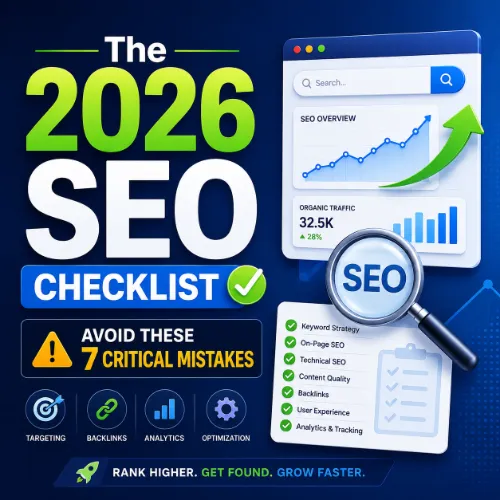
2026 SEO checklist Key Takeaways
Include author bios with real credentials, publish case studies, and link to credible external sources.
- AI-generated search results require content that answers intent directly, not just keyword density.
- Technical SEO, especially Core Web Vitals and page experience, remains a non-negotiable ranking factor.
- A balanced approach to content, links, and user engagement delivers the most durable results.
What the 2026 SEO checklist Means for Your Website
Search engines are evolving faster than ever. By 2026, AI overviews, voice search, and hyper-personalized results will dominate SERPs. Following an 2026 SEO checklist helps you avoid costly mistakes that competitors are already making. This guide breaks down each critical error and shows you exactly how to fix it.
Mistake #1: Ignoring AI Overviews and Search Generative Experience
Google’s AI Overviews now answer many queries directly on the search results page. If your content doesn’t target these answer formats, you lose visibility. For a related guide, see 13 GEO Mistakes That Hurt Visibility in AI Results (Avoid These).
How to Adapt Your Content for AI Overviews
Structure your articles with clear, concise definitions, lists, and tables. Use structured data like FAQ and HowTo schema to increase your chances of being featured. Answer common questions early in the post, and keep paragraphs under three sentences where possible.
Mistake #2: Neglecting Core Web Vitals and Page Experience
Core Web Vitals (LCP, FID/INP, CLS) remain ranking signals. A slow or janky page frustrates users and reduces conversions.
Actionable Steps to Improve Core Web Vitals
- Optimize images: use WebP format and lazy loading.
- Minimize render-blocking resources: critical CSS inlined, defer non-essential JavaScript.
- Monitor INP (Interaction to Next Paint) – ensure click/tap responses occur within 200ms.
Mistake #3: Creating Content That Doesn’t Match Search Intent
Writing for keywords alone is obsolete. Google now evaluates whether your page satisfies the user’s goal: informational, navigational, commercial, or transactional.
How to Align with Search Intent
Analyze the top-ranking pages for your target keyword. If they are listicles, write a listicle. If they are product comparisons, create a comparison table. Use the 2026 SEO checklist to audit every page’s intent match.
Mistake #4: Building Low-Quality or Automated Backlinks
Link spam penalties still exist. Automated link building, private blog networks, and massively scaled guest posts will hurt your domain authority.
Smart Link Building for 2026
Focus on earning links through original research, data studies, and expert roundups. Prioritize referring domains with high domain rating over dozens of low-authority links. Regularly audit your backlink profile and disavow toxic links.
Mistake #5: Overlooking E-E-A-T (Experience, Expertise, Authoritativeness, Trustworthiness)
Google’s quality rater guidelines increasingly reward demonstrated expertise. Generic author bios and thin About pages signal low authority.
Build E-E-A-T into Your Workflow
Include author bios with real credentials, publish case studies, and link to credible external sources. For Your Money or Your Life (YMYL) topics, partner with qualified professionals to review your content.
Mistake #6: Skipping Internal Linking and Topic Clusters
Isolated blog posts rarely rank. Without a topic cluster strategy, you miss the chance to build topical authority and pass link equity across your site.
Implement a Topic Cluster Structure
Create a pillar page for each core topic (e.g., “SEO Checklist 2026“) and link to it from every related blog post. Use descriptive anchor text containing your target keywords. Aim for at least 3-5 internal links per new article.
Mistake #7: Failing to Monitor and Adapt to Algorithm Changes
Search algorithms update hundreds of times per year. A set-it-and-forget-it approach guarantees traffic loss.
Set Up a Monthly SEO Health Routine
Run a site audit with tools like Ahrefs or Screaming Frog monthly. Track your top pages’ rankings and organic traffic trends. When you spot a drop, investigate the cause and adjust your content or technical setup.
SEO Entities and Their Functions
Understanding the main entities in the SEO ecosystem helps you make better decisions when using your 2026 SEO checklist. Here is how each category supports your strategy:
- Domain entities: Root domain, subdomain, and URL-level analysis help you isolate performance issues to a specific section of your site, such as a blog subdomain or a product page.
- Keyword entities: Organic keywords, keyword difficulty (KD), search volume, and SERP features (like AI Overviews) reveal demand, competition, and the format needed to rank.
- Backlink entities: Referring domains, dofollow/nofollow links, and broken backlinks allow you to gauge authority quality and find outreach opportunities.
- Content entities: Published dates, author info, and social shares help you evaluate content freshness and engagement.
- Technical SEO entities: Crawl errors, canonical tags, and Core Web Vitals metrics expose obstacles preventing indexing and good user experience.
Final Action Plan: Putting the 2026 SEO checklist to Work
Start by auditing each of the seven mistakes on your own site. Fix technical issues first — improve Core Web Vitals and fix crawl errors. Then align your content with search intent and build a topic cluster. Dedicate one day per month to reviewing your backlink profile and checking for algorithm updates. Consistency, not perfection, will deliver the best long-term results.
Useful Resources
Dive deeper into each mistake with these trusted guides:
Frequently Asked Questions About 2026 SEO checklist
What is the 2026 SEO checklist?
The 2026 SEO checklist is a curated list of critical SEO tasks and mistakes to avoid for achieving higher search rankings in 2026.
Why is an SEO checklist important for 2026?
SEO changes fast. A checklist helps you stay current with AI updates, Core Web Vitals, and changing user behavior.
What are the biggest SEO mistakes in 2026?
Ignoring AI Overviews, neglecting Core Web Vitals, poor search intent matching, low-quality backlinks, weak E-E-A-T, bad internal linking, and ignoring algorithm updates.
How do AI Overviews affect SEO in 2026?
AI Overviews answer queries directly on SERPs. If your content is not optimized with structured data and concise answers, you miss visibility.
What are Core Web Vitals in SEO?
Core Web Vitals are Google’s metrics for page experience: Largest Contentful Paint (loading), Interaction to Next Paint (interactivity), and Cumulative Layout Shift (visual stability).
How can I improve Core Web Vitals for free?
Optimize images, enable lazy loading, defer JavaScript, and use a content delivery network (CDN). Many actions are achievable without paid tools.
What is search intent in SEO?
Search intent is the goal behind a user’s query — informational, navigational, commercial, or transactional. Matching intent is essential for ranking.
How do I align content with search intent?
Study the top ranking pages for your keyword. If they are guides, write a guide. If they are product pages, create a product page.
What is a topic cluster in SEO?
A topic cluster is a group of related blog posts linked to a central pillar page. It builds topical authority and improves internal linking.
How many internal links should a page have?
Aim for 3 to 5 internal links per new page, linking to relevant pillar or supporting content with natural anchor text.
What is a pillar page?
A pillar page is a comprehensive guide on a core topic. It links to and from multiple cluster pages about subtopics.
What is E-E-A-T in Google’s guidelines?
E-E-A-T stands for Experience, Expertise, Authoritativeness, and Trustworthiness. It’s a framework Google uses to evaluate content quality.
How do I improve E-E-A-T for my site?
Add author bios with real credentials, cite authoritative sources, include customer reviews, and publish case studies or original research.
What are low-quality backlinks?
Backlinks from spammy sites, link farms, or irrelevant pages. They can trigger a manual penalty if used in large volumes.
How do I audit my backlinks?
Use tools like Ahrefs, Semrush, or Moz’s Link Explorer. Look for toxic domains, sudden spikes in links, or unnatural anchor text.
Should I use a tool for an SEO audit?
Yes, tools like Ahrefs Site Audit or Screaming Frog SEO Spider automate the discovery of technical issues like broken links and duplicate content.
What is a site audit in SEO?
A site audit is a thorough analysis of your website’s technical health, on-page elements, and backlink profile to identify issues hurting rankings. For a related guide, see Technical SEO Site Migration Checklist for 2026.
How often should I run an SEO audit?
Monthly for active sites. At least quarterly for smaller sites. After major algorithm updates, run an audit immediately.
What are SERP features?
SERP features are non-standard results on Google Search, like featured snippets, People Also Ask, AI Overviews, and local packs.
How do I optimize for featured snippets?
Answer questions directly in a
or







