

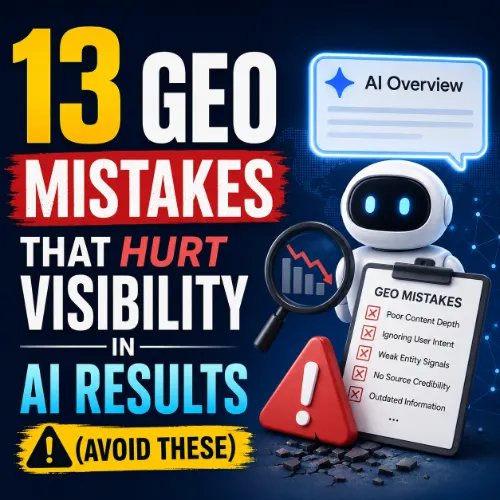
GEO mistakes Key Takeaways
Generative Engine Optimization (GEO) is the practice of structuring content so AI search tools like Google AI Overviews and ChatGPT cite your site.
- Ignoring structured data and clear answer formats is one of the most common GEO mistakes that blocks AI visibility.
- Failing to establish topical authority through internal linking and entity coverage hurts your trustworthiness in AI citations.
- Overlooking user intent and freshness signals can cause AI models to deprioritize your content in generative results.
Why GEO mistakes Hurt Your AI Visibility
Traditional SEO focuses on ranking on a search engine results page (SERP). GEO goes deeper: it optimizes content so AI models extract, cite, and feature your information in answers, summaries, and overviews. When you commit GEO mistakes, your content becomes invisible to these AI systems, no matter how strong your backlink profile is. The fix often requires a shift from keyword-first writing to clarity-first writing.
13 GEO mistakes That Kill Your AI Reach
1. Writing Without a Clear Answer Structure
AI models love direct answers. If your paragraphs bury the key point in fluff, the AI may skip you entirely. Fix this by starting important sections with a concise, bolded sentence that answers the user question.
2. Ignoring Structured Data for Q and A and How-To
Schema markup tells AI precisely where the answer lives. Pages without FAQ or HowTo schema miss a key signal. Use structured data to label your question-answer pairs.
3. Lack of Entity Coverage and Related Terms
AI connects topics through entities. If you only mention the focus keyword but skip related entities (tools, metrics, competitors), your topical depth suffers. Include entities like Domain Rating, keyword difficulty, and SERP features naturally.
4. Thin Content Without Supporting Evidence
AI models prefer authoritative sources. A 300-word page without data, citations, or examples is unlikely to be cited. Add statistics, quotes, and external references to build trust.
5. Overlooking User Intent by Targeting Only Head Terms
Targeting only high-volume keywords ignores the informational and transactional intent that AI models serve. Answer specific long-tail questions with clear, direct responses.
6. Weak Internal Linking That Fails to Build Topical Clusters
AI models evaluate your site as a whole. If pages are disconnected, your topical authority suffers. Create content clusters with pillar pages and supporting articles linked together.
7. Publishing Stale Content Without Regular Updates
Freshness is a ranking signal for both search engines and AI. Update your content with recent data and current best practices to maintain AI visibility.
8. Using Jargon Without Defining Key Terms
AI may skip content it cannot parse. Define technical terms like GEO, DR, or SERP features in plain language so the model can confidently cite your explanation.
9. Failing to Optimize for Featured Snippets and People Also Ask
AI often trains on these boxes. If you do not format content as bullet lists, tables, or succinct definitions, you lose a prime slot for AI extraction.
10. Not Monitoring Your AI Visibility Metrics
You cannot fix what you do not measure. Use tools like Google Search Console and dedicated GEO platforms to track how often your content appears in AI Overviews and chatbots.
11. Neglecting Multimedia Alt Text and Captions
AI uses text around images to understand context. Without descriptive alt text, your visual assets become invisible to generative systems. Always write keyword-rich alt attributes.
12. Copying Competitor Strategies Without Adapting to AI
Competitor research is valuable, but blindly copying content structure overlooks what AI models specifically reward: clarity, authority, and freshness. Audit your own site for these factors.
13. Treating GEO as a One-Time Optimization
GEO is ongoing. As AI models update, you must refine your content structure, schema, and answer formats. Review your approach quarterly.
How to Fix GEO mistakes and Improve AI Visibility
Start by auditing your top 10 pages for the 13 mistakes above. Use a simple checklist:
| Mistake | Quick Fix | Priority |
|---|---|---|
| No clear answer structure | Add bolded answer sentence at top | High |
| No schema markup | Add FAQ/HowTo schema | High |
| Thin content | Expand with examples and data | Medium |
| Stale content | Update by adding recent stats | Medium |
| Missing entities | Mention related terms and tools | Low |
SEO Entities and Their Functions
Understanding key SEO entities helps you avoid GEO mistakes by giving AI the structured signals it needs. For a related guide, see What Is AEO? Beginner’s Guide to Avoid Costly SEO Mistakes in.
- Website/Domain entities: Root domain vs. subdomain analysis shows where authority lives. AI uses this to decide if your whole site or just a section is trustworthy.
- Keyword entities: Organic keywords, keyword difficulty (KD), search volume, and CPC indicate demand and ranking difficulty. AI models look for keyword relevance in context.
- Backlink entities: Referring domains, anchor text, and dofollow/nofollow links reveal link quality. Strong backlink profiles improve your AI citation rate.
- Content entities: Articles, authors, topics, and social shares signal editorial quality. AI prefers content from recognized authorities.
- SERP entities: Featured snippets, People Also Ask, and AI Overviews reward structured answer formats. Optimize for these boxes to gain AI visibility.
- Technical SEO entities: Crawl issues, redirect chains, and Core Web Vitals affect indexability. Fix these to ensure your content is available for AI extraction.
Useful Resources
Dive deeper into avoiding GEO mistakes with these trusted guides:
Frequently Asked Questions About GEO mistakes
What are GEO mistakes in SEO?
GEO mistakes are content and technical errors that prevent your content from being cited or featured by AI-powered search tools like Google AI Overviews, ChatGPT, and Bing Chat. For a related guide, see Link Building Mistakes: 5 Critical Errors Hurting Your Rankings.
How do GEO mistakes differ from traditional SEO mistakes?
Traditional SEO mistakes hurt your ranking on a search engine results page. GEO mistakes specifically block your content from being extracted and used by generative AI models.
Why is clear answer structure important for GEO?
AI models parse content to find direct answers. A clear answer structure with a bolded or first-sentence response helps the AI extract your answer confidently.
Does schema markup really matter for AI visibility?
Yes. Structured data like FAQ and HowTo schema explicitly labels your content, making it easier for AI to understand and cite.
Can you recover from GEO mistakes quickly?
Yes. Fixing common issues like missing schema, thin content, and outdated information can improve AI citations within weeks.
What is the number one GEO mistake?
Not structuring content for direct answers is the most common GEO mistake. Most articles bury the key point in paragraphs.
Do GEO mistakes affect traditional SEO rankings?
Yes, indirectly. Many GEO mistakes also hurt readability, freshness, and topical authority, which are traditional ranking factors.
How often should I check for GEO mistakes ?
Quarterly. AI models and search algorithms update frequently, so your content needs periodic review.
Do I need a special tool to fix GEO mistakes ?
Not always. Google Search Console, a good SEO tool like Ahrefs, and a content audit checklist can catch most issues.
What is topical authority in GEO?
Topical authority means your site covers a subject in depth with multiple interlinked articles. AI models prefer citing authoritative sites.
Do AI models prefer short or long content?
They prefer helpful content that directly answers a question. Both short and long form can work, as long as the answer is clear and supported by evidence.
Should I rewrite old content to fix GEO mistakes ?
Yes. Refreshing old posts with current data, better structure, and updated schema can restore AI visibility.
Are backlinks still important for GEO?
Yes. Backlinks signal authority to both search engines and AI models, increasing the likelihood of citation.
Can I fix GEO mistakes without technical SEO knowledge?
Basic fixes like adding bolded answers and updating old content require no technical skills. For schema, you may need developer help.
What role do entities play in avoiding GEO mistakes ?
Entities (nouns like tools, metrics, and people) help AI understand topic depth. Including relevant entities reduces GEO mistakes.
Do bullet lists help with AI visibility?
Yes. Bullet lists and tables are easily extractable formats that AI models frequently use in generated answers.
Is GEO the same as SEO?
No. GEO is a subset of SEO that specifically optimizes content for AI models, while SEO covers all ranking factors on traditional SERPs.
Can a brand new site avoid GEO mistakes ?
Yes. Start with clear structure, schema, and topical clusters from the beginning to build AI-friendly content.
What is the biggest AI visibility mistake beginners make?
Not including an answer-first format. Beginners often write long intros before stating the answer, which confuses AI models.
How do I measure if my GEO fixes are working?
Use Google Search Console to track impressions in AI Overviews and monitor third-party GEO tools for citation changes.







