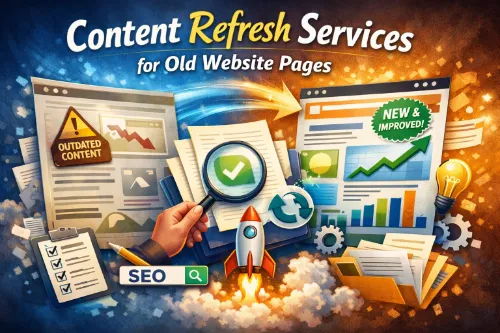
Content Refresh Services for Old Website Pages
If your website has been live for a few years, you almost certainly have old website pages that are losing traffic, slipping in search rankings, or no longer matching what your ideal customers are looking for. Our content refresh services for old website pages are designed to fix that by updating, optimizing, and upgrading what you already have instead of starting from scratch. This approach protects your existing SEO equity while making your content more relevant, more useful, and more profitable.
Refreshing old content is one of the fastest ways to grow organic traffic because you are improving pages that already have impressions, backlinks, and some level of trust with Google and other search engines. Rather than publishing yet another new article, you can revive outdated pages, combat content decay, and win back rankings for important keywords and search intents.
If you are still at the stage of understanding the bigger picture of professional SEO, you can also explore broader SEO services to see how content refresh fits into your overall growth strategy.
What Is a Content Refresh?
A content refresh is a structured update of your existing content so that it better matches current search intent, includes up‑to‑date information, and follows modern on‑page SEO basics and technical best practices. You keep the same URL but improve the depth, clarity, and accuracy of the page, then refine metadata and internal links to reinforce relevance. This is different from a complete rewrite or a brand‑new article; you are upgrading a proven asset, not replacing it.
From an SEO and NLP perspective, a content refresh helps search engines and AI systems understand your page as a high‑quality, comprehensive answer for a topic. By refreshing headings, adding FAQs, and clarifying language, you make the page easier to parse for Google’s algorithms, voice search assistants, and generative systems that rely on well‑structured, factual content. This alignment with search intent optimization and user needs is crucial for modern AEO (Answer Engine Optimization) and for winning featured snippets or “People also ask” visibility.
If you want a deeper strategic view of when to prioritize old assets, the guide on old vs new content gives a useful framework for deciding what to refresh, merge, or replace.
Why Old Website Pages Need a Refresh
Over time, even the best content becomes outdated. Statistics change, product features evolve, competitors publish stronger resources, and user behavior shifts. Old pages that once ranked at the top of Google can quietly slide to the second page or beyond, leading to traffic loss, declining conversions, and content decay.
Common problems we see on older pages include:
- Outdated statistics, screenshots, and examples that reduce trust.
- Thin content that no longer matches comprehensive competitor guides.
- Old target keywords that no longer reflect how users search today.
- Broken links, missing images, and poor formatting on mobile devices.
- Weak or misaligned calls‑to‑action that fail to convert visitors into leads or customers.
A strategic content refresh solves these issues by updating the information, expanding important sections, and reshaping the page for current search behavior. This protects your existing rankings, improves user experience, and sends clear freshness signals to Google’s index. When you pair this with regular SEO audit services, you get a reliable system for spotting and fixing content decay before it seriously impacts performance.
Our Content Refresh Process
To make sure your refreshed pages rank on Google and satisfy real users, we follow a simple but rigorous process that blends SEO, GEO, AEO, and clear, natural language.
1. Discovery and Goal Setting
We start by understanding your business goals, your ideal audience, and the primary locations you want to target. If GEO is important, we identify cities, regions, or countries where you want stronger visibility and weave this geographic context naturally into your content and examples. We also clarify KPIs such as organic traffic, search impressions, conversions, or leads generated from specific pages. For service businesses, this usually ties directly into how many qualified inquiries your refreshed pages should generate, which aligns well with the expectations covered in what SEO clients need to know.
2. Content and Performance Audit
Next, we perform a detailed content audit to find high‑value pages that will benefit most from a refresh. Using analytics and Google Search Console, we identify:
- Pages with declining traffic over the last 6–12 months.
- Articles ranking in positions 11–40 that are close to breaking onto page one.
- Pages with high impressions but low click‑through rates, signaling weak titles or meta descriptions.
- Old website pages that once performed well but show clear signs of content decay.
This sits alongside a broader technical SEO audit where we uncover crawl issues, technical SEO issues, and site‑wide bottlenecks that might prevent refreshed content from reaching its full potential. For many businesses, combining content refresh with ongoing technical SEO services delivers the best results.
We then prioritize URLs based on business impact, search potential, and topical importance within your site architecture and topic clusters. This is where smart keyword mapping for service pages and blogs becomes valuable, ensuring each refreshed asset has a clear role in your overall SEO plan.
3. Search Intent and Keyword Update
User behavior and search queries evolve over time, so older target keywords may no longer match what your audience actually types into Google today. We review current SERPs, analyze “People also ask” questions, and research updated primary and secondary keywords that align with today’s search patterns. Instead of stuffing keywords, we integrate them naturally into headings, subheadings, and body copy, using semantic variations and related phrases.
This search intent alignment is important not only for standard SEO but also for AEO and NLP, because answer engines reward pages that clearly respond to specific questions and tasks in plain, user‑friendly language. If you want to see how this plays out across a full campaign, the guide on commercial vs informational keywords in SEO campaigns gives a helpful breakdown.
4. On‑Page Copy Refresh
Once we know what the page should rank for, we update the copy to make it more relevant, engaging, and straightforward. This often includes:
- Rewriting intros and conclusions so they reflect the current context and user pain points.
- Updating outdated sections with new data, examples, and real‑world scenarios.
- Adding missing sections to cover subtopics users expect in a comprehensive resource.
- Improving readability through shorter paragraphs, clear headings, and scannable lists.
We always favor true content optimization vs keyword stuffing, so your refreshed pages stay natural and conversion‑friendly. If you need a step‑by‑step framework for the on‑page side, the resource on on‑page SEO services and the on‑page SEO checklist for service‑based websites give you a solid reference.
5. SEO Optimization and Internal Links
With the copy refreshed, we optimize core on‑page SEO elements to help your old website pages rank again.
Key actions include:
- Writing new, compelling title tags and meta descriptions that incorporate target keywords and improve SERP click‑through rates.
- Optimizing H1, H2, and H3 headings for both humans and search engines.
- Adding or updating internal links to and from related pages to strengthen topical authority and distribute link equity.
- Checking outbound links, fixing broken URLs, and replacing weak references with trusted, high‑quality sources.
Thoughtful internal linking is a major part of making a content refresh perform. The guide on how internal linking improves rankings shows how to build topic clusters, direct authority to key service pages, and support governance at scale. For large sites, this ties neatly into enterprise SEO services for large websites, SEO governance for large organizations, and managing SEO for thousands of pages.
We keep URLs intact whenever possible to preserve existing backlinks and avoid unnecessary redirects. To understand how much backlinks and authority matter over time, you can explore the guides on how backlinks affect domain authority and rankings and how to evaluate the quality of backlinks.
6. UX, Layout, and Visual Refresh
Content is not just text. Search engines look at engagement signals and user behavior, which depend heavily on design, layout, and overall user experience. We enhance your refreshed pages by:
- Improving layout for mobile and desktop with logical sections and clear visual hierarchy.
- Adding or updating images, screenshots, and media to make complex topics easier to understand.
- Using bullet points, pull‑quotes, and visual emphasis so readers can quickly scan the page for what they need.
Site‑wide, this work supports stronger page speed and SEO performance and aligns your refreshed pages with Core Web Vitals for SEO. Better UX leads to longer time on page, lower bounce rates, and stronger behavioral signals that support sustained rankings.
7. Quality Assurance and Publishing
Before we publish any refreshed content, we run a full QA pass to make sure everything is accurate, consistent, and technically clean. This includes spelling and grammar checks, validation of internal and external links, and verification that structured data and tracking codes still function as expected. We then push updates live and ensure the page is re‑crawled and indexed as quickly as possible using tools such as Google Search Console’s options for refreshing outdated content.
If you already run regular audits, the guide on what to do after an SEO audit pairs perfectly with a content refresh roadmap.
8. Monitoring and Continuous Optimization
Content refresh is not a one‑time event. After publishing, we monitor rankings, impressions, clicks, and engagement metrics to see how the updated pages perform. If necessary, we make incremental adjustments such as refining headings, adding new FAQs, or tightening calls‑to‑action to keep improving results. Over time, this ongoing refresh cycle helps you manage content decay and maintain a healthy, high‑performing content library.
To track whether your refreshed content is delivering a positive return, the resources on how to measure SEO ROI for your business and SEO KPIs every business owner should track are particularly useful.
What We Refresh on Your Old Pages
Our content refresh services cover every element that can influence rankings, readability, and conversions on old website pages.
We typically work on:
- Core body copy: updating, expanding, and reorganizing sections to match modern search intent.
- Headings and structure: revising H1–H3 tags for clarity and logical flow.
- SEO elements: titles, meta descriptions, image alt text, internal linking, and structured data.
- Credibility assets: statistics, references, case studies, and testimonials that build trust.
- UX details: layout, formatting, mobile readability, and visual elements that impact engagement.
For sites that rely heavily on search to drive revenue, integrating content SEO services: strategy, writing, and optimization ensures your refreshed pages stay aligned with your wider editorial calendar and SEO content planning for topical authority.
By addressing everything in one integrated refresh, we help your pages perform better in both traditional search results and newer answer‑driven interfaces.
SEO, GEO, and AEO in One Simple Strategy
Modern search is not only about keywords; it is about intent, context, and location. Our content refresh strategy brings SEO, GEO, and AEO together in a simple, clear framework.
- SEO: We follow established best practices for on‑page optimization, internal linking, and content quality so your pages can rank competitively for relevant queries.
- GEO: When location matters, we integrate geographically relevant examples, terms, and internal links, helping you show up for local or regional searches without making the content feel forced. Resources such as local SEO services for small businesses and local citation building show how refreshed content and local signals work together.
- AEO: By answering common questions, adding FAQ sections, and using conversational language, we position your refreshed pages as strong candidates for featured snippets and voice search results.
All of this is done in simple, natural language so your content is easy to understand for real users while still sending the right signals to search engines and AI systems.
An Example of a Successful Content Refresh
To illustrate how powerful a content refresh can be, imagine a three‑year‑old blog post about “how to update outdated website content” that used to rank on the first page but has recently slipped to the middle of page two. The article still gets impressions, but clicks and conversions are falling.
After a structured refresh that:
- Updates statistics and examples.
- Targets newer, better‑aligned keywords and search intents.
- Improves title and meta description for stronger CTR.
- Adds FAQs, internal links, and better visuals.
the page moves from position 15 to the top 5 and doubles organic leads within a couple of months. The URL stays the same, but the value of the page to both users and search engines is significantly higher. For more ideas on how refreshed content supports revenue, check out the case studies such as content‑led SEO growth and the before and after SEO results.
Why Choose a Professional Content Refresh Service?
Refreshing old website pages might sound simple, but doing it at scale and in a way that consistently improves SEO results requires a defined process, the right tools, and deep understanding of search behavior. Professional content refresh services help you:
- Prioritize the right pages based on data, not guesswork.
- Avoid common mistakes like changing URLs unnecessarily or over‑optimizing keywords.
- Balance SEO, GEO, and AEO requirements with clear, user‑friendly copy.
- Maintain a predictable, repeatable workflow for keeping your content library fresh over time.
Instead of letting old content decay, you can turn it into a reliable growth engine that keeps your website visible, useful, and aligned with what your audience is actually searching for today. If you are still evaluating partners, the guides on how to choose the right SEO agency and questions to ask before hiring SEO services will help you compare options.
How to Get Started
If you have a list of old website pages that used to perform well but are now underperforming, the best next step is a focused content refresh audit. We can review your analytics, identify quick wins, and build a prioritized roadmap for refreshing the pages that matter most to your business. This often dovetails with broader keyword research services for lead generation so that refreshed pages align with high‑intent searches.
From there, we can either handle the full refresh for you or provide detailed recommendations your in‑house team can implement page by page. Either way, your existing content becomes a powerful asset again—optimized for search engines, answer engines, and, most importantly, real people.
Frequently Asked Questions
1. How do I know which old pages should be refreshed first?
Start with pages that already get impressions or some traffic but are trending down in clicks, rankings, or conversions. Use analytics and Search Console to find URLs with declining performance, then prioritize those that are closest to page one or tied directly to revenue goals.
2. Is a content refresh the same as a full website redesign?
No. A content refresh focuses on updating and optimizing existing pages—copy, metadata, internal links, and UX patterns—without rebuilding your entire site. A full redesign changes templates, structure, and often the tech stack; a refresh is faster, less risky, and keeps your current framework intact.
3. How often should I refresh the content on my website?
Most sites benefit from reviewing key pages every 6–12 months, with priority content (money pages, flagship blogs, and high‑traffic guides) checked even more frequently. The right cadence depends on how fast your industry changes and how aggressively competitors update their content.
4. Will refreshing old content hurt my existing rankings?
Done correctly, a content refresh is designed to protect and improve rankings, not hurt them. Problems only arise when URLs change unnecessarily, important sections are removed without replacement, or the new content no longer matches search intent.
5. Can you optimize very old pages that have never ranked before?
Yes, as long as the topic still has search demand and the page fits logically within your site structure, even very old pages can be turned into strong assets. You may need deeper rewrites and better on‑page optimization, but existing age and history can still work in your favor.
6. What’s the difference between refreshing and repurposing content?
Refreshing means improving the existing page at the same URL, while repurposing means turning that content into new formats like videos, infographics, or spin‑off blog posts. Many brands do both: refresh the original page and repurpose the core ideas into multiple assets for broader reach.
7. Do I need to change the publish date when I refresh a page?
You don’t have to, but adding a “last updated” note or adjusting the publish date can signal freshness to users and search engines. The priority is making substantial updates; a date change without real improvements will not help and may harm trust.
8. How long does it take to see SEO results after a content refresh?
Most sites start seeing movement in impressions and rankings within a few weeks, with more meaningful traffic and conversion gains over 1–3 months. Timelines depend on crawl frequency, competition, and how significant the refresh was compared to the previous version.
9. Do you refresh only text, or can you improve design and layout too?
A complete content refresh should address copy, layout, and key UX elements like headings, spacing, and mobile readability. Improving visual hierarchy, formatting, and media support often leads to better engagement metrics, which in turn support stronger SEO outcomes.
10. What KPIs should I track after refreshing content?
Focus on impressions, average position, click‑through rate, organic sessions, scroll depth, time on page, and conversions from refreshed URLs. Comparing these metrics before and after the refresh helps you quantify impact and refine your strategy over time.
11. Can a content refresh fix slow pages and Core Web Vitals issues?
Some issues, like oversized images and poor layout shifts, can be addressed during a refresh, but deeper performance problems often require broader technical work. Ideally, you combine content updates with speed and Core Web Vitals improvements for the strongest results.
12. Is it better to merge multiple weak pages or refresh each one?
If several thin pages target similar topics and keywords, merging them into a single, comprehensive resource is often better than refreshing each separately. This removes internal competition and creates one strong page that matches search intent more completely.
13. What happens to my backlinks when a page is refreshed?
As long as the URL stays the same, existing backlinks continue to count toward that page’s authority. Many times, improving the content actually increases the value of those links and can make your page more attractive for future backlinks.
14. Should I change my URL structure when I refresh content?
In most cases, no. Keeping the same URL preserves authority and reduces the risk of errors with redirects and broken links. Only change URLs when there is a clear structural reason to do so, and implement proper 301 redirects if you do.
15. Can content refresh help me recover from a traffic drop after an algorithm update?
Yes, especially if the drop was related to content quality, relevance, or overall helpfulness. Refreshing pages to improve depth, accuracy, and intent alignment is one of the most effective ways to respond to quality‑focused algorithm updates.
16. How is a content refresh different from writing a brand‑new blog post?
A new post starts with no history, impressions, or backlinks, while a refreshed page builds on existing equity. New content expands your topical coverage, but refreshes maximize the value of what you already have; a strong strategy usually includes both.
17. What if my brand voice has changed since the original content was published?
A refresh is an ideal time to bring old content in line with your current brand voice and messaging. You can keep core information intact while adjusting tone, examples, and calls‑to‑action to match your updated positioning.
18. Do you provide a report showing what was changed on each page?
Professional content refresh workflows typically include a summary of updates, such as sections added, headings revised, metadata changes, and internal links updated. This helps your team understand the work done and makes future refresh cycles more efficient.
19. Can refreshed content help convert more leads, not just drive more traffic?
Yes. By updating offers, clarifying benefits, improving CTAs, and aligning copy with current customer pain points, a refresh often boosts conversion rates. In many projects, conversion gains are as significant as the additional organic traffic.
20. Is a content refresh worth it for small websites with only a handful of pages?
Absolutely. Smaller sites often rely heavily on a few key pages, so improving those can have an outsized impact on visibility and revenue. A focused refresh on your home, core service pages, and top blog posts is a cost‑effective way to grow without rebuilding everything.