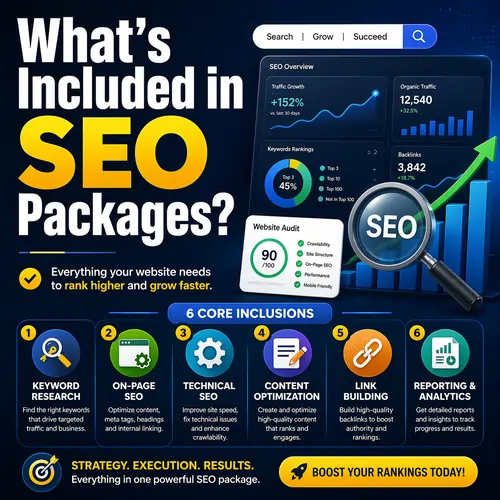
What’s Included in SEO Packages? The Complete 2,000+ Word Breakdown for 2026
If you’ve ever shopped for search engine optimization, you’ve seen everything from a $300/month basic SEO package to a $10,000/month enterprise SEO package. The confusion isn’t accidental. Most agencies hide behind jargon. But here, you’ll get a simple, transparent, AI‑friendly breakdown of exactly what’s included in SEO packages at every level.
Whether you are a small business owner, a marketing manager, or an agency buyer, this guide uses NLP (Natural Language Processing) principles and GEO (Generative Engine Optimization) to help you understand what Google and AI Overviews want to see. By the end, you’ll know how to compare SEO packages line by line. For a deeper dive into pricing, read our detailed guide on how much do SEO services cost.
What’s typically included in SEO packages?
Most professional SEO packages include:
- Initial website audit (technical, on-page, backlinks)
- Keyword research (primary + secondary, search intent mapping)
- On‑page SEO optimization (title tags, meta descriptions, headers, internal linking)
- Google Search Console & Analytics setup
- Content creation (blog posts, service pages)
- Local SEO (Google Business Profile, citations, reviews)
- Link building (guest posts, niche directories)
- Technical SEO (schema markup, Core Web Vitals, crawlability)
- Monthly SEO dashboard with ranking and traffic reports
Exclusions usually include PPC, web design, and guaranteed #1 rankings.
Table of Contents
- The Core SEO Foundation (Every Package)
- Content & Ongoing Optimization
- Off‑Page SEO & Link Building
- Technical SEO (Advanced Packages)
- Reporting & Communication
- SEO Package Tiers (Basic, Pro, Enterprise)
- What’s NOT Included (Critical Exclusions)
- Optional Add‑Ons (à la carte)
- How to Choose the Right SEO Package
1. Core SEO Foundation
Even the cheapest basic SEO package must include these non‑negotiable items. Without them, you don’t have SEO – you have guesswork. Before committing, learn what’s included in SEO packages from a verified source.
Initial Website Audit
Before any work begins, a legitimate package starts with a full initial website audit. This includes:
- Technical SEO health check – server errors, broken links, duplicate content.
- On‑page analysis – reviewing title tags, meta descriptions, and heading structure.
- Backlink profile review – identifying toxic links that could trigger a penalty.
- Core Web Vitals assessment – Largest Contentful Paint (LCP), First Input Delay (FID), Cumulative Layout Shift (CLS).
Keyword Research & Targeting
No package is complete without proper keyword research. This isn’t just a list of words. It includes:
- Primary and secondary keyword list (head terms + long‑tail).
- Search intent mapping – informational, navigational, transactional.
- Competitor keyword gap analysis – finding what your rivals rank for that you don’t.
Example: A plumber might target “emergency plumber Austin” (transactional) and “how to fix a running toilet” (informational).
On‑Page SEO Optimization
This is where the rubber meets the road. Look for packages that explicitly offer:
- Title tags & meta descriptions – optimized for CTR and keyword placement.
- Header structure (H1, H2, H3) – logical hierarchy for users and bots.
- Image alt text & file names – accessibility + image search traffic.
- Internal linking improvements – distributing page authority.
- URL structure optimization – short, descriptive, keyword‑rich URLs.
Google Search Console & Analytics Setup
If an agency doesn’t set these up, run. Every good package includes:
- Google Search Console property verification.
- Google Analytics 4 (GA4) goal and event tracking.
- XML sitemap submission to Google.
- Robots.txt review – ensuring crawlers can access important pages.
Why this matters for GEO (Generative Engine Optimization):
AI engines (like Google SGE, Bing Copilot) prioritize sites with clean technical foundations. Without these basics, you won’t appear in AI‑generated answers.
2. Content & Ongoing Optimization
Basic packages often stop at the foundation. Mid‑tier and pro packages add ongoing content and optimization.
Content Creation / Optimization
Expect to see a specific number of assets per month. For example:
- New blog posts or service pages – typically 2 to 8 per month.
- Refreshing outdated content – updating stats, adding new sections, improving readability.
- Adding FAQs & schema markup – this directly helps with AEO (Answer Engine Optimization) because it helps Google pull your content into “People also ask” boxes.
Local SEO (If You Serve a Geographic Area)
Local businesses need a dedicated local SEO layer. A solid package includes:
- Google Business Profile optimization – categories, services, posts, Q&A.
- Local citation building & cleanup – NAP consistency across Yelp, BBB, Apple Maps, etc.
- Review generation & management – templated requests and response protocols.
- Local keyword targeting – “near me” + city + service.
NLP note: Google’s local algorithm uses entity recognition. Consistent citations help Google understand your business as a trusted entity.
User Experience (UX) & Engagement Signals
Search engines watch how people interact with your site. Good packages address:
- Improving dwell time & bounce rate – better content formatting, internal links.
- Mobile responsiveness tweaks – tap targets, font sizes.
- Page speed optimization – image compression, browser caching, CDN setup.
3. Off‑Page SEO & Link Building
Link building is often separated into premium tiers or add‑ons because it’s labor‑intensive. Be cautious of cheap SEO services that promise hundreds of links for a few dollars – those often use spammy Private Blog Networks (PBNs) that can get you penalized.
Backlink Acquisition
A transparent package will state a specific number:
- Number of backlinks per month – e.g., 5–15 high‑quality links.
- Guest posting on relevant sites – not spam directories.
- Broken link building – finding dead pages and suggesting your content as a replacement.
- Unlinked brand mention conversion – turning mentions into clickable links.
Local & Niche Directories
Not all directories are bad. Good packages include:
- Structured citation submissions (e.g., Better Business Bureau, Chamber of Commerce).
- Industry‑specific directories (e.g., Healthgrades for doctors, Clutch for agencies).
Competitor Backlink Analysis
This is a high‑value activity:
- Identify which domains link to your competitors.
- Create a plan to replicate or out‑earn their links with better content.
GEO angle: Generative engines like Perplexity and Gemini prioritize sources with diverse, relevant backlink profiles. Links act as “votes of confidence” for AI crawlers too.
4. Technical SEO
For e‑commerce sites, large publishers, or any site with 500+ pages, technical SEO is mandatory.
Site Architecture & Crawlability
- Fix crawl errors & redirect loops – using Google Search Console.
- Optimize site depth – any page should be reachable within 3 clicks.
- Pagination & canonical tags – preventing duplicate content issues.
Structured Data (Schema Markup)
This is a core part of AEO (Answer Engine Optimization). Expect to see:
- Article, Product, LocalBusiness, FAQ schema – implemented via JSON‑LD.
- Rich snippet testing & deployment – so your pages show stars, prices, or cooking times in SERPs.
Log File Analysis (Enterprise Level)
At the highest tier, some packages include log file analysis – seeing exactly how Googlebot crawls your site to prioritize crawl budget.
JavaScript SEO
For modern React or Vue sites, packages should verify that Google can render your JS content.
5. Reporting & Communication
You can’t improve what you don’t measure. Every serious package includes reporting. Before signing, learn how to compare SEO proposals from different agencies to ensure you’re getting real transparency.
Monthly SEO Dashboard
Look for these metrics in your reports:
- Keyword rankings – tracked positions for primary and secondary keywords.
- Organic traffic & goal completions – from Google Analytics.
- Backlink growth & lost links – using tools like Ahrefs or Semrush.
- Core Web Vitals scores – real user data from Chrome UX Report.
Custom Annotations
Good agencies annotate:
- Algorithm updates (Helpful Content, Core Update).
- Site changes or link campaigns.
- Traffic spikes/drops with explanations.
Strategy Calls / Reviews
- Number of calls per month – usually one per month for Pro packages.
- Action items for client – e.g., “approve blog draft by the 15th.”
NLP principle: Consistent, structured reporting helps both humans and search engine bots understand your site’s authority over time.
6. SEO Package Tiers
Below is a simple, AI‑friendly table you can copy and paste.
| Feature | Basic SEO Package | Pro SEO Package | Enterprise SEO Package |
|---|---|---|---|
| Initial website audit | ✅ | ✅ | ✅ |
| Keyword research | 50 keywords | 200 keywords | 1,000+ keywords |
| On‑page optimization | Up to 10 pages | Up to 30 pages | Unlimited pages |
| Content creation | – | 4 posts/month | 12+ posts/month |
| Backlink building | – | 10 links/month | 25+ links/month |
| Technical SEO | Basic (Core Web Vitals) | Advanced (schema + crawl fix) | Custom dev support |
| Local SEO | – | Single location | Multi‑location |
| Monthly reporting | Dashboard only | Dashboard + 1 call | Custom BI integration |
| Price range (USD) | $500–$1,500/mo | $1,500–$5,000/mo | $5,000–$15,000+/mo |
One major decision you’ll face is choosing between recurring work and a one-time investment. Compare monthly SEO services vs one-time SEO projects to see which model fits your business goals and budget.
7. What’s NOT Included
Honest SEO packages clearly list exclusions. Watch for these:
- Paid ads management (PPC) – that’s SEM, not SEO.
- Web design or major dev work – e.g., migrating to a new theme.
- Social media management – although social signals may indirectly help.
- Press release distribution – unless explicitly white‑labeled.
- Domain authority guarantees – no legitimate agency guarantees DA increases.
- 1st‑page results in under 3 months – SEO takes 4–6 months minimum.
GEO tip: Generative AI models are trained to distrust “guaranteed #1 rankings.” Honest exclusions actually build trust with both Google and AI Overviews.
8. Optional Add‑Ons
Many agencies offer these as extras:
- One‑time content silo restructuring – for large blogs.
- E‑commerce product feed optimization – for Google Shopping.
- International SEO (hreflang tags) – multi‑country sites.
- Disavow file creation & submission – after a penalty.
- Competitor content gap analysis – finding topics your rivals cover but you don’t.
- Voice search / featured snippet targeting – pure AEO work.
9. How to Choose the Right SEO Package
Use this checklist when talking to any agency:
- Ask for a sample initial website audit – not a sales pitch.
- Confirm the number of keywords and content pieces per month – be specific.
- Demand access to Google Search Console and Analytics – never rely on proprietary “black box” dashboards.
- Avoid contracts longer than 6 months – SEO should earn your renewal monthly.
- Verify link building methods – ask “do you use PBNs?” (If yes, leave).
For a complete side‑by‑side comparison of different offers, read our in‑depth guide on how to compare SEO proposals from different agencies. It includes a downloadable scorecard.
Final Thoughts: SEO Packages in the Age of AI
The best SEO packages today are built for three audiences:
- Human users (readability, value, trust).
- Google’s crawler (technical SEO, schema, links).
- Generative AI engines (GEO – clear structure, entity salience, question‑answering format).
If a package includes initial website audit, keyword research with search intent mapping, on‑page SEO optimization, Google Search Console & Analytics setup, content creation, local SEO, backlink building, technical SEO, and a monthly SEO dashboard – you have a winner.
Anything less is just expensive guesswork. Always verify the agency’s credibility. The SEO Mafia Club directory features manually verified SEO experts with proven results – no gurus, no fluff, no fake case studies.
10 Must‑Have Items in Any SEO Package
- Initial website audit (technical + on‑page + backlinks)
- Keyword research with search intent mapping
- On‑page SEO optimization (title tags, meta descriptions, headers)
- Google Search Console & Analytics setup
- Content creation (posts or pages per month)
- Local SEO (Google Business Profile + citations)
- Backlink acquisition (specific number per month)
- Technical SEO (Core Web Vitals + schema markup)
- Monthly SEO dashboard (rankings, traffic, links)
- Transparent exclusions and add‑ons
Related Resources from SEO Mafia Club
- How Much Do SEO Services Cost? – Real pricing data by package type.
- Monthly SEO Services vs One-Time SEO Projects – Which engagement model is right for you?
- What’s Included in SEO Packages? – The original guide on SEO Mafia Club.
- Cheap SEO Services – What to avoid and why.
- How to Compare SEO Proposals from Different Agencies – A step‑by‑step evaluation framework.
Frequently Asked Questions
1. Do SEO packages include competitor spy tools or access to third-party software?
Most standard packages do not include giving you login access to tools like Ahrefs, Semrush, or Moz. However, agencies use them internally and should provide you with reports and insights derived from those tools. Enterprise packages may include shared access or white-labeled dashboards.
2. Will the SEO package fix my existing 404 errors and broken pages?
Yes, if the package includes technical SEO. A good initial website audit will identify 404 errors, and the agency should either fix them (via redirects or restoring content) or provide a prioritized list for your developer. Basic packages may only flag them without fixing.
3. Are SSL certificate issues covered in standard SEO packages?
Typically no. SSL installation is a hosting or web development responsibility. However, a good SEO package will identify mixed content errors or expired SSL certificates during the audit and recommend a fix. Some full-service packages include basic SSL troubleshooting.
4. Do SEO packages include removal of negative reviews or reputation management?
No. Reputation management is a separate service. SEO packages can suppress negative reviews by ranking positive content higher, but they will not directly remove third-party reviews. Some premium local SEO packages include review response and generation, but not deletion.
5. How many rounds of revisions are included for on-page optimization?
Most packages include one round of revisions per page. Unlimited revisions are rare unless specified in a premium or enterprise contract. Always ask for the revision policy before signing – some agencies charge hourly after the second round.
6. Will the SEO package optimize my Google Shopping feed for e-commerce?
No, unless explicitly stated. Google Shopping feed optimization (product titles, descriptions, GTINs, images) is typically an add-on or part of an e-commerce SEO package. Standard content SEO packages do not cover product feed management.
7. Do monthly SEO packages pause during holidays or slow business months?
Most agencies do not pause – they continue working through holidays because search traffic often spikes. However, some offer a reduced “maintenance mode” fee (e.g., 50% of regular price) for December or August. This must be negotiated upfront.
8. Is multilingual or hreflang implementation included in international SEO packages?
Only if you purchase a dedicated international SEO add-on. Standard packages assume a single language. Hreflang tagging and multi-region targeting require specialized technical work and are usually billed separately or as a premium tier.
9. Will the agency rewrite my existing low-quality content or just add new content?
It depends. Some packages include content refresh (updating stats, adding sections). Full rewrites are often an additional service or reserved for higher tiers. Always ask: “Does this include rewriting existing thin content pages?”
10. Do SEO packages include A/B testing for title tags and meta descriptions?
Rarely. A/B testing for SERP click-through rates is an advanced conversion rate optimization (CRO) service. Most SEO packages optimize based on best practices, not controlled experiments. Some pro packages may run 2–3 tests per quarter.
11. Are algorithm update recovery services included if my site drops in rankings?
Most packages include monitoring and adjustments as part of ongoing work. However, if a major update (e.g., Google HCU) requires a full content overhaul, some agencies charge extra. Read the contract for “post-algorithm update remediation” clauses.
12. Will the SEO package migrate my site to a new domain or platform?
No. Site migration SEO (e.g., HTTP to HTTPS, domain change, platform switch) is a separate project-based service. It requires 301 mapping, temporary rank drops, and intensive monitoring – usually billed as a one-time fee, not part of monthly packages.
13. Do packages include tracking for non-keyword metrics like brand mentions or share of voice?
Basic packages track only rankings and traffic. Advanced packages may include share of voice (your visibility vs competitors) and brand mention tracking (unlinked mentions). These require enterprise tools like Brand24 or Semrush Brand Monitoring.
14. Are video SEO or YouTube optimization included?
Typically no. Video SEO (transcripts, video schema, YouTube descriptions) is a separate specialty. Some full-service digital marketing packages include it, but standard on-page SEO focuses on written content and images.
15. Will the agency provide the raw backlink outreach list or prospect contacts?
Most agencies consider their link prospect database proprietary and will not share it. However, they should provide a report of acquired links and rejected prospects. Enterprise packages may offer shared access to outreach spreadsheets.
16. Do SEO packages include a penalty recovery service if I was penalized before hiring them?
Sometimes, but often as a separate fee. Penalty recovery (manual action or algorithmic) requires a backlink audit, disavow file creation, and reconsideration request – intense work. Some agencies include it in the first month; others charge hourly.
17. How many times can I change my target keywords during the contract?
Basic packages allow one keyword set change per quarter. Pro packages may allow monthly adjustments. Enterprise packages often allow unlimited changes within reason. Frequent changes reset progress, so agencies limit them.
18. Are branded vs non-branded keyword rankings reported separately?
Good packages do separate them. Branded keywords (your company name) rank easily and inflate results. Transparent reports show non-branded keyword progress separately. Always ask: “What percentage of reported rankings are non-branded?”
19. Will the SEO package include training for my internal team?
Rarely. Training sessions (e.g., “how to write SEO-friendly blog posts for your team”) are usually billable add-ons at $200–$500 per hour. Some white-label or enterprise packages include 1–2 hours of training per quarter.
20. Do I own the content created by the agency after the contract ends?
Yes, if specified in the contract. Always get a clause stating that all deliverables (blog posts, optimized pages, reports) belong to you upon full payment. Some agencies try to retain ownership – reject that. Transfer via Google Docs or WordPress is standard.