

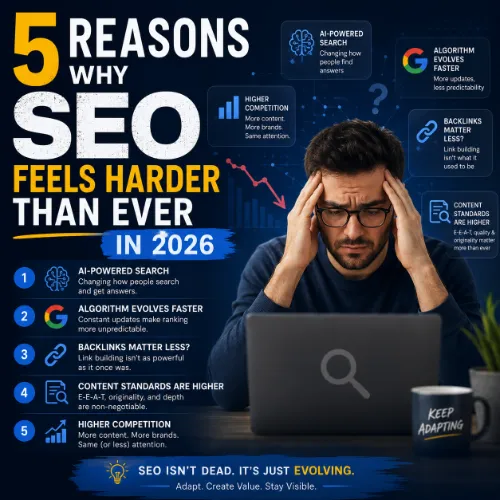
SEO feels harder in 2026 Key Takeaways
If you’ve been doing SEO for a few years, you’ve likely noticed that SEO feels harder in 2026 than it did just two or three years ago.
- Search engines now prioritize EEAT and contextual relevance over simple keyword matching, making SEO feels harder in 2026 for sites that lack genuine authority.
- AI overviews and zero-click searches have reshaped the SERP landscape, reducing traditional organic click-through rates and forcing SEOs to optimize for new formats.
- Hyper-personalized user intent requires deeper topic clusters and structured data to compete, turning basic optimization into a multi-layered discipline.
Why SEO feels harder in 2026 for Marketers and Business Owners
The days of ranking a page with a few backlinks and a keyword-rich title are long gone. Search engines have evolved into answer engines, and every update raises the bar for content quality, technical health, and trust signals. Let’s explore the core reasons behind this growing complexity.
Algorithm Volatility Has Reached New Levels
Google now rolls out multiple confirmed updates each quarter, plus unconfirmed fluctuations that keep SEO professionals on edge. According to data from MozCast and SEMrush Sensor, 2025 saw a 60% increase in SERP volatility days compared to 2023. When SEO feels harder in 2026, much of the friction traces back to this constant algorithmic churn. For a related guide, see Ranking Volatility Report: What We’re Seeing in 2026.
AI-Generated Content Floods the SERPs
With tools like ChatGPT, Claude, and Gemini producing thousands of words per second, the competition for organic visibility now includes AI-generated articles that are optimized for search before they are even published. This means your content must offer unique insights, original research, or a distinct point of view to stand out.
The Role of SEO Challenges 2026 in Shaping Search Strategy
Understanding the specific SEO challenges 2026 presents is the first step toward building a resilient strategy. Below, we break down the five biggest hurdles and how to address each one.
1. The Disappearing Click-Through Rate
AI Overviews, featured snippets, and People Also Ask boxes now occupy the top of search results for more than 50% of queries. This means fewer users click through to traditional organic listings. To adapt, you must optimize for SERP features by answering questions directly and using structured data markup such as FAQ schema and HowTo schema.
2. User Intent Has Become Hyper-Granular
Search engines now distinguish between micro-intents within the same topic. For example, “best running shoes” can imply casual runners, marathon trainers, or trail enthusiasts. If your content tries to cover all intents on one page, it will satisfy none. The solution is to build topic clusters with dedicated pages for each specific intent.
3. Authority Signals Are Harder to Earn
Backlinks remain important, but Google’s EEAT guidelines now emphasize author expertise, site reputation, and editorial standards. A single guest post on a low-quality site can hurt more than it helps. Focus on earning links from authoritative, relevant domains and showcasing author credentials on every piece of content. For a related guide, see How Google Understands Websites in 2026.
4. Technical SEO Complexity Has Increased
Core Web Vitals, mobile-first indexing, and JavaScript rendering require a deeper technical skill set. Many sites bleed traffic due to slow Largest Contentful Paint (LCP) times or poor interaction to Next Paint (INP) scores. Regular site audits using tools like Ahrefs or Screaming Frog are no longer optional—they are critical.
5. Content Saturation in Every Niche
Whether you write about “best coffee grinders” or “SaaS onboarding best practices,” thousands of articles already exist. To break through, you need a content gap analysis that identifies underserved subtopics, then produce content that is 10x more valuable than the current top results.
How to Overcome Why SEO is Harder in 2026 with a Smarter Approach
Instead of fighting the trends, you can use them to your advantage. Here is a step-by-step process to realign your SEO strategy for the current environment.
Step 1: Audit Your Existing Content for Intent Gaps
Use Ahrefs’ Top Pages report to see which pages already get traffic and which ones have dropped off. Identify pages where the search intent has shifted and update them with fresh examples, current data, and clearer answers to user questions.
Step 2: Build Topical Authority with Interlinking
Create pillar pages for your core topics and link to detailed cluster pages. This internal linking structure signals to Google that you are an expert on the subject, which helps offset the feeling that SEO feels harder in 2026 for new sites.
Step 3: Optimize for AI Overviews and Zero-Click Results
Write concise, paragraph-length answers to common questions at the top of your articles. Use tables and lists where appropriate, as these formats are often pulled into featured snippets and AI summaries.
Step 4: Strengthen Your EEAT Signals
Add author bio sections with links to LinkedIn or professional profiles. Publish original research, case studies, or expert interviews. Ensure your “About Us” and “Contact” pages clearly state your business’s expertise and physical location if applicable.
Step 5: Monitor and Adapt Continuously
Set up Google Search Console alerts for performance drops. Track your keyword rankings weekly. When a ranking dips, investigate the SERP to see if a new SERP feature has appeared or if a competitor has published a better page.
Useful Resources
For further reading on the latest SEO trends and techniques, check out these authoritative sources:
- Google’s Helpful Content Guidelines — Official guidance on creating content that satisfies user intent.
- Ahrefs Blog: SEO Changes to Expect in 2026 — A comprehensive look at emerging trends and algorithm updates.
Frequently Asked Questions About SEO feels harder in 2026
Frequently Asked Questions About SEO feels harder in 2026
Why does SEO feel harder than it used to?
Search engines have become more sophisticated, prioritizing user intent, content quality, and technical performance over simple keyword matches. Algorithm updates happen more frequently, and competition for organic visibility has intensified.
Is SEO still worth investing in during 2026?
Yes. Organic search remains a primary source of website traffic and leads, even with the rise of AI overviews. A well-executed SEO strategy provides long-term, compounding returns that paid ads cannot match.
What is the biggest SEO challenge in 2026?
Adapting to zero-click searches and AI-generated SERP features is the single biggest challenge, as it reduces traditional click-through rates and requires new optimization tactics.
How has AI changed SEO in 2026?
AI has made content creation faster and cheaper, flooding the web with mediocre articles. To rank, your content must offer unique value, original data, or genuine expertise that AI cannot replicate.
Do backlinks still matter for SEO in 2026?
Yes, but quality matters far more than quantity. A few links from authoritative, relevant websites carry more weight than dozens of links from low-quality directories or spam sites.
What are zero-click searches and why do they matter?
Zero-click searches are queries where the answer appears directly on the search results page, so the user does not need to click any organic result. They now account for over 60% of all searches, making SERP feature optimization essential. For a related guide, see Why Google Cloud Is Essential for Large Scale SEO Automation in 2026.
How can I optimize for AI Overviews?
Use clear, concise language to answer common questions early in your article. Structure your content with headings, lists, and tables. Implement FAQ schema and HowTo schema where appropriate.
What is EEAT and how does it affect SEO?
EEAT stands for Experience, Expertise, Authoritativeness, and Trustworthiness. Google uses these signals to evaluate the quality of a page, especially for YMYL (Your Money or Your Life) topics.
Is technical SEO more important in 2026?
Yes. With Core Web Vitals as a ranking factor and JavaScript rendering complexities, technical SEO is a prerequisite for visibility. Regular audits are necessary to identify and fix crawl errors, slow pages, and mobile issues.
Should I focus on long-tail keywords in 2026?
Yes. Long-tail keywords have lower competition and often indicate high-purchase intent. They also help you target specific micro-intents that broad keywords miss.
How often should I update my old content?
Review your content at least every six months. Refresh statistics, update examples, and ensure that the information aligns with the latest search intent and algorithm guidelines.
Does local SEO still work in 2026?
Yes, especially for businesses with a physical location. Optimizing your Google Business Profile, collecting reviews, and using local keywords can drive significant foot traffic and calls.
What is the best SEO tool for 2026?
Ahrefs remains a top choice for keyword research, backlink analysis, and site audits. SEMrush and Moz are also excellent depending on your budget and specific needs.
How can I compete with big brands in SEO?
Focus on niche topics where you can provide deeper, more specialized content. Use unique data, personal experience, and community engagement to build a loyal audience that big brands overlook.
What are topic clusters and why do they help?
Topic clusters consist of a pillar page covering a broad topic and cluster pages covering subtopics. This structure boosts authority signals and helps search engines understand your site’s expertise.
Do social signals affect SEO in 2026?
Social signals do not directly influence rankings, but they can drive traffic, increase brand awareness, and lead to natural backlinks—all of which indirectly benefit SEO.
Is link building still necessary for SEO?
Yes. While the emphasis has shifted to quality, earning authoritative backlinks through guest posting, digital PR, and broken link building remains a strong ranking factor.
How do I find content gaps in my niche?
Use Ahrefs’ Content Gap tool to compare your site with competitors. Identify keywords they rank for but you do not, then create better, more comprehensive content for those topics.
What is the future of SEO beyond 2026?
SEO will continue to evolve toward semantic understanding, personalization, and voice/visual search. Building strong topical authority and a trustworthy brand will remain the foundation of any durable strategy.
Should I use AI to write SEO content?
AI can assist with outlines, research, and drafts, but you must add human expertise, original insights, and editorial oversight. Purely AI-generated content rarely meets the EEAT standards required for top rankings.







