

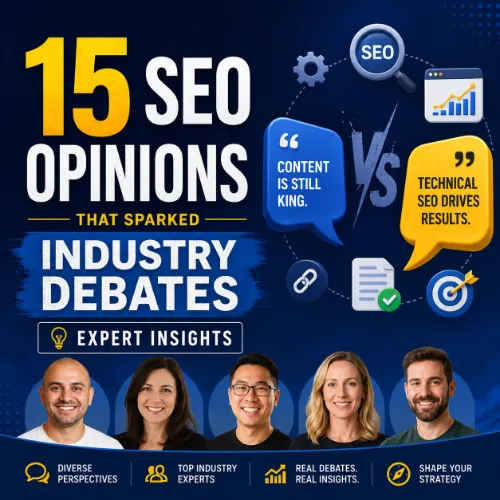
controversial SEO opinions Key Takeaways
SEO is not a static discipline, and every few years, a new controversial SEO opinion emerges that splits the industry into passionate camps.
- Each controversial SEO opinion is presented with both sides of the argument, along with supporting data and real-world examples.
- We highlight where experts agree and disagree, helping you separate marketing hype from practical SEO strategies.
- Actionable takeaways at the end of each section allow you to make informed decisions for your own campaigns.
Why Controversial SEO Opinions Matter in Modern Search
Search engine optimization is a field built on testing and adaptation. Over the past two decades, statements that once seemed radical—like “Google does not need your backlinks” or “keyword research is dead”—have forced practitioners to reconsider their core assumptions. Understanding these SEO industry discussions is not just about staying current; it is about developing a critical filter that helps you judge which advice will survive a core algorithm update and which is merely a short-lived trend.
The 15 Controversial SEO Opinions That Shaped the Industry
1. “Backlinks Are No Longer a Top Ranking Factor”
Why it sparked debate: For years, link building was the single most aggressive tactic in SEO. When Google began downplaying the weight of certain link types, many interpreted this as the death of backlinks. In reality, Google still uses links as a quality signal, but it now places more emphasis on relevance, context, and natural acquisition.
Balanced analysis: High-quality, editorially earned backlinks remain a strong ranking factor, but spammy link schemes can now hurt more than help. The debate persists because some high-authority pages rank with relatively few links, while others thrive on a massive linking profile. The truth lies in the middle: build links, but focus on value over volume.
Takeaway: Continue investing in link-building campaigns, but prioritize relevance and audience value over sheer quantity.
2. “Domain Authority Is a Meaningless Metric”
Why it sparked debate: Domain Authority (DA) and its equivalents are not Google metrics, yet many SEOs treat them as gospel. Critics argue that DA can be manipulated and does not reflect true ranking potential.
Balanced analysis: DA correlates with rankings in many cases, but it is not a direct ranking factor. A page on a low-DA site can outrank a high-DA page if it perfectly matches search intent and has better on-page optimization. The metric is useful for comparative analysis, not as an absolute truth.
Takeaway: Use DA as a directional guide, not a definitive ranking predictor. Always combine it with keyword difficulty and content quality analysis.
3. “Keyword Research Is Dead Because of Semantic Search”
Why it sparked debate: With the rise of natural language processing (NLP) and entity-based search, some experts claimed that exact-match keyword targeting is obsolete. This sparked a wave of content that ignored primary keywords entirely. For a related guide, see SEO Experts Must Adapt Quickly to AI Driven Search Trends.
Balanced analysis: Semantic search has changed how Google interprets queries, but keywords remain the building blocks of user intent. Ignoring keywords completely leads to content that lacks focus. The modern approach is to use keyword research to identify topics, then satisfy user intent with comprehensive, naturally phrased content.
Takeaway: Do not abandon keyword research. Evolve it to focus on topic clusters, entities, and questions your audience is asking.
4. “Content Length Is Irrelevant—Only Quality Matters”
Why it sparked debate: For years, SEOs chased 2,000-word articles to outrank competitors. When Google explicitly stated that word count is not a ranking factor, the pendulum swung to the opposite extreme, with some arguing that a 300-word post could rank just as well.
Balanced analysis: Content length itself is not a ranking factor, but comprehensiveness is. Short content rarely covers a topic in sufficient depth to satisfy user needs. A 1,500- to 2,500-word article typically offers enough room for thorough exploration, but a concise page that perfectly answers a query can also rank well.
Takeaway: Let the topic dictate length. Cover every relevant subtopic your audience expects, then stop. Do not pad for the sake of word count.
5. “SEO Is Dead” (A Recurring Myth)
Why it sparked debate: Every major algorithm update, from Panda to BERT to Helpful Content, is accompanied by a wave of “SEO is dead” declarations. These statements divide optimists who see constant opportunity from pessimists who feel their tactics are being removed.
Balanced analysis: SEO is not dead; it has evolved. Tactics that worked in 2020 may not work today, but the core mission—helping search engines understand and value your content—remains essential. The industry has shifted toward user experience, technical health, and brand authority, but those are still SEO functions.
Takeaway: Treat the “SEO is dead” claim as a signal to review and adapt your strategy, not as reason to abandon the practice.
6. “Link Building Is a Waste of Time in 2025”
Why it sparked debate: Some high-profile SEOs now advocate for a linkless future, claiming that content quality alone determines rankings. This opinion challenges the foundation of off-page SEO and creates friction with traditional practitioners.
Balanced analysis: While content quality has become more important, competitive niches still demand strong authority signals. Pages with zero backlinks rarely rank in top positions for high-competition keywords. The real debate is not about whether to build links, but how to build them (outreach vs. content-based link attraction).
Takeaway: Do not stop link building, but pivot toward earning links through exceptional data, original research, and expert commentary.
7. “User Experience Signals Are Not Ranking Factors”
Why it sparked debate: A decade ago, Google stated that click-through rate and bounce rate are not direct ranking factors. Some SEOs still cling to this statement, while others point to the obvious correlation between poor UX and low rankings.
Balanced analysis: Google does not use a single UX metric as a direct boost or penalty. However, aggregated user behavior patterns—like a high bounce rate on a page that should be engaging—can influence algorithmic assessment. Core Web Vitals are explicit ranking signals, making UX an official part of SEO.
Takeaway: Optimize for user experience as if it were a direct ranking factor. Good UX reduces friction, improves conversions, and satisfies search intent.
8. “You Don’t Need to Optimize for Featured Snippets”
Why it sparked debate: Some SEO experts argue that featured snippet optimization is a distraction because Google can pull snippets from any well-structured content without explicit targeting. Others believe that snippet optimization drives massive traffic gains. For a related guide, see Why Generic SEO Content No Longer Drives Search Traffic.
Balanced analysis: While Google can extract snippets from non-optimized content, intentionally structuring your answer at the top of the page increases your chances by a large margin. The debate usually stems from different priorities—brand visibility vs. click-through rate.
Takeaway: Structure your content to be snippet-friendly when the query has a clear answer format. It is a low-effort, high-reward practice.
9. “Social Signals Directly Influence Rankings”
Why it sparked debate: Several studies have shown a correlation between high social shares and high rankings. This led to the belief that social media activity is a direct ranking factor.
Balanced analysis: Correlation is not causation. Popular content tends to earn links and mentions naturally, which are the actual ranking factors. Social signals themselves are not in Google’s ranking algorithm, but they can amplify content reach and accelerate link acquisition.
Takeaway: Use social channels to distribute and promote content, but do not expect a direct ranking boost. The indirect benefits through visibility and backlinks are valuable.
10. “Google Prefers Long-Form Content Over Short Posts”
Why it sparked debate: In many studies, the average first-page result is over 1,500 words. This led to the mistaken belief that Google inherently favors longer content.
Balanced analysis: Google prefers comprehensive answers. If a topic requires only 300 words to fully satisfy the user, a long article will look padded and poorly engaged. The data showing longer content ranking well reflects the fact that most competitive topics demand depth.
Takeaway: Write as much as needed to answer the query completely, but no more. Focus on thoroughness, not length.
11. “Authority Is Now More Important Than Relevance”
Why it sparked debate: After the Helpful Content update, some observed that large brands began ranking for topics outside their core niche. This led to claims that domain authority can override topic relevance.
Balanced analysis: Authority can help a brand rank for adjacent topics, but it does not replace relevance entirely. A small, niche site can still outrank a giant if its content is more targeted and useful. The debate conflates brand recognition with true topical authority.
Takeaway: Build domain authority through consistent quality, but never assume it will compensate for irrelevant content. Stay focused on your niche.
12. “Duplicate Content Hurts Your Rankings”
Why it sparked debate: For years, SEOs feared duplicate content penalties. When Google clarified that duplicate content is filtered, not penalized, many assumed the risk was zero.
Balanced analysis: Google does not penalize duplicate content in the traditional sense, but it will choose one version to rank while ignoring others. That can dilute traffic and cause confusion. A large-scale plagiarism issue can also harm your site’s trust signals.
Takeaway: Avoid creating multiple pages with the same content. Use canonical tags to indicate the preferred version when duplication is unavoidable.
13. “Mobile-First Indexing Means Desktop SEO Is Dead”
Why it sparked debate: When Google switched to mobile-first indexing, some SEOs shifted all focus to mobile, ignoring desktop performance and content.
Balanced analysis: Mobile-first indexing means Google primarily uses the mobile version for ranking, but the desktop experience still matters for desktop users, especially in B2B and complex purchase journeys. Ignoring desktop creates a poor user experience for a significant portion of your audience.
Takeaway: Prioritize mobile performance, but do not neglect desktop. A good responsive design covers both seamlessly.
14. “You Can Automate SEO Completely”
Why it sparked debate: The rise of AI tools led some to claim that SEO can be fully automated, from keyword research to content creation and link building.
Balanced analysis: Automation can handle repetitive tasks like reporting, monitoring, and basic content generation. However, strategic decisions requiring judgment, nuance, and relationship building remain human domains. Over-automation can lead to spammy, low-quality signals.
Takeaway: Automate processes, not decisions. Use tools to scale monitoring and analysis, but let humans guide strategy and content quality.
15. “The Page Experience Update Made On-Page Content Less Important”
Why it sparked debate: When Core Web Vitals became ranking signals, some SEOs over-indexed on speed and interactivity, neglecting content quality.
Balanced analysis: Page experience is a tiebreaker among otherwise equal pages. Content remains the primary driver of relevance and value. A fast page with weak content will not rank as high as a slightly slower page with excellent content.
Takeaway: Optimize for both content and page experience. They complement each other, and sacrificing one for the other leads to suboptimal results.
How to Navigate SEO Industry Discussions Without Getting Confused
The key to benefiting from SEO debates is to develop a testing mindset. When you encounter a controversial SEO opinion, ask yourself three questions: Does the claim align with Google’s published guidelines? Is there reproducible data supporting it? Does it match my own observations across multiple client accounts? If the answer to two out of three is yes, run a controlled experiment. If not, treat the opinion with healthy skepticism.
The Role of Data in SEO Debates
Data drives resolution. The strongest controversial SEO opinions are those supported by repeatable case studies or large-scale correlation analysis. However, beware of confirmation bias—studies funded by a tool vendor or an agency with a stake in the outcome may skew results. Always seek third-party validation before adjusting your strategy.
SEO Entities and Their Functions
Understanding key SEO entities helps you analyze SEO industry discussions more effectively. Here are the entities most relevant to the arguments in this article:
- Domain Rating (DR): Measures overall authority of a root domain based on backlink quality. Used by SEOs to gauge a site’s competitive strength, but not a direct Google ranking factor.
- URL Rating (UR): Measures the link popularity of a specific URL. Helps determine whether a single page has enough authority to rank for its target keywords.
- Keyword Difficulty (KD): A metric that estimates how hard it is to rank in the top 10 for a given keyword. Useful for prioritizing low-difficulty opportunities in SEO debates about content strategy.
- Referring Domains: The number of unique domains linking to your site. A core entity in link-focused SEO debates, as quality of domains matters more than quantity.
- Core Web Vitals: A set of real-user metrics (LCP, FID, CLS) that Google uses as ranking signals. Central to discussions about page experience vs. content quality.
- Search Intent: The goal behind a user’s query (informational, navigational, commercial, transactional). Resolves many controversial SEO opinions by clarifying what a page should deliver.
Useful Resources
For deeper dives into the topics discussed, check these authoritative sources:
- Google Search Central – SEO Starter Guide – Official guidance that resolves many SEO debates.
- Moz Blog – SEO Category – Regularly publishes balanced analyses of emerging controversial SEO opinions.
Frequently Asked Questions About controversial SEO opinions
Is backlinks still a top ranking factor in 2025?
Yes, backlinks remain a strong ranking factor, but quality and relevance now matter far more than quantity. Google uses links as a vote of confidence, not a direct score.
Does domain authority affect rankings?
Domain Authority is not a Google metric, but it correlates with ranking potential. Use it for competitive analysis, not as an absolute target.
Is keyword research still necessary?
Yes, keyword research helps you understand search intent and topic demand. It has evolved to focus on entities and questions, but it is not obsolete.
Does content length matter for SEO?
Content length is not a direct ranking factor, but comprehensiveness is. Write enough to fully satisfy user intent, whether that is 300 words or 2,000 words.
Is SEO dead?
No, SEO is evolving. The core principles of making content discoverable and valuable to users remain as relevant as ever.
Should I stop building links?
No, but shift your focus to earning links through quality content and relationships rather than chasing quantity.
Are Core Web Vitals more important than content?
No. Content is still the primary driver of rankings. Core Web Vitals act as a tiebreaker among similarly relevant pages.
Can I fully automate SEO?
You can automate reporting and monitoring, but strategic decisions and nuanced content creation still require human judgment.
Does duplicate content penalize my site?
Google does not impose a penalty, but it will choose one version to rank, potentially reducing visibility for the other pages.
Should I optimize for featured snippets?
Yes, structuring your content to answer common questions increases your chance of appearing in a featured snippet, which can improve visibility.
Do social signals directly boost rankings?
No, social signals are not a direct ranking factor, but they can amplify content reach and help earn backlinks.
Is mobile SEO more important than desktop SEO?
Both matter. Mobile-first indexing means the mobile version is primary, but desktop users still expect a good experience.
Can I rank without backlinks?
For low-competition keywords, yes. For competitive ones, backlinks are almost always necessary to build the required authority.
Is Google’s Helpful Content update a penalty?
It is not a penalty but a signal adjustment that promotes content written for people and demotes content written purely for search engines.
Should I use exact-match keywords in headings?
Using exact-match keywords in headings can help both users and search engines understand the topic, but it must feel natural.
Does page speed matter for all industries?
Yes, page speed affects user experience across all industries, but its impact on rankings may vary by competitive landscape.
Can I recover from a Google penalty?
Yes, most manual and algorithmic penalties can be resolved by identifying the issue, fixing it, and submitting a reconsideration request if applicable.
Is local SEO different from general SEO?
Local SEO includes geographic targeting, Google Business Profile optimization, and local citations, but it still relies on the same fundamentals as general SEO.
Do I need to use schema markup?
Schema markup is not a ranking factor, but it helps Google understand your content better and can generate rich snippets that improve CTR.
Will AI replace SEOs?
AI can automate many tasks, but strategic thinking, creative content, and relationship building are areas where human expertise remains essential.







