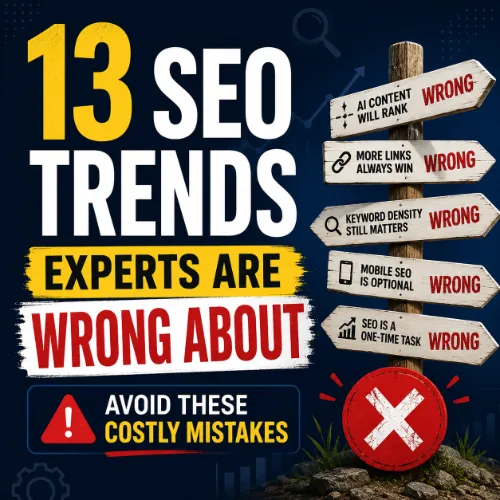
SEO trends experts are wrong about Key Takeaways
Every year a new batch of SEO advice goes viral, but much of it is misleading or outright harmful.
- SEO trends experts are wrong about often prioritize ranking signals over user intent.
- Many viral SEO tips ignore Google’s quality guidelines and can trigger penalties.
- Proven fundamentals — content relevance, technical health, and authority — beat trendy hacks every time.
Why Trusting Every SEO trends experts are wrong about Can Hurt Your Rankings
SEO is full of contradictory advice. One expert says keyword density matters; another says it is dead. One camp pushes link building at any cost; the other swears by zero-link strategies. Sorting signal from noise is difficult, but it is essential. When you follow a trend that sounds smart but lacks data, you risk wasting weeks of effort and possibly triggering a manual action from Google.
The truth is that most SEO trends experts are wrong about arose from over-interpreting isolated cases or outdated algorithm updates. By examining each misconception with published research and documented case studies, we can separate what deserves your time from what does not. For a related guide, see SEO Experts Must Adapt Quickly to AI Driven Search Trends.
Trend #1: Keywords Must Match Exactly
Myth: Your target keyword has to appear verbatim in the title, headers, and body for every page to rank.
Truth: Google’s BERT and MUM models understand synonyms, related concepts, and context. Exact-match keywords are often unnecessary. A page optimized for “affordable leather backpack” can rank for “cheap leather backpack” even if that exact phrase never appears. The key is to cover the topic comprehensively, not to force exact phrases.
Trend #2: Backlinks Are Dead
Myth: With the rise of entity-based search and AI content, links no longer matter.
Truth: The 2024 Google Search Quality Rater Guidelines still treat links as a primary authority signal. Multiple studies — including Ahrefs’ analysis of ranking pages — show a strong correlation between referring domains and top 10 rankings. What changed is that spammy links now hurt more than they help, but earning high-quality editorial links remains one of the most effective SEO trends that actually works. For a related guide, see 9 Emerging SEO Trends After AI Overviews to Watch in 2026.
Trend #3: Content Length Is a Ranking Factor
Myth: Longer content always ranks higher, so every post should be 2,000+ words.
Truth: Google has never confirmed a word-count threshold. Short, focused answers often win featured snippets, while long-form fluff hurts engagement. What matters is whether the content satisfies user intent. A 300-word snippet that directly answers a question can outrank a 3,000-word article that buries the answer.
Trend #4: Exact-Match Domains Are Trash
Myth: Exact-match domains are spammy and get penalized.
Truth: Exact-match domains can still rank well if the site provides solid content and earns genuine links. The penalty came from low-quality EMD sites that existed only to trick search engines. A legitimate brand using an EMD is fine, but it offers no inherent ranking advantage today.
Trend #5: Social Signals Directly Impact Rankings
Myth: More Facebook shares or Twitter retweets boost your Google rank.
Truth: Google has stated repeatedly that social signals are not a direct ranking factor. However, strong social presence can increase visibility, which may lead to more natural backlinks and brand searches — both of which have indirect ranking benefits.
Trend #6: Google Penalizes Duplicate Content
Myth: Any duplicate content on your site triggers a penalty.
Truth: Google applies duplicate content filters rather than penalties. If your site has similar content across multiple URLs, Google picks the best version to show. The real risk is losing crawl budget and traffic spread across duplicates, not a manual penalty. Use canonical tags and consolidate thin pages.
Trend #7: You Must Avoid Nofollow Links Entirely
Myth: Nofollow links pass zero value, so you should remove them from your profile.
Truth: Google now treats nofollow as a hint, not a directive. Some nofollow links still help with discovery and brand visibility. A diverse link profile with both dofollow and nofollow looks natural. Aggressively trying to remove all nofollow links can backfire.
Trend #8: Domain Authority Is a Google Metric
Myth: Domain Authority (DA) or Domain Rating (DR) is used by Google to rank pages.
Truth: DA and DR are third-party metrics created by Moz and Ahrefs. They correlate with rankings but are not part of Google’s algorithm. Obsessing over DA can lead you to chase irrelevant link targets. Focus instead on topical relevance and editorial merit of linking sites.
Trend #9: Mobile-First Indexing Means Mobile-Only Content
Myth: You should cut desktop content to make your mobile version minimal.
Truth: Mobile-first indexing means Google uses the mobile version of your site for indexing and ranking, but that mobile version should still contain all essential content from the desktop version. Hiding content on mobile to “simplify” the design can cause important keywords to vanish from Google’s index.
Trend #10: Voice Search Requires a Separate Strategy
Myth: You need to create separate content for voice search queries.
Truth: Most voice searches are standard queries phrased as questions. The same content that ranks for a typed query can rank for voice if it directly answers the question and loads fast. Overcomplicating voice SEO by building separate “voice-optimized” pages wastes resources. Instead, include clear question-and-answer formats in your existing articles.
Trend #11: AI Content Is Always Penalized
Myth: Any content written by AI will be deindexed or penalized.
Truth: Google’s guidance focuses on the quality of content, not the method of production. Helpful, accurate, original content is fine whether written by a human or an AI. What Google penalizes is mass-produced, low-value content that lacks expertise, regardless of who or what wrote it.
Trend #12: You Must Submit Your Site to Every Search Engine
Myth: Manually submitting your URL to dozens of search engines improves your ranking.
Truth: Google, Bing, and Yandex find new pages through links and sitemaps, not manual submissions. Submitting to obscure engines does nothing for your visibility. Focus your energy on building an XML sitemap and getting quality backlinks so Google naturally discovers your pages.
Trend #13: Meta Keywords Tag Still Matters
Myth: Adding a list of keywords in a meta keywords tag helps search engines understand your page.
Truth: Google stopped using the meta keywords tag for ranking over a decade ago because of rampant keyword stuffing. Bing also ignores it. Meta descriptions, title tags, and body copy are where you should invest your SEO effort.
SEO Entities and Their Functions
Understanding the building blocks of SEO analysis helps you evaluate each trend more accurately. Here are the key entities and what they reveal about your performance:
- Website / Domain entities: Root domain, subdomain, and URL-level analysis identify whether performance belongs to the whole site, a section like blog.example.com, or a single page.
- Keyword entities: Organic keywords, keyword difficulty (KD), search volume, and SERP features show demand, competition, and the result type required to rank.
- Backlink entities: Referring domains, anchor text, dofollow/nofollow links, broken backlinks, and new/lost backlinks explain authority, link quality, and outreach priorities.
- Page entities: Top pages, best by links, best by traffic, broken pages, and internal pages reveal which URLs earn visibility, links, traffic, or need repair.
- Content entities: Articles, authors, topics, published dates, social shares, and referring domains to content help evaluate editorial quality, freshness, authorship, and engagement.
- SERP entities: Featured snippets, People Also Ask, sitelinks, AI Overviews, video results, and local packs show what format the search result rewards.
- Technical SEO entities: Crawl issues, redirect chains, canonicals, duplicate content, Core Web Vitals, and indexability status expose obstacles that prevent crawling or ranking.
- Metrics entities: Domain Rating (DR), URL Rating (UR), traffic value, organic traffic, and referring domains count summarize authority, URL strength, and market value.
Summary Table: Typical Myth vs. Proven Truth
| Myth | Proven Truth | Cost of Following Myth |
|---|---|---|
| Exact-match keywords required | Synonyms and context suffice | Unnatural content, missed traffic |
| Backlinks are dead | High-quality links still critical | Lost rankings from ignoring links |
| Longer content always better | Intent > length | Bloat, lower engagement, higher bounce rate |
| Nofollow links worthless | Help with discovery and natural profile | Unnatural link removals |
| AI content always penalized | Quality matters, not author | Missed efficiency gains |
Actionable Takeaways for Your Strategy
SEO trends experts are wrong about often look good in conference talks but fail in real-world audits. To build a resilient strategy:
- Audit your content for user intent, not just keywords.
- Earn links from authoritative, relevant sites — avoid paid link networks.
- Keep your technical base clean: fast pages, clear navigation, proper canonicals.
- Test every new SEO trend on a small set of pages before rolling it out site-wide.
Useful Resources
For deeper dives into the data behind these truths, check out these resources:
- Google’s official documentation on how search works — authoritative source on ranking processes and guidelines.
- Ahrefs research on common SEO myths — data-backed analysis of what actually correlates with rankings.
Frequently Asked Questions About SEO trends experts are wrong about
What is the most common SEO trend experts are wrong about?
The most common is the belief that exact-match keyword usage is mandatory. Google’s NLP models now handle synonyms and related concepts, so forcing exact phrases often hurts readability without ranking benefit.
Do backlinks still matter for SEO in 2025?
Yes. High-quality, editorially earned backlinks remain a strong authority signal. Google’s patent documentation and multiple correlation studies confirm links are still a key factor.
Is longer content always better for SEO?
No. Content should be as long as necessary to satisfy user intent, not longer. Short, direct answers often rank better for informational queries, while comprehensive guides suit transactional ones.
Can I use AI content without getting penalized?
Yes, if the content is helpful, original, and accurate. Google penalizes low-quality content regardless of whether it is written by a human or an AI.
Do social media shares directly boost ranking?
No. Social shares are not a direct ranking factor, but they can increase visibility, leading to more backlinks and brand searches, which indirectly help.
Should I remove nofollow links from my backlink profile?
No. Nofollow links can still pass discovery and contextual value. A natural link profile contains a mix of dofollow and nofollow links.
Does Google use Domain Authority (DA) to rank pages?
No. DA is a third-party metric created by Moz. Google has its own internal authority metrics but does not reveal or rely on DA.
What is the biggest SEO myth about duplicate content?
That any duplicate content triggers a penalty. Google applies filters to show the best version, not a penalty. The real issue is wasted crawl budget and diluted signals.
Is voice search SEO different from regular SEO?
Not fundamentally. Most voice queries are question-based. Optimize for question-and-answer formats and fast loading, and the same content will serve both typed and voice searches.
Do I need to submit my site to all search engines manually?
No. Google and Bing discover new pages via links and sitemaps. Manual submissions are unnecessary and largely ignored.
Does the meta keywords tag affect rankings?
No. Google and Bing have publicly stated they ignore the meta keywords tag due to historical keyword stuffing abuse.
Can exact-match domains still rank well?
Yes, but only if the site has quality content and earns legitimate backlinks. The old penalization was for low-quality EMD sites, not the domain pattern itself.
Is keyword stuffing still a problem?
Yes, but Google’s algorithms now detect it easily. Keyword stuffing can trigger a manual action or de-ranking. Use keywords naturally.
Does page speed directly impact rankings?
Yes, page speed (especially Core Web Vitals) is a confirmed ranking factor, particularly for mobile results. Slow pages lose visibility.
Is it harmful to have multiple H1 tags on a page?
HTML5 allows multiple H1s, but for clarity and consistency, most SEO experts recommend one H1 per page. Google can still understand the structure with multiple H1s, but it can confuse users.
Do I need to update old content regularly to maintain rankings?
Google often gives a freshness boost to content that has been significantly updated or expanded. Stale content can lose visibility if a newer competitor appears.
Are internal links important for SEO?
Yes. Internal links help distribute authority throughout your site, improve crawlability, and clarify topic relationships to search engines.
Does HTTPS still matter for SEO?
Yes. Google uses HTTPS as a lightweight ranking signal, and browsers mark HTTP pages as “Not Secure,” which can hurt user trust.
Is it bad to use aggressive anchor text variation?
No, natural variation is fine. What triggers over-optimization is a pattern of overly exact-match, keyword-dense anchor text across many links.
Can I rank without any backlinks?
For very low-competition queries, it is possible. For competitive terms, backlinks are usually necessary to establish authority.