

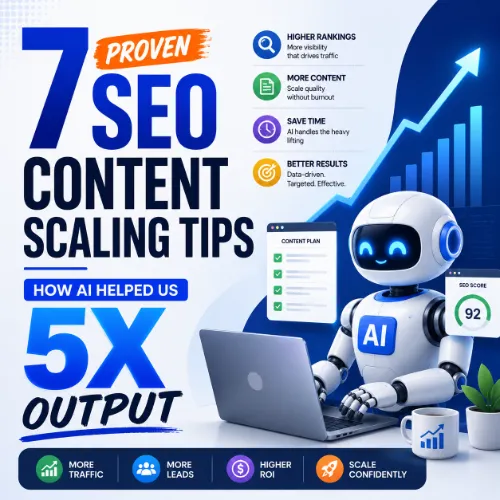
AI helped scale SEO content production Key Takeaways
Scaling content output without sacrificing quality is one of the hardest challenges in SEO.
- A AI helped scale SEO content production by automating research, drafting, and optimization tasks that used to take hours.
- Combining generative AI with human editorial oversight ensures content remains accurate, helpful, and aligned with search intent.
- Measurement and quality-control loops are essential: track organic traffic, keyword gaps, and content freshness to sustain long-term growth.
What AI helped scale SEO content production Actually Means
When we say AI helped scale SEO content production, we aren’t talking about fully automated article farms. Instead, AI serves as a force multiplier — handling repetitive tasks like keyword clustering, outline generation, meta data creation, and even first drafts — so that writers and strategists can focus on high-level insight, storytelling, and editorial judgment. For a related guide, see Gemini Based Automation for SEO Crawling and Content Clustering.
In practice, a typical workflow today starts with an AI tool analyzing top-ranking pages for a target keyword cluster. The tool extracts subtopics, common questions, and content gaps. A human strategist reviews the output, adjusts the angle, and passes a refined brief to a writer — who may use an AI assistant to draft sections. An editor then polishes the piece, checks factual accuracy, and ensures the final product meets your brand standards.
This approach does not replace human expertise; it accelerates it. Teams that adopt this model report producing 3x to 5x more content in the same time frame, often with better keyword coverage and lower cost per article.
7 Proven Tips to scale SEO content with AI
These tips come from real-world campaigns and case studies where AI helped scale SEO content production without causing the quality crash that some critics predicted.
1. Start with AI-Powered Topic Clusters
Instead of writing one-off articles, use AI to map out topic clusters. Tools like Ahrefs or MarketMuse can identify related subtopics and questions automatically. Create a pillar page for the core topic and then commission supporting articles for each subtopic. This structure builds topical authority and improves internal linking.
2. Automate SERP Analysis with NLP
Natural language processing (NLP) models can analyze the top 20 results for any query in seconds. They extract common headings, key terms, and user-intent signals. Feed this analysis into your content brief so every article targets exactly what searchers want.
3. Use Generative AI for Outlines and First Drafts
Provide an AI writer with a brief that includes target keywords, competitor URLs, and a defined tone. The AI generates a structured outline and a first draft. A human writer then revises, adds original research or quotes, and enhances readability. This cuts draft time by 60-70%.
4. Optimize Meta Data Programmatically
AI can generate title tags, meta descriptions, and alt text variations for large volumes of pages. Use a tool like Ryte or an in-house script that pulls keyword data and content summaries to create unique, clickable meta data. Test a few versions per page and pick the best performer.
5. Apply Entity Optimization at Scale
Search engines understand content through entities — people, places, brands, and concepts. AI can scan your content and suggest missing entities that top-ranking pages include. Add these naturally into your text to strengthen topical relevance.
6. Build a Human-in-the-Loop Quality System
Every AI-assisted piece should pass through a manual review stage. Create a checklist: check facts, verify dates and statistics, ensure brand voice consistency, and confirm that the article answers the searcher’s question completely. Without this step, AI content can drift into generic or incorrect territory.
7. Measure and Iterate with AI Analytics
Use AI-enhanced analytics like BrightEdge or Searchmetrics to track keyword rank changes, organic traffic, and content engagement. Set up alerts for content that underperforms. Retrain your AI models based on what worked — for example, if listicles always outperform guides, adjust your prompt templates accordingly. For a related guide, see Fractional SEO Support for Growing Businesses.
Maintaining Quality While scaling SEO content with AI
The biggest fear about scale SEO content with AI is a drop in quality — thin pages, factual errors, and duplicate content. However, with the right controls, the opposite can happen. Here is how to keep quality high.
Define Your Quality Bar Before You Scale
Write clear editorial guidelines that include word count minimums, required sources, acceptable AI usage, and a voice-and-tone document. AI should receive these guidelines as part of the prompt, not as an afterthought.
Use AI for Fact-Checking, Not Just Writing
Before publishing, run every article through a fact-checking AI tool or at least cross-reference key claims against reputable sources. This will catch hallucinated numbers or references that an AI writer might invent.
Monitor Duplicate Content at the Phrase Level
Copyscape or a cosine-similarity checker can flag passages that look too similar to your existing content or competitor pages. Rewrite those sections with fresh examples or angles.
Tools and Technologies That Make AI SEO content production Possible
Several categories of AI tools now support AI SEO content production:
- Research tools — Ahrefs, Semrush, MarketMuse
- Generative writing assistants — Jasper, Copy.ai, Claude, ChatGPT
- Optimization platforms — Surfer SEO, Frase, Clearscope
- Analytics and monitoring — BrightEdge, Searchmetrics, Google Search Console
- Custom automation — Zapier, Make, or Python scripts that connect APIs
No single tool covers everything. The best results come from combining a few of them in a workflow that matches your team size and budget.
SEO Entities and Their Functions
When AI helped scale SEO content production, understanding how entities work in search can decide whether your content ranks or drowns. Here are the key entity categories that AI can help you identify and optimize for:
- Domain-level entities: root domains, subdomains, and URLs. AI audits show whether performance issues belong to the whole site or a specific section.
- Keyword entities: organic keywords, keyword difficulty (KD), search volume, and SERP features. AI clusters keywords by intent and flags opportunities with low KD and high traffic potential.
- Backlink entities: referring domains, anchor text, dofollow/nofollow status. AI prioritizes outreach based on link value and broken link prospects.
- Content entities: articles, authors, topics, and publish dates. AI evaluates freshness, topical coverage, and internal link balance.
- SERP entities: featured snippets, People Also Ask, AI Overviews. AI analyzes which formats appear for your keywords and tailors content to match.
- Technical SEO entities: crawl issues, canonicals, Core Web Vitals. AI runs automated reports and recommends fixes before they impact rankings.
- Competitor entities: competing domains, content gaps, shared keywords. AI identifies where rivals win and surfaces link intersect targets.
Useful Resources
For further reading on AI SEO content production, see the following guides:
- Ahrefs — How to Build an SEO Content Strategy That Scales
- Surfer SEO — AI Content Optimization: 5 Strategies
Frequently Asked Questions About AI helped scale SEO content production
Frequently Asked Questions About AI helped scale SEO content production
Can AI replace human writers for SEO content?
No — AI handles research, outlines, and drafts, but human writers add original insight, brand voice, and fact-checking that search engines reward.
How much faster is AI-assisted content production?
Most teams report 3x to 5x more output in the same time, depending on how much human editing they still do.
Will Google penalize AI-generated content?
Google rewards helpful content regardless of how it is produced, as long as it demonstrates E-E-A-T, originality, and value.
What is the best AI tool for SEO content scaling?
No single tool fits all — combine a research tool like Ahrefs, a writing assistant like Jasper, and an optimizer like Surfer SEO for best results.
How do I maintain brand voice with AI content?
Give the AI detailed style guides, example articles, and tone instructions. Then have an editor review each piece before publishing.
Does AI help with keyword research?
Yes — AI tools can cluster keywords by intent, find long-tail variations, and surface question-based queries from SERP analysis.
What is the biggest risk of scaling content with AI?
Producing generic or factually incorrect content — mitigated by a strong human review process and fact-checking workflow.
How do I measure the ROI of AI content scaling?
Track organic traffic growth, keyword rankings, cost per article, and conversion rate compared to your previous manual-only output.
Can I use AI to rewrite existing content?
Yes — feed the old article into an AI with instructions to update facts, improve readability, and add new subtopics. Then manually verify changed claims.
How do I avoid duplicate content when scaling with AI?
Use a plagiarism checker on every piece, vary examples and phrasing, and ensure each article has a unique angle or data point.
Is AI content production suitable for local SEO?
Absolutely — AI can generate location-specific pages and service descriptions efficiently, as long as you add local citations and contact details.
How do I train my team to use AI for content?
Start with a pilot project, document the workflow, and run a workshop covering prompt engineering, review checklists, and tool setup.
What content types benefit most from AI scaling?
Topical clusters, service pages, product descriptions, and multilingual content tend to see the biggest efficiency gains with AI.
How do I keep AI content fresh?
Set up automated content audits that flag articles older than 12 months and use AI to suggest updates based on recent SERP changes.
Is there a risk of AI content sounding robotic?
Yes — always rewrite AI drafts to include varied sentence structure, personal anecdotes, and conversational transitions.
Can AI help with internal linking at scale?
Yes — AI tools can analyze your entire site map and suggest relevant internal links based on topic similarity and keyword overlap.
How do I scale content production for multiple languages?
AI translation combined with human localization works well: translate the base content, then have a native speaker adapt cultural references and local keywords.
What is the role of NLP in AI content production?
NLP helps AI understand context, synonym variance, and entity relationships, which improves the relevance and semantic quality of generated text.
Should I disclose AI usage in my content?
While not required by Google, transparency builds trust — many publishers include a brief note in their about page or editorial policy.
Will AI eliminate SEO content jobs?
No — AI shifts the focus from manual writing to strategic oversight, editing, and data analysis, creating new roles rather than removing them.







