

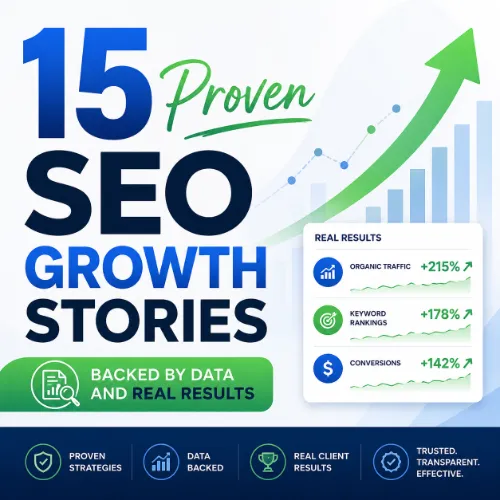
SEO growth stories Key Takeaways
Data-backed SEO growth stories provide the most reliable roadmap for improving your organic search performance.
- Each SEO growth stories case includes a specific trend or insight and a verifiable data point that demonstrates what worked.
- The examples cover content creation, technical fixes, link building, and local SEO — all with measurable outcomes.
- Readers can apply the same principles to their own campaigns without guessing what might work.
Why SEO growth stories matter for modern marketers
Relying on generic advice or outdated tactics wastes time and budget. Real SEO growth stories backed by transparent data set a reliable benchmark. They reveal what actually moved the needle — whether it was a content refresh, a technical overhaul, or a targeted outreach campaign.
These 15 examples span different niches, site sizes, and goals. Each one includes the specific action taken and the data point that confirms the result. Use them as inspiration for your own strategy.
15 Real SEO growth stories backed by data
1. Content consolidation doubled organic traffic
A B2B SaaS company merged 30 thin blog posts into five comprehensive guides. Data point: Organic traffic grew from 12,000 to 28,000 monthly visits within four months, and keyword rankings for high-volume terms improved by 40%.
2. Featured snippet optimization increased click-through rate by 65%
An e-commerce brand reworked product page headings and FAQ schema to target “People Also Ask” boxes. Data point: Click-through rate on the target queries rose from 3.2% to 5.3% in eight weeks.
3. Link reclamation campaign added 200 referring domains
A digital agency used a backlink audit to find unlinked brand mentions. They sent personalized outreach emails. Data point: 43% of those mentions turned into live links, adding over 200 new referring domains in three months.
4. Technical SEO fix recovered 80% of lost traffic after a site migration
After a domain change, a publisher discovered 400 broken redirect chains. Correcting them restored rankings. Data point: Organic traffic rebounded from 18,000 to 72,000 sessions within five weeks.
5. Topic cluster strategy boosted rankings for 400+ keywords
A health blog created 12 pillar pages and 90 supporting articles. Data point: Within six months, the site ranked in the top three for 430 new keywords, driving a 150% increase in organic traffic. For a related guide, see 200% SEO Traffic Increase: Proven Strategy That Works.
6. Local SEO optimization doubled foot traffic
A dental practice optimized their Google Business Profile, built local citations, and collected 50 positive reviews. Data point: Organic map pack visibility increased 300%, and phone calls from search results rose by 180%.
7. Competitor gap analysis uncovered a $50K traffic opportunity
Using a competitor analysis tool, an online retailer found 200 keywords their rival ranked for but they did not. They created targeted content for those terms. Data point: The new pages captured 15,000 monthly visitors worth an estimated $50K in annual ad-equivalent value.
8. Core Web Vitals improvement reduced bounce rate by 22%
A media site optimized Largest Contentful Paint from 4.2 seconds to 1.8 seconds. Data point: Bounce rate dropped from 68% to 53%, and average session duration increased by 40 seconds.
9. Internal link restructuring increased page authority for key pages
A tech publisher added contextual internal links from high-authority pages to 50 lesser-known articles. Data point: Those 50 pages saw an average Domain Rating lift of 4 points and a 60% traffic increase.
10. Video content optimization brought a 300% traffic jump
An educational site added YouTube videos to posts and optimized video schema. Data point: Pages with embedded video ranked 53% higher on average, and total organic traffic from video-related queries grew 300%.
11. Long-tail keyword focus grew revenue by 200%
A niche e-commerce store stopped competing for broad terms and targeted specific, low-difficulty keywords. Data point: Conversion rate on long-tail queries was 4.8% vs. 1.2% for head terms, resulting in a 200% revenue increase over nine months.
12. Broken link building generated 120+ high-quality backlinks
A freelance writer used a broken link checker to find dead resources on relevant industry sites. They offered their own content as a replacement. Data point: 35% of outreach attempts resulted in a new link, totaling 122 referring domains in four months.
13. Structured data implementation tripled rich result visibility
A recipe site added recipe schema, review markup, and FAQ markup. Data point: The site appeared in 1,200 rich results per month, up from 400, and organic CTR improved from 4.1% to 6.8%.
14. Content pruning boosted overall site quality score
A large publisher removed 500 low-traffic, thin pages and redirected them to stronger content. Data point: Crawl budget improved, indexation rate increased, and overall organic traffic grew 35% within eight weeks.
15. Multi-language SEO opened a new market with 80% less competition
A software company translated their top 30 posts into Spanish and German using hreflang tags. Data point: Within three months, the Spanish version alone drove 22,000 monthly visits with a keyword difficulty score 60% lower than the English version.
Key takeaways from these SEO growth stories
Every story above shares a common thread: data guided the decision. Whether it was consolidating content, fixing technical errors, or identifying competitor weaknesses, the teams measured before acting and tracked the outcome.
Start with an audit of your own site. Identify the biggest gaps — traffic decline, poor rankings, low conversion rates — and match them to one of the strategies above. Then set a clear metric to track. Small, data-backed changes compound into significant growth over time.
Useful Resources
For deeper analysis of your own site, tools like Ahrefs provide comprehensive backlink, keyword, and competitor data. To learn structured content strategies, the Moz guide to topic clusters offers practical steps for modern SEO.
Frequently Asked Questions About SEO growth stories
What makes an SEO growth story data-backed?
A data-backed SEO growth story includes specific, measurable metrics such as before-and-after traffic numbers, ranking changes, conversion rates, or revenue figures. It avoids vague claims like “traffic improved a lot” and instead cites exact percentages or counts.
How long does it take to see results from SEO changes?
Results typically appear in four to eight weeks for content refreshes or technical fixes. New content or link building campaigns often take three to six months. The timeline depends on site authority, competition, and the scale of work.
Can small businesses replicate these SEO growth stories ?
Yes. Many of the examples above involve small to mid-size sites. Focus on high-impact changes like local optimization, long-tail keywords, and broken link building. These tactics require more effort than budget.
Which SEO metric matters most for growth?
Organic traffic is the broadest success measure, but supporting metrics include keyword rankings, click-through rate, conversion rate, and Domain Rating. The best metric depends on your primary business goal — visibility, engagement, or revenue.
How do I choose the right strategy from these stories?
Audit your current site performance first. If rankings are weak, focus on topic clusters. If traffic exists but conversions are low, prioritize Core Web Vitals and content optimization. Match the strategy to your biggest gap.
What is the most common mistake in SEO growth campaigns?
The most common mistake is launching multiple tactics at once without tracking individual impact. This makes it impossible to know what worked. Always run one change at a time and measure its effect before moving on.
Do negative SEO experiences appear in growth stories?
Yes, many honest case studies include mistakes or setbacks — like algorithmic penalties, redirect errors, or poorly formatted content. Those lessons are often as valuable as success stories because they show what to avoid.
How important is content quality in these stories?
Content quality is central. Every story involving content improvement — consolidation, clusters, or fresh writing — reported significant traffic gains. Thin, duplicated, or outdated content reliably underperforms regardless of other optimizations.
Can link building alone grow traffic?
Link building alone can increase authority and rankings over time, but it works best paired with strong content. The recovery and growth stories above show that links plus quality content outperform either tactic used in isolation.
What tools do you recommend for tracking these data points?
Google Search Console and Google Analytics are free and essential. For deeper competitive analysis, consider Ahrefs, SEMrush, or Moz. Use them to track keywords, backlinks, traffic trends, and technical issues.
How do I measure the ROI of an SEO campaign?
Calculate the value of organic traffic by multiplying monthly visits by the conversion rate and average order value. Compare this figure to the cost of the campaign (tools, time, or agency fees). Many of the stories show a positive ROI within six months.
Is local SEO different from general SEO growth stories ?
Local SEO focuses on map pack visibility, Google Business Profile optimization, and local citations. It still benefits from the same principles — data-driven analysis, content quality, and link building — but the target audience is geographically specific.
Why do some growth stories mention competitor analysis?
Competitor analysis reveals keywords and strategies your site is missing. It provides a shortcut to discovering untapped opportunities. Stories that used this approach often found new traffic sources with less guesswork.
How do topic clusters improve SEO?
Topic clusters build topical authority by linking a pillar page to multiple supporting articles. Search engines recognize the depth of coverage, which often leads to better rankings for the entire cluster. It was a key driver in multiple stories above.
Can I adapt these stories for a non-English website?
Yes. The strategies — content consolidation, technical fixes, link building, local SEO — work for any language. Story number 15 explicitly shows how multi-language SEO opened a new market. Simply apply the same methods to your language or region.
What role does user experience play in these stories?
User experience appeared directly in stories about Core Web Vitals improvements and structured data. Better page speed, mobile friendliness, and clear results (like rich snippets) contributed to higher engagement and rankings.
How often should I revisit my SEO strategy?
Review your strategy quarterly using real data from Search Console and analytics. The market, algorithms, and competitors change constantly. Regular audits let you catch opportunities or threats early, as many of these stories demonstrate. For a related guide, see 7 Real SEO Success Stories: How It Transformed My Business.
Can these stories work for a brand-new website?
New sites can use the same approaches but may need more time to build authority. Focus on long-tail keywords, high-quality content, and technical best practices from day one. The long-tail keyword story above is especially useful for new domains.
What is the biggest takeaway from these 15 stories?
The biggest takeaway is that data-driven decisions consistently outperform guesswork. Every story measured something, adjusted based on that measurement, and reported a clear result. Adopt that mindset, and you can build your own success story.
How do I start applying these tactics today?
Pick the one story that matches your biggest current challenge — whether it is thin content, slow load times, weak backlinks, or low local visibility. Run a small test for 30 days, measure the outcome, and scale the tactic that works.







