

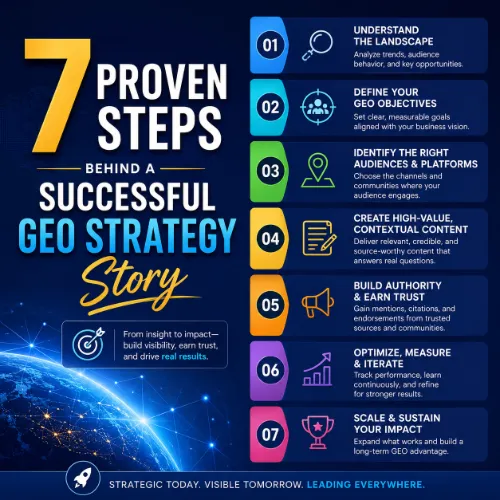
successful GEO strategy Key Takeaways
A successful GEO strategy is about more than translating keywords — it requires deep research, genuine local relevance, and continuous refinement.
- A successful GEO strategy starts with unmet demand analysis, not keyword volume alone.
- Localization must go beyond language — adapt your value proposition, partnerships, and user experience.
- Iterative optimization, informed by analytics and local feedback, separates short-term gains from long-term growth.
Why Most Geographic Expansion Strategies Fail — and What a successful GEO strategy Does Differently
Expanding into a new geography sounds exciting. More users, more revenue, more brand reach. Yet most companies that attempt it experience painful setbacks: low conversion rates, wasted ad spend, or even reputational damage. The root cause isn’t a bad product — it’s a lack of genuine geographic intelligence. A successful GEO strategy flips the script by focusing on local intent and readiness before scaling.
In our work with companies that have executed cross-border growth, three patterns emerge: they invest in pre-entry research, localize with empathy, and treat the new market as a continuous experiment. This article unpacks those patterns into seven actionable steps.
Step 1: Conduct Demand Validation Before Assuming Opportunity
Too many teams assume that if something works at home, it will work abroad. A successful GEO strategy begins with demand validation — verifying that the problem you solve actually exists in the target region, and that people are actively searching for solutions. For a related guide, see 200% SEO Traffic Increase: Proven Strategy That Works.
Use Data Sources Beyond Keyword Volume
Search volume tells you interest, but it doesn’t tell you intent or purchasing power. Combine keyword research with trend tools, competitor mention analysis, and local forums (e.g., Reddit regionals, local business directories). For example, when a meal-kit brand expanded into Germany, search volume for “meal kit delivery” was moderate — but deeper analysis showed strong demand for “bio-vegan meal kit” (organic vegan), which revealed a specific geographic expansion strategy angle.
Validate with Small-Scale Testing
Run geo-targeted ad campaigns or a minimal landing page in the new market for 4–6 weeks. Measure not just clicks but on-page behavior and inquiry quality. This small bet prevents a costly full launch into a market that may not convert.
Step 2: Build Local Relevance Through Deep Localization
Translation is a commodity. Localization is a competitive advantage. A successful GEO strategy adapts every touchpoint — search snippets, pricing displays, payment methods, customer support hours, and even visual imagery — to match local expectations.
Prioritize Content Localization Based on Intent
Rather than bulk-translating your entire site, localize pages in order of priority: home page, pricing page, top-of-funnel blog posts, and product pages. A European SaaS company that expanded into Japan localized only five core pages initially, then expanded based on user flow data. The result? A 34% increase in trial sign-ups within the first quarter.
Adapt Your SERP Strategy for the Local Market
Search engines in different countries reward different content formats. In France, People Also Ask and video results dominate many categories. In Australia, AI Overviews and local packs are more prominent. Tailor your content structure accordingly. This is where understanding SEO entities like SERP features becomes invaluable.
Step 3: Leverage Local Partnerships to Earn Trust and Links
No brand enters a new market with built-in authority. A successful GEO strategy accelerates trust by partnering with local entities: media outlets, influencers, industry associations, and complementary businesses. Partnerships generate two critical assets: relevant inbound links and social proof.
Map the Local Link Landscape
Use tools to identify referring domains that the competition earns in the target country. Look for broken link opportunities or unlinked brand mentions. For instance, a fintech company expanding into Mexico found that their top competitor had 40% of its backlink profile from local finance blogs and university .edu.mx pages. Outreach to those same domains produced a DR jump from 18 to 34 in six months.
Step 4: Optimize for Local Search Intent and Entity Signals
Search engines use entities — people, places, brands, and concepts — to understand context. A successful GEO strategy optimizes for the entity relationships that matter in the target geography.
SEO Entities and Their Functions
Understanding how SEO entities influence local visibility helps you prioritize optimization effort:
- Page entities: Top pages — best by links, best by traffic — reveal which URLs already earn visibility in the region. Focus localization on these first.
- Backlink entities: Referring domains (referring domains), anchor text distribution, and new/lost backlinks help assess whether link quality is improving in the local market.
- Keyword entities: organic keywords, keyword difficulty (KD), and search volume at the country level show where demand is real versus inflated. Use traffic potential to prioritize pages.
- SERP entities: featured snippets, People Also Ask, and local packs indicate which content format the local search result rewards.
- Technical SEO entities: crawl issues, canonicals, and Core Web Vitals can degrade local rankings faster if the site is served from a different geography. Use Indexability status to ensure local pages are discoverable.
- Competitor entities: competing domains and shared keywords help identify content gap opportunities in the local market.
- Metrics entities: DR (Domain Rating), UR (URL Rating), and organic traffic indicate overall site authority — but segment these by country for a clearer picture.
These entity signals help you decide where to invest content creation, link building, and technical fixes for maximum local impact.
Step 5: Create a Local Content Engine That Earns Topical Authority
One-off translated posts rarely rank. A successful GEO strategy requires a consistent stream of locally relevant content that builds topical authority in the new geography.
Identify Local Content Gaps
Run a content gap analysis against competitors in the target region. Look for topics that have high search demand but low-quality results. For example, a home services franchise expanding into the UK discovered that most local competitors had thin content on “how to choose a gas-safe engineer in [city].” They created a definitive guide with city-specific sections, earning 12 backlinks in the first month.
Hire Local Writers and Editors
AI translation tools can handle 80% of the work, but the final 20% — tone, cultural nuance, local regulations — requires a human who lives in the market. That human touch is often the difference between a page that ranks and one that bounces.
Step 6: Track the Right Metrics and Iterate Based on Local Data
Global dashboards hide local problems. A successful GEO strategy segments performance by country, city, and even language variant. Monitor organic traffic, bounce rate, conversion rate, and average session duration at the country level.
Set Up Country-Specific Tracking
Use Google Search Console’s country filter and GA4’s location dimension. Create a custom dashboard that shows only the target country’s data. This helps you detect issues like canonical misconfigurations that send international users to the wrong version, or content that fails to engage because of cultural mismatches.
Create a Monthly Optimization Cadence
Iterate based on local data: improve thin pages, fix broken backlinks from local sources, update outdated information, and refine internal linking to propagate authority. This ongoing cycle is what turns a one-time launch into sustained growth.
Step 7: Scale Only After Validation — Then Repeat the Process
After you’ve validated demand, built relevance, earned local links, and seen consistent organic growth, you can scale. But scaling doesn’t mean abandoning the process. Each new sub-geography (e.g., moving from Berlin to Munich) or language variant requires its own mini-cycle of research, localization, and iteration.
A successful GEO strategy is never truly finished. It is a living system that adapts to algorithm updates, competitor moves, and shifting local demand.
Avoid These Common Traps When Building Your successful GEO strategy
Even with a solid framework, mistakes happen. Here are three traps to avoid:
- Treating all localization as equal: Not every page needs full localization. Use analytics to find the 20% of pages that drive 80% of your potential local traffic, and start there.
- Ignoring local backlink quality: Links from local directories, universities, and news outlets carry more weight than generic international links. Prioritize them.
- Not accounting for local search features: If your target market heavily uses AI Overviews or local packs, optimize for those features specifically. A standard blog post format may not win.
Useful Resources
Deepen your understanding of geographic expansion with these authoritative sources:
- Geographic SEO Guide by Ahrefs — practical walkthrough of country-level keyword research and hreflang implementation.
- Google’s Multi-Regional Site Guidance — official best practices for serving content across different countries and languages.
Frequently Asked Questions About successful GEO strategy
What is a GEO strategy?
A GEO strategy (geographic expansion strategy) is a structured plan to enter and grow in a new country or region, combining SEO, localization, partnerships, and iterative optimization.
How long does it take to see results from a GEO strategy?
Most companies see early signals (organic visits, CTR) within 3–6 months, but meaningful revenue growth typically takes 6–12 months due to the time required to build local authority.
Is a GEO strategy the same as international SEO?
No. International SEO focuses on technical setup like hreflang and country targeting. A GEO strategy is broader — it includes market research, content localization, local link building, and cultural adaptation.
Do I need a local domain for each country?
Not always. A subdirectory (example.com/de/) or ccTLD (example.de) can work, depending on your budget. Subdirectory is easier to manage but ccTLD can signal stronger local relevance.
What is the biggest mistake companies make in geographic expansion?
Jumping into a new market without validating demand. They assume what works at home will work abroad, then waste budget on content and ads that don’t convert. For a related guide, see Law Firm Content Strategy for Organic Leads.
How do I choose which country to expand into?
Analyze search demand, competitive intensity, language barrier, regulatory environment, and payment infrastructure. Start with one or two countries where you have some existing organic traction.
Can I use AI to localize my entire site?
AI can handle bulk translation, but a human editor must review for cultural tone, idioms, and local regulations. Fully AI-localized content often feels generic and struggles to rank.
What metrics should I track for a GEO strategy?
Country-level organic traffic, bounce rate, conversion rate, keyword rankings, and referring domains from local websites. Segment these by language and city for granular insight.
How many countries should I target at once?
Start with one or two, validate the approach, then expand. Spreading too thin dilutes your budget and makes it hard to iterate based on local data.
What role do backlinks play in a GEO strategy?
Local backlinks from trustworthy sources (universities, news sites, industry associations) accelerate local authority and rankings. Without them, even well-localized content may not rank.
Should I create separate social media accounts for each country?
Only if you have the resources to manage them with local content. Otherwise, use geo-targeting on existing platforms and focus on local forums or platforms like Weibo (China) or VK (Russia).
How do I handle duplicate content across languages?
Use hreflang tags correctly to indicate language and regional variations. Canonical tags should point to the preferred version for each region.
Is a GEO strategy expensive to implement?
Costs vary. You’ll need local content writers, link-building outreach, and possibly platform adjustments. Start with a pilot budget of $5,000–$15,000 for a single country before scaling.
Can I use existing global content and just change the URL structure?
No. Content must be written for the local audience, not just translated. Localized content that references local events, data, and regulations performs significantly better.
What is the most important step in a GEO strategy?
Demand validation. Without proving that real people in the target market actively need your solution, every subsequent step is wasted effort.
How do I find local link opportunities?
Use Ahrefs to analyze your competitors’ referring domains filtered by country. Also look for unlinked brand mentions, local business directories, and guest posting opportunities on local media.
Should I use a local address in my Google Business Profile?
Yes, if you have a physical presence there. A verified local address helps with local pack rankings and trust signals. Coworking spaces can work if they meet Google’s guidelines.
How do I handle currency and pricing displays?
Display prices in the local currency and include tax-compliance notes (e.g., VAT in Europe, GST in India). Price anchoring without currency conversion can cause cart abandonment.
What are the risks of entering a new market too fast?
You can burn budget on ads and content for a market that doesn’t convert, damage your brand’s reputation with poor localization, and lose focus on your core market.
Can I use content syndication to build local authority?
Yes, but only if you syndicate to locally trusted platforms (e.g., local news sites, industry blogs). Syndication alone won’t build deep topical authority — original, on-site content is still essential.







