

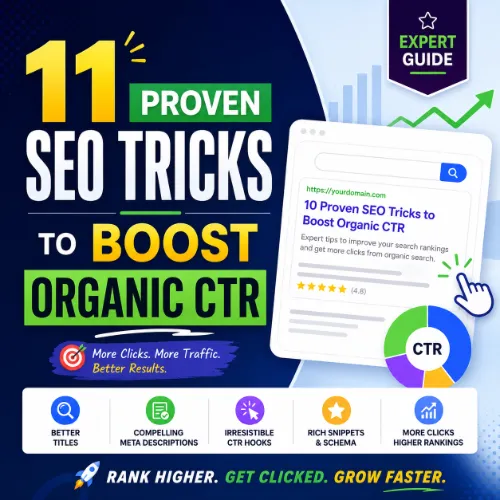
SEO tricks to improve organic CTR Key Takeaways
When you work hard to rank on the first page of Google, every click represents a potential customer, subscriber, or reader.
- Master the art of writing compelling title tags and meta descriptions that earn clicks.
- Use structured data and rich snippets to stand out in search results.
- Apply psychological triggers like urgency, curiosity, and social proof to increase organic click-through rate .
Why SEO Tricks to Boost Organic CTR Matter for Your Traffic Goals
When you work hard to rank on the first page of Google, every click represents a potential customer, subscriber, or reader. Yet many SEOs focus exclusively on rankings and neglect the second critical step: earning the click. Small changes — a better title, a more enticing snippet, a well-placed number — can lift CTR by 10–30% without any ranking improvement. That is the power of SEO tricks to improve organic CTR. For a related guide, see 20 Tricks That Improve Your Google Rankings Today (SEO).
Understanding user intent and SERP behavior is key. Google tests different titles and snippets, but you can influence the final display through proper markup and copywriting. Below are 11 actionable tactics, each backed by real-world results.
1. Craft Magnetic Title Tags That Include the Focus Keyword
Your title tag is the first thing searchers see. It should contain your focus keyword naturally, plus an emotional or curiosity-driven hook. For example, instead of “SEO Tips for Higher CTR,” try “11 Proven SEO Tricks to Improve Organic CTR (Expert Guide)” — the number, promise, and descriptor all work together.
Best practices for title tags
- Keep it under 60 characters to avoid truncation.
- Place the target keyword near the beginning.
- Add a benefit, year, or power word (e.g., “Proven,” “Secrets,” “2025”).
- Avoid keyword stuffing; write for humans first.
2. Write Meta Descriptions That Sell the Click
Google sometimes rewrites meta descriptions, but a well-crafted one still increases the chance that your snippet gets used. Include your focus keyword naturally, address the searcher’s pain point, and end with a call to action like “Learn how” or “Get started.”
Example: “Discover 11 proven SEO tricks that improve organic CTR. Learn expert strategies to increase clicks from search results and maximize traffic with actionable tips.”
3. Use Schema Markup to Earn Rich Results
Structured data helps search engines understand your content, and it can generate rich snippets that stand out dramatically. Ratings, FAQs, how-to steps, product prices — all of these increase visibility and click-through. Implementing FAQ schema, for instance, can double your real estate on the SERP.
Use Google’s Structured Data Testing Tool to validate your markup. Even a simple rating schema can push your CTR up by 10–20% according to many case studies.
4. Add Numbers and Data Points to Your Headlines
Headlines with numbers consistently outperform vague ones. “11 SEO Tricks” beats “SEO Tricks” because it sets a clear expectation. Odd numbers (7, 11, 21) tend to work better than even ones. Whenever relevant, include percentages, years, or statistics to add credibility.
5. Optimize for Featured Snippets and People Also Ask
Featured snippets capture a huge portion of clicks. To target them, answer specific questions concisely in your content. Use
and headings that match question phrases. For People Also Ask, create dedicated FAQ sections (like the one at the end of this article). Each time Google pulls your content into a snippet, your organic click-through rate can spike.6. Use Emotional and Power Words in Your Snippets
6. Use Emotional and Power Words in Your Snippets
Words like “proven,” “essential,” “insider,” “mistake,” “secret,” “urgent,” and “guaranteed” trigger emotional responses. They make your listing more compelling than the competition. Pair them with your focus keyword for maximum effect.
7. Improve Your URL Structure
A clean, readable URL that includes your target keyword signals relevance and builds trust. For example, /seo-tricks-improve-organic-ctr/ is far more clickable than /p=123 or a string of numbers. Keep URLs short, lowercase, and hyphenated.
8. Leverage Social Proof and Authority Signals
If your site has earned trust signals — like high Domain Rating, mentions in authoritative publications, or a large following — hint at them in your snippet or title. For B2B content, including “Expert Guide” or “Backed by Data” can reassure searchers that your result is worth clicking.
9. Test Different Titles and Descriptions at Scale
Use Google Search Console to identify pages with low CTR despite good rankings. Then A/B test new titles and meta descriptions. Even a 1% improvement across hundreds of pages compounds into thousands of extra visits. This is one of the most effective SEO tricks to improve organic CTR because it is purely data-driven. For a related guide, see 8 Hidden Tricks to Improve Output Using Google Gemini.
10. Use Structured Data for Breadcrumbs
Breadcrumb schema adds a navigational path to your SERP listing, making it more informative and clickable. It helps users understand where they are on your site before they click, increasing trust and organic click-through rate.
11. Optimize for Sitelinks
Site links appear for branded queries and high-authority pages. They take up more space and increase the chance of a click. To encourage sitelinks, build a clear site structure with descriptive internal anchor text and a logical hierarchy. Google automatically generates them, but you can guide the process through proper navigation and internal linking.
Useful Resources
To dive deeper into CTR optimization, explore these expert resources:
- Moz: How to Improve Click-Through Rate (CTR) in Organic Search
- Search Engine Land: 2024 CTR Benchmark Study
Frequently Asked Questions About SEO tricks to improve organic CTR
What is organic CTR in SEO?
Organic CTR (click-through rate) is the percentage of users who click on your website link in the organic search results, out of the total number of users who see your listing.
Why is organic CTR important for SEO?
A high CTR signals to search engines that your result is relevant and engaging, which can indirectly boost rankings. More directly, it brings more traffic without additional ranking effort.
How do SEO tricks improve organic CTR ?
They optimize the elements visible in search results — title tags, meta descriptions, URLs, and rich snippets — to make your listing more appealing and trustworthy than competitors.
What is a good organic CTR benchmark?
It varies by industry, but the average CTR for the first organic position is around 27–30%. Position 2 averages 15–18%, and position 3 about 10–12%.
Can I improve CTR without ranking higher?
Yes. Optimizing title tags, adding schema markup, and using power words can boost CTR even if your ranking stays the same.
Does Google rewrite meta descriptions?
Yes, Google often rewrites meta descriptions if it determines the original does not match the query well. Writing clear, query-relevant descriptions reduces the chance of rewriting.
How do I use schema markup for CTR?
Implement FAQ, review, how-to, or product schema to generate rich snippets that take up more space and include visual elements like stars or images.
What is the best title tag length for CTR?
Keep title tags between 50 and 60 characters to avoid truncation on desktop and mobile. Shorter titles can also work if they are compelling.
Do numbers in headlines really increase CTR?
Yes. Studies show that headlines with numbers (especially odd numbers) can increase CTR by 20–30% because they set clear expectations and appear more credible.
How do I find which pages have low CTR?
Use Google Search Console > Performance > Queries, then filter by impressions and sort by CTR to identify underperforming pages.
What is a featured snippet CTR?
Featured snippets often capture 8–10% of clicks, but the exact share depends on the query. They can reduce click-through to the first organic result but increase overall brand visibility.
Should I optimize for People Also Ask?
Yes. Creating an FAQ section that mirrors common PAA questions can earn you a spot in that box, increasing your total SERP real estate and CTR.
How often does Google change snippets?
Google updates snippets frequently, especially when new content is published or when the algorithm detects a better match for a query.
Can a bad URL harm CTR?
Yes. Long, ugly URLs with random numbers or parameters can reduce trust and click-through. Keep them readable and keyword-rich.
What are power words in SEO?
Power words are emotionally charged terms like “proven,” “exclusive,” “urgent,” “instant,” and “secret” that trigger curiosity or urgency, increasing the likelihood of a click.
How do I test different title tags?
Use Google Search Console to identify pages, then manually update the title tag in your CMS. Monitor CTR changes over 2–4 weeks. Some tools offer A/B testing for titles.
What is sitelinks and how do I get them?
Site links are additional navigation links under your main result on branded queries. They appear automatically for well-structured sites with clear internal linking.
Does mobile CTR differ from desktop?
Yes. Mobile CTRs tend to be slightly lower because of smaller screens and more competition from ads. Optimizing for mobile snippets is critical.
Can I increase CTR with emojis in titles?
Some studies show emojis can boost CTR in certain niches (e.g., entertainment, local businesses), but they may look unprofessional in B2B contexts. Test carefully.
How quickly can I see CTR improvements?
Changes can appear within days of updating titles or descriptions, but it often takes 2–3 weeks for Google to recrawl and reflect new snippets.







