

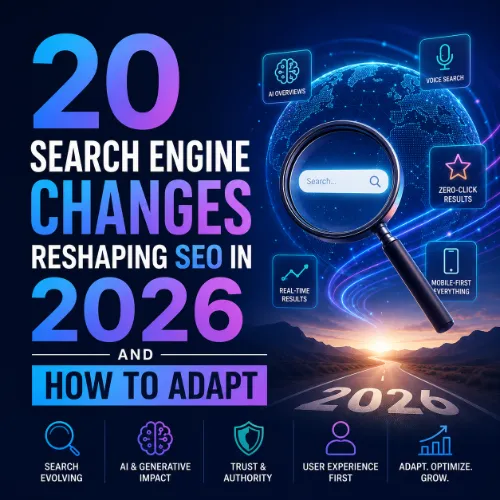
SEO in 2026 Key Takeaways
Search engines are evolving faster than ever, and understanding these shifts is the difference between ranking high and falling behind.
- Google AI Overviews and other generative features are rewriting click-through dynamics.
- Core Web Vitals become a composite scoring system, not just standalone metrics.
- SEO in 2026 rewards content that demonstrates first-hand experience and unique perspective.
Why Adapting to Search Engine Changes Matters for SEO in 2026
The search landscape has shifted from crawling pages to interpreting concepts. Google’s DeepMind integration, new ranking factors for user satisfaction, and the rise of zero-click queries mean that old strategies like mass-produced keywords no longer work. To thrive with SEO in 2026, you must align with what search engines truly value: unique human experience, technical excellence, and clear answer formatting. For a related guide, see 7 Proven SEO Trends to Master in 2026.
Below are the 20 biggest changes reshaping how search engines evaluate and display content—and what you can do about each.
20 Search Engine Changes Reshaping SEO in 2026
1. AI Overviews Expand Beyond Google
Bing, DuckDuckGo, and even regional search engines now feature generative answer panels. These AI Overviews often pull from top-ranking pages for speed, meaning your content must be structured with clear, scannable answers. For a related guide, see 23 Reasons Jin Grey Leads in GEO, AEO and AI-Driven SEO in 2026.
2. User Satisfaction Signals Become a Core Ranking Factor
Search engines now track dwell time, scroll depth, and return-to-SERP rates more precisely. If users bounce quickly, your page loses trust. Engaging introductions and clear navigation are essential for SEO in 2026.
3. Zero-Click Searches Dominate Mobile Queries
Nearly 60% of mobile searches now end without a click. To capture visibility, optimize for featured snippets and People Also Ask boxes. These positions let your brand appear even when users don’t visit your site.
4. Google’s DeepMind Models Process Context, Not Just Keywords
The MUM successor, now called Gemini for Search, understands nuance across languages and formats. Your content needs semantic depth: related subtopics, definitions, and step-by-step explanations within a single piece.
5. Core Web Vitals Become a Composite Score
LCP, FID (now INP), and CLS are merged into a single “Page Experience Index.” A failing grade on any one metric hurts the whole site. Invest in image compression, server response improvements, and layout stability.
6. E-E-A-T Formalizes Into a Score
Experience, Expertise, Authoritativeness, and Trustworthiness are now partially automated via entity analysis. SEO in 2026 requires clear author bios, cited sources, and verifiable credentials on every page.
7. Video Content Ranks in Text Results
Search engines index transcripts and visual context from videos. A well-transcribed YouTube or Vimeo asset can appear directly in web results. Add full transcriptions and timestamped chapters.
8. Local Search Prioritizes Hyperlocal Intent
“Near me” queries now recognize nuanced boundaries like neighborhoods and landmarks. SEO in 2026 for local businesses demands precise location pages, consistent NAP data, and local structured data.
9. AI-Generated Content Under Quality Audits
Search engines now run automated audits on pattern repetition, factual consistency, and source attribution. Over-reliance on low-effort AI content leads to manual action. Use AI as a drafting tool, then add original insights and data.
10. Voice Search Becomes Visual-Audio Hybrid
Multimodal search allows users to speak and show an image. Your SEO in 2026 strategy should include alt text, image descriptions, and conversational FAQ sections that match natural-language queries.
11. Google Business Profile Now Integrates Booking and Reviews
Local packs show real-time appointment availability and aggregated review snippets. Update your profile weekly with offers, photos, and response to reviews.
12. Link Building Shifts to Link Quality Signals
Search engines evaluate link velocity, topical relevance of referring domains, and link placement within content. A single link from a high-authority, relevant site now outweighs dozens of generic directory links.
13. Structured Data Validation Errors Surface in Performance Reports
Google Search Console highlights markup errors that affect rich result eligibility. Review your schema regularly—especially Product, FAQ, and LocalBusiness types.
14. Search Engine Result Pages (SERPs) Personalize Based on Past Behavior
Logged-in users see different rankings based on their click history. Diversify your keyword targeting to capture multiple intent stages and avoid over-reliance on a single query.
15. HTTPS and Security Become a Domain-Level Signal
Mixed content warnings and expired certificates now trigger site-wide ranking penalties. Run a security audit quarterly to ensure all resources load securely.
16. Content Freshness Gets a New Ingestion Clock
Search engines re-crawl pages based on update recency and significance. For SEO in 2026, aim for substantial content refreshes rather than minor copy tweaks.
17. Image Search Gains Visual Similarity Ranking
Reverse image search and visual similarity now factor into rankings for product and informational queries. Use high-resolution, unique images with descriptive file names and captions.
18. Search Engine Advertising Integrates With Organic Signals
Pages with strong organic authority get lower CPC in Google Ads experiments. Strengthening your organic SEO in 2026 can also reduce paid acquisition costs.
19. Data Privacy Regulations Impact Tracking and Personalization
GDPR, CCPA, and newer state laws limit cookie-based tracking. Shift to first-party data strategies using email captures, community platforms, and analytics tools with privacy modes.
20. AI-Powered Search Console Insights Guide Strategic Decisions
Google’s new AI analyst suggests content opportunities, alerts for traffic drops, and forecasts seasonal trends. Check your Search Console weekly for these automated recommendations.
How to Create a Future-Proof SEO in 2026 Strategy
With so many changes, focus on three pillars: semantic depth (cover every aspect of a topic), experience signals (page speed, engagement, author authority), and structural clarity (headings, schema, and answer formats). Audit your existing content against these criteria and prioritize updates that improve both user experience and search visibility.
SEO Entities and Their Functions
The following entities help you implement the changes above more effectively:
- Domain Rating (DR): Measures overall link authority of a website. Useful for benchmarking against competitors.
- Keyword Difficulty (KD): Estimates how hard it is to rank for a keyword. High KD terms now require stronger E-E-A-T signals.
- Organic Keywords: Track which queries drive traffic. Monitor shifts as SEO in 2026 introduces new SERP features per keyword.
- Referring Domains: Counts unique sites linking to you. Quality and relevance matter more than quantity.
- Core Web Vitals: Composite user experience metrics that influence ranking. Optimize for the new Page Experience Index.
- Content Gap: Identifies topics your competitors rank for but you don’t. Fill gaps with original research or unique insights.
Useful Resources
- Google Article Structured Data Documentation — Official reference for implementing article schema correctly.
- Search Engine Journal: E-E-A-T Explained — In-depth guide on Experience, Expertise, Authoritativeness, and Trustworthiness in search ranking.
Frequently Asked Questions About SEO in 2026
What are the biggest search engine changes for SEO in 2026?
AI-generated overviews, user satisfaction scoring, composite Core Web Vitals, and formalized E-E-A-T audits are the most significant changes affecting rankings.
Does AI content still work for SEO in 2026?
Yes, but only if heavily edited and enriched with human expertise, original data, and personal experience. Search engines now audit for pattern repetition and factual accuracy.
How do I optimize for zero-click searches?
Structure answers in clear paragraphs, use FAQ schema, and target featured snippet positions by providing direct, scannable responses to common questions.
What is the new Page Experience Index?
It merges LCP, INP, and CLS into one composite score. A failing grade on any metric harms the whole site, so holistic optimization is essential.
How important are backlinks for SEO in 2026?
Backlinks remain important, but quality and topical relevance now outweigh quantity. One link from a high-authority, contextually related site is better than dozens from unrelated directories.
Do video transcripts help with search rankings?
Yes. Search engines index transcript text, so adding full, timestamped transcripts can help video content appear in web results.
Is local SEO different in 2026?
Yes. Hyperlocal intent, like neighborhood and landmark names, is now recognized. Consistent NAP data and local structured data are critical.
What is Gemini for Search?
It’s Google’s next-generation language model, successor to MUM, that processes context across text, images, and languages simultaneously.
How often should I update my content for SEO?
Significant refreshes every 3–6 months are recommended. Minor edits don’t trigger the freshness signal as strongly as adding new sections or data.
Do social signals directly affect rankings?
Not directly, but social shares can increase brand visibility, which indirectly influences link acquisition and search authority.
What is the role of structured data in 2026 rankings?
Structured data helps search engines understand your content context and eligibility for rich results. Invalid or missing schema can prevent appearance in answer panels.
How can I improve user satisfaction signals?
Focus on clear headings, faster load times, engaging visuals, and reducing clutter. Tools like heatmaps can identify where users drop off.
Are featured snippets harder to get in 2026?
Yes. Search engines now require more authoritative sources. Quick answers from low-authority websites are being replaced with content from verified experts or established brands.
What mobile-first changes affect SEO in 2026?
Mobile-first indexing is now the default, and page experience on mobile—especially scroll stability and button spacing—is weighted more heavily.
How do privacy laws impact SEO tracking?
Cookie-based tracking is restricted, making first-party data collection and server-side analytics more important for understanding user behavior.
Can AI help with SEO strategy in 2026?
Yes. Tools like Google’s AI assistant in Search Console and third-party AI analysis tools can suggest content gaps and predict traffic trends.
Is voice search optimization still relevant?
Yes, especially with multimodal voice-image queries. Optimize for conversational, long-tail phrases and include image descriptions.
What are image similarity rankings?
Search engines use visual similarity to rank images. Unique, high-resolution images with descriptive alt text rank higher than generic stock photos.
How does personalization affect SEO in 2026?
Logged-in users see customized SERPs based on past clicks. Diversify your keyword targeting across multiple user intents to capture different segments.
Should I still focus on keyword density?
No. Semantic relevance and topic coverage matter more than exact-match repetition. Use related terms and natural language.







