

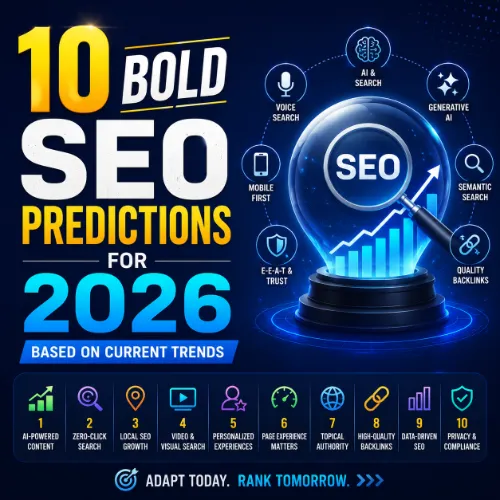
SEO predictions 2026 Key Takeaways
Whether you manage a small business website, an e-commerce store, or a content publication, these ten forecasts will help you allocate resources wisely.
Why SEO predictions 2026 Matter for Your Strategy
The days of chasing single keywords are fading. Google’s March 2024 core update emphasized helpful content and user experience. Meanwhile, AI Overviews are reshaping SERPs by answering queries directly. Staying ahead means understanding where search is headed — not just reacting to changes after they happen. These SEO predictions 2026 are grounded in current algorithm shifts, search behavior data, and industry experiments. For a related guide, see 10 Technical SEO Trends Webmasters Can’t Ignore in 2026.
Whether you manage a small business website, an e-commerce store, or a content publication, these ten forecasts will help you allocate resources wisely. Let’s explore each prediction with trend evidence, a clear explanation, and an actionable takeaway.
1. AI Overviews Will Dominate Informational Queries
Google’s AI Overviews are already appearing for millions of queries. By 2026, expect them to occupy more real estate above traditional organic results for informational searches. This shift reduces click-through rates for many pages but creates new opportunities for sites that earn placement in those overviews.
Trend evidence: Google reported that AI Overviews increase search satisfaction in internal tests. Many publishers saw traffic drops in mid-2024 after the rollout expanded.
Actionable takeaway: Structure your content with clear, factual answers at the top. Use FAQ schema and bullet lists to increase your chances of being cited in an AI Overview. Focus on unique analysis rather than generic summaries.
2. E-E-A-T Will Become a Measurable Ranking Signal
Experience, expertise, authoritativeness, and trustworthiness are already implicit signals. In 2026, Google may formalize how it evaluates these — especially author expertise via linked author profiles and publication history.
Trend evidence: Google’s Search Quality Rater Guidelines continue to emphasize author credentials. In a recent Google Search Central blog post, they stressed the value of original reporting and transparent authorship.
Actionable takeaway: Add author bios with links to relevant credentials. Create a dedicated “About Our Experts” page. Avoid ghostwritten content without attribution.
3. Topic Clusters Will Replace Keyword-Based Targeting
Instead of optimizing individual pages for single keywords, SEOs will structure entire content ecosystems around core topics. Hub-and-spoke models will help search engines understand your site’s depth on a subject.
Trend evidence: Ahrefs data shows that pages from strong topic clusters rank for 3x more keywords than isolated posts.
Actionable takeaway: Map your pillar page and cluster content for 3-5 core topics. Interlink them intelligently using descriptive anchor text. Update cluster posts annually.
4. Zero-Click Searches Will Continue to Grow
With featured snippets, AI Overviews, and knowledge panels answering queries directly, many searches never result in a click. For 2026, expect this trend to accelerate for mobile and voice queries.
Trend evidence: Studies from SparkToro and Similarweb indicate that nearly 65% of Google searches end without a click.
Actionable takeaway: Optimize for brand queries and transactional keywords to capture clicks when intent is commercial. Track branded search volume and protect your reputation through consistent local listings and PR.
5. Core Web Vitals Will Include Interaction to Next Paint
Google plans to replace First Input Delay with Interaction to Next Paint as a metric for responsiveness. Sites that feel sluggish will face ranking pressure.
Trend evidence: Google announced INP will become a stable Core Web Vital in March 2024, with full rollout throughout the year.
Actionable takeaway: Audit your site’s INP score using PageSpeed Insights. Minimize long tasks, optimize third-party scripts, and consider lazy-loading for images below the fold.
6. Brand Searches Will Influence Organic Rankings More
Google increasingly uses brand signals — such as branded search volume, brand mentions, and direct traffic — as proxies for authority. A strong brand helps your entire site rank better. For a related guide, see 19 Content Formats Dominating Google Rankings (2026 Guide).
Trend evidence: Research by Search Engine Land showed that sites with high branded search volume recover faster from algorithm updates.
Actionable takeaway: Invest in brand awareness campaigns, earn unlinked brand mentions from reputable sites, and encourage customers to search for your business name before visiting.
7. Video Content Will Gain Direct SERP Placement
Google is surfacing video results — especially short-form — more frequently outside YouTube. Expect more videos in carousels and featured snippets for how-to and tutorial queries.
Trend evidence: Google’s video index has grown 60% year-over-year. They now require video structured data to surface in search.
Actionable takeaway: Add VideoObject schema to embed URLs. Create short, focused answer videos for your top 10 informational queries. Host videos on your domain, not just YouTube, to keep traffic.
8. Local SEO Will Require Hyper-Specific Content
Generic location pages (like “Plumber in Chicago”) will lose effectiveness. Google expects unique, neighborhood-level information. Hyper-local content will dominate local packs.
Trend evidence: Google’s local algorithm update in late 2023 prioritized reviews and proximity signals from nearby landmarks.
Actionable takeaway: Create separate pages for each neighborhood you serve. Include local landmarks, specific addresses, and area-relevant keywords. Embed a Google Map.
9. Link Building Will Shift Toward Relationships Over Directories
High-quality editorial links from trusted domains will become even more valuable. Directory and low-quality guest post links will lose impact.
Trend evidence: Google’s link spam update (December 2024) penalized sites with unnatural link patterns.
Actionable takeaway: Focus on digital PR, broken link building, and creating original research that journalists want to cite. Aim for links from .edu, .gov, and industry-leading sites.
10. Structured Data Will Become a Competitive Advantage
Schema markup currently helps with rich snippets. In 2026, expect Google to use structured data to understand page context and topic hierarchy — not just present enhanced results.
Trend evidence: Google’s developer documentation now recommends entity-based schema (like Person, Organization, and LocalBusiness) for content understanding.
Actionable takeaway: Implement schema for every page type: Article, Product, FAQ, HowTo, and Video. Test with Google’s Rich Results Test tool. Keep your schema aligned with content changes.
SEO Entities and Their Functions
To act on these SEO predictions 2026, you need the right data. Understanding how entities interact helps you diagnose problems and spot opportunities. Here is what the key entities reveal:
- Domain and URL entities: Analyze root domain vs. subdomain performance. If your blog outperforms your main domain, consider consolidating authority via redirects or internal linking.
- Keyword entities: Beyond search volume, look at keyword difficulty and traffic potential. High-difficulty keywords may be achievable via a topic cluster approach.
- Backlink entities: Track referring domains, lost links, and spam score. A sudden loss may indicate a manual action or a broken redirect.
- SERP entities: Monitor featured snippets and People Also Ask boxes. Optimize your content to win these positions, not just the organic listing.
- Technical SEO entities: Crawl errors, duplicate content, and Core Web Vitals reveal blockers. Prioritize fixing issues that affect indexability and user experience.
Useful Resources
The following resources offer deeper guidance on specific predictions:
- Google Search Central Documentation — Official guidance on structured data, Core Web Vitals, and E-E-A-T.
- Ahrefs SEO Trends Report — Data-driven analysis of keyword difficulty, SERP features, and search volume shifts.
Frequently Asked Questions About SEO predictions 2026
What is the most important SEO trend for 2026?
AI Overviews and E-E-A-T signals rank highest. Preparing your content for AI summaries and building author authority will have the broadest impact.
Will keyword research still work in 2026?
Yes, but it will be part of a broader topic cluster strategy. Instead of chasing single keywords, research clusters of related terms and map them to user intents.
How do AI Overviews affect click-through rates?
Early data shows a 10-20% drop in CTR for informational queries. However, brands that get cited in the overview can recover traffic through brand searches and direct visits.
What is Interaction to Next Paint (INP)?
INP measures a page’s responsiveness to user interactions like clicks and taps. Google will replace First Input Delay with INP as a Core Web Vital in 2026.
How do I improve my site’s E-E-A-T?
Display author credentials, cite original research, include a clear about page with real contact info, and earn mentions from authoritative industry sources.
What is a topic cluster in SEO?
A topic cluster is a group of interlinked pages built around a central pillar page. It signals to Google that your site has comprehensive coverage of a subject.
Are guest posts still effective for link building?
Only if the guest post is published on a high-authority, relevant site with editorial oversight. Low-quality guest posts will likely be ignored or penalized.
How does schema markup help with AI Overviews?
Structured data helps Google parse your content accurately. Using FAQ, HowTo, and Article schema increases the chance your answer is used in an AI summary.
Should I optimize for zero-click searches?
Yes, but strategically. For brand awareness, optimize for featured snippets. For direct traffic, focus on transactional and navigational queries where clicks are more likely.
Will local SEO change in 2026?
Yes. Google is rewarding hyper-local content. Create pages targeting specific neighborhoods with unique local details and encourage reviews that mention local landmarks.
How can I track my SEO progress for 2026?
Use tools like Google Search Console, Ahrefs, and SEMrush. Monitor organic traffic, keyword rankings for head terms, Core Web Vitals, and brand search volume monthly.
What is a SERP feature?
A SERP feature is any non-standard result on a search engine results page, such as featured snippets, knowledge panels, image carousels, or AI Overviews.
Do backlinks still matter for SEO in 2026?
Absolutely. High-quality, relevant backlinks from trusted domains remain one of the strongest ranking signals. Focus on earning links through digital PR and research.
What is the future of search intent in SEO?
Search intent optimization will become more granular. You will need to satisfy informational, navigational, transactional, and commercial investigation intents with separate page types.
How does Google use brand mentions as a ranking signal?
Google may treat unlinked brand mentions as a vote of trust. They are especially valuable when they appear on authoritative sites alongside positive context.
What is the best way to structure content for AI Overviews?
Write clear, direct answers near the top of your page. Use bullet points or numbered steps. Include relevant schema (FAQ, HowTo) and keep paragraphs short.
Will Google penalize AI-generated content?
Google’s policy is to reward helpful content regardless of how it is produced. However, low-quality AI content that lacks originality or expertise will not rank well.
What are the biggest SEO mistakes to avoid in 2026?
Ignoring Core Web Vitals, using outdated keyword stuffing, building low-quality backlinks, and neglecting E-E-A-T signals are all common pitfalls.
How often should I update my SEO strategy?
Review your strategy quarterly. Track algorithm updates, competitor moves, and new Google features. Adjust your content calendar and link building targets accordingly.
What tool should I use for keyword research in 2026?
Ahrefs, SEMrush, and Google Keyword Planner remain industry standards. For zero-click insight, use tools that track featured snippet opportunities and AI Overview mentions.







