If you want to dominate Google in 2026, mastering featured snippet optimization is your fastest path to zero‑click visibility. Featured snippets now appear on 12‑15% of all search queries, and the page holding position zero can see click‑through rates up to 42% for transactional keywords—far outpacing the standard #1 organic result.
This 7‑step tactical guide shows you exactly how to steal position zero from competitors by targeting question‑based keywords, formatting for paragraph, list, and table snippets, and using structured data that also appeals to ChatGPT, Gemini, Perplexity, Microsoft Copilot, Claude, and every major LLM. You’ll learn the art of answer engine optimization (AEO) and turn featured snippets into a predictable traffic machine.
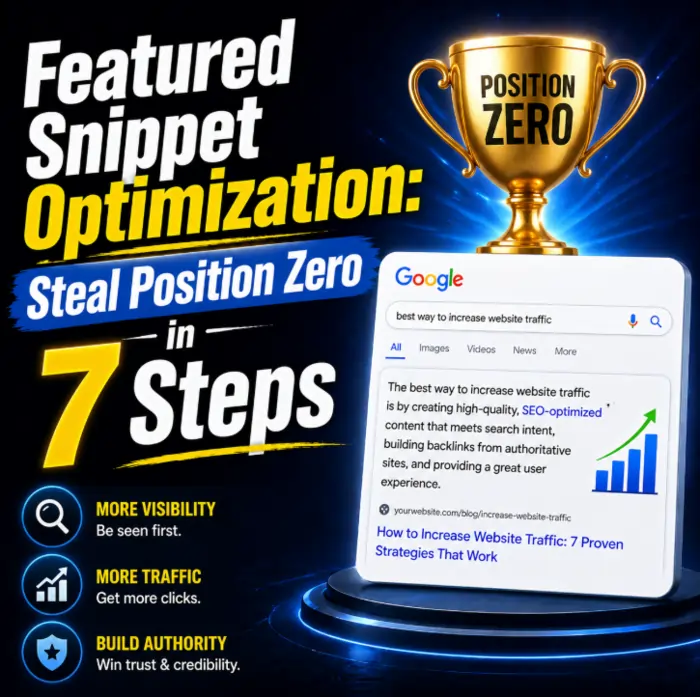
For years, SEOs chased the #1 organic ranking. But in 2026, the real trophy sits above position one—the featured snippet. Also known as position zero, this answer box appears before any organic result, often stealing more than half the clicks for informational queries. Yet when optimized correctly for high‑intent searches, the snippet can deliver conversion rates 5x higher than standard organic traffic.
The catch? Most of your competitors have no idea how to win it. They write long, rambling paragraphs without clear headings, ignore question‑based formatting, and never add structured data. That leaves the door wide open for you.
This guide will walk you through seven repeatable steps to systematically steal featured snippets from any competitor—no matter how authoritative their domain appears.
Featured Snippet Optimization: Understanding the 2026 Landscape
Before you steal, you need to understand what you’re stealing. In 2026, Google uses four primary featured snippet types: paragraph snippets (direct answers to “what is,” “why,” “who”), list snippets (ordered or unordered steps), table snippets (comparisons or structured data), and video snippets (instructional content). Each requires a different optimization approach.
But there is a new layer: Generative Engine Optimization (GEO) . Google’s AI Overviews now coexist with featured snippets, and the same content that wins a snippet is also more likely to be cited inside ChatGPT, Gemini, and Perplexity. So when you optimize for position zero, you are also future‑proofing for answer engine optimization (AEO) .
The data backs this up: pages that hold a featured snippet see 30‑40% higher brand recall even when users don’t click. And for commercial queries like “best SEO tools” or “top CRM software,” a featured snippet can deliver click‑through rates above 42%—higher than the #1 organic result alone.
Step 1: Identify Snippet Opportunities Your Competitors Are Winning
You cannot steal a snippet you cannot see. Start with a competitor snippet audit:
- Compile a list of your top 30‑50 keywords by search volume and intent.
- Use a tool like Ahrefs, SEMrush, or Moz to filter by SERP features – “Featured snippet.”
- For each keyword where a snippet exists, note:
- Which URL currently holds the snippet (likely a competitor).
- What type of snippet it is (paragraph, list, table, or video).
- What heading appears directly above the snippet’s source.
Pro tip: Also check for keywords where no snippet exists but where a clear answer format could trigger one. Those are often easier to win because you are not competing against an incumbent.
For a complete framework on identifying SERP opportunities, our Zero Click SEO guide walks through the exact audit process with spreadsheet templates.
Step 2: Reverse‑Engineer the Winning Format
Once you have a target snippet, click through to the competitor’s page and inspect the exact section Google pulled the answer from. Ask:
- Is the answer a single paragraph? If so, how many words? (Typically 40‑60)
- Is it a numbered list? How many steps?
- Is it a table? What columns and rows?
- What heading (H2 or H3) sits directly above that content?
Now, open your own page that ranks on the first page for the same query (even position #5 or lower). Compare:
- Does your page have a similar heading + answer structure?
- If not, you have a clear format gap.
Your goal is not to copy. It is to outperform by adding one extra step, a clearer definition, a fresher statistic, or a better formatting element. For list snippets, for example, if the competitor has 5 steps, aim for 6—but only if the 6th adds real value.
To see how this reverse‑engineering works for AI Overviews as well, check out our AI Overviews SEO guide – the principles are identical, but the extraction signals differ slightly.
Step 3: Write a “Definition Block” for Paragraph Snippets
The most common snippet type is the paragraph snippet, triggered by “what is,” “why does,” “who,” and “how does” queries. To win it, you need a definition block placed under a question‑format H2, ideally within the first 200 words of your page.
Structure of a winning definition block:
[Question as H2]: What is featured snippet optimization?
Answer (40‑60 words): Featured snippet optimization is the practice of structuring web content to earn the answer box that appears above organic search results. It requires direct answers, question‑based headings, and often structured data. When done correctly, it can increase click‑through rates by 40% or more.
Notice the pattern: repeat the keyword, keep it concise, and front‑load the answer. Avoid fluff like “in today’s digital landscape.”
For comparison queries like “X vs Y,” a table snippet works better. Your definition block then becomes the introduction to that table.
Step 4: Optimize List Snippets with Proper HTML
List snippets—ordered (numbered) or unordered (bulleted)—are ideal for “how to,” “steps to,” “ways to,” and “reasons to” queries. Google extracts these directly from your HTML list elements.
To win a list snippet:
- Use
<ol>for numbered steps or<ul>for bullet points. - Wrap the list in a
<div>with clear semantic meaning. - Place a descriptive H2 directly above the list (e.g., “7 Steps to Optimize for Featured Snippets”).
- Keep each list item short: 10‑20 words ideally, max 30.
- Use strong action verbs at the start of each list item.
- For ordered lists, ensure the steps are sequential and complete.
Most importantly, do not bury lists inside long paragraphs. Google’s extractor looks for isolated HTML list elements, not lists inside text blocks.
For a deeper dive into how list snippets interact with AI engines like ChatGPT and Perplexity, see our zero click content strategy – it covers why lists are the most cited format inside LLM answers.
Step 5: Build Comparison Tables for Table Snippets
Table snippets appear for comparison keywords (“iPhone vs Samsung,” “HubSpot vs Salesforce,” “best credit cards”). They display columns and rows directly inside the search results.
To win a table snippet:
- Use proper HTML
<table>tags with<th>for headers. - Keep the table small: 3‑5 rows and 2‑3 columns maximum.
- Place the table directly under an H2 that contains the comparison phrase.
- Use clear, scannable cell content (short phrases, not long sentences).
- Add a short introductory sentence above the table explaining what it compares.
Google’s AI Overview system also loves tables for data synthesis. If you win the table snippet, you are also more likely to be cited inside Gemini’s AI Overviews for similar comparison queries.
For measurement of how many clicks and citations your table snippet actually earns, our AI Citation Tracking guide provides a dashboard framework.
Step 6: Add FAQPage and HowTo Schema
Structured data is not a direct ranking factor for featured snippets, but it dramatically increases your chances of being extracted. Google’s extractor looks for semantic markers.
For question‑based snippets (paragraph or list):
Implement FAQPage schema on the page. Each Question and Answer pair becomes a candidate extraction point. You do not need to hide the FAQ content; visible FAQs with schema work best.
For step‑by‑step snippets:
Use HowTo schema with step and instruction properties. This tells Google exactly where your list of steps begins and ends, reducing extraction errors.
Both schema types also help LLMs like Claude and Gemini understand your content structure, making you more likely to be cited inside ChatGPT and Perplexity.
For official syntax, refer to Google’s structured data documentation. It includes live examples you can copy.
Step 7: Monitor, Refresh, and Defend Your Snippets
Stealing a snippet is only half the battle. Competitors will try to steal it back. You need a snippet maintenance system:
- Set up SERP tracking in Ahrefs or SEMrush with “SERP features” alerts.
- Check monthly for snippet changes on your top 20 keywords.
- For any snippet you lose, immediately re‑audit the competitor’s new winning page.
- Update your content with fresher data, more steps, or clearer language.
- Re‑submit the page to Google Search Console for recrawling.
Also track AI Overview citations alongside featured snippets. Often, a page can lose a featured snippet but still be cited inside AI Overviews—a different but still valuable form of visibility. Our future of search in 2027 guide explains how AI Agents will change snippet dynamics entirely.
Tools for Featured Snippet Optimization
To execute the 7 steps above, you need the right toolset:
- Ahrefs Keywords Explorer – Filter by “SERP features: Featured snippet” and see exactly which pages hold snippets for your keywords.
- SEMrush Position Tracking – Set up campaigns with “SERP features” to get alerts when you win or lose a snippet.
- Moz Keyword Explorer – Similar functionality with a clean interface for snippet discovery.
- Google Search Console – Filter by “Search appearance: Featured snippet” to see which of your pages currently own snippets.
- Schema Markup Generator (Merkle) – Free tool to generate FAQPage and HowTo schema without coding.
For a real‑world example of how to use these tools to steal position zero from a competitor, check out the case study in our featured snippet optimization cluster – it walks through a live example from start to finish.
And for authoritative external reading, the Search Engine Land featured snippet guide is updated quarterly with Google’s latest changes. The Ahrefs SERP features glossary also provides excellent visual examples.
The Zero‑Click Trap Revisited
Remember: winning a featured snippet for a purely informational query can reduce your click‑through rate because users get the answer without visiting your site. That is the zero‑click trap.
How to counter it:
- After the snippet block, immediately add a benefit‑driven lead like: “Want the full 25‑point checklist for stealing snippets? Download it here.”
- For commercial keywords, ensure the snippet answers only part of the question, forcing a click for details.
- Use internal linking from the snippet‑winning page to your product or service pages.
Also, track brand lift separately from clicks. A cited snippet builds brand recognition that pays off in future search and direct traffic. For a full measurement framework, see our AI citation tracking guide .
Final Thoughts
Featured snippet optimization is one of the highest‑ROI activities you can do in 2026. It puts your brand at position zero, above every organic result, and often inside AI Overviews and LLM answers. The 7‑step framework above works whether you are a solo blogger or a Fortune 500 SEO team.
Start with a competitor audit. Identify one snippet you can realistically steal. Implement the format improvements, add schema, and wait 2‑4 weeks. Then rinse and repeat. Over time, you will build a portfolio of position‑zero real estate that drives both visibility and traffic.
And remember: the same techniques that win featured snippets also prepare you for the future of AI‑only search. For the complete picture, dive into our Zero Click SEO pillar – it connects every piece of the puzzle.
Now go steal position zero.
Frequently Asked Questions (FAQs)
1. What is featured snippet optimization?
Featured snippet optimization is the process of structuring content to earn the answer box that appears above organic search results, often called position zero.
2. How do I find keywords that have featured snippets?
Use SEO tools like Ahrefs, SEMrush, or Moz to filter your keyword list by the SERP feature “Featured snippet.”
3. Can I steal a snippet if my page ranks #5?
Yes. Google selects snippets based on answer clarity and format, not just ranking. A well‑structured page in position #5 can steal the snippet from a #1 result.
4. What is the ideal length for a paragraph snippet?
40‑60 words, placed directly below a question‑format H2 heading. The answer must be complete and standalone.
5. Do I need special coding for list snippets?
No, but you should use proper HTML <ol> (ordered) or <ul> (unordered) lists. Avoid using dashes or asterisks inside paragraphs—those are not always recognized.
6. How does FAQ schema help with featured snippets?
FAQ schema provides Google’s extractor with pre‑packaged question‑answer units, increasing the odds that your content is chosen for question‑based snippets.
7. What is the difference between a featured snippet and an AI Overview?
A featured snippet is a direct answer from a single page. An AI Overview synthesizes information from multiple pages into a paragraph‑length answer.
8. Can ChatGPT or Perplexity help me optimize for snippets?
Yes. You can prompt an LLM to analyze a competitor’s snippet and suggest improvements to your own content based on clarity, depth, and formatting.
9. Which industries see the highest snippet win rates?
Industries with heavy “how‑to,” comparison, and definitional searches—software, finance, health, home improvement, legal, and education—tend to see the best results.
10. How often should I monitor my snippets?
At least monthly using rank‑tracking tools with SERP feature alerts. For competitive niches, weekly monitoring is recommended.
11. What is the zero‑click trap and how do I avoid it?
The zero‑click trap occurs when a snippet fully answers a query, so users never click your link. Counter it by adding a “lead magnet” (checklist, template) immediately after the snippet block.
12. Does internal linking affect snippet eligibility?
Yes. Strong internal links from high‑authority pages to your snippet‑targeted page help Google understand topical relevance, increasing snippet eligibility.
13. What is the best type of snippet for eCommerce?
Table snippets for product comparisons and list snippets for “best X” queries tend to perform best for eCommerce, with click‑through rates above 40%.
14. Can I optimize for snippets without backlinks?
Yes. Snippets are primarily won through on‑page formatting and answer quality. Backlinks help you rank high enough to enter the candidate set, but formatting does the heavy lifting.
15. How do I measure the ROI of a featured snippet?
Track branded search lift, direct traffic increase, and click‑through rate from the snippet itself using Google Search Console’s “Performance report” filtered by “Search appearance: Featured snippet.”
16. What role does content freshness play?
Google prioritizes fresh content for snippet extraction, especially for trending or time‑sensitive topics. Pages updated in the last 3 months are significantly more likely to win snippets.
17. Can a single page have multiple featured snippets?
Yes. A long‑form guide can win paragraph snippets for one query and list snippets for another query on the same page, as long as each section is clearly structured.
18. What is the fastest way to steal a snippet?
Run a competitor SERP analysis, find a query where you rank in positions 2‑5, copy the competitor’s snippet format, improve the answer (add a step, clearer language, fresher data), and wait 2‑4 weeks for Google to recrawl.
19. Do outbound links help with snippet optimization?
Outbound links to authoritative, relevant sources improve E‑E‑A‑T signals and can indirectly help. But outbound links rarely appear inside the snippet itself.
20. Will featured snippets disappear with AI Overviews?
No. As of 2026, featured snippets remain Google’s primary format for direct answers to specific, fact‑based questions. AI Overviews are more common for broader or comparative queries. Both will coexist for the foreseeable future.