

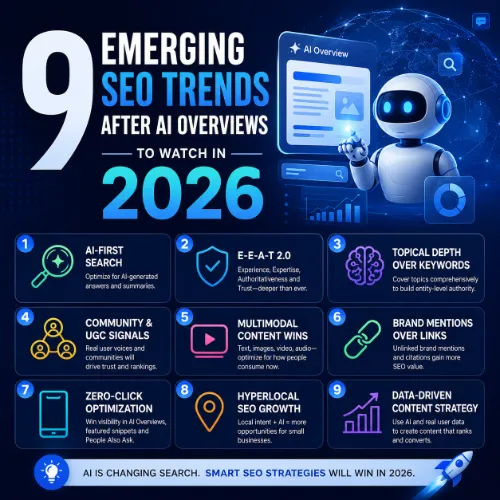
SEO trends after AI Overviews Key Takeaways
AI Overviews have fundamentally changed how Google surfaces information, shifting from ten blue links to summarized, conversational answers.
- The rise of zero-click searches means SEO trends after AI Overviews prioritize featured snippets and People Also Ask boxes.
- Content must now answer questions concisely to win AI-generated citations, not just organic clicks.
- Building entity-based topical clusters strengthens your site’s authority for AI summarization algorithms.
Why SEO Trends After AI Overviews Matter in 2026
Google’s introduction of AI Overviews — the AI-generated summaries that appear at the top of many search results — marked one of the biggest SERP shifts in a decade. For site owners and marketers, this change means that “ranking #1” no longer guarantees visibility if the answer is already provided in the overview. Understanding the SEO trends after AI Overviews helps you adapt your strategy to maintain traffic, build authority, and capture voice-search and zero-click opportunities. Below, we break down nine trends that are shaping the future of search optimization. For a related guide, see 17 Search Updates and Trends That Could Affect Publishers in 2026.
1. Zero-Click Optimization Becomes a Core SEO Trend After AI Overviews
With AI Overviews answering many queries directly on the SERP, users are less likely to click through to a website. This makes zero-click optimization — securing a featured snippet, a People Also Ask entry, or a cited source within the overview — a critical skill. To win these spots, provide clear, concise answers to common questions in your content, using lists, tables, and short paragraphs.
How to Structure Content for Zero-Click Wins
Use the inverted pyramid: start with the direct answer in the first paragraph, then expand with context. Add FAQ schema and bullet-point summaries to increase the chance Google pulls your text into an overview. Tools like Ahrefs Site Audit can help you identify pages that already rank in position zero and need updating.
2. Topical Authority Replaces Keyword Density as the Primary Ranking Signal
AI Overviews evaluate a site’s overall expertise on a topic rather than just keyword matches. Building topical clusters — a series of interlinked pages that cover every angle of a subject — is now one of the most important SEO trends after AI Overviews. For example, a single article on “coffee brewing methods” is weak; a cluster of articles on pour-over, French press, espresso, and grinder types signals authority.
Practical Steps to Build Topical Authority
Start with a pillar page on your broad topic, then create supporting posts that link back to the pillar. Use internal links with descriptive anchor text. Track your coverage gaps with a content audit using Ahrefs Content Gap to find subtopics your competitors cover that you do not.
3. Brand Searches Gain New Importance in the AI Overview Era
When AI Overviews cite a source, they often favor well-known, trusted brands. Growing brand search volume — people searching for your company name or branded terms — signals to Google that you are a reputable entity. This is a subtle but powerful SEO trend after AI Overviews that rewards long-term brand building.
How to Increase Brand Searches
Invest in PR, guest posting on authoritative sites, and social media campaigns that include your brand name. Monitor your brand mention growth using Ahrefs Brand Monitoring tools. Positive brand sentiment and increased direct traffic correlate with higher trust signals for AI summarization.
4. Structured Data and Schema Markup Move From Optional to Essential
AI Overviews rely heavily on structured data to interpret content quickly. Pages with detailed FAQ, HowTo, and Article schema are more likely to be used as sources. Implementing schema is no longer a technical bonus; it is a baseline requirement among SEO trends after AI Overviews.
Schema Types That Drive AI Visibility
Prioritize FAQ schema for question-based content, HowTo schema for instructional posts, and BreadcrumbList schema for navigation clarity. Test your markup using the Google Rich Results Test and fix errors flagged during an Ahrefs Site Audit.
5. E-E-A-T Signals Become More Transparent and Actionable
Experience, Expertise, Authoritativeness, and Trustworthiness are now directly evaluated by AI models that generate overviews. Publishing content with clear author bios, citing primary sources, and linking to original research are key SEO trends after AI Overviews that separate mediocre content from high-performing material.
Actionable E-E-A-T Improvements
Add an author box to every article with credentials and links to their other work. Link to independent studies or official statistics. Update old content to reflect the latest information. Google’s Search Quality Evaluator Guidelines provide a clear benchmark for what qualifies as high E-E-A-T. For a related guide, see AI Studio Updates and Their Impact on Content Ranking Strategies.
6. Long-Tail and Conversational Queries See a Resurgence
Because AI Overviews excel at answering natural-language questions, optimizing for long-tail, conversational queries (like “how do I fix a leaky faucet without a wrench?”) now pays off more than targeting head terms. This SEO trend after AI Overviews mirrors the rise of voice search.
Keyword Research for Conversational Queries
Use Ahrefs Keywords Explorer to filter for questions and prepositions. Look for queries with a question word (who, what, when, where, why, how) and moderate search volume. Create dedicated landing pages that answer these questions directly, using the same language a user would speak.
7. Video Content Gets a Boost in Mixed Media Overviews
Many AI Overviews now include embedded video results. Publishing high-quality, well-transcribed video content increases your chance of being surfaced in these mixed-media answer blocks. This is a rapidly emerging SEO trend after AI Overviews that video marketers should seize.
Video Optimization for AI Overviews
Host videos on YouTube (owned by Google) or optimize your self-hosted videos with VideoObject schema. Include a transcript below the video and use chapter markers to help AI pinpoint key moments. Use Ahrefs YouTube keyword research to find topics your audience is searching for.
8. Local SEO Becomes More Entity-Driven
For local queries, AI Overviews often pull from Google Business Profile data, local directories, and review sites. Strengthening your local entity — accurate NAP (Name, Address, Phone), consistent citations, and positive reviews — is a critical SEO trend after AI Overviews for brick-and-mortar businesses.
Local SEO Checklist for AI Visibility
Claim and verify your Google Business Profile. Ensure your address appears the same on every directory. Encourage customers to leave reviews on platforms Google trusts. Use Ahrefs’ local search features to see which terms drive local pack appearances.
9. Data-Driven Content Updates Become a Continuous Cycle
Finally, the pace of AI content updates means your pages need regular refresh cycles. One-time optimization no longer works. This SEO trend after AI Overviews requires a systematic approach to auditing and updating content based on performance data.
Creating a Content Refresh Workflow
Every quarter, review your top 20 performing pages (by traffic or keyword rankings) using Ahrefs Top Pages report. Update statistics, add new examples, and improve readability. Use the Content Gap tool to find new subtopics to add. A six-month-old study on “best running shoes” can lose its cite-ability; a fresh one wins citations.
SEO Entities and Their Functions
Understanding the entities that power modern SEO analysis helps you make smarter decisions with the trends above. Here are the most relevant entities for the SEO trends after AI Overviews:
- Website/Domain entities: root domain and URL-level analysis show whether performance belongs to your whole site or a specific page.
- Keyword entities: organic keywords, search volume, keyword difficulty (KD), and SERP features help you prioritize terms that align with AI Overview triggers.
- Backlink entities: referring domains, anchor text, and dofollow/nofollow links reveal authority sources that boost E-E-A-T signals.
- Content entities: articles, authors, topics, and referring domains to content evaluate which pieces earn citations in overviews.
- SERP entities: featured snippets, People Also Ask, AI Overviews, and video results show which format the search engine rewards.
- Technical SEO entities: crawl issues, Core Web Vitals, and indexability status prevent your content from being discovered by the AI generator.
- Competitor entities: competing domains and content gap opportunities point to topics your site can own.
Useful Resources
For deeper understanding of how AI Overviews work, read Google’s official announcement: AI Overviews in Search – May 2026 Update.
To master structured data for AI visibility, explore Google’s schema documentation: Structured Data Overview.
Frequently Asked Questions About SEO trends after AI Overviews
What are AI Overviews in Google Search?
AI Overviews are AI-generated summaries that appear at the top of Google search results, providing direct answers to user queries without always requiring a click to a website.
How do AI Overviews affect organic click-through rates?
Early data shows that AI Overviews reduce click-through rates for some queries because users get the answer directly on the SERP, especially for simple, fact-based questions.
What is zero-click SEO?
Zero-click SEO is the practice of optimizing content to appear in features like snippets, People Also Ask, and AI Overviews so your brand gains visibility even when users don’t click through.
How do I get my content cited in an AI Overview?
To get cited, provide clear, authoritative answers early in your content, use schema markup, build topical authority, and maintain strong E-E-A-T signals such as author bios and external references.
Do backlinks still matter after AI Overviews?
Yes, backlinks remain a core ranking factor because they signal authority and trust, which AI models use when selecting sources for overviews.
What is topical authority in SEO?
Topical authority means your site is recognized as a comprehensive expert on a subject, achieved by creating a cluster of interlinked content covering all aspects of the topic.
Should I focus on head keywords or long-tail keywords now?
Long-tail and conversational keywords are gaining importance because AI Overviews excel at answering natural-language questions, while head terms are becoming harder to monetize.
How does E-E-A-T relate to AI Overviews?
E-E-A-T (Experience, Expertise, Authoritativeness, Trustworthiness) helps Google determine which sources are reliable enough to feature in AI-generated summaries.
What schema types help with AI Overview visibility?
FAQ, HowTo, Article, and Product schema are the most effective for helping AI models understand and cite your content.
Is local SEO affected by AI Overviews?
Yes, local SEO is impacted because AI Overviews often pull data from Google Business Profiles and local directories to answer local queries.
How often should I update my content for AI Overview trends?
Best practice is to review and refresh your top-performing content every quarter, adding new data, examples, and internal links to maintain freshness.
Do video results appear in AI Overviews?
Yes, many AI Overviews now include embedded video results from YouTube, making video optimization an important strategy.
What is an SEO entity?
An SEO entity is a distinct concept, person, place, or thing that search engines use to understand the meaning and relationships within your content.
How do I measure the impact of AI Overviews on my traffic?
Use Google Search Console to monitor impressions, clicks, and average position before and after the rollout, and compare against organic traffic data from analytics tools. For a related guide, see 15 Google Search Changes Hurting Organic Traffic: Expert Guide.
Can small businesses compete after AI Overviews?
Yes, by focusing on local SEO, building topical authority in niche areas, and creating high-quality content with strong E-E-A-T signals, small businesses can still win visibility.
What role does brand search volume play in AI Overview citations?
Brand search volume signals trust and authority to AI models; higher branded searches correlate with increased likelihood of being cited.
How do I optimize for People Also Ask boxes?
Identify common questions in your niche using keyword tools, then create dedicated content that answers each question directly in a concise paragraph, using question-and-answer format.
Does page speed still matter after AI Overviews?
Yes, Core Web Vitals remain a ranking factor, and slower pages are less likely to be considered for citation in overviews even if the content is good.
What is a content cluster in SEO?
A content cluster is a group of related pages that link to a central pillar page, covering a broad topic in depth and signaling topical authority to search engines.
Should I stop writing traditional blog posts because of AI Overviews?
No, traditional blog posts remain valuable for building authority, driving long-term organic traffic, and providing context that AI Overviews may cite for deeper queries.







