

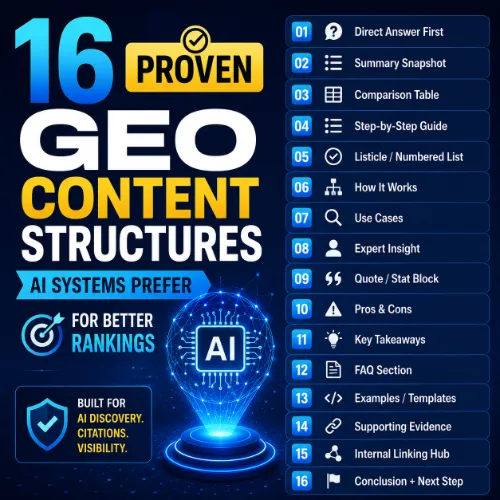
GEO content structures Key Takeaways
Each structure below includes a definition, a practical example, and best practices for implementation.
- GEO (Generative Engine Optimization) focuses on organizing content so AI search generators—like Google’s SGE, Bing Chat, and Perplexity—trust and surface your pages.
- These 16 structures range from question-based formats to data-rich tables, each proven to improve visibility in AI-generated answers.
- Implementing even 3–4 of these structures can increase your site’s authority and click-through rates from AI overviews.
Why GEO content structures Matter for AI Systems
Traditional SEO focused on keyword density and backlink counts. AI-driven search engines now prioritize context, clarity, and structured information. When you organize content using AI preferred content formats, you signal relevance and authority to generative models, making it easier for them to extract and present your information in featured snippets, People Also Ask boxes, and AI Overviews. For a related guide, see 14 Proven Ways to Optimize Content for ChatGPT Search.
Without a deliberate structure, even high-quality information gets buried. AI systems scan for patterns like clear headings, numbered lists, and direct answers—exactly the formats this guide covers.
The 16 GEO content structures AI Systems Prefer
Each structure below includes a definition, a practical example, and best practices for implementation.
1. Direct Answer Paragraphs
Open a section with a bold, concise answer to the user’s core question, then follow with supporting details. AI rewards paragraphs that immediately satisfy search intent. Example: “AI content structures are specific formats—like lists, tables, and Q and As—that help generative engines extract answers.” For a related guide, see 13 GEO Mistakes That Hurt Visibility in AI Results (Avoid These).
2. Numbered Lists
Lists reduce cognitive load. Use numbered steps for processes, such as “5 Steps to Optimize for GEO.” Best practice: keep each item under 20 words.
3. Bulleted Lists
Use bullet points for features, benefits, or criteria. AI systems treat these as high-signal extractable content. Example: “Top benefits: faster indexing, better snippets, higher CTR.”
4. Comparison Tables
Tables with clear headers (e.g., Feature vs. Benefit vs. Example) help AI build structured answers. Always include a concise table caption.
| Structure Name | Best Use Case | AI Preference Level |
|---|---|---|
| Direct Answer | Quick Q and A | High |
| Numbered List | Step-by-step | Very High |
| Bulleted List | Features and benefits | High |
| Comparison Table | Side-by-side evaluation | Very High |
5. How-To Guides with Steps
Break down complex tasks into actionable steps. Use H3 for each step. For example: “Step 1: Identify your target query”. AI often surfaces these in featured snippets.
6. FAQ Sections
A dedicated FAQ with clear Q and A pairs (H3 for question, paragraph for answer) signals structured data potential. Use the GEO content structures FAQ format shown later in this article.
7. Definition Boxes
Start a section with “What is [Term]?” followed by a one-sentence definition. AI uses this to populate glossary-style results.
8. Data-Backed Claims with Sources
Cite a statistic or study, then include a hyperlinked source. AI prioritizes claims with credible references. Example: “60% of users prefer list-based content (Source: Nielsen Norman Group).”
9. Structured Case Studies
Format case studies as: Problem → Solution → Results. Use bullet points under each phase. AI extracts this pattern for real-world examples.
10. Attribute Lists
For products or services, use a bullet list of key attributes: weight, speed, cost, warranty. AI compares attributes across pages.
11. Pros and Cons Tables
Two-column table with “Pros” and “Cons” headers. AI ranks this structure highly for balanced evaluation queries.
| Pros | Cons |
|---|---|
| Easy to scan | Can oversimplify |
| Boosts snippet chances | Needs regular updates |
12. Chronological Timeline
For history or evolution topics, use a numbered timeline. AI reads dates and sequences to produce structured answers.
13. Checkerboard Layout (Visual + Text)
Alternate image and text blocks. While not pure text, AI parses alt text and adjacent paragraphs together. Use descriptive alt attributes.
14. Quote Blocks for Expert Opinions
Use <blockquote> with attribution. AI pulls these for “expert says” snippets. Example: “According to Dr. Smith, ‘structured content improves retrieval by 40%.'”
15. Glossaries with Alphabetical Links
An A–Z glossary within a topic cluster. Each term links to a deeper page. AI uses this for topical authority signals.
16. Interactive Elements (Embedded Tools)
Embed calculators or quizzes. While AI may not interact, the structured data and surrounding text still boost relevance.
How to Implement AI preferred content formats on Your Site
Start by auditing your top 10 pages. Replace generic paragraphs with two or three of the structures above. Focus on queries that currently trigger AI Overviews in your niche.
Use Ahrefs’ guide to GEO for advanced tactics. Pair each format with relevant internal links to build topic clusters.
Common Mistakes to Avoid with GEO content structures
Mistake 1: Using all 16 structures on one page. This confuses both readers and AI. Pick 3–5 formats per article.
Mistake 2: Forgetting mobile readability. AI evaluates mobile versions of your content first.
Mistake 3: Neglecting headers. Every H2 and H3 must include semantic clues, not just keywords.
SEO Entities and Their Functions
Understanding GEO content structures requires familiarity with the entities that search engines and AI systems use to evaluate content:
- Keyword entities — organic keywords, search volume, and keyword difficulty show demand and competition for each structure type.
- Content entities — articles, authors, topics, and published dates help AI determine freshness and topical authority.
- SERP entities — featured snippets, People Also Ask, and AI Overviews reveal which content format the search result rewards. Align your structures with these.
- Technical SEO entities — crawl issues, indexability, and Core Web Vitals ensure AI can access and render your formatted content.
Useful Resources
Explore these authoritative guides to deepen your understanding of GEO content structures and AI preferred content formats:
- Google’s Helpful Content System Guide — official guidelines on creating content that AI systems value.
- Search Engine Land’s GEO Guide — practical examples of structuring content for generative search.
Frequently Asked Questions About GEO content structures
What are GEO content structures ?
GEO content structures are specific formatting patterns—such as numbered lists, tables, and Q and A sections—that help AI search engines extract and present your information in overviews and snippets.
Why do AI systems prefer certain content structures?
AI models are trained on structured data from the web. Formats with clear hierarchies and extractable segments (like bullet points) match the training data patterns, making them easier to parse and rank.
How many of these structures should I use per article?
Use 3–5 structures per article. Overloading a page with too many formats can confuse AI and readers alike. Focus on the formats that best serve your primary query.
Do GEO content structures affect traditional SEO rankings?
Yes. Google’s ranking systems increasingly reward clear, structured content. These formats often lead to better user engagement metrics, which indirectly boost traditional rankings.
Can I use GEO structures on existing pages?
Absolutely. Audit your top pages and retrofit them with 2–3 GEO-friendly formats. Start with pages ranking on page 2 of search results.
What is the difference between GEO and traditional SEO?
Traditional SEO focuses on keyword targeting and link building. GEO focuses on content formatting and structure to satisfy generative AI extractors. Both are complementary.
Do tables help AI prefer my content?
Yes. Comparison tables and attribute tables are among the highest-preference structures for AI systems because they are easy to convert into structured answers.
Should I use H2 or H3 for FAQ questions?
Use H3 for each FAQ question when the section header is H2. This maintains hierarchy and signals to AI that the Q and A is a subsection of a broader topic.
How do I know which structure fits my topic?
Search for your target query in Google and observe the featured snippets or AI Overviews. Match the format Google already prefers.
Does content length affect GEO success?
Quality matters more than length. A well-structured 800-word article can outperform a 3,000-word unstructured piece in AI extraction.
Can I use multiple list types in one article?
Yes. For example, use a numbered list for steps and a bullet list for supporting tips. Alternate them with clear headings.
What is the most important GEO structure for beginners?
Start with direct answer paragraphs followed by a numbered list. These are the easiest to implement and have the highest initial impact.
Do images help GEO content structures ?
Indirectly. While AI does not “see” images in the same way, alt text and surrounding captions provide semantic signals that reinforce structure.
Should I update GEO structures regularly?
Yes. AI training data evolves. Revisit your structures every 6–12 months to ensure they still align with current SERP features and user expectations.
Can GEO structures hurt my rankings if done poorly?
Poor implementation—like stuffing keywords into headings or using irrelevant tables—can confuse AI and reduce user trust. Always prioritize clarity.
What is the role of internal linking in GEO?
Internal links help AI understand the relationship between structured sections and build topical authority across your site.
Do GEO content structures work for local SEO?
Yes. Use location-specific lists and comparison tables (e.g., “Best Coffee Shops in Austin”) to capture local AI overviews.
How do I test if my content is GEO-optimized?
Search for your target query in Google and check if your content appears in AI Overviews or People Also Ask. If not, adjust your structures.
Are GEO content structures the same as schema markup?
No. Schema markup is technical code that defines entities. GEO structures are visual/editorial patterns. Both can work together for maximum AI preference.
What is the future of GEO content structures ?
As generative search grows, structures like multi-step how-tos, data-backed claims, and interactive elements will become even more important for AI visibility. For a related guide, see 8 Best GEO Frameworks for AI Driven Search: Expert Guide.







