

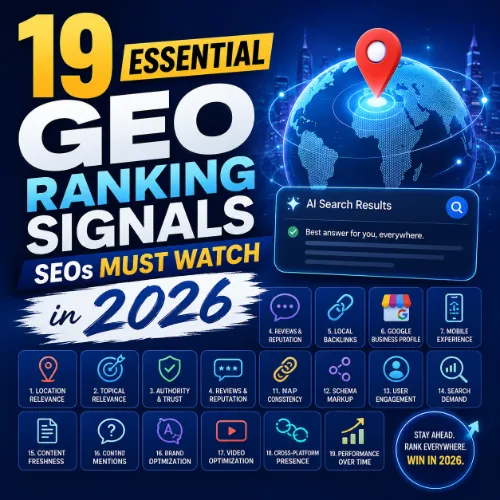
GEO ranking signals Key Takeaways
Understanding GEO ranking signals is no longer optional for SEOs aiming to stay visible in generative search results.
- GEO ranking signals encompass content relevance, authority, structured data, and user engagement metrics that influence generative engine response selection.
- Optimizing for these signals helps your content appear in featured snippets, AI Overviews, and direct answer blocks, driving both click-through and zero-click visibility.
- Prioritizing entity clarity, topical depth, and citation-worthy structure gives you a competitive edge as search shifts from links to answers.
Why GEO Ranking Signals Are Reshaping SEO Strategy
Traditional search ranking factors—backlinks, keyword density, and domain authority—still matter. But generative engines evaluate content differently. They prioritize clear, authoritative answers that can be extracted and repackaged. GEO ranking signals are the specific measurable indicators that help these engines decide which content to cite in an AI-generated response. For a related guide, see 19 Ranking Factors Inside Your Pages You Should Fix Now.
If your content lacks these signals, you risk losing visibility even if your pages rank well in conventional SERPs. The shift from blue links to conversational answers demands a new optimization lens. In this article, we’ll walk through all 19 critical GEO ranking signals SEOs should watch, with practical insights for each.
How Generative Engines Differ From Classic Search
Classic search ranks pages. Generative engines rank answers. That distinction changes what gets rewarded. Instead of a page’s overall authority, these engines look for concise, well-structured, and well-referenced answer units. This is why GEO ranking signals focus heavily on content clarity, entity usage, and citation trustworthiness.
1. Content Answer Relevance
Generative engines extract answers from content that directly matches the user’s query intent. If your content meanders before reaching the point, the engine may skip it. Ensure your opening paragraphs deliver a clear answer within the first 60–100 words. This is the foundational GEO ranking signal that underpins everything else.
2. Entity Clarity and Density
Generative models rely on entities—people, places, products, concepts—to understand context. Including well-defined entities and connecting them logically (e.g., “Ahrefs is an SEO tool that tracks backlinks and keyword rankings”) helps the engine extract your content confidently. Use recognized names, avoid vague synonyms, and link entities to authoritative sources when appropriate.
3. Structured Data Markup (Schema)
FAQ schema, HowTo schema, and Article schema are three of the most powerful GEO ranking signals. They tell generative engines exactly which parts of your page contain answerable content. Without schema, the engine has to guess—and guesses often lead to omissions.
4. Citation Quality and Source Authority
Generative engines prefer answers that cite trustworthy, well-known sources. Linking to .gov, .edu, or established industry publications (like Ahrefs, Moz, or Search Engine Land) signals that your content is research-backed. This is especially important for YMYL (Your Money or Your Life) topics. For a related guide, see 5 Powerful Benefits of Generative Engine Optimization (GEO) for Beginners.
5. Natural Language Simplicity
Complex sentence structures confuse generative models. Write in clear, short declarative sentences. Use active voice. Avoid jargon unless it’s defined nearby. This GEO ranking signal directly affects extractability—if the parser can’t easily parse your sentence, your content won’t make the cut.
6. Topical Depth and Coverage
Shallow content that only scratches the surface rarely gets cited. Generative engines prefer content that comprehensively covers a topic, including subtopics, definitions, examples, and edge cases. Aim for at least 8–12 distinct sub-points per main topic to demonstrate expertise.
7. Freshness Signals
Outdated facts hurt credibility. Generative engines favor recently updated content, especially for rapidly changing industries like SEO, technology, and health. Regularly audit and update your articles. Add a visible “Last updated” date with schema markup to signal freshness.
8. Author Expertise and Byline
Content attributed to a named author with a bio, credentials, and links to their professional presence (LinkedIn, personal site) scores higher on trust. Generative engines treat an author’s domain authority as part of the content’s credibility. This is why GEO ranking signals now include author E-E-A-T indicators.
9. Internal Linking Structure
A logical internal link network helps generative engines understand your site’s topical clusters. Link related articles together using descriptive anchor text. This not only improves navigation but reinforces the semantic context of each page.
10. External Link Trustworthiness
Linking to low-quality or spammy domains damages your content’s reliability. Only link to sites with strong Domain Rating (DR 50+) and clean backlink profiles. If you must reference a weaker source, provide context explaining its relevance.
11. Readability Score (Flesch-Kincaid)
Generative engines favor content that a broad audience can understand. Aim for a Flesch-Kincaid grade level of 8–10 for general topics. Use shorter paragraphs, bullet lists (like this one), and subheadings to break down complex ideas. Readability directly impacts extractability.
12. Accurate Metadata and Title Tags
Your title tag and meta description act as the first hint of content relevance. If they mislead, generative engines will distrust the entire page. Keep titles under 60 characters and meta descriptions under 160 characters, reflecting the actual answer your page provides.
13. Recent Social Engagement Signals
While not a direct ranking factor, social shares, comments, and engagement on platforms like X (Twitter) and LinkedIn signal recency and relevance. Generative engines sometimes consider these as implicit endorsements, especially for trending topics.
14. Content Type Matching Intent
If the query is a “how-to” question, your content should use HowTo schema and step-by-step instructions. If it’s a definition query, use Article schema with a clear definition in the first paragraph. Mismatching content format with query intent is a frequently missed GEO ranking signal.
15. Table and List Structures
Generative engines love tables and lists because they are easy to parse and summarize. Adding a comparison table, a checklist, or a numbered list within your article increases the likelihood that the engine selects that exact section for an answer.
16. Mobile Page Experience (Core Web Vitals)
Google’s generative components run on the same infrastructure as classic search, so LCP, FID/INP, and CLS remain relevant. A slow or janky page signals poor user experience, which makes generative engines less likely to recommend your content in high-ambient scenarios (e.g., in-car or voice queries).
17. Geographic Relevance Signals
For local queries, include city names, regional landmarks, and local citations. Google’s generative responses on maps and local packs rely heavily on NAP consistency, local structured data, and reviews. This subset of GEO ranking signals is critical for multi-location businesses.
18. Image Alt Text and Captions
Images are increasingly used in generative answers. Include descriptive alt text that explains the image content, not just the filename. Captions that add context (“[Image: Graph showing click-through rate decline from 2015 to 2026]”) help models understand and potentially include your visuals in responses.
19. User Interaction Flow (Dwell Time + Repeat Visits)
Generative engines and classic search both weigh how users interact with your content after clicking. If users quickly bounce back to the search results, the engine interprets that as a signal that your answer wasn’t satisfactory. High dwell time and return visits indicate genuinely helpful content.
Putting It All Together: Your GEO Ranking Signals Optimization Checklist
To make these 19 signals actionable, use the checklist below when auditing any page for generative search readiness.
| Signal Group | Key Action | Priority |
|---|---|---|
| Content Relevance | Front-load answers, match intent | High |
| Entity and Schema | Add FAQ/HowTo schema, use explicit entities | High |
| Authority and Citations | Link to DR50+ sources, credit authors | High |
| Readability | Grade level 8–10, short sentences | Medium |
| Freshness | Update content quarterly, add last-updated | Medium |
| Technical UX | Optimize Core Web Vitals, mobile speed | Medium |
| Structured Output | Use tables, lists, clear subheadings | Low-Medium |
Start by applying the high-priority items to your top-traffic pages. Within two crawl cycles, you should see improved visibility in generative search features like AI Overviews and People Also Ask expansions.
SEO Entities and Their Functions
Understanding how the following entities interact with GEO ranking signals will sharpen your optimization workflow:
- Website / Domain entities — Root domain vs. subdomain vs. URL-level analysis helps you isolate whether a signal issue belongs to a specific page or your entire site.
- Keyword entities — Organic keywords, paid keywords, and search volume metrics show which queries your content should target for generative extraction.
- Backlink entities — Referring domains and dofollow/nofollow links help evaluate the trustworthiness of your content’s citation network.
- SERP entities — Featured snippets, People Also Ask, and AI Overviews reveal what content formats generative engines are already rewarding for your target queries.
- Technical SEO entities — Indexability status and Core Web Vitals data expose obstacles that prevent your content from being considered for generative responses.
- Metrics entities — Domain Rating (DR), URL Rating (UR), and traffic value give you a baseline authority level when assessing whether your domain is citation-worthy.
Useful Resources
Deepen your knowledge of generative search optimization with these trusted guides:
- Ahrefs: Generative Engine Optimization – The Complete Guide – A detailed breakdown of how to structure content for AI-powered search engines.
- Google Developers: FAQ Structured Data – Official schema documentation to help your content appear in rich results and generative summaries.
Frequently Asked Questions About GEO ranking signals
What are GEO ranking signals ?
GEO ranking signals are the measurable indicators that generative search engines use to determine which content should appear in AI-generated answers, summaries, and conversational responses.
How do GEO ranking signals differ from traditional SEO factors?
Traditional SEO factors evaluate page authority and relevance, while GEO ranking signals focus on answer extractability, entity clarity, and citation trustworthiness for AI-driven summarization.
Why should SEOs watch these 19 signals now?
Generative search is growing rapidly. Optimizing for these 19 signals early gives you a competitive advantage in visibility across AI Overviews, SGE, and other conversational search tools.
Is schema markup still important for generative search?
Yes. Structured data like FAQ schema and HowTo schema directly feed generative engines with clear answer units, making schema a high-priority GEO ranking signal.
Does content length matter for GEO ranking signals ?
Length matters less than depth. A concise 800-word article that covers a topic comprehensively can outperform a 3000-word piece that lacks structure and repetition.
How does entity clarity help generative engines?
Clear entity usage helps the engine connect concepts correctly. For example, explicitly stating “Ahrefs is an SEO tool” prevents the engine from confusing the brand with a person or place.
Are backlinks still a GEO ranking signal?
Yes, but only as part of citation quality. Links from authoritative domains signal trustworthiness, which generative engines weigh heavily when citing your content.
Can I use the same content for both classic SEO and GEO optimization?
Yes, but you need to adjust formatting—add schema, front-load answers, and improve readability—without changing the core information. The substance stays the same.
What role does readability play in GEO ranking signals ?
Readability determines how easily a generative parser can extract and repackage your content. Simple sentence structures and active voice improve extractability.
Do generative engines prefer list-style content?
Yes. Tables, numbered lists, and bullet points are easy for engines to parse and often get directly pulled into AI Overviews or featured snippets.
How often should I update content for freshness signals?
Every 3–6 months for evergreen topics, and monthly for fast-changing subjects like SEO, technology, or health. Adding a visible “Last updated” date improves credibility.
Does author byline really matter for generative search?
Yes. A named author with credentials and a professional profile increases the trust score of your content, especially for YMYL topics.
What is the most important GEO ranking signal for local businesses?
Geographic relevance signals—such as NAP consistency, local schema, and city-specific keywords—are critical for local generative search results.
Are Core Web Vitals part of GEO ranking signals ?
Indirectly yes. A poor mobile page experience can disqualify your content from being shown in high-ambient or voice-based generative responses.
Should I remove old content that doesn’t rank?
Instead of removing it, update the content to align with current GEO ranking signals. Add schema, improve readability, and strengthen citations.
Do social signals count as GEO ranking signals ?
Social engagement signals (shares, comments) act as indicators of recency and relevance, though they are not direct ranking factors for generative engines.
Can multiple GEO ranking signals conflict?
Yes. For example, adding too much schema markup can confuse parsers. Balance each signal with the goal of clarity and extractability.
How do I measure GEO ranking signal improvements?
Track visibility in AI Overviews, People Also Ask expansions, and featured snippet appearances using tools like Ahrefs, Semrush, or STAT Search Analytics.
Is there a checklist for optimizing GEO ranking signals ?
Yes, use the 7-point checklist in the table above, focusing first on high-priority items: content relevance, schema, authority, readability, freshness, technical UX, and structured output.
Will GEO ranking signals replace traditional SEO?
No, but they will augment it. Classic SEO factors like backlinks and keyword targeting remain important, but you must layer GEO ranking signals on top to maintain visibility across all search modalities.







