GEO strategies future proof SEO Key Takeaways
GEO strategies future-proof SEO by shifting your focus from traditional ranking factors to trust signals, user engagement depth, and content that performs well in AI-generated search summaries, voice queries, and zero-click results.
- GEO strategies future-proof SEO emphasize entity recognition, topical authority, and user satisfaction signals over outdated link counting.
- Optimizing for AI Overviews, People Also Ask, and featured snippets requires concise, well-structured answers with clear attribution.
- Aligning your content strategy with search intent and natural language patterns helps you stay visible across traditional and generative search surfaces.
Why GEO strategies future-proof SEO Matters in 2026
Search is no longer a simple list of blue links. Google’s AI Overviews, Bing Chat, and other generative search tools now synthesize answers from multiple sources. If your content is not structured for this new reality, you risk losing visibility even for queries where you once ranked first.
GEO strategies future-proof SEO by focusing on the factors that generative models use to select and attribute information: clear entity relationships, authoritative citations, comprehensive coverage, and user engagement depth. The goal is not just to rank but to be cited as a trusted source inside AI-generated answers.
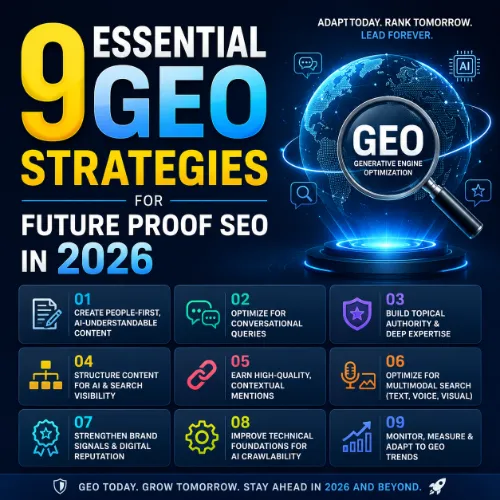
1. Build Topical Authority Through Entity Clusters
Search engines and AI models now evaluate your site’s expertise on a topic, not just individual pages. GEO strategies future-proof SEO begin with mapping your core topic into subtopics and linking them through clear entity relationships.
How to create entity clusters
Start with one broad pillar page that covers your main topic comprehensively. Then create cluster pages that address specific subtopics, linking back to the pillar. Use schema markup to define entities like organization, person, product, or event. AI models rely on these signals to understand your expertise.
2. Optimize for AI Overviews and Featured Snippets
Generative search extracts answers from content that is concise, well-structured, and directly answers a question. To win these spots, your content must match the query format expected by the AI.
Actionable steps
Identify queries that trigger AI Overviews in your niche. For each, write a direct answer in one or two paragraphs. Use numbered lists or bullet points for steps. Include a clear attribution sentence that states your brand or source. Test your snippet potential using Ahrefs’ Keyword Generator to see which SERP features appear for your target terms.
3. Prioritize User Engagement Depth
Generative models learn from user behavior signals like dwell time, scroll depth, and return visits. GEO strategies future-proof SEO require content that keeps readers engaged, not just pages that load fast.
Engagement tactics that work
Use interactive elements such as calculators, quizzes, or custom tables. Write in a conversational tone with short paragraphs and clear headings. Embed relevant videos or infographics that explain complex points. Track engagement metrics in Google Analytics to see which pages hold attention longest.
4. Leverage Structured Data for Entity Recognition
Schema markup helps AI models understand your content’s context and relationships. For GEO for SEO, use Article, FAQPage, HowTo, and Organization schemas where applicable.
Quick implementation guide
Install a schema plugin like Yoast SEO or Rank Math. Add FAQ schema to your FAQ section. Use HowTo schema for step-by-step guides. Validate your markup with Google’s Rich Results Test. Properly marked-up content is more likely to appear in AI-generated summaries.
5. Optimize for Zero-Click and Voice Search
Many queries now end with zero clicks because the answer appears directly in the SERP or AI Overview. GEO strategies future-proof SEO target these opportunities by providing complete, self-contained answers.
Voice search optimization tips
Use natural language phrases and question-based headings. Keep answers under 50 words when possible. Include conversational variants of your target keywords. Test your content on Google Assistant or Siri to see if it returns your page as a source.
6. Build Author Trust and Credibility Signals
AI models prioritize sources with clear author expertise. GEO for SEO benefits from visible author bios that link to social profiles and published credentials.
Author trust signals to add
Include bylines with full names. Add a short bio at the bottom of each article with links to the author’s LinkedIn, Twitter, or personal website. Use structured data to mark the author as a Person with knowsAbout properties for your topic.
7. Focus on Content Freshness and Recency
Generative models often prefer recent content for time-sensitive queries. Regularly updating your cornerstone articles signals relevance and authority.
How to keep content fresh
Set a quarterly review schedule for your top 20 performing pages. Update statistics, add new examples, and refresh outdated links. Change the published date only when substantial updates are made. Use Google Search Console to identify pages with declining impressions and refresh them first.
8. Master Internal Linking for Entity Flow
Internal links help AI models understand the relationship between your pages and the depth of your topical coverage. GEO strategies future-proof SEO rely on a logical internal linking structure that connects cluster pages to pillar content.
Internal linking best practices
Use descriptive anchor text that includes entity names. Link from new articles to at least two existing relevant posts. Avoid linking to the same page twice in one article. Audit your internal links quarterly using Ahrefs’ Site Audit to find orphaned pages.
9. Monitor AI-Powered Search Engine Result Pages
The SERP is evolving constantly. GEO strategies future-proof SEO require ongoing monitoring of how your brand appears in AI Overviews, People Also Ask, and ChatGPT responses.
Monitoring tools and methods
Use Ahrefs’ Rank Tracker to see which SERP features appear for your keywords. Set up Google Alerts for brand mentions in AI-generated content. Run monthly manual searches for your top 10 queries and note whether your site appears as a source in AI summaries. Adjust your strategy based on what you observe.
SEO Entities and Their Functions
Understanding the key entities and metrics in GEO for SEO helps you make better optimization decisions:
- Content entities — Articles, authors, topics, and published dates help search engines evaluate editorial quality and freshness. Marking authors and topics with schema boosts entity recognition.
- SERP entities — AI Overviews, featured snippets, People Also Ask, and local packs show what answer format the search engine rewards. Targeting these with structured answers increases your chance of appearing.
- Technical SEO entities — Core Web Vitals, indexability, and crawl issues directly affect whether your content can be found and evaluated by generative models. Fixing these is a prerequisite for GEO success.
Useful Resources
Learn more about GEO strategies from these trusted sources:
- Google’s Guide to Creating Helpful, Reliable, People-First Content — Official guidance on content quality signals that align with generative search.
- Ahrefs Blog: How to Optimize for AI Overviews — Practical tips for appearing in Google’s AI-generated search results.
Frequently Asked Questions About GEO strategies future proof SEO
What does GEO stand for in SEO?
GEO stands for Generative Engine Optimization. It refers to strategies that optimize content for AI-powered search engines and generative models like Google’s AI Overviews, Bing Chat, and ChatGPT. For a related guide, see Geo Optimization: 7 Proven GEO Strategies to Optimize for Local Search Results.
How is GEO different from traditional SEO?
Traditional SEO focuses on ranking in blue link results. GEO emphasizes being selected as a source by AI models, which prioritize entity clarity, authority signals, and user engagement depth over backlink counts alone.
Is GEO strategies future-proof SEO the same as AI optimization?
Yes, GEO is a subset of AI optimization. While AI optimization covers all AI-driven ranking factors, GEO specifically targets generative search experiences where answers are synthesized from multiple sources.
Do I need to change my entire SEO strategy for GEO?
Not entirely. Proven SEO fundamentals like quality content, technical health, and link building still matter. GEO adds a layer of optimization for how AI models read, interpret, and cite your content. For a related guide, see Link Building Strategies: 7 Proven Methods for 2026.
Which schema types help with GEO?
Article, FAQPage, HowTo, Organization, Person, and Product schemas are most helpful. They help AI models identify entities, relationships, and answer formats on your pages.
How do I know if my content appears in AI Overviews?
Use a rank tracker that monitors SERP features. You can also run manual searches for your target queries and look for your brand name or URL inside the AI-generated answer box.
What is an entity cluster in SEO?
An entity cluster is a group of pages that cover related subtopics around a central topic. They are linked together with descriptive anchor text and schema markup to show search engines the breadth of your expertise.
How often should I update content for GEO?
Review your top 20 pages quarterly. Update statistics, add new examples, and refresh any outdated information. For time-sensitive topics, update monthly or whenever new data becomes available.
Does voice search affect GEO?
Yes. Voice search often triggers featured snippets and AI Overviews. Optimizing for natural language questions and concise answers helps both voice and generative search visibility.
Can small businesses benefit from GEO?
Absolutely. Small businesses with strong local expertise can gain visibility by creating authoritative content that answers specific local queries. Local entity signals and reviews also help GEO.
What is the role of backlinks in GEO?
Backlinks remain important as authority signals. However, GEO places more weight on contextual link placement, relevance of linking pages, and the overall topical ecosystem rather than raw link volume.
How do I measure GEO success?
Track impressions from AI Overviews, featured snippets, and People Also Ask in Google Search Console. Also monitor brand mentions in AI-generated summaries and referral traffic from chat interfaces.
Should I target zero-click queries?
Yes, but with a strategy. Even if users don’t click, appearing as a cited source builds brand authority and can lead to future clicks. Include a strong CTA and internal links for those who do visit.
What is the biggest mistake in GEO?
Treating GEO as a separate tactic instead of an evolution of SEO. The biggest mistake is ignoring user intent and entity clarity while chasing AI-specific shortcuts like keyword stuffing in schemas.
How does E-E-A-T relate to GEO?
E-E-A-T (Experience, Expertise, Authoritativeness, Trustworthiness) is foundational for GEO. AI models favor content from authors and sites with proven credentials, clear bylines, and credible citations.
Can GEO help with brand visibility in ChatGPT?
Yes. If your content is well-structured, authoritative, and frequently cited in AI Overviews, it may also appear in ChatGPT responses. Focus on entity clarity and comprehensive coverage.
Is GEO the same as Google’s Helpful Content System?
Not exactly, but they overlap. The Helpful Content System rewards people-first content. GEO adds a layer of technical and structural optimization specifically for how generative AI reads and cites content.
How long does it take to see GEO results?
Results vary. Some pages appear in AI Overviews within weeks of optimization, especially for low-competition queries. Broader authority gains typically take three to six months of consistent effort.
Do I need special tools for GEO?
Standard SEO tools like Ahrefs, Google Search Console, and schema validators are sufficient. Focus on keyword research, entity mapping, and SERP feature tracking rather than specialized GEO tools.
Will GEO replace traditional SEO?
No. GEO is an evolution, not a replacement. Traditional SEO techniques like keyword research, link building, and technical optimization remain essential. GEO adds a new layer of optimization for generative search surfaces.