

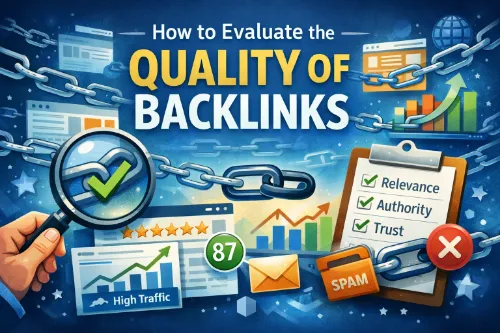
Learning how to evaluate the quality of backlinks is essential if you want higher Google rankings, stronger organic traffic, and long-term SEO growth. High-quality backlinks come from relevant, trustworthy websites, with natural anchor text, strong content, and clean link placement, while low-quality backlinks often come from spammy, irrelevant sites, link farms, or automated link schemes that can hurt your domain’s authority and visibility.
To evaluate backlink quality, always check:
- The topical relevance of the linking domain and linking page
- Authority signals such as organic traffic, domain metrics, and trust
- How and where the link appears in the content (link context and placement)
- Anchor text type and optimization level
- Technical attributes, like follow/nofollow and indexation
- The overall health and diversity of your backlink profile
By applying a simple backlink quality checklist and doing regular backlink audits in Google Search Console, third‑party SEO tools, and dedicated SEO audit services, you can keep the good backlinks, avoid risky ones, and build a stronger, future‑proof link profile.
What Is a High-Quality Backlink?
A backlink is a hyperlink from another website that points to your page, and search engines treat backlinks like “votes of confidence,” but not all votes are equal in value. A high-quality backlink sends clear, positive signals about your content and your brand, helping reinforce your topical authority and your broader SEO strategy.
Key characteristics of a high-quality backlink
- Relevance: The linking website and the linking page are closely related to your niche, topic, or industry.
- Authority: The referring domain has strong authority signals, such as good organic traffic, strong domain metrics, and a real audience.
- Trustworthiness: The site is legitimate, not part of a link farm, PBN, or spam network, and aligns with white-hat link building services.
- Contextual placement: The link is placed naturally inside the main body content, surrounded by relevant text, not hidden in footers, sidebars, or random link lists.
- Natural anchor text: The anchor text is relevant but not overly optimized or spammy, contributing to a balanced anchor text profile.
- Indexation: The linking page is indexed and can be crawled by search engines, so the link can actually pass value.
If a link looks like a natural recommendation that a user would find helpful, it’s more likely to be a high-quality backlink that supports sustainable off-page SEO services.
Why Backlink Quality Matters More Than Quantity
Many websites still focus on the number of backlinks they get, but modern SEO, AI-driven search, and Google’s ranking systems care more about quality, relevance, and trust. Backlink quality needs to align with your on-page foundations, your technical health, and your broader SEO packages and services.
Risks of low-quality backlinks
- Algorithmic demotions or loss of trust in your domain, especially if links resemble black-hat or manipulative schemes.
- Wasted budget on paid links that don’t move the needle because they come from weak or irrelevant sites.
- Difficulty ranking for competitive keywords due to a diluted or toxic backlink profile.
- Possible manual actions if you build aggressive or unnatural links at scale, particularly via PBNs or cheap link farms.
Benefits of high-quality backlinks
- Stronger rankings for important keywords when combined with solid on-page SEO services.
- More targeted referral traffic from relevant audiences that actually convert into leads or sales.
- Better brand visibility and authority in your niche, supporting content-led growth and digital PR.
- A backlink profile that can survive core updates, AI-driven changes, and long-term SEO campaigns.
If you want to rank well in Google SERPs and appear in AI Overviews, you must focus on evaluating backlink quality, not just building links blindly, and align your efforts with modern white-hat link building.
The 7 Core Factors of Backlink Quality
Use these seven core factors as your simple checklist when you evaluate any backlink or potential link opportunity.
1. Relevance
Relevance is one of the most important signals in backlink quality analysis.
Ask:
- Is the linking website in the same or a related niche?
- Does the linking page cover a topic closely connected to my content?
- Would a real human reader see this link as useful and logical?
A backlink from a niche-relevant blog, industry magazine, or local website is usually more valuable than a random link from a generic or unrelated site, especially when it reinforces your topical clusters and search intent optimization.
2. Authority
Authority refers to the overall strength and influence of the site and page that links to you.
Common indicators:
- Domain authority or domain rating scores from SEO tools
- Page-level metrics such as URL rating or page authority
- Organic traffic volume and trend
- Quality of the site’s own backlinks
High-authority backlinks are harder to earn but often move rankings faster, especially when they point to optimized service pages and landing pages. However, a relevant backlink from a smaller, emerging site can also be valuable if it has real content and real users.
3. Trust and Legitimacy
To evaluate trust:
- Check if the site has clear branding and an About page.
- Look for a real team, social media profiles, or a physical location.
- Pay attention to excessive ads, pop-ups, or auto-generated content.
- Avoid sites that obviously sell links on every page or publish unrelated posts just to add more backlinks.
If the site looks risky to you as a human, search engines may see it as risky too, which is why high-trust sites are a better fit for sustainable SEO services.
4. Link Placement
Placement can strongly affect how search engines value a link.
Better placements:
- In the main content body
- Within a helpful paragraph or a list
- Near related keywords and entities
Weaker placements:
- Footer links
- Sitewide blogroll or sidebar links
- Author bio links only
- Pages full of hundreds of unrelated outbound links
Contextual in-content links are one of the strongest signals of a high-quality backlink and pair well with strong content SEO services.
5. Anchor Text
Anchor text is the clickable text of the link.
Good anchor text is:
- Descriptive, so users know what to expect
- Related to your main keyword or entities, but not spammy
- Mixed across your profile: brand, URL, partial match, generic, and occasional exact match
Avoid over-optimized patterns such as repeating the same keyword-heavy anchor hundreds of times, because that can trigger spam signals and issues associated with black-hat link building tactics.
6. Technical Attributes
Technical SEO also affects backlink quality.
Key checks:
- Follow vs nofollow vs sponsored vs UGC: Follow links pass more authority, but nofollow and labeled links still have value for visibility and traffic.
- Indexation: If the linking page is not indexed, it will not help you much.
- Redirects: Links that go through multiple redirects or broken paths can lose value.
- Site security: Links from HTTPS sites are generally preferred over old, insecure HTTP-only sites.
A clean, crawlable linking page with a follow link in the main content is ideal and should sit on a technically sound site that has addressed key technical SEO issues.
7. Backlink Profile Diversity
Quality evaluation is not just about individual links; you must also evaluate the health of your overall backlink profile.
Monitor:
- Number of unique referring domains vs total backlinks
- Diversity in TLDs (com, org, local ccTLDs) and locations
- Mix of link types: editorial links, resource links, niche edits, citations, local links, etc.
- Natural anchor text distribution
A healthy profile looks like a natural mix, while a profile with thousands of links from the same domain, same anchor text, or same network is a red flag that may need a targeted SEO audit.
Step-by-Step Checklist: How to Evaluate a Backlink
Use this simple, AI Overview–friendly checklist every time you need to evaluate the quality of a backlink.
1. Check the Domain
- Visit the homepage and skim the content.
- Confirm the niche: is it relevant or at least related?
- Look for basic trust signals: about page, contact page, privacy policy, social profiles.
- Use your SEO tools to check domain metrics and organic traffic trends.
If the domain looks like a PBN, made-for-ads site, or expired domain repurposed for links, treat it as low quality and avoid using it in your link building campaigns.
2. Check the Linking Page
- Read the page title and main heading.
- Confirm that the topic aligns with your page or industry.
- Check if the content is original, detailed, and human-friendly.
- Look at the number and type of outbound links: are they natural and relevant, or spammy and excessive?
A strong page is usually well-structured, readable, and genuinely trying to help users, similar to well-optimized SEO guides and checklists.
3. Review Link Placement and Context
- Find your link on the page.
- Check the paragraph around it: does it mention related keywords or entities?
- Confirm that the link is in the main content, not hidden in a footer list.
- Ask yourself: “If this page had no SEO value, would I still be happy to have this link for users?”
If the link looks forced, unrelated, or added only for SEO, its quality is likely low and may conflict with best practices for ethical SEO services.
4. Analyze Anchor Text
- Identify which type: brand, URL, partial match, exact match, or generic.
- Check if it makes sense in context.
- Compare with other links you have: are you overusing one keyword?
Aim for a natural, diversified anchor text profile that matches how real people link on the web and supports your keyword mapping strategy.
5. Check Technical Details
- Use your browser or tools to see if the link is follow or nofollow.
- Confirm that the page returns a 200 status (no 404 or endless redirects).
- Make sure the page is indexed by searching for it in Google with “site:domain.com page title”.
If the link is on a noindexed page, it is unlikely to help you rank, and it should be addressed in your next technical SEO audit.
6. Decide: Keep, Improve, or Avoid
Based on your evaluation:
- High quality: Keep the link, maybe build more on this relationship through content collaborations or digital PR campaigns.
- Medium quality: Keep it, but don’t invest heavily in duplicates from similar sites.
- Low quality or risky: Avoid similar sources in future link building, and for truly toxic links you may consider removal or disavow, especially if your site has a history of aggressive link building.
Signals of a High-Quality Backlink
Use this list when you want a quick AI Overview–friendly reminder.
- The site is in your niche or closely related, supporting topical authority.
- The page topic matches your content and intent.
- The domain has real organic traffic and visible audience.
- The content is original, detailed, and user-focused, like high-quality SEO content planning guides.
- Your link sits naturally in the main body text.
- Anchor text is descriptive and not spammy.
- The link is follow and the page is indexed.
- The site doesn’t sell links on every page and avoids obvious link schemes.
- There is a healthy mix of internal and external links.
- The website looks like a real brand with real people behind it.
Red Flags of a Low-Quality Backlink
Here are quick red flags that should make you skeptical:
- The site covers every niche with thin, generic content and no clear focus.
- There are hundreds of outbound links on a single page.
- The domain has little or no organic traffic.
- The site openly sells links or “guest posts” everywhere.
- The design looks outdated or auto-generated.
- Content is poorly written and filled with keywords or spun text.
- Your link appears in a random list with no context.
- The site is part of a visible network of cloned domains or PBNs.
- Most articles are AI-generated with no editing or clear value.
- The domain or page is not indexed in Google.
If you see several of these signals together, treat the backlink as low quality and prioritize safer, white-hat SEO strategies.
GEO & Local SEO Angle: Evaluating Local Backlinks
For local SEO, GEO relevance is a big part of backlink quality. When you serve a specific city, region, or country, backlinks from locally relevant domains are extremely valuable and often feature prominently in effective local SEO services.
What makes a local backlink strong?
- The site has a local TLD or clear local focus (for example, city/region pages).
- The content targets local keywords and entities like neighborhoods, landmarks, or local businesses.
- The audience is geographically aligned with your target customers.
- The link appears in local directories, local blogs, news sites, or community pages that real residents use.
A local backlink with moderate authority and strong GEO relevance can outperform a generic backlink from a global site with no connection to your location, especially when combined with local citation building and Google Business Profile optimization services.
AEO & NLP Considerations: Making Link Evaluation Helpful for AI
AI Overviews and modern search systems rely heavily on natural language, entities, and user intent. When you evaluate backlink quality, think in terms of how a user and an AI system would judge the link.
- Make sure the surrounding content clearly mentions entities (brands, places, products) relevant to your page.
- Avoid links placed in content that doesn’t answer any specific user intent or question.
- Prioritize backlinks from pages that genuinely solve problems, answer questions, or offer step-by-step guides.
- When you build or request links, suggest copy that naturally describes what your page covers, not just your target keyword.
In short, links surrounded by clear, helpful language and strong entities look better to both users and AI, and they support stronger content optimization.
How to Run a Simple Backlink Audit
A backlink audit is the process of reviewing your entire link profile to evaluate backlink quality at scale.
Simple audit workflow
- Export your backlinks from Google Search Console and your favorite SEO tool.
- Group links by referring domain to see which domains link the most.
- Manually review a sample of domains starting with:
- High-impact domains (most links)
- Suspicious or unknown domains
- Score each domain as high, medium, or low quality.
- Flag clearly toxic links for potential removal or disavow.
- Make a list of your best backlinks and use them as models when planning future SEO campaigns and audits.
Doing this audit every few months helps you keep your link profile healthy and aligned with modern ranking systems, especially when integrated into recurring SEO audit services.
Building More High-Quality Backlinks After Evaluation
Once you know how to evaluate backlinks, you can focus your link building on the sources that really matter and support your broader off-page SEO strategy.
Effective strategies include:
- Creating linkable assets: in-depth guides, original research, tools, templates, or checklists that naturally earn links.
- Digital PR: pitching stories, data, and expert insights to journalists and bloggers, as covered in digital PR vs traditional link building.
- Strategic guest posting on niche-relevant, high-quality sites that align with your SEO services packages.
- Local sponsorships, partnerships, and community involvement for local backlinks that support local SEO success stories.
- Content collaboration with influencers, podcasters, and other brands.
When you choose link opportunities, always apply the backlink quality checklist first; if the site doesn’t pass your evaluation, don’t invest your time and budget there, and instead focus on safer, value-driven SEO services and consulting.
Frequently Asked Questions
What is the difference between a backlink and a referring domain?
A backlink is a single hyperlink from one page to another, while a referring domain is the unique website that sends one or more backlinks to your site. Multiple backlinks can come from the same referring domain, so you should track both counts when evaluating link quality.
Are nofollow backlinks still valuable for SEO?
Yes, nofollow backlinks can drive referral traffic, build brand awareness, and diversify your link profile, even if they pass limited or no PageRank. A natural profile usually includes both follow and nofollow links from relevant, trustworthy domains.
How many backlinks do I need to rank on page one?
There is no fixed number because ranking depends on the strength, relevance, and trust of your backlinks relative to competitors for that specific keyword. Fewer high-quality backlinks often outperform a large volume of weak or spammy links.
Do backlinks from social media posts help SEO?
Links from social media are typically nofollow, but they can indirectly help SEO by driving traffic, engagement, and brand signals. Viral or widely shared content can also attract organic editorial backlinks from blogs, news sites, and forums.
Are backlinks from forums and blog comments safe to use?
Occasional, relevant links from real forum participation or thoughtful blog comments can be fine, but large-scale comment spam is risky. You should focus on adding value to discussions, not dropping keyword-stuffed links.
How can I tell if a backlink is coming from an automated link scheme?
Signals include identical templates across many sites, spun or duplicate content, and pages filled with random outbound links across unrelated niches. If most pages on a domain exist only to host paid or “SEO guest post” links, it’s likely part of a link scheme.
Do image backlinks (links on images) help as much as text links?
Image backlinks can pass authority, but search engines have less context because they rely mainly on alt text and surrounding content. When possible, combine image links with descriptive anchor text nearby to maximize relevance.
How often should I monitor my backlink profile?
Most sites benefit from checking their backlink profile at least monthly, and more frequently during active link building or after big algorithm updates. High-growth or enterprise sites may monitor weekly to catch toxic patterns early.
What is the difference between toxic backlinks and simply low-quality backlinks?
Low-quality backlinks may be weak or irrelevant but often do not trigger penalties on their own, while toxic backlinks show clear spam signals or policy violations. Toxic links are more likely to coincide with link schemes, hacked sites, or malware, and may require removal or disavow.
Should I disavow all low-quality backlinks I find?
No, you should reserve disavow for clearly manipulative, spammy, or toxic backlinks that you cannot get removed manually. Normal low-value links are common and usually safe to ignore as long as your overall profile looks natural.
Do backlinks from new websites have any value?
New sites with low authority can still provide value if they are relevant, legitimate, and serving a real audience. Over time, those domains may grow in authority, turning early backlinks into strong long-term assets.
Can internal links replace backlinks from other websites?
Internal links help distribute authority within your site and improve crawlability, but they cannot replace external backlinks as a ranking signal. You need both a strong internal linking structure and high‑quality external backlinks to compete for competitive terms.
How do I prioritize backlink opportunities when resources are limited?
Focus first on opportunities that are niche-relevant, editorially earned, and on sites with consistent organic traffic. Next, prioritize links that support key revenue pages or high-intent keywords, rather than generic homepage mentions.
Are directory backlinks still useful for SEO?
High-quality, niche or local directories with real human usage can still be valuable, especially for local SEO and citations. Low-quality, mass-submission directories with thin content and thousands of outbound links should generally be avoided.
How do I evaluate backlinks for a brand-new domain I just launched?
For a new domain, avoid aggressive link schemes and focus on a small number of highly relevant, trustworthy backlinks. Also pay close attention to branded anchors and citations that reinforce your brand name and location.
Can removing bad backlinks cause my rankings to drop?
If a large portion of your ranking power comes from manipulative links and you remove or disavow them, you may see a short‑term drop. However, cleaning up toxic links usually leads to more stable, sustainable performance over the long term.
Do backlinks to non-indexed pages on my site provide any SEO benefit?
If your target page is noindexed or blocked from crawling, backlinks to it provide little or no direct ranking benefit. In those cases, you should fix indexation issues and ensure important landing pages are crawlable.
How important is anchor text diversity when evaluating backlink quality?
Anchor text diversity is crucial because a natural profile includes branded, generic, partial-match, and some exact-match anchors. Over-optimization of one keyword across many backlinks is a common pattern in penalized link profiles.
Do backlinks help with SEO metrics beyond rankings, like engagement or conversions?
Yes, relevant backlinks can drive targeted referral traffic that spends more time on your site and converts at higher rates. These engagement signals can indirectly support your overall SEO strategy and ROI.
What role do competitor backlinks play in my backlink quality strategy?
Analyzing competitor backlinks helps you discover the types of sites, content formats, and topics that attract strong links in your niche. You can then prioritize similar, high-quality sources instead of copying every link, including risky ones.







