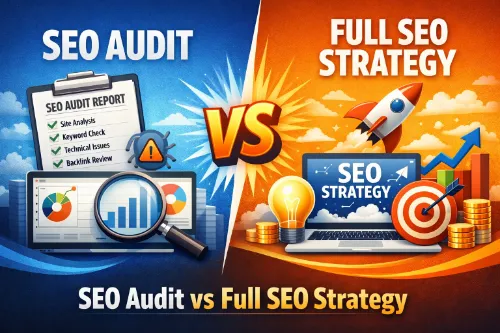
If you want to improve your website’s organic traffic, you need both a Website SEO Audit and a Full SEO Strategy. A Website SEO Audit acts as a comprehensive health check, while a Full SEO Strategy turns those insights into an ongoing roadmap for growth.
An SEO audit is a comprehensive health check that reviews technical SEO, on‑page optimization, content quality, user experience, and backlinks to show what is wrong and why your rankings may be stuck. For a deeper look at what professional SEO services typically include, you can explore this guide on SEO services.
A full SEO strategy builds on those findings to create a step‑by‑step action plan that covers keyword research, content strategy, technical fixes, internal linking, and off‑page SEO so you can increase visibility, clicks, and conversions over time. You can see how this plays out in practice in this dedicated guide on website SEO audit vs full SEO strategy.
For most businesses, the best approach is: run a detailed SEO website audit first, then use it to design and execute a focused SEO strategy instead of guessing what to do next. If you are unsure how frequently to repeat this, check out how often to get an audit in this resource on how often should you get an SEO audit.
What Is a Website SEO Audit?
A Website SEO Audit is a structured process for checking how well your site meets modern search engine requirements. It combines SEO analysis, technical diagnostics, and content review to measure your current SEO health, reveal issues, and uncover missed opportunities for organic growth.
For a service‑level breakdown, you can review this overview of SEO audit services, which explains the main deliverables and expectations from a professional audit engagement.
Core goals of an SEO website audit include:
- Find technical SEO problems that block crawling, indexing, and Core Web Vitals performance. For example, this deep dive into technical SEO audit shows how agencies structure technical checks and prioritize fixes.
- Evaluate on‑page SEO elements such as titles, meta descriptions, headers, and internal links, following fundamentals like those in this article on on‑page SEO basics.
- Assess content quality, search intent match, and topical authority while avoiding keyword stuffing by using principles from content optimization vs keyword stuffing.
- Review off‑page SEO and backlink profile to spot risks and opportunities, using criteria similar to those in this guide on how to evaluate the quality of backlinks.
- Benchmark your website against competitors and current Google guidelines so you can later measure SEO ROI using frameworks like how to measure SEO ROI for your business.
Most professional audits follow a repeatable SEO audit workflow so nothing critical is missed. This workflow is often turned into an SEO audit template that can be reused for different domains, CMS platforms, and markets, as outlined in this article about important sections of an SEO audit report.
Key Components of a Website SEO Audit
A robust SEO audit covers multiple dimensions of your site so you get a complete picture rather than isolated data points.
1. Technical SEO audit
The technical SEO audit focuses on the behind‑the‑scenes elements that determine whether search engines can efficiently crawl and index your pages. To understand what a specialist service includes, you can review technical SEO services.
Typical checks include:
- Crawlability and indexation (sitemaps, robots.txt, noindex tags), and common technical SEO issues that can silently block performance.
- Site architecture and URL structure, which matter more for large setups like those covered in enterprise technical SEO challenges and solutions.
- HTTPS, redirects, canonicalization, and duplicate content.
- Core Web Vitals, page speed, and mobile responsiveness; you can deepen this with guides on page speed impacts SEO performance and Core Web Vitals for SEO.
- JavaScript rendering and crawl budget efficiency, which become critical when managing SEO for thousands of pages.
A clean technical foundation makes every other SEO effort more effective and improves both user experience and rankings. For platform‑specific guidance, see this piece on technical SEO for Shopify, WooCommerce, and Magento.
2. On‑page SEO audit
The on‑page SEO audit reviews how each page communicates relevance to search engines and users. If you want a service‑style overview, this article on on‑page SEO services outlines what specialists typically handle.
It typically covers:
- Page titles, meta descriptions, and H1–H3 headers, supported by checklists such as this on‑page SEO checklist for service‑based websites.
- Keyword usage, synonyms, and natural language phrasing in the copy, aligned with modern practices like search intent optimization for better rankings.
- Internal linking structure, anchor text, and contextual links; see this guide on internal linking improves rankings.
- Image optimization (alt text, filenames, compression).
- Schema markup and structured data for rich results where relevant.
This on‑page review is where NLP‑friendly optimization really matters, because search engines increasingly evaluate how naturally content answers queries instead of just counting keywords. For landing‑page‑focused work, refer to optimize landing pages for search engines.
3. Content and user intent analysis
A modern SEO audit must evaluate how well your content matches search intent and user expectations.
Key tasks include:
- Mapping priority keywords to pages and topics, using methods like keyword mapping for service pages and blogs.
- Identifying content gaps, thin content, and outdated pages, and planning content refresh services for old website pages.
- Reviewing E‑E‑A‑T signals such as author expertise, references, and helpfulness; this is crucial in sensitive niches covered in medical content SEO and E‑E‑A‑T best practices.
- Grouping related articles into topic clusters and pillar pages, following frameworks from SEO content planning for topical authority and how blog clusters support SEO service pages.
- Ensuring content answers questions clearly and directly for AEO and AI Overviews, similar to the approach in traffic vs leads.
This is also where GEO targeting can be layered in by tailoring content for specific locations, such as city‑level service pages or local landing pages, using examples like local SEO helps clinics, law firms, and restaurants.
4. Off‑page SEO and backlink profile
Off‑page SEO audits review your website’s authority and trust signals. For an overview of what’s included, you can check off‑page SEO services.
They usually include:
- Backlink quantity, quality, and topical relevance, using principles from how backlinks affect domain authority and rankings.
- Toxic links or spammy patterns that may need disavowal, with guidance on white hat vs black hat SEO link building.
- Competitor link gaps and link‑worthy content opportunities, supported by link‑building services and digital PR vs traditional link building.
- Brand mentions, local citations, and digital PR potential, including tactics from local citation building.
These insights help you build a targeted link‑building and digital PR plan instead of chasing random backlinks.
What Is a Full SEO Strategy?
A Full SEO Strategy is the long‑term roadmap built on top of your audit findings. Rather than just telling you what is wrong, it defines what to prioritize, how to implement changes, and how to scale organic growth over months and years.
A comprehensive SEO strategy covers:
- Clear goals and KPIs (traffic, leads, revenue, visibility), with measurement frameworks like SEO KPIs every business owner should track.
- Keyword research and topic clustering using guides like keyword research services for lead generation and commercial vs informational keywords in SEO campaigns.
- Content strategy and publishing calendar, as outlined in content SEO services: strategy, writing, and optimization.
- Technical roadmap and ongoing SEO analysis, which is especially important in enterprise SEO services for large websites.
- Internal linking, site architecture, and UX improvements.
- Link‑building, digital PR, and authority growth guided by SEO reporting metrics clients actually care about.
- Reporting, dashboards, and iteration based on data, with expectations set in what to expect from an SEO strategy consultant.
The most effective strategies use your initial SEO audit as the baseline and then evolve using continuous SEO analysis over time, as shown in what to do after an SEO audit.
Website SEO Audit vs Full SEO Strategy
Here is a simple way to compare Website SEO Audit vs Full SEO Strategy so decision‑makers can quickly understand the difference.
| Aspect | Website SEO Audit | Full SEO Strategy |
|---|---|---|
| Main purpose | Diagnose SEO health and problems, similar to an SEO audit service | Plan and execute long‑term organic growth using structured SEO services |
| Scope | Technical, on‑page, content, backlinks at a point in time | Research, planning, implementation, optimization across channels |
| Duration | Fixed project, usually days or weeks | Ongoing work over months/years |
| Output | Written report, issues, and prioritized actions | Roadmap, content plan, sprint backlog, KPIs |
| Ownership | Consultant or agency delivers the audit | Shared with in‑house team and partners |
| Best use case | Before any major SEO investment or redesign | For businesses ready to treat SEO as a core growth channel |
An SEO Audit is the “diagnosis,” while a Full SEO Strategy is the “treatment plan plus ongoing care.” Case studies like before and after SEO results show how both pieces work together in practice.
How an SEO Audit Feeds a Full SEO Strategy
In a mature SEO program, the Website SEO Audit is always the first step. It creates a data‑driven foundation that prevents you from wasting budget on tactics that will never work because of hidden technical or content issues.
Typical flow from audit to strategy:
- Run a full SEO website audit (technical, on‑page, content, backlinks, UX), following a structure like website SEO audit vs full SEO strategy.
- Prioritize findings by impact, effort, and business value, taking cues from commercial intent clusters.
- Translate high‑priority items into a structured SEO action plan.
- Map keywords and topics into a content strategy and publishing roadmap, using frameworks from industry‑specific clusters.
- Implement fixes and new content in sprints, starting with quick wins; examples appear in SEO wins from technical fixes alone.
- Monitor performance with SEO analytics and refine the strategy using guidance from how to measure SEO ROI for your business.
- Repeat mini‑audits to keep your SEO strategy aligned with Google updates, following expectations in why SEO is a long‑term investment.
This approach ties your ongoing SEO strategy directly to evidence from your audit, which aligns with how Google recommends using data to improve site quality over time.
Why This Approach Is AEO and AI‑Overview Friendly
Answer Engine Optimization (AEO) and AI Overview visibility rely on clear, direct, and trustworthy answers. When your content explains concepts like “Website SEO Audit vs Full SEO Strategy” in simple language, structured sections, and helpful listicles, it becomes easier for search engines and AI systems to extract and present it.
Elements that improve AEO and AI Overview readiness include:
- Concise, direct definitions at the top of the page.
- Logical headings and subheadings that mirror real queries, like those used across the guides section.
- Bulleted lists and numbered steps that highlight key points.
- Clear comparisons that answer “vs” questions, similar to SEO consultant vs SEO agency.
- Natural language phrases similar to how users speak their questions.
By aligning your content with these patterns, you make it AI Overview keyword friendly without resorting to unnatural keyword stuffing.
Benefits of a Website SEO Audit
Here are practical benefits your business gets from a proper SEO website audit.
- Clear picture of SEO health – see technical issues, content gaps, and link risks in one place, as shown in local SEO audit guide.
- Prioritized action plan – know exactly what to fix first for the biggest impact.
- Better use of SEO budget – avoid random tasks and focus on work that moves the needle, aligning with are SEO services worth it for small businesses.
- Improved crawlability and indexation – help search engines discover and understand your content.
- Higher content quality and relevance – align pages with user intent and modern ranking factors, using ideas from search intent optimization for better rankings.
- Reduced technical debt – fix long‑standing site issues that slow down future SEO work.
- Stronger E‑E‑A‑T signals – evaluate and improve expertise, authoritativeness, and trust.
- Reliable baseline for reporting – compare future SEO performance to an accurate starting point using metrics from SEO KPIs every business owner should track.
Benefits of a Full SEO Strategy
A Full SEO Strategy goes beyond one‑off fixes to create sustainable growth.
- Clear SEO goals and KPIs aligned with your business metrics, not vanity numbers, following guidance from how to measure SEO ROI for your business.
- Structured keyword and topic plan that feeds your content calendar for months, supported by agencies find low‑competition high‑intent keywords.
- Consistent content creation using topic clusters and pillar pages to build topical authority.
- Ongoing technical maintenance so your site stays fast, crawlable, and user‑friendly.
- Strategic link‑building and PR that grow your authority instead of chasing random links, aligned with digital PR vs traditional link building.
- Regular SEO analysis and reporting to see what works and what needs to change.
- Better alignment with other channels like paid ads, email, and social media.
- Resilience against algorithm updates because your strategy follows best practices and real user value, echoing why some SEO campaigns fail.
When You Need a Website SEO Audit
You should consider a Website SEO Audit if any of these situations apply to you.
- Your organic traffic has dropped and you do not know why, similar to scenarios in why rankings dropped even with SEO work.
- You plan a site redesign, migration, or new CMS.
- You have never had a structured SEO analysis done.
- You publish content regularly but rankings barely move.
- You suspect technical issues such as slow pages, broken links, or indexing problems.
- You want an independent, objective diagnosis before signing a long‑term SEO retainer.
In these cases, an audit is the safest starting point because it gives you evidence before you commit to a full SEO strategy.
When You Need a Full SEO Strategy
A Full SEO Strategy is the right move when you already understand your baseline and are ready to grow systematically.
Common signals include:
- You have completed an SEO audit and want help implementing it, often via SEO consulting for in‑house marketing teams.
- You have clear growth targets for organic traffic, leads, or online sales.
- Your market is competitive and you need a structured plan to win, using guidance from how to choose the right SEO agency.
- You have internal resources but need expert direction and prioritization.
- You want ongoing SEO analytics, reporting, and adjustments, not just a one‑time report.
In this scenario, the SEO strategy becomes part of your broader digital marketing plan, informing content, UX, and even product decisions, similar to the case study in how a service business increased leads organically.
Simple, NLP‑Friendly Optimization Principles
To make your “Website SEO Audit vs Full SEO Strategy” page perform well in Google SERPs and AI Overviews, follow a few simple content principles.
- Use natural language that matches how real people ask questions.
- Answer the core question clearly in the first few paragraphs.
- Use descriptive headings like “What Is a Website SEO Audit?” and “What Is a Full SEO Strategy?”.
- Include listicles and comparison tables to surface key points.
- Add supporting sections that cover related queries (benefits, when to choose which, how they work together), using examples from SEO clients need to know.
- Show expertise with practical advice, not just definitions, as demonstrated in why SEO is a long‑term investment.
These steps keep the content accessible for users while also signaling relevance to search engines that rely on NLP and semantic understanding.
- An SEO website audit is a one‑time, in‑depth review of your current SEO health and performance, often delivered as part of SEO audit services.
- A full SEO strategy uses those audit insights to create an ongoing plan for content, technical improvements, and link‑building.
- The best results come from combining both: audit first, then strategy and implementation based on real data, as illustrated in content‑led SEO growth case study.
Frequently Asked Questions
1. Is an SEO audit the same as a website audit?
No. A general website audit may focus on design, branding, or basic usability, while an SEO audit focuses specifically on search performance factors like technical health, content, and backlinks.
2. How long does a typical SEO audit take?
Most small‑to‑medium websites can be fully audited in 5–15 business days, while large or enterprise sites with thousands of URLs may take several weeks due to deeper crawling and validation.
3. What tools are usually used in an SEO audit?
Common tools include Google Search Console, Google Analytics, a crawling tool (like Screaming Frog), and all‑in‑one platforms for keyword and backlink analysis.
4. Do I need access to my CMS and analytics for an audit?
Yes. Granting read‑only access to your CMS, analytics, and search console allows the SEO specialist to confirm data, validate hypotheses, and provide more accurate, actionable recommendations.
5. Will an SEO audit alone improve my rankings?
The audit itself does not move rankings; results only come when you implement the recommended technical fixes, content updates, and link‑building actions outlined in the audit report.
6. How often should I repeat an SEO audit?
Most businesses benefit from a comprehensive audit every 6–12 months, with lighter “health checks” or mini‑audits quarterly to catch new issues early.
7. What is included in a professional SEO audit report?
A good report includes a summary of key findings, a prioritized issue list, screenshots or examples, and a clear action plan that shows what to fix, why it matters, and how to do it.
8. Can I perform my own SEO audit?
You can run a basic DIY audit using free and freemium tools, but a professional audit typically goes deeper into technical diagnostics, crawl analysis, and competitive insights.
9. What happens after an SEO audit is finished?
After delivery, the next step is to translate the recommendations into a roadmap, assign responsibilities, and schedule implementation sprints for technical fixes and content updates.
10. How do I know if my SEO strategy is working?
Track KPIs such as organic traffic, rankings for target keywords, leads or sales from organic search, and technical health scores from regular site reports.
11. Do I need both SEO and PPC if I have a solid SEO strategy?
SEO and PPC often work best together: SEO builds long‑term visibility, while PPC provides immediate traffic and testing data that can refine your keyword and content strategy.
12. Will a full SEO strategy lock me into a long contract?
Not necessarily. Many providers offer project‑based roadmaps, quarterly retainers, or flexible monthly plans; what matters is that the engagement allows consistent execution over time.
13. How long does it take to see results from an SEO strategy?
Most sites start to see meaningful improvements in 3–6 months, with stronger compounding gains over 6–12 months depending on competition, budget, and how quickly changes are implemented.
14. What budget should I set aside for SEO each month?
Budgets vary widely, but many small to mid‑sized businesses invest a consistent monthly amount similar to or greater than one key paid channel, treating SEO as a core acquisition investment.
15. Who should own the SEO strategy inside my company?
Ideally, a dedicated SEO lead or experienced marketer owns the strategy, while developers, content writers, and leadership collaborate to execute and prioritize roadmap items.
16. What is the difference between local SEO and general SEO?
Local SEO focuses on geography‑based visibility (maps, local packs, and nearby searches) and relies heavily on business profiles, citations, and localized content, while general SEO targets broader, non‑location specific queries.
17. Do SEO audits cover social media or only the website?
Most SEO audits focus primarily on your website and its presence in organic search, but some providers also review social signals and how your content is shared off‑site.
18. How detailed should technical recommendations be?
Effective audit recommendations clearly state the issue, explain the impact, and include developer‑ready guidance so your technical team can implement changes without guesswork.
19. Can an SEO strategy help if my site is brand new?
Yes. For new sites, a strategy can guide site architecture, keyword mapping, and content priorities from day one, helping you avoid costly structural mistakes later.
20. What questions should I ask before hiring someone for an audit or strategy?
Ask to see sample reports, clarify what is included, confirm which tools they use, and understand how they communicate priorities, timelines, and expected outcomes.