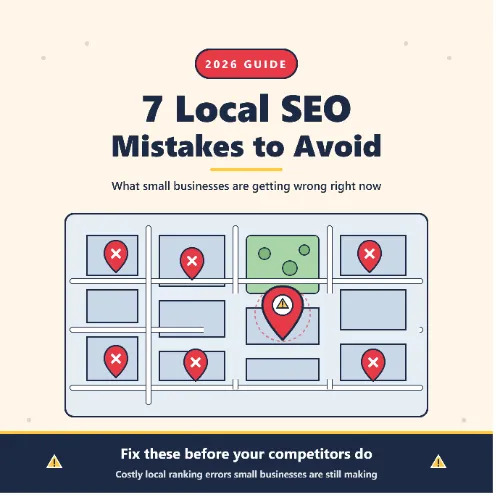
local SEO mistakes small businesses Key Takeaways
Local search is one of the most powerful ways to attract nearby customers, yet many small businesses hurt their own visibility by making simple but costly errors.
- local SEO mistakes small businesses often include incomplete Google Business Profiles, inconsistent NAP data, and ignoring online reviews.
- Fixing these mistakes can dramatically improve where your business shows up in local pack results and Google Maps.
- A focused local strategy—built on accurate citations, local content, and genuine reviews—delivers measurable traffic and foot traffic gains.
Why Local SEO Mistakes Small Businesses Hurt Your Bottom Line
When a potential customer searches for “plumber near me” or “best coffee shop in Austin,” they are ready to act. If your business is invisible in those results, you are losing leads to competitors who have their local SEO basics right. The problem is that many local SEO mistakes small businesses make are easy to fix once you know what to look for. For a related guide, see 10 Bold SEO Predictions for 2026 Based on Current Trends.
Local SEO is not the same as traditional SEO. It requires specific signals: a verified Google Business Profile, consistent citations across the web, localized content, and a steady stream of positive reviews. Ignore any one of these, and your rankings suffer. Let’s walk through the seven most damaging mistakes and how to correct them. For a related guide, see 13 SEO Trends Experts Are Wrong About: Avoid These Costly Mistakes.
Mistake #1: Neglecting Google Business Profile Optimization
Your Google Business Profile is the single most important asset for local visibility. Yet many businesses leave it unclaimed, incomplete, or outdated. This is one of the most common local SEO mistakes small businesses commit.
What to Fix
Claim your profile, verify it, and fill every field: business name, address, phone number, website, hours, categories, and services. Add high-quality photos regularly and post updates at least once a week. Choose primary and secondary categories precisely—a coffee shop should not list as “restaurant.”
Mistake #2: Inconsistent NAP Information Across the Web
NAP stands for Name, Address, Phone number. Search engines cross-reference this data across directories like Yelp, Bing Places, and Yellow Pages. When your NAP is inconsistent—e.g., “Suite 100” vs. “Ste. 100″—it confuses Google and lowers trust.
How to Fix Inconsistent Citations
Use a tool like Moz Local or BrightLocal to audit your existing citations. Standardize your NAP format and update every directory. Prioritize high-authority sites: Google Business Profile, Apple Maps, Bing Places, Facebook, Yelp, and industry-specific directories.
Mistake #3: Ignoring Local Keyword Research
Relying only on generic keywords like “pizza” or “dentist” is a missed opportunity. Local searches include geographic modifiers: “pizza in Brooklyn” or “dentist open on Saturday in Phoenix.” Without small business local SEO tips focused on location-specific terms, you attract the wrong audience.
How to Find Local Keywords
Start with Google Autocomplete—type your service plus “near me” or your city name. Use free tools like Google Keyword Planner or Ahrefs Keyword Explorer with the country database set to your region. Look for keywords with decent search volume and low competition. Include these terms in your page titles, meta descriptions, headings, and body content.
Mistake #4: Weak On-Page Local Signals
On-page SEO tells Google what your page is about and where it serves. Many small businesses forget to include location signals beyond the homepage. This is another common local SEO mistakes small businesses pattern.
On-Page Local Checklist
- Include city and state in title tags and H1 headings.
- Write location-specific landing pages for each service area.
- Embed a Google Map on your contact page.
- Use schema markup (LocalBusiness, Address, OpeningHours).
- Ensure your site is mobile-friendly and loads fast—Core Web Vitals matter locally too.
Mistake #5: Not Building Local Citations
Citations are mentions of your business on other websites. They confirm your legitimacy. Yet many small businesses neglect citation building, especially on niche directories relevant to their industry.
Where to Build Citations
Start with the major aggregators: Data Axle (formerly Infogroup), Factual, and Neustar Localeze. Then add industry-specific directories: attorneys should be on Avvo and Justia, restaurants on TripAdvisor and Zomato. Consistency is key—your NAP must match your Google Business Profile exactly.
Mistake #6: Overlooking Review Management
Reviews are a direct ranking signal for local packs. They also influence click-through rates. Ignoring reviews—or worse, not responding to negative ones—damages both trust and rankings.
Review Management Best Practices
- Ask happy customers to leave reviews on Google and Yelp.
- Respond to every review within 48 hours, including negative ones.
- Never buy fake reviews. Google penalizes businesses that do.
- Monitor your reviews weekly using a tool like ReviewTrackers or Google Alerts.
Mistake #7: Not Tracking Local Rankings
If you are not measuring your local search performance, you are flying blind. Many small businesses set up local SEO but never check whether it is working.
How to Track Local Rankings
Use a rank-tracking tool that allows you to set a specific location (important because local results vary by searcher location). Ahrefs, BrightLocal, and Semrush all offer local rank tracking. Monitor your Google Business Profile insights too—they show how customers find you: via Maps, organic search, or direct searches. Adjust your strategy based on what is working.
SEO Entities and Their Functions
Understanding a few key SEO entities helps you make better decisions when fixing these mistakes. Here is what each one does:
- Website / Domain entities: root domain, subdomain, and URL-level analysis let you see whether local performance belongs to your whole site or a specific landing page.
- Keyword entities: organic keywords, keyword difficulty (KD), and search volume show demand and competition for local terms.
- Backlink entities: referring domains and anchor text explain which local sites link to you and with what relevance.
- SERP entities: local packs, featured snippets, and People Also Ask reveal what search result formats your target queries trigger.
- Local SEO entities: country database, city-specific keywords, and local competitors connect your campaign to the correct geography.
- Metrics entities: Domain Rating (DR), organic traffic, and referring domains count summarize authority and visibility.
Actionable Small Business Local SEO Tips Checklist
Use this checklist to audit your current setup and fix the most common local SEO mistakes small businesses make:
- Claim and verify your Google Business Profile.
- Complete every field with accurate NAP, hours, and categories.
- Audit citations across 10+ directories and fix inconsistencies.
- Research and implement 5–10 location-specific keywords on your site.
- Add LocalBusiness schema markup to your contact page.
- Create location-specific landing pages for each area you serve.
- Ask for reviews after every positive customer interaction.
- Respond to all reviews within two days.
- Set up local rank tracking with a location-specific tool.
- Review Google Business Profile insights monthly.
Useful Resources
Google’s official documentation on local packs explains how Google selects businesses for local results—essential reading for anyone serious about local SEO.
Moz’s Local SEO guide provides a comprehensive walkthrough of citation building, review management, and GBP optimization.
Frequently Asked Questions About local SEO mistakes small businesses
What is the most common local SEO mistake small businesses make?
The most common mistake is having an incomplete or unclaimed Google Business Profile. Without a verified profile with full details, you are essentially invisible in local pack results.
How long does it take to fix local SEO mistakes?
It depends on the mistake. Simple fixes like updating your NAP on directories can show improvements within a few weeks. Building authority through reviews and backlinks takes three to six months.
Do I need to hire an agency to fix local SEO?
Not necessarily. Many small business owners can fix the basics themselves using free tools and checklists. For advanced citation cleanup and ongoing tracking, you might consider a specialist.
How many citations do I need for local SEO?
There is no fixed number, but covering the top 10–15 directories (Google, Yelp, Bing, Apple Maps, Facebook, Yellow Pages, and industry-specific ones) is usually sufficient for consistency.
Is it bad to have duplicate Google Business Profiles?
Yes. Duplicate profiles confuse Google and can lead to suspension. Merge duplicates through Google Business Profile support or delete the extra profile.
How do I find local keywords for free?
Use Google Autocomplete by typing your service plus your city. Also see Google’s “People also search for” suggestions at the bottom of search results. Google Keyword Planner (free with Google Ads) is another good source.
Does having a mobile-friendly site help local SEO?
Absolutely. Google uses mobile-first indexing, and a poor mobile experience hurts rankings. It also frustrates local customers who often search on phones while on the go.
How important are online reviews for local SEO?
Very important. Review count, quality, and recency are direct ranking factors in local packs. They also affect click-through rates from search results.
Should I use a fake address for local SEO?
No. Using a fake or residential address when you are a service-area business is against Google’s guidelines. You can hide your address if you meet customers at their locations.
Can I rank without a Google Business Profile?
You can rank for organic results without one, but you cannot appear in the local pack or Google Maps without a verified profile. Local pack visibility drives a huge portion of local leads.
What is NAP consistency?
NAP stands for Name, Address, Phone number. Consistency means that your business name, address, and phone number appear exactly the same across every website and directory.
How often should I check my local rankings?
Check at least monthly, but weekly is better if you are actively optimizing. Local rankings can shift quickly due to competitor activity or algorithm updates.
Do location pages help with local SEO?
Yes. Dedicated location pages for each city or area you serve allow you to target specific local keywords and provide a better user experience for nearby customers.
What is the difference between local SEO and organic SEO?
Local SEO focuses on appearing in location-based searches and local packs, while organic SEO targets broader, non-geographic queries. Both strategies overlap but use different signals.
Can social media help my local SEO?
Indirectly. Social signals do not directly influence rankings, but an active social presence can drive brand searches, generate mentions, and earn shares that contribute to local authority.
How do I fix duplicate content on location pages?
Ensure each location page has unique content about that specific area, including local testimonials, photos, and services. Avoid copying and pasting the same text across multiple pages.
Is it worth paying for local directory listings?
Only if the directory is high-authority and relevant to your industry. Skip low-quality directories. Paid listings on Yelp or BBB may provide some value but are not necessary for basic citation consistency.
What should I do if a competitor has better local rankings?
Analyze their Google Business Profile, citations, reviews, and local content. Identify gaps in your own strategy—like fewer reviews or incomplete directories—and close them systematically.
Does my website need a blog for local SEO?
A blog helps you publish locally relevant content (events, community involvement, local tips), which can attract links and establish topical authority. It is not mandatory but very helpful.
How do I know if my local SEO is working?
Track Google Business Profile insights (calls, direction requests, website clicks), local rank tracking reports, and organic traffic from location-specific keywords in Google Analytics.