

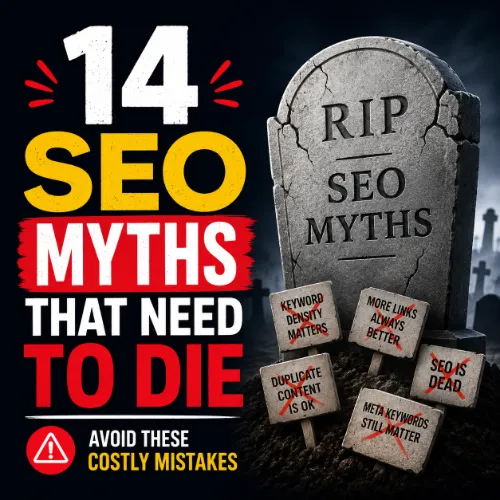
SEO myths Key Takeaways
Outdated SEO myths still being circulated can quietly sabotage your rankings and waste your marketing budget.
- SEO myths often stem from old tactics that Google’s core updates have rendered ineffective or harmful.
- Modern SEO prioritizes user intent, content quality, technical health, and a solid backlink profile over keyword density or exact-match domains.
- Adopting current best practices — like focusing on EEAT, Core Web Vitals, and topical authority — will protect your site from ranking drops.
Google’s Core Web Vitals apply to both desktop and mobile. While mobile-first indexing means Google primarily uses the mobile version of your site for ranking and indexing, page speed on desktop still affects user experience and, consequently, rankings. Slow load times increase bounce rates across all devices.
Do this instead: Optimize images, enable caching, minimize JavaScript, and use a CDN for all devices. Test your site using Google PageSpeed Insights and address both mobile and desktop issues. For a related guide, see Topical Authority Outperforms Keyword Stuffing in Modern SEO.
Myth 14: SEO Is All About Tricking Google
This is perhaps the most harmful SEO myth. Treating SEO as a game of loopholes leads to short-term gains followed by long-term penalties. Google’s algorithms are designed to reward sites that provide a great user experience. Trying to “beat” the system is a losing strategy.
Do this instead: Adopt a user-first mindset. Create content that genuinely helps your audience, build a site that is fast and easy to navigate, and earn links through reputation and value. When you prioritize users, SEO results follow.
SEO Entities and Their Functions
Understanding key SEO entities helps you analyze and improve your site’s performance with precision. Here are the most relevant ones for debunking SEO myths and building a sound strategy. For a related guide, see AI SEO Myths That Need to Die.
- Page entities: Top pages, best by links, best by traffic, and broken pages reveal which URLs earn visibility, links, traffic, or need repair. Use this data to focus your content updates.
- Backlink entities: Referring domains, anchor text distribution, dofollow/nofollow ratios, and lost backlinks help you assess link quality and spot unnatural patterns.
- Keyword entities: Organic keywords, keyword difficulty (KD), search volume, and SERP features show demand, competition, and the ranking opportunity for each term.
- Technical SEO entities: Crawl issues, redirect chains, canonicals, duplicate content, Core Web Vitals, and indexability status expose obstacles that prevent crawling or good page experience.
Useful Resources
For further reading on modern SEO practices and avoiding SEO myths, explore these authoritative sources:
- Google Search Central: SEO Starter Guide — The definitive guide from Google on best practices.
- Ahrefs Blog: SEO Mistakes That Will Hurt Your Rankings — A comprehensive look at common pitfalls backed by data.
Frequently Asked Questions About SEO myths
What is the most common SEO myth?
The most common SEO myth is that keyword density is a ranking factor. In reality, Google uses semantic understanding and context, not keyword repetition, to rank pages.
Are meta keywords still used for ranking?
No, Google stopped using the meta keywords tag years ago because it was heavily abused by spammers. It has no impact on rankings and is irrelevant for modern SEO.
Do I need to pay Google to rank higher?
No. Google’s organic search results are free and based on relevance and quality. Pay-per-click ads are separate and do not influence organic ranking positions.
Is SEO dead after AI search?
No, SEO is evolving. AI search changes how results are displayed, but the need to create high-quality, authoritative content that answers user intent remains as strong as ever.
Does Google penalize slow websites?
While speed itself is not a direct penalty, slow-loading pages lead to poor user experience, higher bounce rates, and lower engagement — all of which can indirectly hurt rankings.
Is it true that you need 500 words per page to rank?
No, content length is not a ranking factor. Some queries are best answered in 100 words (e.g., a definition). Others require 2,000+ words for comprehensive coverage.
Do backlinks still matter in 2025?
Absolutely. Backlinks remain a top-three ranking signal. The difference is that quality and relevance matter far more than sheer quantity.
Can I use the same content on multiple pages?
You can, but it is not recommended. Duplicate content does not cause a penalty, but it confuses Google about which page to rank and dilutes your page authority.
Does having a blog automatically improve SEO?
No. A blog only helps if you publish high-quality, relevant content that earns backlinks and satisfies search intent. A low-effort blog can actually harm your site’s authority.
Is it true that Google ignores nofollow links?
Somewhat. Google says it does not follow nofollow links for ranking purposes, but it may use them for discovery and as a hint about link quality. They are not worthless for SEO.
Do I need a separate mobile site for SEO?
No. Google recommends responsive design, not a separate mobile site. A responsive site is easier to maintain and avoids common issues like duplicate content.
Is link building the only way to rank?
No. Many pages rank without many backlinks if they have strong on-page SEO, excellent content, and low competition. However, for competitive queries, links are essential.
Can I use the same title tag on every page?
No. Each page should have a unique, descriptive title tag that includes the target keyword. Duplicate title tags confuse search engines and hurt click-through rates.
Does social media directly improve rankings?
No, social signals are not a direct ranking factor. But social sharing can lead to more visibility, traffic, and backlinks — all of which benefit SEO.
Is keyword research still important?
Yes, keyword research helps you understand what your audience is searching for and how to structure your content. It is not about density but about relevance and intent.
Do I need to update old content?
Yes. Google values freshness and accuracy for many queries. Regularly reviewing and updating older posts — adding new data, examples, and keywords — can improve their rankings.
Is it true that Google prefers .com domains?
No. Google treats all TLDs equally. A .net or .org site can rank just as well as a .com if the content and backlink profile are strong.
Can I rank without any backlinks?
Yes, for low-competition queries. For example, local service pages or very niche long-tail keywords can rank with strong on-page SEO alone. But for most topics, backlinks help.
Does Google punish affiliate sites?
No, but Google expects affiliate sites to provide genuine value beyond just linking to products. Thin affiliate content with no added insight can be devalued.
Is SEO a one-time setup?
No. SEO requires ongoing effort: content updates, technical audits, competitive analysis, and link building. Sites that treat it as a one-time task often see rankings decline over time.







