

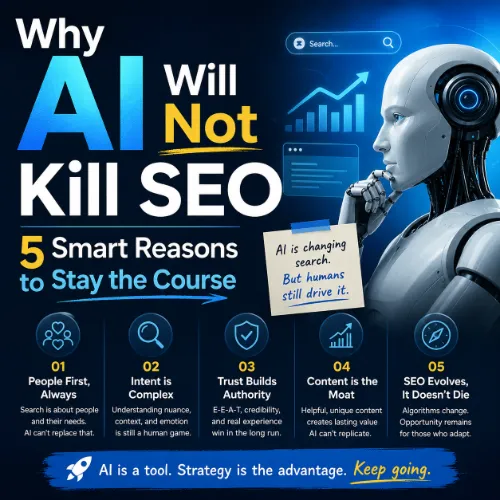
why AI will not kill SEO Key Takeaways
Many marketers worry that generative AI will make search engines obsolete, but the reality is far more nuanced.
- Why AI will not kill SEO — AI lacks the real-world nuance and brand authority that Google rewards.
- Search engines are evolving to detect and demote AI-generated fluff, favoring original insight.
- SEO professionals who embrace AI as an efficiency tool will thrive, not disappear.
A mid-sized agency specializing in B2B SaaS used ChatGPT to generate first-draft outlines and introductory paragraphs. Their senior editors then rewrote the sections for voice, added original data from client case studies, and optimized the structure for featured snippets. Organic traffic for those pages increased 34% in three months. The agency didn’t replace anyone — they simply reallocated time from drafting to value-adding tasks.
SEO Entities and Their Functions
Understanding how modern SEO tools measure performance helps clarify why AI will not kill SEO. These entities are the building blocks of any search strategy: For a related guide, see Will Vibe Coding Kill or Boost Developer Jobs?.
- Keyword entities — organic keywords, keyword difficulty (KD), search volume, and SERP features reveal demand and ranking feasibility.
- Backlink entities — referring domains, dofollow/nofollow status, and new/lost links show authority growth and risk.
- Page entities — top pages by traffic, best by links, and broken pages identify strengths and repair needs.
- Technical SEO entities — crawl errors, canonical tags, Core Web Vitals, and indexability flags uncover hidden blockers.
- Competitor entities — content gaps, link intersect domains, and shared keywords highlight where you can outrank rivals.
- SERP entities — featured snippets, People Also Ask, and AI Overviews inform content format decisions.
How to Future-Proof Your SEO Strategy in the Age of AI
Rather than fear automation, smart marketers are doubling down on uniquely human strengths:
- Build topical authority — publish genuinely useful deep dives, not thin rephrasings.
- Invest in original data — surveys, customer interviews, and proprietary research earn links.
- Optimize for AI Overviews and snippets — structure content to answer questions concisely.
- Strengthen brand signals — Google uses brand searches and mentions as trust signals.
- Use AI for efficiency, not replacement — let tools handle repetitive tasks while you add insight.
Useful Resources
Learn more from these trusted sources:
- Google’s official guidance on AI-generated content — straight from the source on how they treat automated content.
- Ahrefs SEO statistics — data-backed insights on organic traffic, backlinks, and ranking factors.
Frequently Asked Questions About why AI will not kill SEO
Will AI completely replace SEO?
No. AI will automate certain SEO tasks, but strategic judgment, brand building, and content quality still require human oversight.
Does Google penalize AI-generated content?
Google does not specifically penalize content solely for being AI-generated, but it does devalue content that lacks originality, expertise, or helpfulness — regardless of how it was produced.
Can AI do keyword research better than humans?
AI can process large volumes of keyword data quickly, but interpreting search intent, seasonality, and user behavior still benefits from human analysis. For a related guide, see Topical Authority Outperforms Keyword Stuffing in Modern SEO.
Is SEO still a good career in 2025?
Yes. The demand for organic traffic is rising, and companies need SEO professionals who can combine technical skills with strategic thinking — something AI cannot fully replicate.
What are the most important SEO skills for the future?
Understanding user intent, data analysis, content strategy, technical audits, and the ability to guide AI tools effectively are becoming key differentiators.
How do AI Overviews affect organic clicks?
Early data suggests AI Overviews may reduce click-through rates for some simple queries, but they also create new opportunities for brands that appear in the overview itself.
Will link building become obsolete because of AI?
No. Links remain a top ranking factor. AI can help identify link prospects, but building relationships and earning high-quality backlinks still requires human outreach.
Can AI write content that ranks on page one?
AI-generated content can rank if it is thoroughly edited for originality, depth, and accuracy — but purely AI output rarely competes with well-researched human content for competitive keywords.
What is the biggest threat AI poses to SEO?
The biggest risk is not AI itself, but the flood of low-quality AI content that could drown out original voices — which is why Google is doubling down on quality signals.
How should SEOs use AI tools ethically?
Use AI as a drafting assistant, not a final author. Always fact-check, add unique value, and disclose AI use transparently where appropriate.
Will voice search and AI change long-tail keyword strategy?
Yes, conversational queries are growing. But long-tail keyword research remains effective — AI tools just make it faster to identify natural language patterns.
Does AI help with technical SEO audits?
Absolutely. AI can crawl sites, detect issues, and prioritize fixes much faster than manual audits, saving hours of repetitive work.
What is E-E-A-T and why does it matter for AI content?
E-E-A-T stands for Experience, Expertise, Authoritativeness, and Trustworthiness. Google uses it to evaluate content quality, which is hard for AI to demonstrate without human backing.
Can AI predict ranking changes?
AI can spot patterns from historical data, but Google updates often involve manual quality raters and unannounced algorithm changes, making prediction imperfect.
Are SEO tools becoming obsolete?
No, SEO tools are evolving to include AI features. The need for data about keywords, backlinks, and competitors is stronger than ever.
Will local SEO be affected by AI?
Local SEO relies on location signals, reviews, and citations — all areas where AI can assist (e.g., generating listings) but human verification is still essential for accuracy.
How do I improve my SEO with AI without breaking guidelines?
Use AI for research, outline creation, meta writing, and content expansion — then always layer in original data, personal experience, and thorough fact-checking.
What happens to organic traffic if AI search dominates?
Even in an AI-powered SERP, brands with strong reputation and direct traffic channels (email, social, brand searches) will see less disruption than those relying only on generic queries.
Should I stop investing in SEO and focus only on AI content?
No. SEO provides sustainable, compounding returns. The smartest approach is to combine AI efficiency with SEO strategy — not replace one with the other.
What is the best way to learn SEO in 2025?
Follow trusted industry blogs (Moz, Ahrefs, Search Engine Land), take hands-on courses, and practice by auditing real websites. AI tools can help you learn faster. For a related guide, see 13 Technical SEO Tools That Save Time When Auditing Your Site.







