If you run a service-based website, on-page SEO is one of the easiest ways to get more leads, calls, and bookings from Google, AI Overviews, and other search experiences. When your service pages are optimized properly, they can rank higher in organic search results, show up in local packs, and support broader campaigns like SEO services.
This guide gives you a practical on-page SEO checklist you can follow for each service page. It combines classic on-page SEO, local GEO optimization, AI Overview (AEO) considerations, and simple NLP-friendly formatting so search engines and users clearly understand what you do and where you do it.
On-page SEO for service-based websites means making each service page clear, helpful, and easy to understand for both people and search engines. Start by assigning one primary keyword and a few related secondary keywords to every service page, then reflect those in your URL, title tag, meta description, headings, and main content, using frameworks like on-page SEO basics and on-page SEO checklist for service-based websites.
Use simple language, strong H1 and H2 headings, and list-based sections to answer common questions about your service, such as what you do, who you help, where you operate, how much it costs, and how to book. Add clear calls to action, trust elements like reviews and certifications, and local details such as NAP and service areas, drawing on resources like local SEO services for small businesses and Google Business Profile optimization services. Optimize images, make the page fast and mobile-friendly, and support your content with internal links, external links, and relevant schema markup, which you can refine using technical SEO audit and important sections of an SEO audit report.
Follow this checklist for every service page, and you’ll build a service-based site that ranks better, converts more visitors into leads, and is more likely to be included in AI-powered summaries and overviews.
1. Start With Smart Keyword and Intent Mapping
Before you touch title tags or content, decide what each page should rank for. This is where keyword mapping and search intent come in. You can go deeper with a dedicated guide to keyword mapping for service pages and blogs.
Choose a primary keyword per service page
Every service page should have one clear primary keyword, plus a small cluster of secondary keywords that support it. If you want help finding the right phrases, use resources on keyword research services for lead generation and commercial vs informational keywords.
For example, for a plumbing business:
- Primary keyword: “emergency plumber in Sydney”
- Secondary keywords: “24/7 plumbing services Sydney”, “burst pipe repair Sydney”, “local plumber near me”
To expand the keyword set while staying focused on buyer intent, you can use ecommerce keyword research for buyer intent as a model and adapt the principles to service pages.
Match content to search intent
Service-based queries are usually transactional or local: users want a solution now, not a long theory article. A short primer on search intent optimization for better rankings shows how to align your copy with what users expect to see.
Align your page with this intent:
- Use clear service names in your headings and copy
- Answer “who, what, where, when, how much, how to book”
- Include local signals like city, suburb, and service areas where relevant
When your page satisfies both the keyword and the intent, it becomes easier for both classic search and AI Overviews to choose your content as a relevant answer.
2. Use Clean, Geo-Friendly URL Structure
Your URL structure helps both users and search engines understand your site. For service-based websites, use short, descriptive, keyword-rich URLs and avoid random numbers or long query strings. The fundamentals in this on-page SEO basics guide apply directly here.
Examples of SEO-friendly URLs
- /services/emergency-plumber-sydney
- /services/roof-repair-melbourne
- /services/social-media-management
Good URLs often include the main service and, for local businesses, a location keyword. You can cross-check your work against this dedicated on-page SEO checklist for service-based websites.
3. Optimize Title Tags and Meta Descriptions
Title tags and meta descriptions are small elements that have a big impact on on-page SEO, click-through rate, and AI answer visibility. If you want outside validation of your approach, look at specialized on-page SEO services and how they structure metadata.
How to write SEO-friendly title tags
- Include the primary keyword near the beginning
- Mention location for local services
- Keep them clear, natural, and under roughly 60 characters
Examples:
- “Emergency Plumber in Sydney | 24/7 Local Plumbing Services”
- “House Cleaning Service in Brisbane | Trusted Local Cleaners”
How to write meta descriptions that convert
Use your meta descriptions to summarize the service, add benefits, and include a call to action. To avoid over-optimizing, check this guide on content optimization vs keyword stuffing.
Example:
- “Need an emergency plumber in Sydney? We offer 24/7 plumbing services, fast response, and upfront pricing. Call now for same-day repairs.”
This style is keyword-rich, NLP-friendly, and designed for both users and AI Overview snippets.
4. Structure Your Page With Strong Header Tags
Search engines and AI systems rely on clear structure. Use heading tags (H1, H2, H3) to break your content into logical sections. If you want an expanded walkthrough, see this guide on on-page SEO services.
Best practices for H1
- One H1 per page
- Include the main service and location if local
- Make it read like a human-friendly page title
Examples:
- “Emergency Plumbing Services in Sydney”
- “Professional Roof Repair and Replacement in Melbourne”
Use H2 and H3 for sections and FAQs
Typical H2s for a service page:
- “Why Choose Our [Service]”
- “Our [Service] Process”
- “Areas We Serve”
- “Frequently Asked Questions About [Service]”
This structure helps NLP systems understand topics and subtopics, and it is perfect for list-based sections and AI Overview paragraphs.
5. Create Helpful, Conversion-Focused Service Page Content
Your service content should be clear, simple, and focused on solving the user’s problem. For a deeper process, check content SEO services: strategy, writing, and optimization.
Key elements of high-performing service content
Use this checklist for every service page:
- Explain the problem your customer has
- Show how your service solves that problem
- Highlight benefits and outcomes (not just features)
- Add social proof (reviews, ratings, testimonials, case studies)
- Include pricing or at least explain how pricing works
- Tell users exactly how to book, call, or get a quote
To keep your site fresh, you can schedule content refresh services for old website pages.
Use natural, semantic (NLP) keywords
Instead of stuffing exact-match keywords, sprinkle natural variations and related phrases. You can plan this using SEO content planning for topical authority and how blog clusters support SEO service pages.
For “emergency plumber in Sydney,” you might also use:
- “urgent plumbing repair”
- “24-hour plumber”
- “same-day plumbing services”
- “licensed local plumber”
These semantic variations help NLP and AI systems understand that your page comprehensively covers the topic.
6. Local & GEO Optimization for Service-Based Businesses
If you serve a specific city or region, local SEO should be baked into your on-page optimization. The principles in local SEO services for small businesses are a strong complement to this checklist.
Add clear NAP and service area details
NAP stands for Name, Address, Phone number. Ensure it is consistent across:
- Your website (footer, contact page, service pages)
- Your Google Business Profile
- Local listings and directories
For more detail, review Google Business Profile optimization services and local citation building.
You can also include:
- A short “Areas We Serve” section listing key suburbs or cities
- Embedded map of your office or primary service region
- Links to location pages if you have multiple branches
Use geo-modified keywords naturally
Include location in headings, intro paragraphs, and CTAs where it feels natural. For inspiration, see niche-focused local guides like local SEO helps clinics, law firms and restaurants or the local SEO audit guide for Philippine businesses.
This GEO-friendly content helps you rank for “near me” style queries and makes it easier for AI Overviews and local packs to recognize where you operate.
7. Make Your Calls to Action Clear and Visible
On-page SEO is not just about rankings; it’s about conversions. Case studies such as how a service business increased leads organically and before and after SEO results show how much difference strong CTAs can make.
Essential CTAs for service pages
Use strong, action-oriented CTAs such as:
- “Call now for a free quote”
- “Book your consultation online”
- “Request a same-day appointment”
- “Get your custom proposal”
Place your primary CTA above the fold and repeat it several times down the page, especially after important sections like benefits, process, and FAQs.
Add trust-building elements near your CTAs
Boost conversions by placing trust markers around your CTAs:
- Star ratings and review snippets
- “Trusted by 500+ local customers”
- Industry certifications and memberships
- Guarantees (for example, “100% satisfaction guarantee”)
These patterns align with what’s highlighted in SEO reporting metrics clients actually care about.
8. Optimize Images and Media
Images and videos are powerful for service pages but they also affect SEO, user experience, and page speed.
Image SEO checklist
For every image on your service page:
- Use descriptive file names
- Add alt text describing the image and including relevant keywords naturally
- Compress images to keep the page fast
To see how performance ties into rankings, review page speed impacts SEO performance and Core Web Vitals for SEO.
Use short videos where helpful
Short explainer or “before and after” videos can increase time on page, build trust, and create extra engagement signals for search engines. When reviewing results, compare them to examples like SEO wins from technical fixes alone and content-led SEO growth case study.
9. Strengthen Internal and External Linking
Internal and external links are core parts of any on-page SEO checklist.
Internal linking best practices
- Link from related blog posts to key service pages
- Link between related services (for example, “emergency plumbing” and “blocked drains”)
- Use descriptive anchor text like “our roof repair services in Melbourne” instead of “click here”
For a deeper approach, use this guide on how internal linking improves rankings.
External links to credible sources
You can link to:
- Industry associations
- Standards or regulations relevant to your service
- Helpful guides that support your content
When talking about broader strategy, resources on off-page SEO services, link building services, and how backlinks affect domain authority and rankings provide useful context.
10. Improve Technical and UX Elements on the Page
Even the best content can struggle if the page is slow, clunky, or hard to use on mobile.
Mobile-friendliness and speed
Make sure your service pages:
- Load quickly on mobile and desktop
- Use responsive design so layouts adapt to different screens
- Avoid heavy, blocking scripts that slow down the page
To diagnose deeper issues, see technical SEO services, technical SEO audit, and technical SEO issues.
Clear navigation and contact options
Users should never have to hunt for your contact details. Good UX supports better engagement metrics, which often correlate with stronger rankings. For a holistic review, compare your site against a full website SEO audit vs full SEO strategy and SEO audit services.
11. Use Schema Markup for Services and FAQs
Schema markup (structured data) tells search engines and AI systems more about your business and services.
Useful schema types for service pages
Consider adding:
- LocalBusiness or relevant subtype
- Service schema to describe specific services
- FAQ schema for your question-and-answer sections
- Review schema if you feature ratings and testimonials
When you run audits, check that structured data is implemented correctly and tracked as part of important sections of an SEO audit report.
12. Showcase E‑E‑A‑T (Experience, Expertise, Authority, Trust)
Service-based websites often depend on trust. This is especially true in sensitive verticals like healthcare and law, where guides such as medical content SEO and E‑E‑A‑T best practices or law firm content strategy for organic leads become highly relevant.
Ways to build trust on a service page
- Add a short founder or team bio with qualifications
- Show real photos of your team, office, and work
- Display logos of certifications, licenses, and associations
- Include links to in-depth case studies or client success stories
- Make legal pages (privacy policy, terms, refund policy) easy to find
For proof, look at vertical-specific resources such as SEO services for law firms, SEO services for medical websites, or SEO services for real estate agencies.
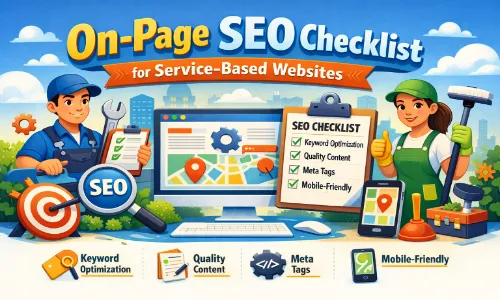
13. Quick On-Page SEO Checklist for Service-Based Websites (Listicle)
Use this simple list every time you publish or update a service page:
- One primary keyword and a few related secondary keywords mapped to the page
- Clean, keyword-rich, geo-friendly URL
- Compelling title tag with service + location + main benefit
- Meta description that explains the service and includes a clear CTA
- One H1 that matches the main service
- Clear H2/H3 sections for benefits, process, pricing, locations, and FAQs
- Helpful, conversion-focused content that answers real customer questions
- Natural use of synonyms and semantic keywords, not keyword stuffing
- Local details: NAP, service areas, map, and geo-modified phrases
- Strong CTAs above the fold and repeated across the page
- Trust elements: reviews, testimonials, ratings, certifications
- Optimized images with descriptive file names and alt text
- Internal links from and to other relevant pages
- External links to credible, relevant resources where useful
- Mobile-friendly design and fast loading times
- Service, LocalBusiness, FAQ, and Review schema where appropriate
- Regular updates, supported by periodic SEO audit services and how often you should get an SEO audit.
Frequently Asked Questions
How many service pages should my website have for SEO?
You should create one main page for each core service and, if needed, separate pages for major variations or locations. Avoid creating dozens of thin, nearly identical pages.
Should I create separate pages for each suburb or city I serve?
Yes, but only if you can add unique, valuable content for each location page. Thin or duplicate city pages can hurt rather than help your local SEO.
How long should a service page be for best on-page SEO results?
There is no fixed length, but most high-performing service pages are at least 800–1,500 words and fully answer common questions about the service, pricing, and process.
Is it okay to use the same content across multiple service pages?
No. Duplicate or near-duplicate content can confuse search engines and dilute relevance. Each service page should have unique angles, examples, and FAQs.
How often should I update my service pages for SEO?
Review and update key service pages every 3–6 months to refresh data, pricing, service areas, and examples, and to add new FAQs based on real customer questions.
Do I need a blog if my main goal is ranking service pages?
A blog is not mandatory, but supporting blog content can help you build topical authority and internal links that push more authority to your service pages.
What is the difference between a service page and a landing page?
A service page is usually evergreen and part of your main navigation, while a landing page is more campaign-specific, often used for ads or a single focused offer.
Should my homepage or my service page target my main keyword?
Your homepage can cover brand and broad terms, but specific “money” keywords like “emergency plumber in Sydney” are usually better targeted on dedicated service pages.
How many internal links should point to each service page?
There is no exact number, but every important service page should be linked from your main navigation, relevant blog posts, and related service or location pages.
Is it helpful to add a pricing table on a service page for SEO?
Yes. Clear pricing or pricing ranges improve user experience, reduce bounce rates, and help answer intent-driven queries like “cost,” “rates,” or “pricing” for your service.
Do testimonials and reviews on the page affect on-page SEO?
They help indirectly by boosting trust, increasing conversions, and keeping users on the page longer, which are all positive behavioral signals for search.
Should my service pages target voice search queries as well?
Yes. Include natural-language questions and answers (for example, in an FAQ section) to capture conversational searches and AI-driven responses.
Is it necessary to include a FAQ section on every service page?
It is not required, but FAQs are highly recommended because they address specific objections, improve UX, and give you opportunities to target long-tail questions.
Can I use chat widgets or pop-ups on my service pages without hurting SEO?
Yes, as long as they do not block core content, slow down the page significantly, or create a poor experience on mobile devices.
How do I know if my on-page SEO changes are working?
Track rankings, organic traffic, calls, form submissions, and click-through rates in tools like Google Search Console and analytics platforms over several weeks.
Do service pages need separate mobile designs for SEO?
You do not need a separate mobile site, but your design must be responsive, easy to read on small screens, and built with mobile-first usability in mind.
Is it worth adding a live chat or booking widget to a service page?
Yes. Live chat and booking widgets can reduce friction, increase conversions, and give visitors an easy way to take action directly from the page.
Should I show my service areas on a map or just list them in text?
Use both when possible. A map helps users visualize coverage quickly, and a text list of suburbs or cities reinforces geo relevancy for search engines.
Can I link directly from my service pages to external partners or tools?
Yes, linking to high-quality, relevant external resources is fine and can enhance trust, as long as you do not overdo it or link to low-quality sites.
What is the biggest on-page SEO mistake service businesses make?
The most common mistake is publishing thin, generic service pages that do not answer real customer questions, lack local signals, and have weak calls to action.